‘Separate but Equal’: The Struggle for Civil Rights (HSC SSCE Modern History): Revision Notes
📚Revision Notes
'Separate but Equal': The Struggle for Civil Rights
Introduction: Linda Brown and the fight for integrated education
In 1950, eight-year-old Linda Brown faced a difficult reality. She lived in Kansas and wanted to attend the well-equipped local school for white students, which was within walking distance from her home. Instead, she had to walk more than six blocks to attend a poorly equipped school designated for Black American children in Monroe.
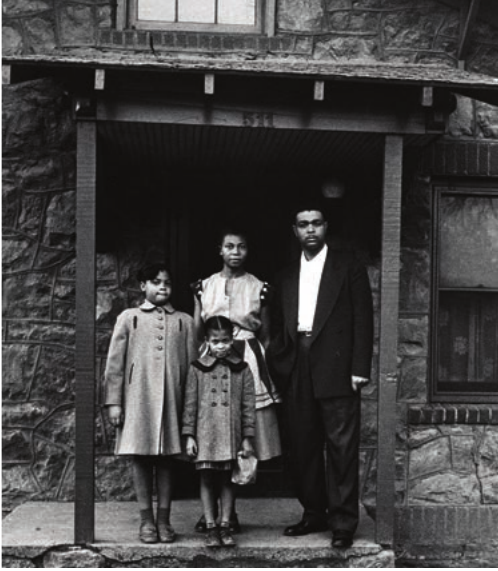
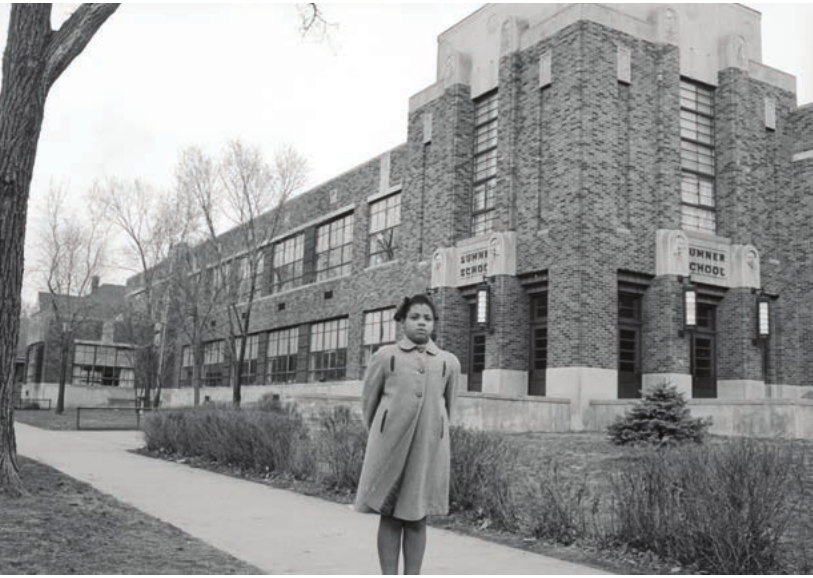
This injustice prompted her father, Reverend Oliver Brown, to challenge the system. When the principal of Sumner School refused Linda's enrolment, the National Association for the Advancement of Colored People (NAACP) took up the case.
Note
The NAACP was an organisation formed in 1909 specifically to fight Jim Crow Laws through legal means. It opposed lynching and used the Constitution to launch legal action against states and individuals who practised racial discrimination. This made it one of the most important civil rights organisations in American history.
The resulting case, Brown v Board of Education of Topeka, became one of the most significant legal battles in American civil rights history. With legal representation from the NAACP, the case eventually reached the Supreme Court, which ruled that separate educational facilities were inherently unequal.
The dolls test: Scientific evidence of segregation's harm
The Brown v Board of Education of Topeka case was actually one of five related cases presented to the Supreme Court. These cases relied on groundbreaking social science research from the 1940s conducted by psychologists Kenneth Bancroft Clark and his wife, Mamie Phipps Clark.
What was the dolls test?
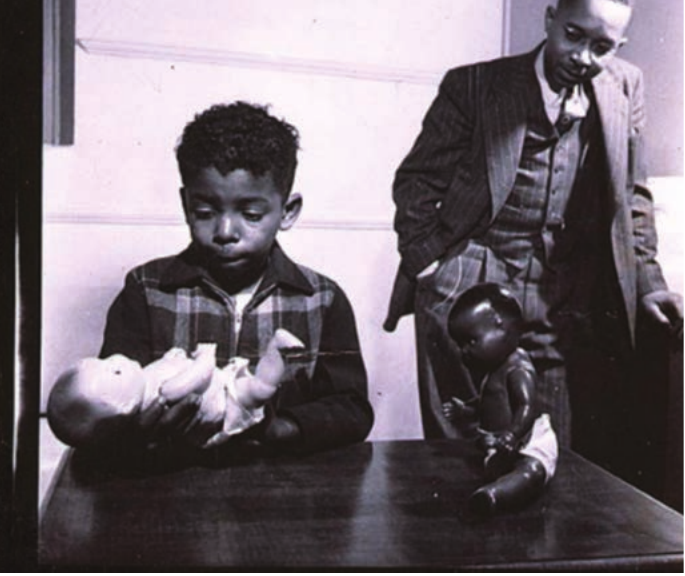
The Clarks conducted experiments with children aged 3-7 years old, using white and black baby dolls. They wanted to understand how racial segregation affected children's self-esteem and self-perception.
Important
The results were striking. Children as young as four years old, including Black children, showed a preference for the white dolls. In similar experiments, children drew themselves as white people and associated positive characteristics with their white-person drawings.
This demonstrated the profound psychological damage caused by segregation - even very young children had internalized racist messages about their own worth.
As Dr Kenneth Clark explained:
The Dolls Test was an attempt on the part of my wife and me to study the development of the sense of self-esteem in children. We worked with Negro children – I'll call them black children – to see the extent to which their colour, their sense of their own race and status, influenced their judgement about themselves, self-esteem.
Why was this research important?
These experiments proved influential in the Supreme Court's decision. They demonstrated that racial segregation damaged the self-concept and outcomes of all children, but especially Black American children. Dr Clark emphasised that this research was not created specifically for the NAACP's case. Rather, it was the product of many years of study during a period when behavioural science was making new discoveries about how environment influences educational and social outcomes.
Note
Exam tip: When discussing the Brown v Board of Education case, remember that the Supreme Court used both constitutional arguments (the Fourteenth Amendment) and scientific evidence (the dolls test) to reach its decision. This combination of legal and social science reasoning made the ruling particularly powerful.
The Supreme Court's historic decision
Chief Justice Earl Warren delivered the Supreme Court's ruling, declaring that the doctrine of 'separate but equal' in schooling has no place in American education. He stated clearly: 'Separate educational facilities are unequal'.
This historic judgement upheld the citizenship rights guaranteed by the Fourteenth Amendment and fundamentally changed civil rights in America. The decision was unanimous among the justices, which gave it additional moral weight and legal authority.
Justice Harold H Burton wrote to Chief Justice Warren, recognising the significance of the moment and the difficulty of achieving unanimity. He praised Warren for producing opinions of appropriate character and spirit, crediting him for the all-important unanimous decision.
Important
Key point: The Supreme Court's decision overturned state laws that had maintained segregated schools, establishing that the federal Constitution protected all citizens' rights to equal education regardless of race.
The unanimous nature of the decision was particularly significant - it meant there was no dissenting opinion for segregationists to exploit.
The gap between legal victory and real change
Whilst the 1955 official desegregation of all schools marked a legal triumph, the reality on the ground told a very different story. Throughout many Southern states, the Supreme Court's decision faced fierce resistance and was openly defied in numerous counties and communities.
President Eisenhower's response
President Dwight D Eisenhower's position complicated the implementation of desegregation. He refused to publicly endorse the Brown v Board of Education ruling, disagreeing with how the Supreme Court had used the Clarks' research to morally condemn the 'separate but equal' doctrine.
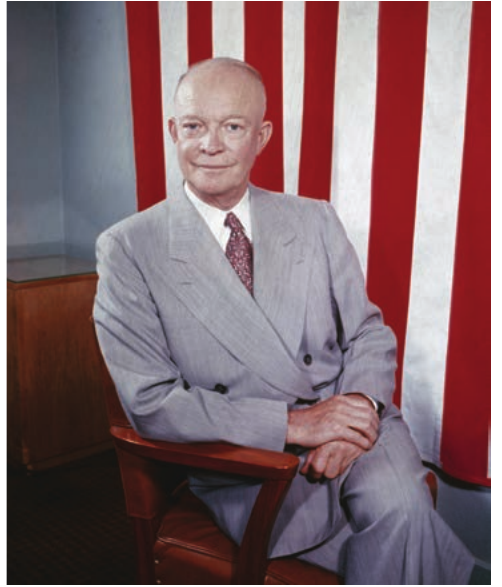
Eisenhower was heavily influenced by FBI Director J Edgar Hoover's views on communism and civil rights. Hoover considered both concepts dangerous threats to American stability and democracy. During the Cold War era, a common tactic to discredit civil rights organisations was to link them with communism. By associating groups like CORE (Congress of Racial Equality) and the NAACP with communist threats to America, opponents created a powerful deterrent for conservative Americans.
Note
Despite Eisenhower's general support for civil rights in principle, his reluctance to fully back the Supreme Court decision made it much more difficult for states to implement the ruling. This situation revealed deep divisions within the American federal system and exposed the entrenched prejudice in society, especially in Southern and mid-western states with strong links to the Ku Klux Klan (KKK) and white conservative movements.
Implementation problems
The Supreme Court's decision created a significant problem: whilst it upheld the moral and legal precedent of equal and integrated education, it left the actual steps to achieve integration in the hands of local school boards and county officials. These boards and officials were overwhelmingly white and often strongly opposed to desegregation.
The statistics reveal how little changed:
- Ten years after the Brown v Board of Education decision, less than 1% of previously 'white-only' schools were attended by Black children
- The vast majority of schools remained unsuccessfully desegregated
- By 1965, only 27% of Black Americans had graduated from high school (predominantly in northern states)
- Only 5% of Black Americans had graduated from college
In contrast:
- 51% of white Americans had graduated from high school
- 10% of white Americans had graduated from college
These figures demonstrate the enormous educational inequality that persisted despite the Supreme Court's ruling.
Important
Historical perspective: Many historians criticise the remedy applied by the Supreme Court and its failure to enforce federal legislation. Dr Martin Luther King Jr declared that civil change could only be 'written in the streets', implying that change could not occur through courts staffed by white male judges alone. His statement reflected the growing belief that direct action and protest would be necessary to achieve real equality.
The Little Rock Nine: Testing the Supreme Court decision
In 1957, nine Black American students, known as the Little Rock Nine, directly challenged school segregation by seeking to attend their local school in Little Rock, Arkansas. Little Rock Central High School had refused to admit them, and violent threats emerged to prevent their attendance.
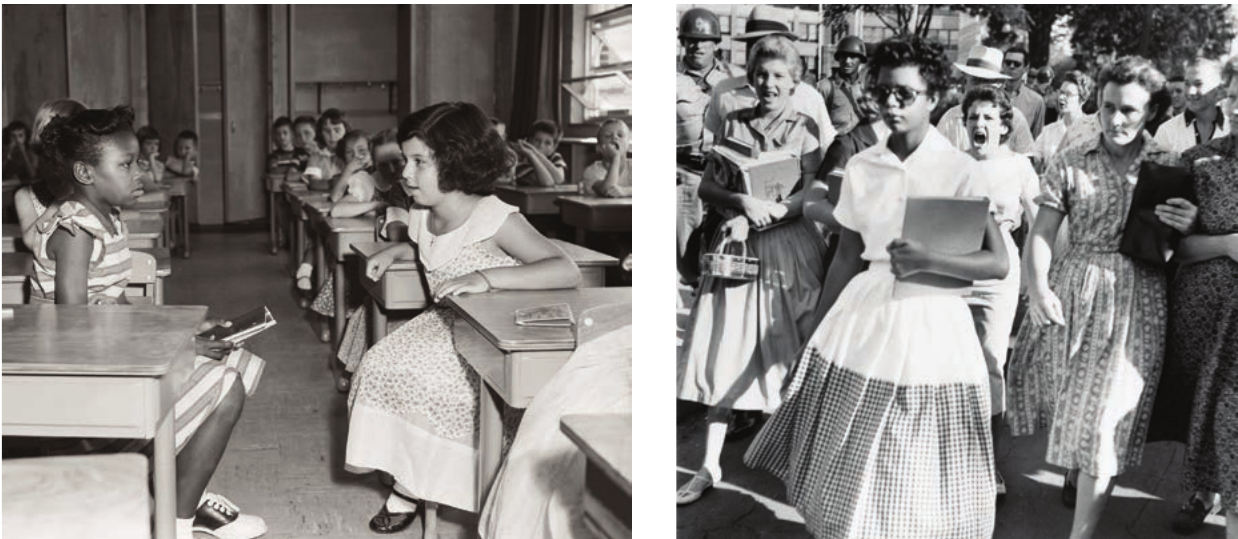
The situation rapidly escalated. Angry crowds lined the streets to block and jeer at the children as they attempted to reach the school. The Governor of Arkansas brought in the National Guard, ostensibly to 'preserve order', but this action actually prevented the students from entering.
The tension led to rioting and vicious attacks on Black people and their properties. Eventually, President Eisenhower felt compelled to intervene. He sent 1000 US troops to control the escalating violence and declared martial law in Little Rock.
Elizabeth Eckford's experience
One of the Little Rock Nine, Elizabeth Eckford, was just 14 years old when she attempted to attend the school. She later recalled thinking that the National Guards would protect her. Instead, when she approached the school, bayonets were raised as the National Guard blocked her entry.
Example
Historical Moment: The Little Rock Nine's Victory
In 1957, the Little Rock Nine achieved victory when they were finally escorted to the school under US military guard. Their courage and determination represented an extraordinary moment in American history, demonstrating how young individuals could use their democratic rights to pursue the promises of the First Amendment regarding the right to life, liberty, and the pursuit of happiness.
Their ages ranged from 14 to 16 years old, yet they faced down mob violence and state opposition to assert their constitutional rights.
Important
Remember: The Little Rock Nine case shows the civil rights phenomenon at work – ordinary individuals, including children, using peaceful assertion of their rights to challenge and ultimately change deeply entrenched systems of discrimination.
This case also demonstrated that federal intervention was necessary to enforce Supreme Court rulings when state and local governments refused to comply.
Violent opposition to desegregation
The Brown v Board of Education ruling triggered widespread and often violent opposition to forced desegregation. The KKK mounted considerable resistance throughout Southern states, particularly in Mississippi and Alabama. This opposition was so intense that it prevented the NAACP from even establishing offices in the South. In Mississippi especially, racial tensions escalated into random and terrifying attacks on Black Americans.
This violent backlash demonstrated that changing laws alone could not immediately change deeply held prejudices and social structures. Real integration would require sustained effort, federal intervention, and continued courage from those fighting for their constitutional rights.
The 1957 Civil Rights Bill
The ongoing issues of desegregation and voting rights pushed civil rights to the forefront of American domestic policy. In 1957, President Eisenhower introduced the first Civil Rights Bill, aiming to increase Black voter registration.
Political manoeuvring
Democrat Senator Lyndon B Johnson played a crucial role in negotiating the Bill through Congress. The Bill was complex and only partially successful. It made it illegal to intimidate, coerce or interfere with voter registration and the right to vote. However, significant problems remained:
Note
The Bill's Critical Weakness:
- Those found guilty of obstructing voter registration would face a court trial
- However, juries could only comprise white members
- Therefore, the likelihood of abuses and violations of voter registration resulting in court convictions was extremely low
This represented a fundamental flaw in the legislation - it created legal protections that were nearly impossible to enforce in practice.
Senate voting patterns
The Senate vote on the 1957 Civil Rights Bill revealed interesting political divisions:
| Vote Type | All Votes | Democrats | Republicans |
|---|---|---|---|
| Yea | 76% (72 votes) | 29 | 43 |
| Nay | 19% (18 votes) | 18 | 0 |
| Present | 1% (1 vote) | 0 | 1 |
| Not Voting | 4% (4 votes) | 2 | 2 |
Important
Analysis points:
- Republicans voted unanimously in favour (43-0)
- Democrats were deeply split (29 in favour, 18 against)
- The Democratic split reflected regional divisions, with Southern Democrats generally opposing civil rights legislation
- The Bill passed because of strong Republican support combined with support from Northern Democrats
This voting pattern shows that civil rights was not simply a partisan issue but reflected deeper regional and cultural divisions in American society.
Eisenhower's pragmatic approach
Whilst supporting aspects of civil rights campaigns, Eisenhower did not necessarily agree with all their goals, nor would he morally challenge people's racist convictions directly. Many historians view Eisenhower as a pragmatic rather than idealistic leader, primarily interested in political stability and control rather than forcing rapid social change.
This pragmatic approach meant that whilst some progress was made through legislation like the 1957 Civil Rights Bill, fundamental change remained slow and contested. The gap between legal rights and actual equality persisted, requiring continued activism and federal intervention to narrow.
Remember!
Summary
Key Points to Remember:
-
The Brown v Board of Education of Topeka case (1954) was a landmark Supreme Court decision that ruled 'separate but equal' education unconstitutional, overturning state segregation laws.
-
The dolls test conducted by Kenneth and Mamie Clark provided crucial scientific evidence showing how segregation damaged children's self-esteem, particularly Black children. This social science research was instrumental in the Supreme Court's decision.
-
Despite the Supreme Court ruling, actual desegregation was extremely slow. Ten years after the decision, less than 1% of previously white-only schools were attended by Black children, revealing the gap between legal rulings and social reality.
-
The Little Rock Nine (1957) demonstrated extraordinary courage by insisting on their right to attend their local school. Their action required federal troops to enforce and showed that real change often came through individual action and direct challenge, not just court decisions.
-
The 1957 Civil Rights Bill made voter intimidation illegal but had limited practical effect because all-white juries were unlikely to convict white defendants. This highlighted how legal changes alone could not immediately overcome deeply entrenched racism and discriminatory practices.