Energy and Work in Uniform Circular Motion (HSC SSCE Physics): Revision Notes
📚Revision Notes
Energy and Work in Uniform Circular Motion
Understanding energy in circular motion
When studying uniform circular motion, it's essential to understand how energy behaves in these systems. There are two main types of energy to consider: kinetic energy and potential energy. Kinetic energy relates to an object's motion, while potential energy depends on an object's position and the forces acting on it. In circular motion, these energy forms behave in specific and predictable ways that help us understand the physics of the system.
The total mechanical energy of a system is the sum of its kinetic and potential energies. Understanding how these components change (or remain constant) during circular motion is key to analysing such systems.
Kinetic energy in uniform circular motion
The kinetic energy (, sometimes written as ) of an object represents the energy it possesses due to its motion. The formula for kinetic energy is:
where is the mass of the object and is its speed.
Important
In uniform circular motion, the word "uniform" is crucial. It tells us that the speed of the object remains constant throughout its circular path. Since the kinetic energy formula depends on the square of the speed, and the speed doesn't change, the kinetic energy remains constant during uniform circular motion.
This is an important principle: even though the velocity vector is constantly changing direction in circular motion, the speed (the magnitude of velocity) stays the same. Therefore, the kinetic energy doesn't vary as the object moves around its circular path.
Potential energy in uniform circular motion
Gravitational potential energy depends on an object's height above a reference point. For an Earth-object system, the gravitational potential energy is given by:
where is the mass, is the acceleration due to gravity (), and is the height above the reference point (typically Earth's surface).
When an object undergoes uniform circular motion in a horizontal plane, its height doesn't change. The object stays at the same vertical level throughout its motion. This means that the potential energy also remains constant for horizontal circular motion.
Note
The combination of constant kinetic energy and constant potential energy means that the total mechanical energy of an object in horizontal uniform circular motion is constant.
Work done in uniform circular motion
The energy perspective
Work done on an object equals the energy transferred to that object. For an object moving in uniform circular motion in a horizontal plane, the total energy (kinetic plus potential) remains constant. Since there's no change in energy, there's no work being done on the object.
The force-displacement perspective
We can also understand this by examining the definition of work:
where is the force and is the displacement in the direction of the force.
The diagram below illustrates a crucial geometric relationship in uniform circular motion:
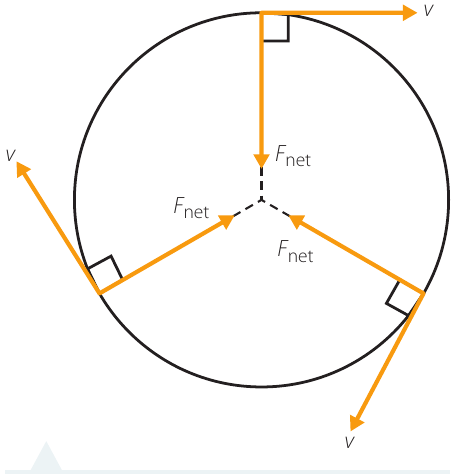
In uniform circular motion, the net force always points towards the centre of the circular path (this is the centripetal force). Meanwhile, at any instant, the object's velocity is tangent to the circle. Since the displacement occurs in the same direction as the velocity, the force and displacement are always perpendicular to each other.
Important
When the force is perpendicular to the displacement, the component of displacement in the direction of the force is zero. Therefore:
This perpendicular relationship means that no work is done by the centripetal force during uniform circular motion in a horizontal plane.
Energy changes in vertical circular motion
The situation differs when an object undergoes uniform circular motion in a vertical plane (such as a ball on a string being swung in a vertical circle). In this case, the object's height changes as it moves around the circle, causing its potential energy to vary.
When the object moves upward, its potential energy increases, and when it moves downward, its potential energy decreases. Since energy changes occur, work is being done during different parts of the cycle.
Note
However, there's an important consideration: over a complete circular path, the object returns to its initial position. This means it returns to its initial height and therefore to its initial potential energy. As a result, the net work done over a complete cycle is zero, even though work is done during portions of the motion.
This illustrates the principle of energy conservation in closed paths: while energy can shift between kinetic and potential forms during the motion, the total energy for a complete cycle remains unchanged.
Worked example: Energy calculations in vertical circular motion
Example
Worked Example: Energy in Vertical Circular Motion
A glider with a mass of is being whirled in a vertical circle with a radius of at a constant speed of . At the bottom of the path, the glider is above the ground. We need to calculate the kinetic, potential, and total energy at both the top and bottom of the path.
Given information:
| Quantity | Value |
|---|---|
| Mass | |
| Radius | |
| Speed | |
| Height at bottom |
Calculations at the bottom of the path:
Kinetic energy:
Using the kinetic energy formula:
Potential energy:
Using the gravitational potential energy formula:
Total energy:
Calculations at the top of the path:
Kinetic energy:
Since the speed is constant in uniform circular motion, the kinetic energy at the top equals the kinetic energy at the bottom:
Potential energy:
At the top of the circle, the height equals the height at the bottom plus the diameter of the circle (which is ):
Total energy:
Key observations from this example
Note
This worked example demonstrates several important principles:
- The kinetic energy remains constant () at both positions because the speed is constant.
- The potential energy increases from at the bottom to at the top due to the increase in height.
- The total energy increases from to as the object moves from bottom to top.
- The increase in total energy () represents the work done in moving the object upward against gravity.
Exam tips
- Always identify whether circular motion is in a horizontal or vertical plane, as this affects whether potential energy changes.
- Remember that "uniform" means constant speed, which means constant kinetic energy.
- When calculating potential energy, clearly define your reference height (usually ground level).
- In vertical circular motion problems, the height at the top equals the height at the bottom plus the diameter of the circle.
- Work done over a complete cycle is always zero because the object returns to its starting position.
- Force perpendicular to displacement always means zero work done.
Summary
Key Points to Remember:
- In uniform circular motion, the speed is constant, so kinetic energy remains constant.
- For horizontal circular motion, height doesn't change, so potential energy also remains constant.
- When both kinetic and potential energies are constant, no work is being done on the object.
- The centripetal force in circular motion is always perpendicular to the velocity and displacement, which is why .
- In vertical circular motion, potential energy varies as the object's height changes, but the net work over a complete cycle is zero.
- Energy conservation applies throughout: energy may transform between kinetic and potential forms, but total mechanical energy is conserved in the absence of non-conservative forces.