Rotation and Torque (HSC SSCE Physics): Revision Notes
📚Revision Notes
Rotation and Torque
What is torque?
When you apply a force to an object, it accelerates in a straight line in the direction of that force. This type of motion is called translational motion. However, there's another type of motion you've observed—rotational motion, where objects spin or turn around a point or axis.
To make an object rotate rather than translate, you need to apply something called torque. Think of torque as the rotational equivalent of force. Just as force causes linear acceleration, torque causes rotational acceleration.
Note
Consider the example of using a spanner to loosen a bolt. You don't want the bolt to move sideways or up and down—you want it to rotate. To achieve this rotation without translation, you need to apply torque to the bolt. A torque occurs when you apply a force to an object at some distance from a pivot point or axis of rotation.
The torque equation
The torque, represented by the Greek letter τ (tau), depends on three factors:
- The magnitude of the applied force ()
- The distance from the pivot point to where the force is applied ()
- The angle between the force and the line connecting the pivot to the application point ()
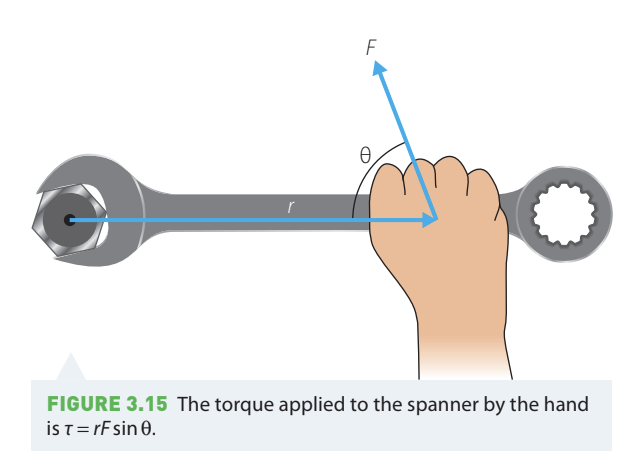
The mathematical formula for torque is:
Where:
- is the torque (measured in newton-metres, N m)
- is the distance from the pivot point to where the force is applied, also called the lever arm
- is the magnitude of the applied force (in newtons, N)
- is the component of the force perpendicular to the vector
- is the angle between the lever arm and the force vector
Understanding the units
Important
Torque has units of N m (newton-metres). You might notice these are the same units as work, which we usually express in joules (J). However, torque is NOT a form of energy, so we never write the units of torque as joules. Always use N m when stating torque values.
Torque as a vector quantity
Like force, torque is a vector—it has both magnitude and direction. The direction of torque determines which way the object will rotate. Imagine pushing on a spanner handle. If you push upward, the bolt rotates one way. If you push downward, it rotates the opposite way.
The right-hand rule for torque direction
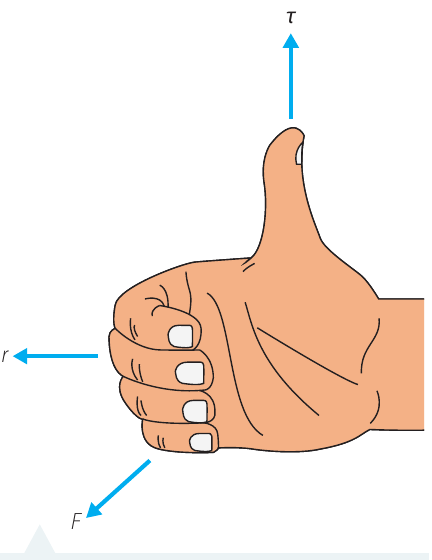
To determine the direction of the torque vector, use the right-hand rule:
- Point the fingers of your right hand along the direction of (from the pivot point to where the force is applied)
- Curl your fingers in the direction of the force
- Your thumb now points in the direction of the torque vector
- Your curled fingers show the direction of the resulting rotation
Note
You might find it surprising that the torque vector points perpendicular to the plane of rotation. However, this makes sense when you consider that every point on a rotating object is constantly changing its velocity direction (similar to circular motion). Defining the torque vector as perpendicular to the rotation plane is the only way to assign a unique direction that applies to the entire rotating object.
Factors affecting torque magnitude
Force and distance
To apply a large torque, you need to:
- Apply a large force
- Apply that force at a large distance from the pivot point
The distance from the pivot point to where you apply the force is called the lever arm. This is why spanners with longer handles are more effective—they provide a longer lever arm, allowing you to apply greater torque with the same force.
The angle of application
Important
The angle at which you apply the force is crucial. Maximum torque occurs when you apply the force perpendicular to the lever arm, meaning .
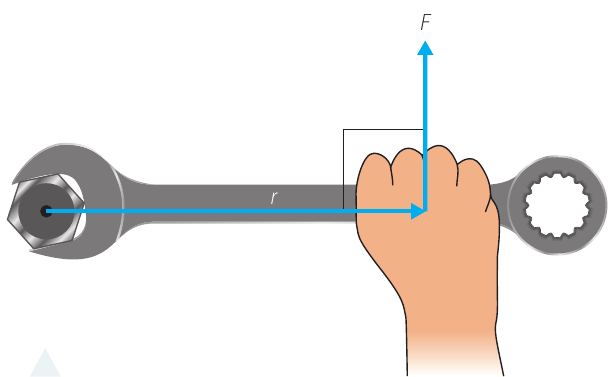
When , , so the torque formula simplifies to:
If you pull or push along the line of the spanner handle (parallel to ), then and . This means the torque is zero, and no rotation occurs. You've probably experienced this frustration when trying to use a tool—pushing along the handle achieves nothing!
Note
Exam tip: Always check whether the force is applied at to the lever arm. If , you can use the simpler formula . If not, you must use .
Pivot points and axes of rotation
The pivot point is the point about which an object rotates. Common examples include:
- The hinges of a door
- The center of a bolt being turned
- The tip of a pencil balanced on a desk
When a pencil is balanced on its end on a desk, it rotates about its tip when it falls—the tip is the pivot point.
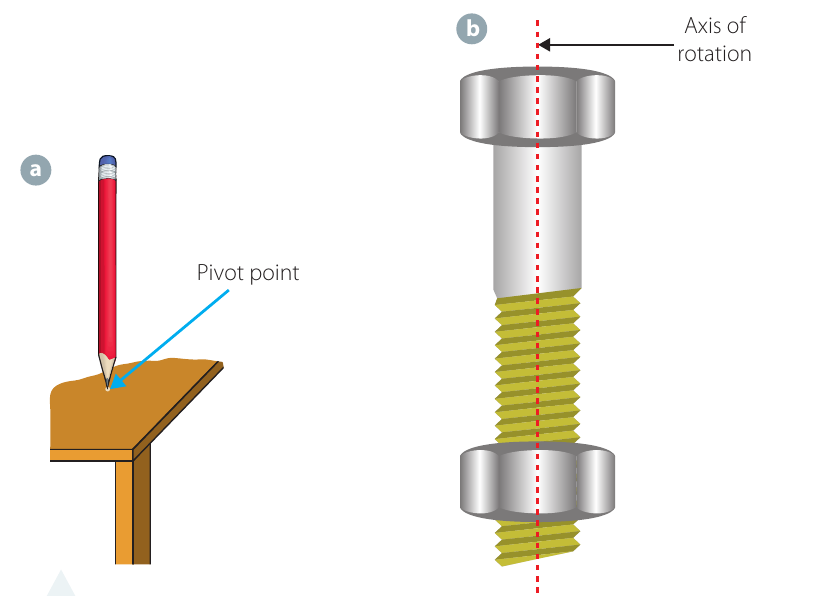
Sometimes we talk about an axis of rotation rather than a pivot point. This terminology is used when considering a three-dimensional object rotating about a particular line or axis. For example, when you turn a bolt with a spanner, the bolt rotates about a line running through its center along its length. This line is the axis of rotation.
Note
The key difference:
- Pivot point: A single point in 2D or 3D space
- Axis of rotation: A line in 3D space about which rotation occurs
Worked example: calculating torque
Example
Worked Example: Calculating Torque with a Spanner
A mechanic uses a spanner to tighten a bolt. The spanner has a handle 35 cm long, and the mechanic applies a force of 95 N perpendicular to the handle.
a) What torque does she apply?
b) If she applied the force at an angle of 45°, how much force would she need to apply to produce the same torque?
Solution
| Step | Calculation | Explanation |
|---|---|---|
| Part a | ||
| Given | m, N, | Identify the data and convert to SI units |
| Formula | Write the torque equation | |
| Substitute | Substitute values with units | |
| Calculate | N m | Calculate the value |
| Answer | N m | State final answer with appropriate significant figures |
| Part b | ||
| Given | Identify the changed variable | |
| Formula | Write the torque equation | |
| Rearrange | Rearrange to solve for force | |
| Substitute | Substitute values with units | |
| Calculate | N | Calculate the value |
| Answer | N | State final answer with appropriate significant figures |
Practice question: If 50 N m is the torque required to turn the bolt, and the mechanic can exert a maximum force of 150 N, what is the minimum length handle she needs on her spanner?
Note
Exam tip: When solving torque problems:
- Always convert all measurements to SI units (metres for distance, newtons for force)
- Check whether the angle is 90°—if so, you can simplify the equation
- Be careful with significant figures in your final answer
- Always include units in your final answer (N m for torque)
Remember!
Summary
Key Points to Remember:
- Torque () is the rotational equivalent of force, causing objects to rotate rather than translate
- The torque equation is , where is the lever arm, is the applied force, and is the angle between them
- Torque is measured in N m (never joules, even though the units are equivalent)
- Maximum torque occurs when the force is applied perpendicular to the lever arm ()
- Use the right-hand rule to determine the direction of the torque vector: point fingers along , curl toward , and your thumb shows
- Longer lever arms and larger forces produce greater torque—this is why longer spanners are more effective
- The pivot point is where rotation occurs, while the axis of rotation refers to the line about which a 3D object rotates