Uniform Circular Motion (HSC SSCE Physics): Revision Notes
📚Revision Notes
Uniform Circular Motion
Introduction to circular motion
Circular motion occurs when forces cause an object to follow a curved path instead of moving in a straight line. According to Newton's first law, an object travelling in a straight line at constant speed has no net force acting on it. However, when an object travels at constant speed around a corner or curve, its direction is changing, which means a net force must be acting on it.
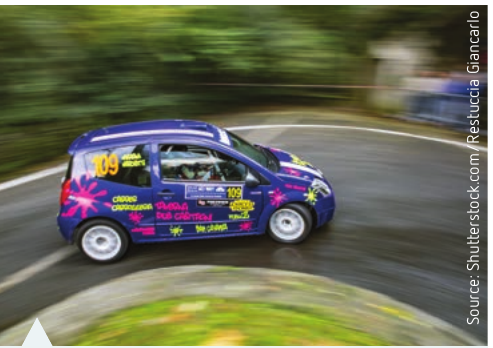
Consider a car turning a corner on a horizontal road. The road surface pushes on the car through the tyres, and it is the friction force between the road and tyres that makes the car turn. This is an example of how different forces can produce circular motion. We can apply the same mathematical model to describe many types of circular motion, regardless of which specific forces are involved.
Note
Uniform circular motion is motion along a circular path at constant speed. This could describe the motion of an entire object (like a ball swinging on a string) or a single point on a rotating object (like a person sitting on a Ferris wheel). The motion might involve one complete circle, many circles, or just a fraction of a circle - for instance, we can model a car cornering as circular motion for part of a circle.
Velocity and speed in circular motion
Understanding speed in circular paths
When an object moves around a circle with radius at constant speed , it takes a time (called the period) to complete one full revolution around the circumference. Since speed equals distance travelled per unit time, and the object travels one complete circumference () in one period, we can write:
Velocity is tangential
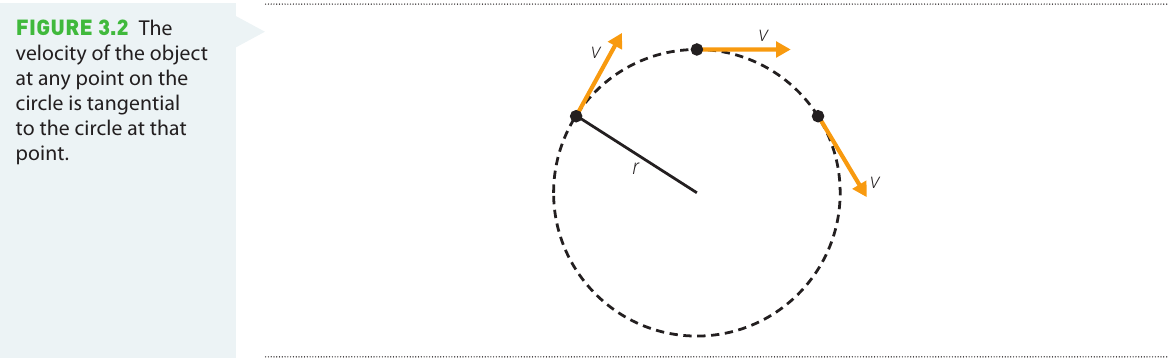
Although the object's speed remains constant during uniform circular motion, its direction is continuously changing, which means the velocity is changing. At any point on the circle, the velocity has magnitude and points in the direction tangent to the circle at that point.
Important
This tangential direction means the object is always moving perpendicular to the radius at its current position. Even though the speed is constant, the changing direction means the velocity vector is constantly changing.
Centripetal acceleration
Why circular motion involves acceleration
Since velocity is constantly changing in circular motion (even though speed is constant), the object must be accelerating. Recall that acceleration is the rate of change of velocity. To find this acceleration, we can examine the velocity vectors at two different times.
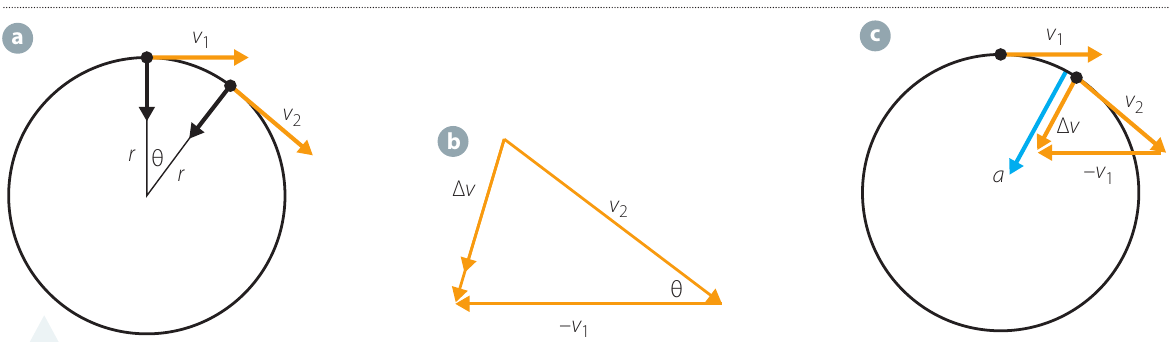
Consider velocity vectors and at two positions separated by time interval . The average acceleration over this time interval is:
During time interval , the object travels a distance , and the velocity change is . The direction of this velocity change points toward the centre of the circle. Since acceleration is in the same direction as , the acceleration also points toward the centre.
Centripetal acceleration formula
We call this centripetal acceleration because it points towards the centre. The word 'centripetal' means centre-seeking.
To find the magnitude of centripetal acceleration, we use similar triangles. The triangle formed by the two position vectors and displacement is similar to the triangle formed by the velocity vectors. Using this similarity:
Rearranging:
Therefore, the magnitude of centripetal acceleration is:
where is the centripetal acceleration pointing toward the centre of the circular path, and is the speed.
Note
The centripetal acceleration always points toward the centre of the circular path, while the velocity is always tangent to the circle. These two vectors are perpendicular to each other at every point along the path.
Worked example: Calculating centripetal acceleration
Example
Worked Example: Calculating Centripetal Acceleration
Problem: Ben is on a ride at the Royal Easter Show. The carriage he is in moves in a circle of radius at a speed of . What is Ben's centripetal acceleration?
| Step | Calculation | Explanation |
|---|---|---|
| 1 | , | Identify the relevant data |
| 2 | Write the expression for centripetal acceleration | |
| 3 | Substitute values with correct units | |
| 4 | Calculate the final value | |
| 5 | towards the centre | State answer with appropriate significant figures |
Answer: Ben experiences a centripetal acceleration of 29 m s⁻² directed toward the centre of the circular path.
Centripetal force
Newton's second law and circular motion
Newton's second law tells us that when an object accelerates, there must be a net force acting on it. The net force equals mass times acceleration:
When an object moves in uniform circular motion, we call the net force the centripetal force. Like centripetal acceleration, it points toward the centre of the circle. Its magnitude is:
Understanding centripetal force
Important
It's crucial to remember that the net force is the vector sum of all forces acting on the object. The centripetal force is not an additional force - it's the result of combining all the actual forces acting on the object.
The specific forces providing the centripetal force depend on the situation:
- For a car turning on a flat road: friction force (horizontal), normal force (vertical), and gravitational force (vertical). On a flat road, only the friction force acts horizontally, so it provides the centripetal acceleration.
- For other situations: the forces might include tension forces, electric forces, or magnetic forces.
Worked example: Calculating centripetal force
Example
Worked Example: Calculating Centripetal Force
Problem: Ben is on a ride at the Royal Easter Show. The carriage he is in moves in a circle of radius at a speed of . Ben has a mass of . What net force is applied to Ben?
| Step | Calculation | Explanation |
|---|---|---|
| 1 | , , | Identify the relevant data |
| 2 | Write the expression for net (centripetal) force | |
| 3 | Substitute values with correct units | |
| 4 | Calculate the final value | |
| 5 | towards centre | State answer with appropriate significant figures |
Answer: A net force of 1900 N directed toward the centre of the circular path is applied to Ben.
Angular position and velocity
When describing circular or rotational motion, it's often more useful to use angular units rather than linear distances and speeds.
Angular displacement
The angular displacement of an object moving in a circle describes how far it has rotated around the circle, measured as an angle .
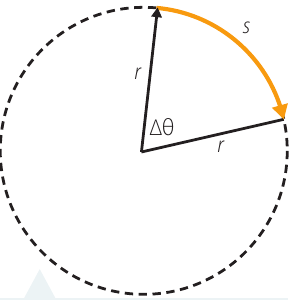
For an object that has moved through an arc length along a circle of radius , the angular displacement is:
Note
The units of are radians, not degrees. The radian is dimensionless - it's a pure number because it's the ratio of two lengths.
Important conversion:
Angular velocity
Angular velocity, , is the angular displacement per unit time:
The units of are radians per second ().
If we measure time from to some later time , we can write:
Relating angular and linear velocity
We can connect angular velocity to linear velocity using the definition of radians:
Therefore:
Note
Remember that has units of and has units of . The radian unit comes from the ratio .
Worked example: Angular velocity and displacement
Example
Worked Example: Angular Velocity and Displacement
Problem: Ben is on a ride at the Royal Easter Show. The carriage he is in moves in a circle of radius at a speed of .
a) What is the angular speed, , at which Ben moves?
b) If the ride lasts minutes, what is Ben's angular displacement in this time? (Assume constant speed.)
| Step | Calculation | Explanation |
|---|---|---|
| 1 | , , | Identify the relevant data |
| 2 | Convert to SI units | |
| Part a | ||
| 3 | Write the expression for angular velocity | |
| 4 | Substitute values with correct units | |
| 5 | Calculate the final value | |
| 6 | State answer with appropriate significant figures | |
| Part b | ||
| 7 | Relate angular velocity to angular displacement | |
| 8 | Rearrange for angular displacement | |
| 9 | Substitute values with correct units | |
| 10 | Calculate the final value | |
| 11 | State answer with appropriate significant figures |
Answers:
- a) Ben moves with an angular speed of 2.9 rad s⁻¹
- b) Ben's angular displacement is 510 rad
Investigation: Measuring friction with a turntable
Aim
To measure the maximum static friction force between an object and a turntable.
Materials
- Ruler
- Stopwatch
- Turntable (e.g. two-speed record player or pottery wheel)
- Eraser
- Coin
- Weighing scale
Safety considerations
| What are the risks? | How can you manage these risks? |
|---|---|
| Long hair can get caught in rotating equipment | Always tie back long hair when doing experiments |
Important
Consider what other risks might be associated with your investigation and how to manage them safely. Always follow proper laboratory safety procedures when working with rotating equipment.
Method
- Measure the mass of the eraser and the coin.
- Place the eraser at a point close to the centre of the turntable. Measure its distance, , from the centre.
- Turn on the turntable at the lower speed setting and measure the time taken for ten rotations.
- Repeat step 3 with the turntable at its higher speed setting.
- Move the eraser outwards approximately further away from the centre. Measure the new radial distance .
- Repeat steps 2 and 3, noting whether the eraser begins to slide.
- Repeat the experiment, replacing the eraser with the coin.
Note
Alternative method: If you have a turntable with continuously adjustable speed (such as a pottery wheel), you can hold the radius constant and vary the speed. Finding the speed at which the object begins to slide allows you to calculate the maximum friction force.
Results
Record your results in a table as you measure them. Note in the 'Slide?' column whether the object began to slide at each speed.
| Object | (m) | (s) | (s) | (rad s) | (m s) | (m s) | (kg m s) | Slide? |
|---|---|---|---|---|---|---|---|---|
Analysis of results
- Complete the table by calculating , , , and . You can use a spreadsheet program to calculate these values automatically.
- Draw a force diagram for the object on the turntable. Note that the net force (centripetal force) is the friction force. This is what holds the object to the turntable and prevents it from sliding.
Note
The maximum friction force between the object and turntable has a value between the largest force at which the object did not slide and the smallest force at which it did slide. This gives you upper and lower bounds on the maximum friction force.
Discussion
- Give an estimated value and range for the maximum friction force between each object and the turntable. For which object was it greater?
- Summarise the relationships between centripetal force, radius of path and speed. Explain why an object is more likely to slide off the turntable at large angular speeds and large radius.
- Answer your inquiry question.
Conclusion
Write a conclusion summarising the outcomes of your investigation.
Remember!
Summary
Key Points to Remember:
-
Uniform circular motion occurs when an object moves in a circular path at constant speed. Although the speed is constant, the velocity changes because direction changes.
-
The speed in circular motion is , where is the radius and is the period.
-
Centripetal acceleration points toward the centre of the circular path and has magnitude .
-
Centripetal force is the net force causing circular motion: . This is not a separate force, but the vector sum of all forces acting on the object.
-
Angular displacement is (measured in radians), and angular velocity is .
-
Higher speeds and larger radii require greater centripetal forces to maintain circular motion.