Motion in Gravitational Fields (HSC SSCE Physics): Revision Notes
📚Revision Notes
Energy in Gravitational Fields
Introduction to gravitational potential energy
You may recall learning about gravitational potential energy near Earth's surface using the formula , where is mass, is gravitational field strength, and is height. This formula works well when objects are close to Earth's surface because the gravitational force remains approximately constant over small distances.
However, when objects are far from Earth's surface, or when dealing with orbiting satellites and spacecraft, we cannot assume that the gravitational force stays constant. For these situations, we need a more general formula that accounts for how gravitational force changes with distance.
Note
The simple formula is only an approximation that works when is much smaller than Earth's radius. For satellites, spacecraft, and astronomical objects, we must use the more fundamental gravitational potential energy formula that accounts for the nature of gravitational force.
Potential energy in a gravitational field
The gravitational potential energy formula
When two objects with masses and are separated by a distance , the gravitational force between them is:
To find the gravitational potential energy of this system, we need to consider how much work would be done to bring the two masses together from infinitely far apart.
We define the zero point of gravitational potential energy as the configuration where the two masses are infinitely far apart (). At this separation, there is no gravitational force between them, so when .
When we bring mass gradually closer to mass from infinity to a final distance , work is done by the gravitational field. The gravitational potential energy of the two-mass system is:
This equation tells us several important things about gravitational potential energy:
- It is proportional to the product of the two masses ()
- It is inversely proportional to the separation distance ()
- It is always negative (when the masses are at finite separation)
Why is gravitational potential energy negative?
The negative sign in the gravitational potential energy formula might seem confusing at first, but it makes physical sense when we remember that we chose when the masses are infinitely far apart.
Important
Common Misconception: Why Negative Energy?
Since gravity is an attractive force, any configuration where the masses are closer together than infinite separation has less potential energy than zero - hence the negative value. The closer the masses are together, the more negative (lower) the potential energy becomes.
Think of negative potential energy as indicating a bound system - the objects are gravitationally bound together and would need energy added to separate them completely.
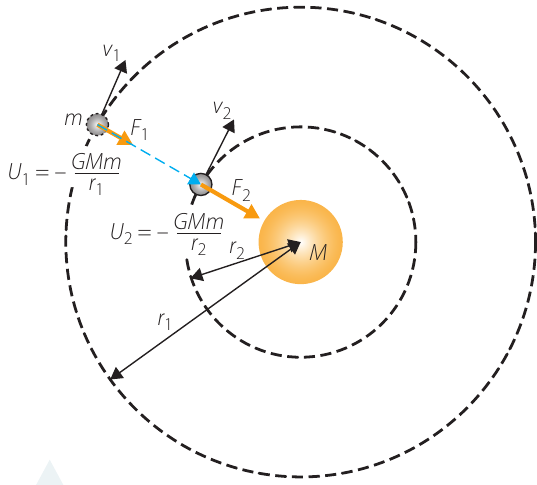
Think of it this way: to separate two gravitationally bound objects and move them infinitely far apart, you must do positive work on the system (add energy). This means the system must have had negative potential energy to begin with. Conversely, when an object moves toward another mass in a gravitational field, it accelerates and gains kinetic energy. By conservation of energy, this kinetic energy gain comes from a decrease (becoming more negative) in potential energy.
Binding energy
Gravitational potential energy is a type of binding energy. This is the energy you would need to add to a system of two massive objects to completely separate them (move them infinitely far apart).
For an object of mass on Earth's surface, the binding energy is:
Note
This represents the minimum amount of work needed to remove the object completely from Earth's gravitational field. Notice that this is the magnitude (positive value) of the potential energy at Earth's surface. The binding energy is always expressed as a positive quantity representing how much energy must be supplied to break the gravitational bond.
Energy changes in gravitational systems
When objects move within gravitational fields, energy is transformed between kinetic energy and potential energy. The table below summarises these changes for different scenarios:
| System | Object moves | Work is done | Potential energy | Kinetic energy |
|---|---|---|---|---|
| Isolated | With the field (objects get closer together) | By the field | Decreases | Increases |
| Isolated | Against the field (objects get further apart) | On the field | Increases | Decreases |
| Open or closed | With the field (objects get closer together) | By external agent and by the field | Decreases | Increases |
| Open or closed | Against the field (objects get further apart) | By external agent and on the field | Increases | Either (depends which does more work) |
Key patterns from this table:
- In an isolated system, when objects move closer together (with the field), gravitational potential energy decreases and kinetic energy increases
- When objects move further apart (against the field), potential energy increases and kinetic energy decreases
- In open or closed systems, external forces can also do work, affecting the energy changes
Note
Energy Conservation in Gravitational Systems:
In an isolated system (no external forces), the total mechanical energy remains constant. As potential energy decreases (becomes more negative), kinetic energy increases by exactly the same amount. This is why satellites speed up as they fall to lower orbits - the loss in potential energy is converted entirely to kinetic energy.
Worked example: satellite orbit decay
Example
Worked Example: Calculating Energy Change During Orbit Decay
Question: What is the change in potential energy of a satellite with a mass of when it is in near-Earth orbit with an initial altitude of and its orbit decays to an altitude of ?
Solution:
| Step | Working | Explanation |
|---|---|---|
| 1. Identify data | Convert all values to SI units and gather needed constants | |
| 2. Formula | Gravitational potential energy formula | |
| 3. Change in PE | Definition of change in potential energy | |
| 4. Expand | Substitute the formula for initial and final states | |
| 5. Find radii | Orbital radius equals Earth's radius plus altitude | |
| 6. Substitute radii | Complete expression for change in PE | |
| 7. Calculate | Substitute numerical values with units | |
| 8. Result | Perform calculation | |
| 9. Final answer | Express with appropriate significant figures |
Interpretation: The negative change in potential energy indicates that the potential energy decreased as the satellite moved to a lower orbit. This energy was converted to kinetic energy, causing the satellite to speed up.
Total orbital energy
An object in orbit possesses both kinetic energy and gravitational potential energy. Understanding how these relate to each other is crucial for analysing orbital motion.
Components of orbital energy
Potential energy:
where is the orbital radius (distance from the centre of the central mass).
Kinetic energy:
For an object in circular orbit, we can use the orbital velocity to express kinetic energy as:
Total energy:
The total energy of the orbiting system is the sum of kinetic and potential energies:
Important relationships between orbital energies
Important
Critical Energy Relationships for Orbits:
From the total energy formula, we can derive these fundamental relationships:
This tells us that:
- The total energy equals half the potential energy
- The total energy equals the negative of the kinetic energy
- The kinetic energy has magnitude equal to half the magnitude of potential energy
These relationships are essential for solving orbital mechanics problems!
Key observations about orbital energies:
- Kinetic energy is positive and increases as orbital radius decreases (closer orbits are faster)
- Potential energy is negative and becomes more negative as orbital radius decreases
- Total energy is negative for bound orbits (objects that cannot escape)
Note
Why Do Closer Orbits Have Higher Speeds?
This might seem counterintuitive - shouldn't gravity make objects move faster when they're farther away? Actually, objects in closer orbits must move faster to maintain their circular path against the stronger gravitational force. The kinetic energy formula shows that as decreases, increases. This is why Mercury orbits the Sun much faster than Neptune.
Worked example: Earth's orbital energy around the Sun
Example
Worked Example: Energy of Earth's Orbit
Question: Find the potential, kinetic, and total energy of Earth due to its orbit about the Sun. The orbit has an average radius of million km.
Given: ,
Solution:
| Step | Working | Explanation |
|---|---|---|
| 1. Data | Convert to SI units | |
| 2. Potential energy | Gravitational potential energy formula | |
| 3. Calculate U | Substitute values | |
| 4. Result U | Final potential energy | |
| 5. Kinetic energy | Use relationship between K and U | |
| 6. Calculate K | Substitute value | |
| 7. Result K | Final kinetic energy | |
| 8. Total energy | Use relationship between total and potential | |
| 9. Calculate E | Substitute value | |
| 10. Result E | Final total energy | |
| 11. Summary | All three energies with correct units |
Analysis: Notice that the kinetic energy is positive, the potential energy is negative with twice the magnitude of the kinetic energy, and the total energy is negative (indicating a bound orbit). This confirms the energy relationships we derived earlier.
Escape velocity
What is escape velocity?
The gravitational potential energy of two objects is zero when they are infinitely far apart. At this infinite separation, the objects no longer experience any gravitational force from each other.
Imagine launching a spacecraft from Earth's surface that must travel to a distant galaxy. For the spacecraft to completely escape Earth's gravitational field, it needs sufficient kinetic energy to overcome Earth's gravitational binding.
Deriving the escape velocity formula
For an object to just barely escape a gravitational field, its total energy must be zero (it reaches infinite distance with zero velocity). Using conservation of energy:
As the object moves away from Earth, the change in potential energy equals the negative of the change in kinetic energy:
For an object starting at Earth's surface (radius ) with initial velocity and ending infinitely far away with final velocity zero:
Since the left side equals zero, we can rearrange to find:
Solving for the initial velocity:
This minimum speed required to escape is called the escape velocity. At Earth's surface, escape velocity is approximately 11.2 km·s⁻¹.
General escape velocity formula
For any object at distance from a mass , the escape velocity is:
Important
Key Properties of Escape Velocity:
- It depends only on the mass of the central body and the distance from its centre
- It does not depend on the mass of the escaping object - a feather and a rocket have the same escape velocity!
- The object must be moving radially away from the central mass (not in a circular path)
- Objects with speeds less than escape velocity will eventually fall back
Worked example: escape velocity from the International Space Station
Example
Worked Example: ISS Escape Velocity
Question: Calculate the escape velocity for the International Space Station, in orbit above the surface of Earth.
Solution:
| Step | Working | Explanation |
|---|---|---|
| 1. Data | Identify data and convert to SI units | |
| 2. Formula | Escape velocity formula | |
| 3. Substitute | Insert values with units | |
| 4. Calculate | Perform calculation | |
| 5. Final answer | Convert to appropriate units |
Interpretation: Note that this is only slightly less than the escape velocity from Earth's surface (), showing that the ISS is still well within Earth's gravitational influence.
Practical considerations for satellite launches
Note
Why Launch from the Equator?
Satellites are typically launched from locations close to the equator because Earth's rotation contributes to the satellite's kinetic energy, reducing the fuel needed for launch. At the equator, Earth's rotational speed is greatest (approximately ).
Satellites are also launched at an angle rather than straight upwards. This allows them to take advantage of Earth's rotational velocity and enter orbit more efficiently. The angled trajectory helps the satellite gain the horizontal velocity component needed for orbit while minimizing energy expenditure.
Summary
Key Concepts to Remember:
-
Gravitational potential energy for two masses and separated by distance is , which is negative because we define zero potential energy at infinite separation
-
As objects get closer in a gravitational field, potential energy decreases (becomes more negative) and kinetic energy increases
-
For an object in orbit: total energy , which equals and also equals
-
The kinetic energy of an orbiting object is , which is always positive
-
Escape velocity is the minimum speed needed to completely escape a gravitational field:
-
At Earth's surface, escape velocity is approximately 11.2 km·s⁻¹
-
The closer an orbit, the faster the orbital speed and the greater the kinetic energy
-
All bound orbits have negative total energy, while objects that can escape have zero or positive total energy