The Gravitational Force and the Gravitational Field (HSC SSCE Physics): Revision Notes
📚Revision Notes
The Gravitational Force and the Gravitational Field
Introduction to universal gravitation
Understanding forces is fundamental to physics. Newton's development of the Law of Universal Gravitation was a groundbreaking achievement because it was the first mathematical model to describe a fundamental force that applies everywhere in the universe. Before Newton, there was no single equation that could explain both how objects fall on Earth and how planets move through space.
Note
Newton's Law of Universal Gravitation works for all objects with mass, from tiny atoms to massive galaxies. This universality was revolutionary - it showed that the same mathematical principles govern both "heavenly" motion (planets and stars) and "earthly" motion (falling objects). This was shocking to many people at the time, who believed celestial and terrestrial physics were fundamentally different.
Newton's Law of Universal Gravitation
The gravitational force equation
Newton's law states that every object with mass attracts every other object with mass. The strength of this attractive force depends on:
- The masses of both objects
- The distance between them
The mathematical formula is:
Where:
- is the gravitational force (in newtons, N)
- is the universal gravitational constant =
- and are the masses of the two objects (in kg)
- is the distance between the centres of the two objects (in m)
This equation shows that gravitational force follows an inverse square law - if you double the distance between two objects, the force becomes one-quarter as strong.
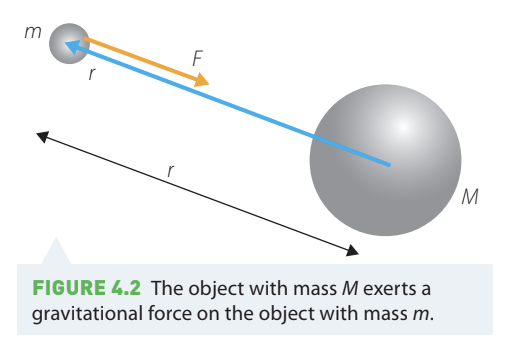
The gravitational force always points toward the object creating it, making gravity an attractive force. Each object pulls on the other - the small mass is pulled toward the large mass, and the large mass is pulled toward the small mass (although the effect on the large mass may be harder to observe).
Example
Worked Example: Gravitational force between Earth and the Sun
Let's calculate the gravitational force that the Sun exerts on Earth.
Given data:
- Mass of Earth, kg
- Mass of the Sun, kg
- Mean radius of Earth's orbit, m
Solution:
Using Newton's Law of Universal Gravitation:
Substituting the values:
The force is directed towards the Sun.
Important
Exam tip: Always include the direction when stating a force as your final answer. For gravitational forces, this is always toward the object creating the force.
Gravity and Newton's third law
Newton's third law tells us that forces always come in pairs. If object A exerts a force on object B, then object B exerts an equal and opposite force on object A. We write this as:
This applies to gravitational forces too. The force the Sun exerts on Earth is matched by an equal and opposite force that Earth exerts on the Sun.
For the Sun and Earth:
- Force of Sun on Earth: (pointing toward the Sun)
- Force of Earth on Sun: (pointing toward Earth)
Both forces have the same magnitude but opposite directions, so:
Example
Worked Example: Earth's force on the Sun
What is the gravitational force that Earth exerts on the Sun?
Solution:
From Newton's third law, we know that:
From our previous calculation, N toward the Sun.
Therefore:
The negative sign indicates the opposite direction. So the force Earth exerts on the Sun is N directed toward Earth.
Note
Key point: The forces are equal in magnitude but opposite in direction. Even though the Sun is much more massive than Earth, both objects experience the same size force - they just respond differently due to their different masses.
The gravitational field
Definition and concept
Like electric and magnetic forces, gravity acts at a distance without direct contact. We explain this using the concept of a gravitational field. Just as we defined the electric field as force per unit charge, we define the gravitational field as the force per unit mass acting on a small test mass:
The units of gravitational field are newtons per kilogram (N kg⁻¹) or, equivalently, metres per second squared (m s⁻²).
Combining this definition with Newton's Law of Universal Gravitation gives us:
This equation tells us that:
- Every object with mass creates a gravitational field around it
- The field strength depends on the mass of the object creating the field
- The field strength decreases with the square of the distance from the object
- The field is a vector quantity pointing toward the mass creating it
Important
The distance is measured from the centre of the object, not from its surface. This equation works for point masses and spherically symmetric objects (like planets and stars).
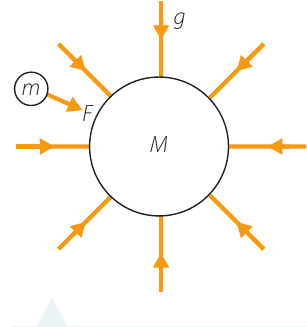
Gravitational field lines
We can visualise gravitational fields using field lines, similar to electric field lines. These lines show:
- The direction of the gravitational field (and therefore the direction of force on a test mass)
- The strength of the field (indicated by the density of field lines - closer lines mean stronger field)
Note
Key difference from electric fields: Gravitational field lines always point toward the mass creating the field, never away from it. This is because gravity is always attractive, whereas electric charges can be positive or negative.
Gravitational field at Earth's surface
Let's find Earth's gravitational field at its surface using:
- Mass of Earth, kg
- Radius of Earth, m
This is the familiar acceleration due to gravity that we use in many physics problems. The gravitational field strength equals the acceleration that gravity gives to falling objects.
Example
Worked Example: Gravitational field on the Moon's surface
Calculate the acceleration due to gravity on the surface of the Moon.
Given data:
- Mass of Moon, kg
- Radius of Moon, km m
Solution:
Using the gravitational field equation:
Substituting the values:
This shows that gravity on the Moon is about one-sixth the strength of gravity on Earth (1.6/9.8 ≈ 1/6), which is why astronauts can jump much higher on the Moon!
The near-Earth approximation
When we're close to Earth's surface (or any large object's surface), and our movements are small compared to Earth's radius, the gravitational field doesn't change much. In this situation, we can treat the gravitational field as constant.
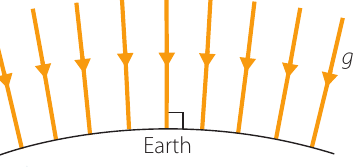
In this near-Earth approximation:
- The gravitational field lines are parallel to each other
- The field is perpendicular to Earth's surface
- We can use with constant m s⁻²
Note
This approximation is what we use for most everyday physics problems involving projectiles, falling objects, or objects on Earth's surface. It's only when we consider large changes in altitude (like satellites in orbit) that we need to use the full equation and account for changes in gravitational field strength.
Important
Exam tip: Always check whether the problem involves distances comparable to Earth's radius. If altitude changes are small (a few kilometres), use the near-Earth approximation. If they're large (thousands of kilometres), use the full gravitational field equation.
Summary
Key Points to Remember:
-
Newton's Law of Universal Gravitation: describes the attractive force between any two masses, where N kg⁻² m²
-
Gravitational forces are always attractive and always point toward the object creating the force
-
Newton's third law applies to gravity: If object A pulls on object B with force , then object B pulls on object A with force (equal magnitude, opposite direction)
-
Gravitational field is defined as force per unit mass: , with units N kg⁻¹ or m s⁻²
-
At Earth's surface: m s⁻², which is both the gravitational field strength and the acceleration due to gravity
-
Field lines always point toward masses (unlike electric fields), showing that gravity is purely attractive
-
Near-Earth approximation: For small altitude changes, treat as constant; for large changes, use the full inverse square law equation