Projectile Motion (HSC SSCE Physics): Revision Notes
📚Revision Notes
The Trajectory of a Projectile
Introduction to projectile trajectories
When you throw, kick, or launch an object into the air, it follows a curved path called a trajectory. This trajectory is parabolic in shape when air resistance is negligible. A projectile can be launched at any angle and from any initial height above the ground.
The launch height is the initial vertical position from which the projectile is released. You can define your coordinate system in different ways - either setting the launch height as zero and measuring downward, or setting the ground as zero and measuring the launch height as positive.
Note
Coordinate System Flexibility
The key principle when choosing your coordinate system is to be consistent throughout your calculations. Whether you set the launch point or the ground as your zero reference doesn't matter mathematically - what matters is maintaining that choice for all subsequent calculations.
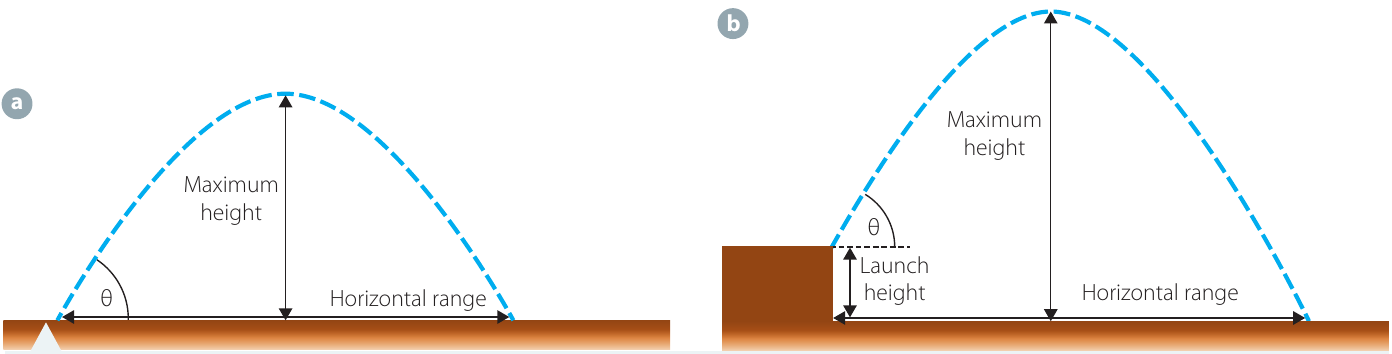
The diagram above shows two important scenarios:
- Figure a: A projectile launched from ground level () that lands back at ground level
- Figure b: A projectile launched from above ground level with a positive launch height
Both trajectories show two key measurements:
- Maximum height: The highest point the projectile reaches
- Horizontal range: The total horizontal distance travelled
Maximum height
What is maximum height?
The maximum height () is the highest vertical position reached by a projectile during its flight. This occurs at the exact moment when the vertical velocity becomes zero - the projectile stops moving upward before it begins to fall back down.
Important
Critical Principle: What Determines Maximum Height
The maximum height depends only on:
- The vertical component of the initial velocity ()
- The launch height ()
The horizontal velocity has no effect on how high the projectile goes. This is a crucial concept to remember when analyzing projectile motion.
Calculating maximum height
The vertical position of a projectile at any time is given by the kinematic equation:
At the maximum height, we know that (vertical velocity is zero) and (vertical position equals maximum height).
Using the equation , we can write:
Rearranging to find the time at which maximum height occurs:
Note
While this expression appears negative, the value of is also negative (), so the calculated time will always be positive. The negative signs cancel out in practice.
Now we can substitute this time back into the position equation:
If the launch height is not zero, the maximum height is the launch height plus the additional height gained:
Alternative derivation
You can also derive the maximum height formula using the equation . In the vertical direction:
At maximum height, and , giving:
This is exactly the same result, demonstrating the consistency of kinematic equations.
Worked example: Maximum height
Let's work through a complete example to demonstrate the calculation process.
Example
Worked Example: Calculating Maximum Height
Imagine Jen throws her maths textbook out a window that is above the ground. She throws it with an initial velocity of at an angle of above the horizontal. We need to find the maximum height the book reaches.
Given information:
- Initial velocity:
- Launch angle:
- Launch height:
Step 1: Find the vertical component of the initial velocity:
Step 2: Substitute into the maximum height formula:
Step 3: Insert the values:
Step 4: Calculate:
Answer: The textbook reaches a maximum height of approximately 6.0 m above the ground.
Time of flight
Understanding time of flight
The time of flight is the total time interval between when a projectile is launched and when it hits the ground. Understanding this concept requires us to look carefully at the shape of the trajectory.
For a symmetric trajectory (where the launch height equals the landing height), the path is perfectly parabolic. This symmetry means:
- Time to reach maximum height = Time to fall from maximum height back to ground
- The ascent phase mirrors the descent phase
We already found that the time to reach maximum height is:
Therefore, for a symmetric trajectory, the total time of flight is:
Non-symmetric trajectories
When the launch and landing heights are different, it's simplest to consider the flight in two separate phases:
- Ascent: From launch point to maximum height
- Descent: From maximum height to landing point
Note
Dealing with Non-Symmetric Paths
You calculate each time separately and add them together for the total time of flight. This approach is more reliable than trying to solve a quadratic equation directly, as it clearly separates the two distinct phases of motion.
Worked example: Time of flight
Continuing with Jen's textbook thrown from a window, let's find how long it takes to reach the ground.
Example
Worked Example: Calculating Time of Flight
Using Jen's textbook thrown from a window high with initial velocity at . From the previous example, we know the maximum height is .
Phase 1 - Time to reach maximum height ():
Phase 2 - Time to fall from maximum height to ground ():
For the descent, the book starts with zero vertical velocity () and falls through a vertical distance of (negative because it's falling):
Total time of flight:
Answer: The textbook is in the air for approximately 2.0 seconds.
Final velocity
For symmetric trajectories
When a projectile lands at the same height from which it was launched, something interesting happens. The final velocity has the same magnitude as the initial velocity, but its direction is different.
Why does this occur?
- The horizontal velocity remains constant throughout the flight (no horizontal forces)
- The vertical velocity decreases by the same amount during ascent as it increases during descent
- The path is symmetric, so the velocity is also symmetric
Note
Symmetry in Projectile Motion
The only difference between initial and final velocity in symmetric trajectories is the angle: the final velocity makes the same angle below the horizontal as the initial velocity made above the horizontal. This is a powerful result that can save calculation time.
For non-symmetric trajectories
When launch and landing heights differ, it's easiest to calculate the final velocity by finding its components separately.
Horizontal component: This remains constant throughout the flight:
Vertical component: We need to consider only the descent phase. If we know the time for this phase (), we can calculate:
For the descent phase starting from maximum height, , so:
Once we have both components, we can find the magnitude and direction of the final velocity.
Worked example: Final velocity
Let's find the final velocity of Jen's textbook using the component method.
Example
Worked Example: Calculating Final Velocity
From previous examples, we know for the descent phase.
Horizontal component:
Vertical component:
During the descent phase, the initial vertical velocity is zero, so:
The negative sign indicates downward motion.
Magnitude of final velocity:
Direction:
Answer: The final velocity is approximately 14 m s⁻¹ at 52° below the horizontal.
Horizontal range
Understanding horizontal range
The horizontal range (often simply called "the range") is the total horizontal distance a projectile travels before it lands. You can find it directly from the time of flight, because the horizontal velocity remains constant throughout the flight.
From the kinematic equations:
Since , we can write:
Worked example: Horizontal range
How far from the window does Jen's textbook land?
Example
Worked Example: Calculating Horizontal Range
Given information:
- (from earlier calculation)
Calculation:
Answer: The textbook lands approximately 17 m from the window.
Range formula for symmetric trajectories
For projectiles that land at the same height from which they were launched, we can derive a useful formula. Starting with:
Substituting and :
Important
Important Limitation
This formula only applies when the launch height equals the landing height. For non-symmetric trajectories, you must calculate the time of flight separately and use the basic range equation.
The effect of launch angle
An important result from projectile motion theory is that the maximum possible horizontal range occurs when the launch angle is 45° (assuming no air resistance).
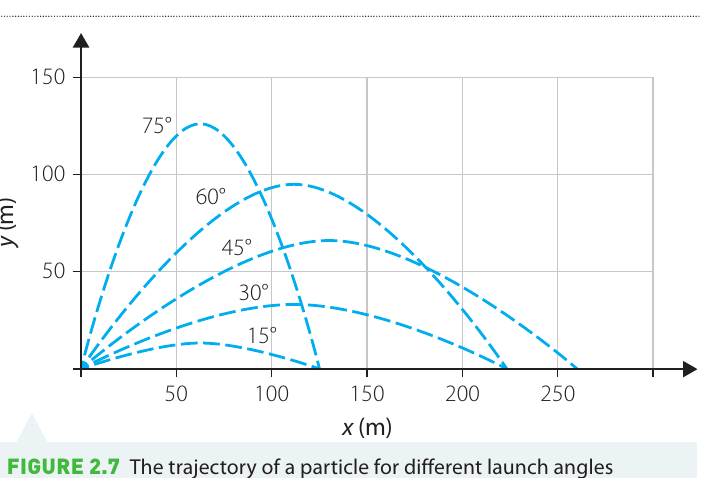
The diagram above compares trajectories for the same initial speed but different launch angles: , , , , and . Notice that:
- The trajectory achieves the greatest horizontal distance
- Angles below have flatter trajectories with less maximum height
- Angles above have higher maximum heights but shorter ranges
- Complementary angles (like and ) achieve the same range
Note
Real-World Applications
This is why athletes throwing for distance, such as javelin throwers, aim to release at approximately to the horizontal. In practice, the optimal angle may differ slightly due to air resistance and the height of release, but remains the theoretical ideal for maximum range.
Investigation: Measuring horizontal range
This practical investigation allows you to measure the launch velocity and time of flight of a projectile experimentally and compare your results with theoretical predictions.
Aim
To find the launch velocity and time of flight of a projectile.
Materials
- Curved ramp (such as a toy car track)
- Ball bearing
- Tape measure
- Sand tray
Risk assessment
Risk: The ball bearing may hit someone Management: Keep the area at the end of the ramp clear
Important
Safety First
Consider other risks such as the ball rolling off the desk unexpectedly, and plan how to manage them. Always conduct a thorough risk assessment before beginning practical work.
Method
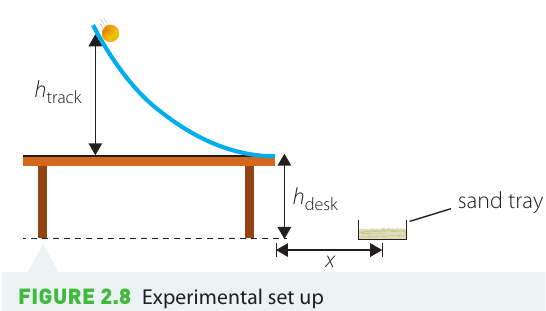
- Set up the curved track on the edge of a desk as shown in the diagram. Ensure the end of the track is horizontal.
- Measure the vertical distance from the ground to the desk edge () and from the ground to the top of the track ().
- Release the ball bearing from the top of the track. Observe where it lands and position the sand tray accordingly.
- Release the ball bearing again from the top of the track.
- Measure the horizontal distance () from the edge of the desk to the point where the ball bearing landed in the sand.
- Smooth the sand and repeat steps 4 and 5 at least five times to get multiple measurements.
Results
Record all measurements:
- Heights: and
- Multiple measurements of horizontal range
Analysis
1. Calculate time of flight: Use and the equation to find how long the ball is in the air. Assume the ball leaves the track horizontally ().
2. Calculate average range: Find the mean of your horizontal range measurements and determine the uncertainty.
3. Calculate initial velocity: Use with your average range and time of flight. Since the ball leaves horizontally, . Calculate the uncertainty in your result.
4. Compare with energy method: Use conservation of energy to predict what the velocity should be based on . The potential energy at the top () converts to kinetic energy at the bottom (), assuming no energy losses.
Note
Understanding Experimental Error
This investigation helps you understand how theoretical predictions compare with experimental measurements and highlights the importance of considering energy losses due to friction. The difference between your calculated velocity and the energy prediction reveals the effects of real-world factors like friction in the track.
Remember!
Summary
Key Points to Remember:
-
The trajectory of a projectile is the parabolic path it follows through the air.
-
Maximum height occurs when the vertical velocity is zero and depends only on the vertical component of initial velocity:
-
Time of flight for symmetric trajectories is . For non-symmetric paths, calculate ascent and descent times separately.
-
The horizontal range is found from and is maximized at a launch angle of 45° (when landing at launch height).
-
Throughout projectile motion, the horizontal velocity remains constant while the vertical velocity changes due to gravity.