Investigating Projectile Motion (HSC SSCE Physics): Revision Notes
📚Revision Notes
Investigating Projectile Motion
Introduction to experimental projectile motion
Studying projectile motion in a practical setting presents unique challenges. One of the main difficulties is achieving consistent, repeatable results. When throwing a ball by hand, it's nearly impossible to maintain the same speed and angle for each throw. This is why investigations typically require a projectile launcher to ensure reproducibility.
Note
Various types of launchers can be used, such as tennis ball launchers (commonly used for sports practice) or similar devices. While it's possible to construct your own launcher, safety must always be the top priority.
Important
Safety Warning: Projectile launchers can be extremely dangerous. Only use low-powered launchers with soft projectiles to minimise risk. Never point launchers at people or fragile objects.
In this investigation, you will collect measurements from a launched projectile and use these to reconstruct its trajectory. The trajectory represents the complete path the projectile follows through the air.
Investigation 2.2: Trajectory of a projectile
Aim
To plot the trajectory of a projectile by measuring its motion and calculating velocity components at different points during flight.
Note
Before beginning, you should formulate a hypothesis or develop an inquiry question. For example: "How does the launch angle affect the trajectory and range of a projectile?"
Materials required
- Tennis ball launcher (or similar projectile launcher)
- Tennis ball
- Chalk dust
- Stopwatch
- Large tape measure (minimum 30 m length)
- Large protractor
- Extension cord and power source for the launcher
Risk assessment
Before conducting any practical investigation, it's essential to identify potential hazards and plan how to manage them safely.
Note
Risks you should consider:
- Stand clear of the launcher when firing
- Trip hazards from equipment and cables
- Projectile bouncing unpredictably after landing
- Eye injury from projectile or chalk dust
Manage these by keeping the work area tidy, wearing safety glasses if necessary, and maintaining awareness of your surroundings.
Method
Follow these steps carefully to collect accurate data:
1. Test the launcher by firing the ball several times to estimate the range. Choose a landing area where the ball will leave a visible chalk mark, such as a concrete surface.
2. Measure the launch angle () using the protractor. This is the angle between the launch tube and the horizontal ground.
3. Coat the ball lightly with chalk dust so it will mark the landing point clearly.
4. Fire the ball from the launcher.
5. Use the stopwatch to measure and record the time of flight. Remember to include the uncertainty in your measurement. The uncertainty will be larger than just the reading error from the stopwatch (typically around s for reaction time).
6. Measure the horizontal range from the launcher to the chalk mark where the ball first contacted the ground. Record this measurement with its uncertainty.
7. Adjust the launcher to a different angle and repeat steps 1-6. Perform this twice more so you have three complete sets of data at different angles.
Note
Optional extension: If you have access to a high frame rate video camera, you can record the flight and analyse the footage to make additional measurements.
Results
Record your measurements systematically as you collect them. Use a table format to keep your data organised:
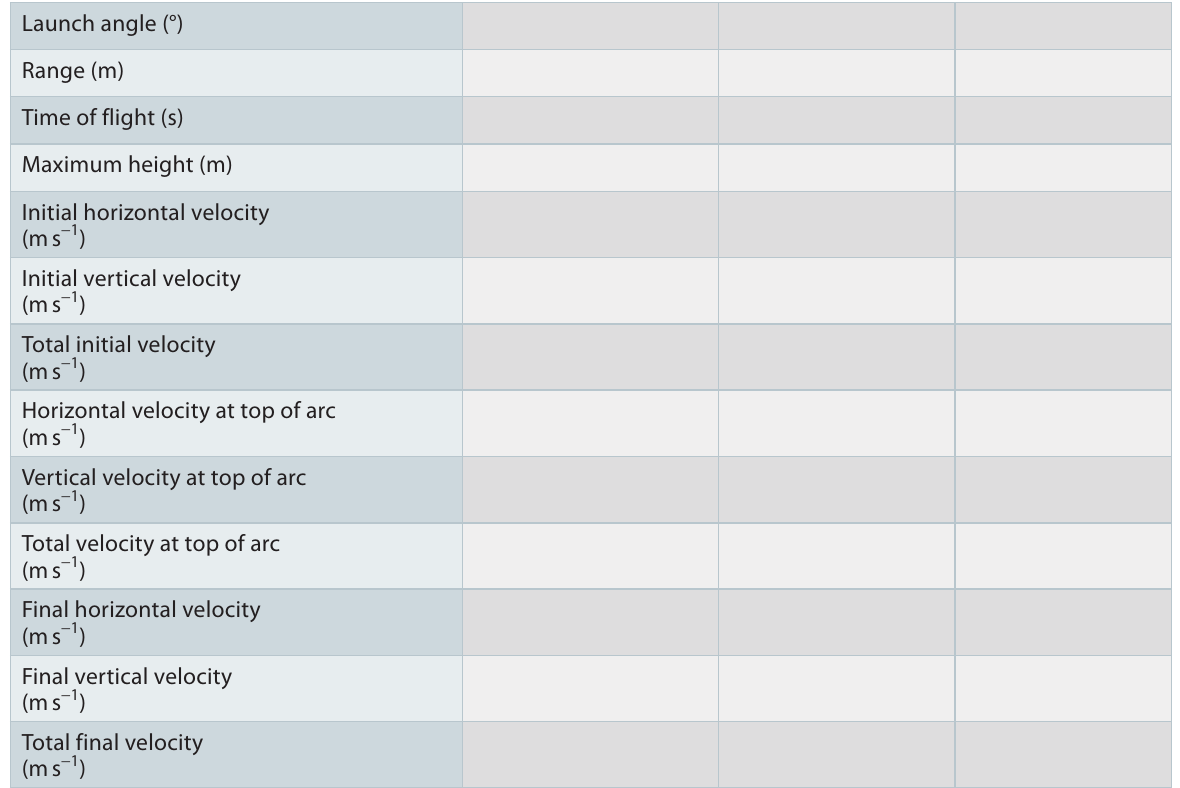
This table has space for three trials at different launch angles. You will measure the first three rows directly (launch angle, range, time of flight) and calculate the remaining values during your analysis.
Analysis of results
Complete the results table by performing the following calculations. Remember to show your working and state any assumptions clearly.
Example
Analysis Task 1: Calculate maximum height and initial vertical velocity
Use the measured time of flight to determine:
- The maximum height () reached by the tennis ball
- The initial vertical velocity ()
Assumption to state: The ball takes equal time to rise to maximum height and fall back down (symmetrical trajectory).
Example
Analysis Task 2: Calculate initial velocity components from range
Use the measured horizontal range and launch angle to find:
- The initial horizontal velocity ()
- The initial vertical velocity ()
Assumption to state: Air resistance is negligible, so horizontal velocity remains constant.
Example
Analysis Task 3: Determine total initial velocity
Draw a vector diagram showing the horizontal and vertical components of velocity. Use vector addition (Pythagoras' theorem) to calculate the total initial velocity ():
Example
Analysis Task 4: Calculate velocities at different trajectory points
Determine the velocity and its components at:
- The top of the trajectory (maximum height)
- The end point (just before landing)
For each point, find:
- Horizontal velocity component
- Vertical velocity component
- Total velocity magnitude
Key assumption: At the highest point, vertical velocity = 0, but horizontal velocity remains constant throughout.
Example
Analysis Task 5: Create scale trajectory diagrams
Draw accurate scale diagrams of the trajectory for each launch angle, similar to Figure 2.9 shown below:
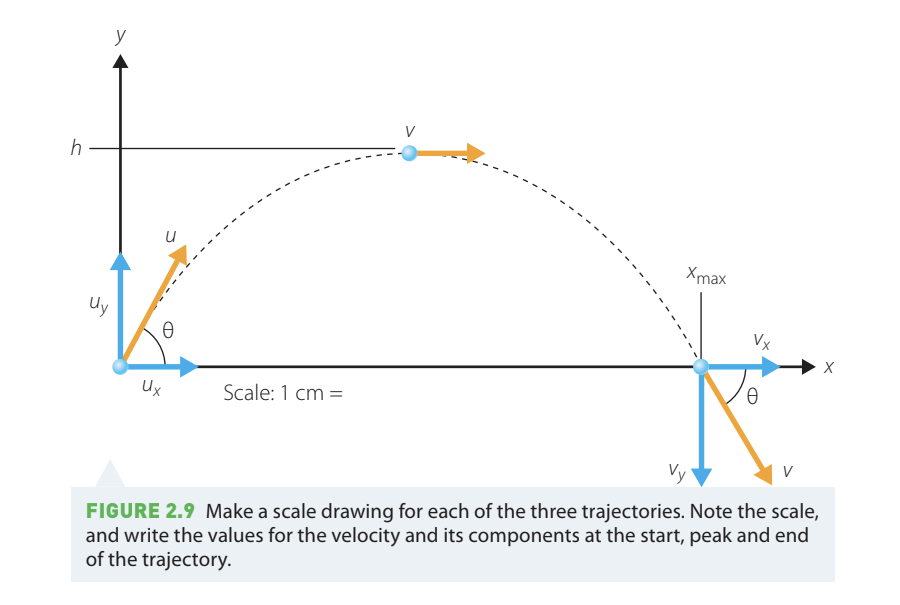
Your diagrams must include:
- A clearly marked scale (e.g., 1 cm = 2 m)
- The maximum height () marked and labelled
- The horizontal range () marked and labelled
- Velocity values at three key points: start, peak, and end
- Vector arrows showing velocity components at these three points
- The launch angle () clearly indicated
Discussion
Analyse your results by considering these questions:
1. Compare the three trajectories you created. How do the velocity components change throughout the flight? What patterns do you notice?
2. You calculated initial vertical velocity two different ways (from time of flight and from range/angle). Do these values agree? Consider the uncertainties when making your comparison.
3. Evaluate the validity of your assumptions. Were they reasonable? How might violations of these assumptions affect your results?
4. Suggest specific improvements to the investigation method or propose extensions to explore further aspects of projectile motion.
5. Answer your original inquiry question or state whether your hypothesis was supported by the evidence.
Important
Critical Analysis Points:
- Always compare calculated values with their uncertainties before drawing conclusions
- Consider how air resistance (which we ignored) would affect real trajectories
- Think about which measurements contribute most to the overall uncertainty
Conclusion
Write a summary that:
- Restates the aim
- Summarises key findings
- Comments on the validity of results
- Addresses your hypothesis or inquiry question
Key concepts
Summary
Important points to remember about investigating projectile motion:
- Projectile motion can be investigated experimentally using a projectile launcher and suitable projectile
- Safety is paramount - projectiles can move very fast and cause serious injuries
- The velocity of a projectile and its horizontal and vertical components can be calculated from measured values (range, time of flight, launch angle) using kinematic equations
- The standard projectile motion model assumes no air resistance, making it an approximation of real motion
Understanding check
Test your knowledge with these questions:
1. Why do we assume a projectile travels the same horizontal distance before and after reaching peak height? If this assumption is incorrect due to air resistance, in which part of the trajectory does the projectile travel further horizontally?
2. In an experiment, Ali measures the time of flight as s. Calculate:
- The maximum height of the trajectory
- The uncertainty in this calculated value
- State your assumptions clearly
3. Using the time of flight from Question 2, calculate:
- The initial vertical velocity
- The uncertainty in this value
Remember!
Summary
Key Points to Remember:
- Reproducibility is key: Use a mechanical launcher rather than throwing by hand to get consistent results
- Safety first: Always use soft projectiles and low-powered launchers in open areas
- Measure carefully: Record uncertainties for all measurements - they're essential for evaluating your results
- Show your assumptions: Always state what you're assuming (e.g., no air resistance, symmetrical trajectory)
- Vector thinking: Projectile motion has independent horizontal and vertical components that must be analysed separately and then combined