Forces, Acceleration, and Energy (HSC SSCE Physics): Revision Notes
📚Revision Notes
Energy
Energy is one of the most important concepts in physics. It connects to our understanding of forces and helps us describe how objects move and interact. Understanding energy allows us to predict and explain a wide range of physical phenomena.
Types of energy
There are two fundamental forms of energy in physics:
Kinetic energy is the energy an object possesses due to its motion. Any moving object has kinetic energy.
Potential energy is stored energy that exists because of the forces acting between objects in a system. It depends on the positions of objects relative to each other.
Kinetic energy
Kinetic energy exists whenever an object is moving. The faster an object moves, or the more massive it is, the greater its kinetic energy.
The kinetic energy formula
For a single object moving at a particular speed, the kinetic energy is given by:
where:
- is the kinetic energy (measured in joules, J)
- is the mass of the object (in kilograms, kg)
- is the velocity of the object (in metres per second, )
Units of energy
Looking at the kinetic energy formula, we can work out that the units must be . This combination of units is given the special name joule (symbol J), in honour of physicist James Prescott Joule.
Important properties of kinetic energy
Important
Unlike force, which has both magnitude and direction (a vector), energy is a scalar quantity - it only has magnitude, no direction. This often makes energy easier to work with when solving physics problems.
Kinetic energy is always positive. It doesn't matter which direction an object is moving; as long as it's moving, it has kinetic energy.
Different types of kinetic energy
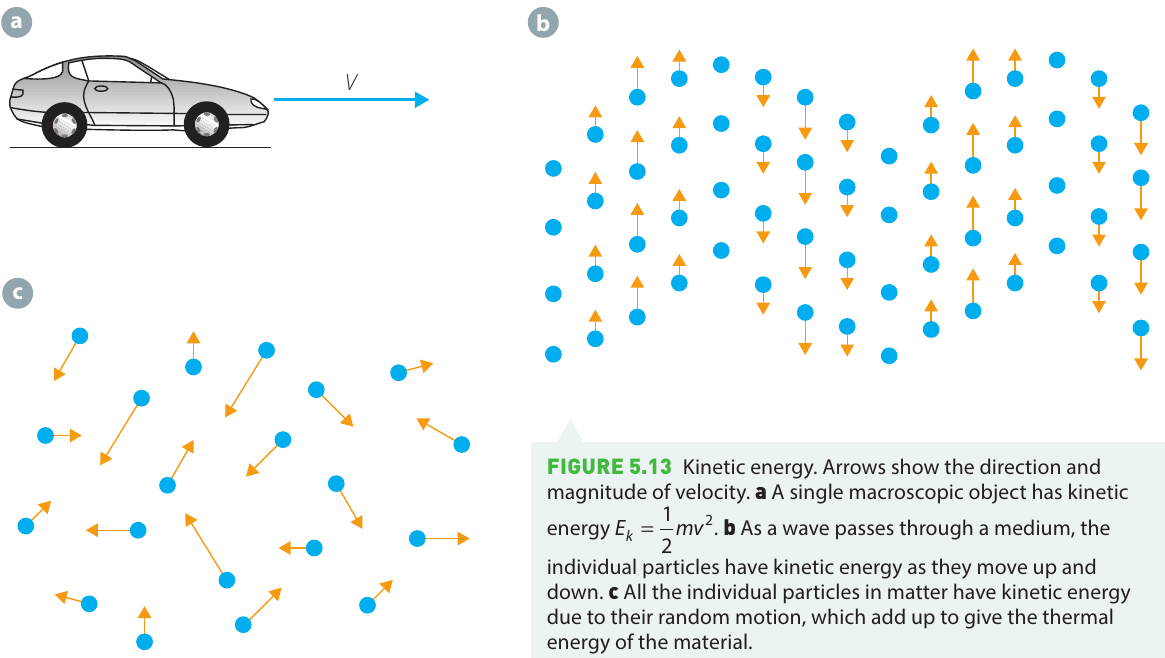
In this course, we focus mainly on the kinetic energy of single, large-scale objects (like cars, balls, or books). However, kinetic energy appears in other contexts too:
- Macroscopic kinetic energy: A single object moving in one direction, like a moving car
- Wave motion: When a wave passes through a material, individual particles oscillate up and down or back and forth, giving them kinetic energy, even though there's no net movement of material
- Thermal energy: All particles in matter are constantly moving randomly. This random kinetic energy of many microscopic particles is what we measure as temperature
Note
The kinetic energy we calculate using applies to macroscopic objects moving in a specific direction. Thermal energy represents the random kinetic energy of countless microscopic particles, while wave motion involves particles oscillating around fixed positions.
Example
Worked Example: Calculating kinetic energy
Problem: Bill is driving his car (mass 1900 kg) through a small town at 50 km h. Calculate the kinetic energy of the car.
Solution:
First, identify the data: kg; km h
We need to convert the velocity to SI units ():
Now we can calculate the kinetic energy using :
The kinetic energy of the car is 180 kilojoules (to 2 significant figures).
Key points:
- Always convert units to SI before calculating
- Remember to square the velocity
- Round your final answer to an appropriate number of significant figures
Potential energy
Potential energy is stored energy that has the capacity to do work. Whenever a force acts on an object, there is potential energy associated with that force.
Understanding potential energy
Important
Potential energy belongs to a system of objects, not to a single object. For example, if you hold a book above the Earth's surface, the potential energy exists in the Earth-book system. Without Earth's gravitational field, the book wouldn't experience a force and there would be no potential energy.
We can think of potential energy as being stored in the field that produces the force.
Gravitational potential energy
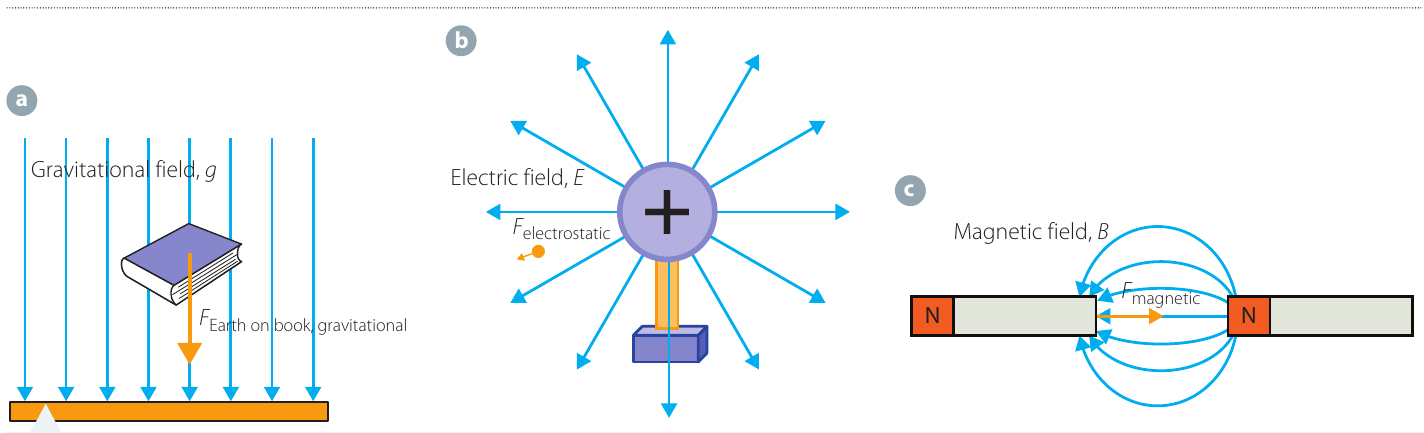
When you hold an object at a height above Earth's surface, you're working against the gravitational force. The Earth-object system stores gravitational potential energy. If you release the object, this stored energy gets converted into kinetic energy as the object falls and accelerates.
The gravitational potential energy of an object near Earth's surface is given by:
where:
- is the gravitational potential energy (in joules, J)
- is the mass of the object (in kilograms, kg)
- is the gravitational field strength, equal to the acceleration due to gravity ( near Earth's surface)
- is the height of the object above a chosen reference point (in metres, m)
Important
This formula assumes that is constant, which is only valid near Earth's surface.
Positive and negative potential energy
Unlike kinetic energy, potential energy can be positive or negative. We define the zero point of potential energy by choosing a convenient reference position. Once we've chosen this reference point, potential energy is calculated based on the object's distance from that position.
Note
For example, if we define ground level as having zero gravitational potential energy:
- An object above ground has positive potential energy
- An object below ground (in a hole) has negative potential energy
Other types of potential energy
Beyond gravitational potential energy, forces in other fields also store energy:
- Electric potential energy: A charged particle in an electric field experiences a force, so the field stores potential energy. If the particle is free to move, it will accelerate, converting potential energy to kinetic energy.
- Magnetic potential energy: Magnetic fields also exert forces and store potential energy.
- Elastic potential energy: A compressed or stretched spring has stored energy. When released, the spring can do work by applying a force over a distance. This is actually a form of electromagnetic potential energy, because the force from a spring comes from atoms being pushed closer together or pulled further apart than their normal separation, and atoms interact through electromagnetic forces between their electrons.
Example
Worked Example: Gravitational potential energy
Problem: Louise throws a ball to Rob, who misses the catch. The ball, with a mass of 150 g, rolls down a drain.
- Calculate the gravitational potential energy of the ball when it is at a height of 2.5 m above the ground.
- Calculate the gravitational potential energy of the ball when it is at the bottom of the drain, 1.5 m below the ground.
Solution 1:
Given: g; m
Convert to SI units: kg
Using :
Solution 2:
Given: g; m (note the negative sign - the ball is below our reference point)
Convert to SI units: kg
Using :
The negative value shows the ball is below our chosen zero point (ground level).
Key points:
- Choose a reference point for zero potential energy (here, ground level)
- Heights above the reference point are positive
- Heights below the reference point are negative
- Always include the correct sign in your calculations
Conservation of energy
Energy is a conserved quantity. This means energy cannot be created or destroyed - it can only change from one form to another. The total amount of energy in the universe remains constant.
Important
The Law of Conservation of Energy
The total amount of energy in the universe remains constant. Energy cannot be created or destroyed - it can only be transformed from one form to another.
Isolated systems
When solving problems using conservation of energy, we need to carefully define the system we're analyzing.
An isolated system is one where energy (or mass) cannot be transferred into or out of the system. For an isolated system, the total energy stays constant:
This means the sum of all potential energies plus the sum of all kinetic energies in the system doesn't change.
Non-isolated systems
Note
For a system that is not isolated, the total energy can change, but only by the exact amount that is added to or removed from the system. Remember, the total energy of the universe is always constant, so any energy gained by a system must come from somewhere else in the universe.
Work done by a constant force
Forces act to transfer energy and to change the form of energy. When a force acts on an object and causes it to accelerate, kinetic energy increases, which means there must be a corresponding decrease in potential energy (or energy transferred from elsewhere). When a force slows an object down, kinetic energy decreases and potential energy or some other form of energy increases.
Definition of work
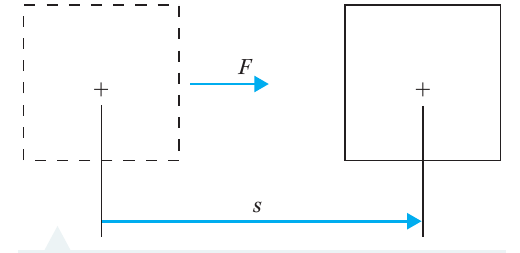
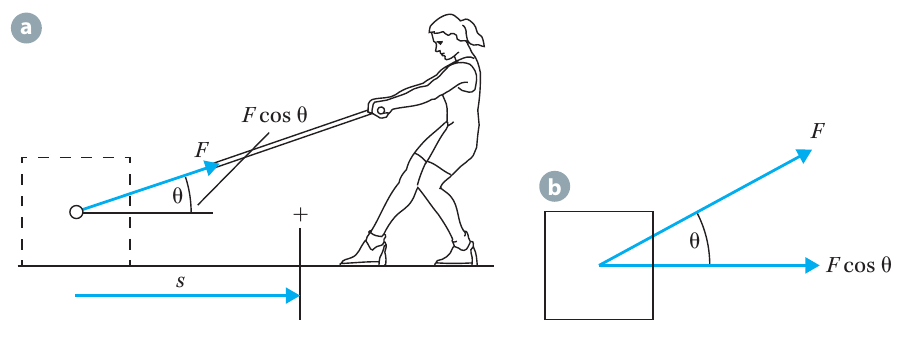
The amount of energy transferred by a force is called the work done by that force. Work is calculated using:
where:
- is the work done (in joules, J)
- is the component of the force in the direction of motion (in newtons, N)
- is the displacement of the object (in metres, m)
- is the angle between the force and the displacement
Important
When dealing with work, directions are crucial because we're working with forces:
- If an object moves in the same direction as the force, the work done is positive
- If an object moves in the opposite direction to the force, the work done is negative
- When the force and motion are not in the same direction, we only consider the component of the force parallel to the direction of motion
Units of work
Since work is energy transferred, it has the same units as energy: joules (J). The formula for work also tells us that:
This makes sense because , so:
Work from graphs
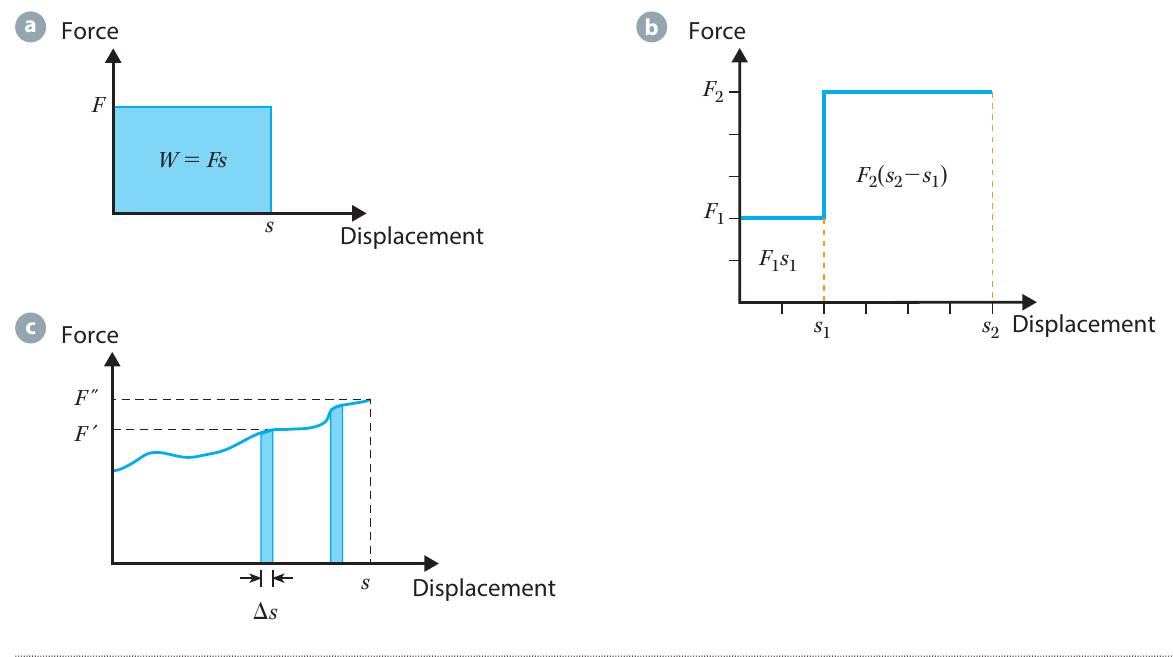
The work done by a force can be found from a graph of force versus displacement. The work done equals the area under the curve.
For a constant force, this is simply a rectangular area. When the force varies, you may need to divide the area into many small segments and add them all up.
Example
Worked Example: Calculating work
Problem: Phil pushes a textbook across a desk towards Ranji, applying a constant force of 60 N for a distance of 5 cm in the direction of the book's motion. The book then slides an additional 20 cm, subject to a friction force of 10 N, before Ranji stops it.
- How much work does Phil do on the book?
- How much work does the desk do on the book?
Solution 1:
Given: N; cm = 0.05 m
Using :
Phil does 3 J of work on the book.
Solution 2:
Given: N (negative because friction opposes motion); cm = 0.20 m
Using :
The desk does -2 J of work on the book (negative work because friction opposes the motion).
Key points:
- Positive work means the force is in the direction of motion
- Negative work means the force opposes the motion
- Always check the direction of forces carefully
The work-energy theorem
When work is done on an object, the object's kinetic energy changes. Specifically:
- When positive work is done (force in direction of motion), kinetic energy increases and the object speeds up
- When negative work is done (force opposes motion), kinetic energy decreases and the object slows down
The total work done on an object equals the sum of work done by all forces acting:
Using Newton's second law () and the kinematic equation (), we can show that:
Important
The Work-Energy Theorem
The net work done on an object equals the change in its kinetic energy:
Example
Worked Example: Work and kinetic energy
Problem: Phil pushes a textbook (mass 1.5 kg) from rest across a desk towards Ranji, applying a constant force of 60 N for a distance of 5 cm. At the same time, the book experiences a friction force of 10 N. Both forces act in the direction of motion.
- Calculate the change in kinetic energy of the book.
- Calculate the final speed of the book.
Solution 1:
Given: N; N; cm = 0.05 m
The net work done equals the change in kinetic energy:
The kinetic energy increases by 2.5 J.
Solution 2:
Given: J; (starts from rest); kg
Since the book starts from rest:
Using :
The final speed is 1.8 m·s⁻¹.
Key points:
- Net work equals the sum of work done by all forces
- When an object starts from rest, the change in kinetic energy equals the final kinetic energy
- Remember that when working with units
Energy and the gravitational field
The gravitational force that Earth exerts on an object is given by , where is the object's mass and is the gravitational field strength (equal to the acceleration due to gravity).
Work done by gravity
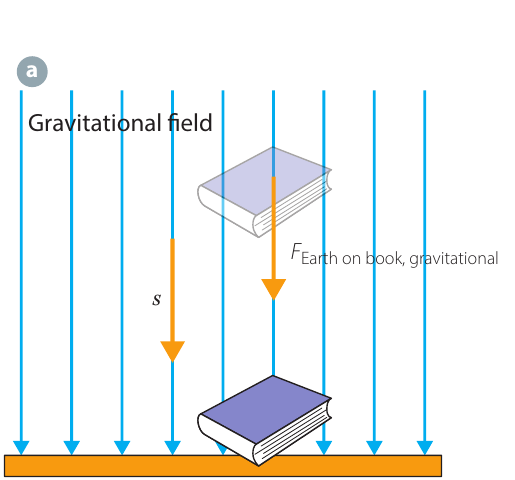
When you drop an object, it falls and accelerates due to the gravitational force. The kinetic energy increases because gravity is doing work on the object. If we assume air resistance is negligible, then only the gravitational force acts, and we can treat the Earth-object system as isolated.
The work done by gravity when an object falls through a height is:
Looking at the expression for gravitational potential energy (), we can see that the magnitude of work done by gravity equals the change in gravitational potential energy:
Note
The negative sign appears because the force points downward while we measure height upward from the ground. The work done by gravity decreases the potential energy of the object.
Connecting work, kinetic energy, and potential energy
The work done by gravity also equals the change in kinetic energy:
This can be rearranged to give:
Important
This is really a statement of conservation of energy - when potential energy decreases, kinetic energy increases by the same amount (and vice versa).
For an object falling freely in Earth's gravitational field:
Example
Worked Example: Falling objects
Problem: Phil pushes a textbook across a table towards Ranji, but it falls off the edge. Consider motion in the vertical direction only and ignore air resistance. Calculate the speed at which the book hits the floor if the table is 75 cm high.
Solution:
Given: cm = 0.75 m; (starts from rest)
Apply conservation of energy:
Substituting the expressions:
Notice the mass cancels out:
The book hits the floor at 3.8 m·s⁻¹.
Key insight: The final speed of a falling object depends only on the height fallen and gravity, not on its mass.
Lifting objects against gravity
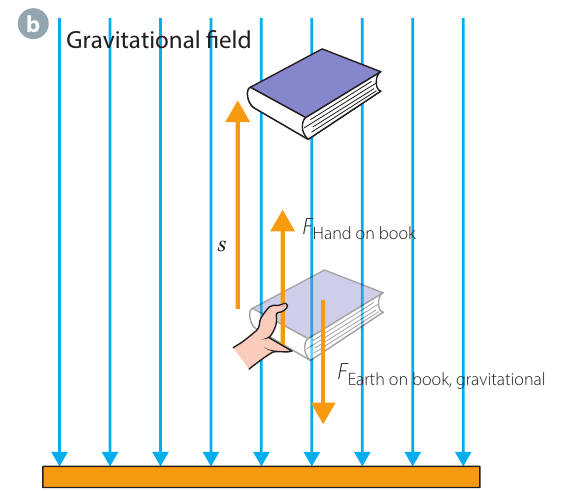
When you lift an object, you exert an upward force while gravity exerts a downward force. If the object moves upward:
- You do positive work on it
- Gravity does negative work on it
Example
Worked Example: Lifting objects
Problem: Ranji picks up the fallen book with mass 1.5 kg and places it back on the table 75 cm above the floor.
- How much work must Ranji do?
- How much work is done by the gravitational field?
Solution 1:
Given: cm = 0.75 m; ; ; kg
The book starts and ends at rest, so .
The work Ranji does must equal the increase in potential energy:
Ranji does 11 J of work.
Note: This is the work needed to increase the potential energy. Ranji also needs to do a small amount of work to initially accelerate the book from rest, but this example assumes she lifts it very slowly.
Solution 2:
The gravitational force acts downward while the displacement is upward, so:
The gravitational field does -11 J of work (negative because it opposes the motion).
Key points:
- The work done by Ranji and the work done by gravity are equal in magnitude but opposite in sign
- Since the book starts and ends at rest, the change in kinetic energy is zero
- All the work done by Ranji goes into increasing the potential energy of the book-Earth system
Investigation: Energy changes of falling objects
Aim: To investigate the transformation of gravitational potential energy to kinetic energy as an object is accelerated by a gravitational field.
Materials:
- Objects to drop
- Data-logger equipment for measuring motion
- Computer with data-logging software
Method:
- Set up the data-logger according to the manufacturer's instructions
- Ensure you can record position, velocity, and acceleration data
- Drop objects from various heights
- Record the motion data
- Save each dataset with a descriptive name
Important
Risk assessment: Consider risks such as falling objects, equipment damage, and how to manage these safely.
Analysis:
- Create graphs of velocity versus time to calculate kinetic energy as a function of time
- Create graphs of position versus time to calculate gravitational potential energy as a function of time
- Create graphs of acceleration versus time to calculate net force as a function of time
- Compare how potential energy decreases while kinetic energy increases
Discussion questions:
- Did your graphs have the expected shapes?
- How much gravitational potential energy was converted to kinetic energy?
- Was air resistance significant? Did the size, shape, or mass of objects make a difference?
Conclusion: Write a conclusion addressing the aim and summarizing your findings about energy transformation.
Mechanical energy
Mechanical energy is a term used to group together:
- The kinetic energy of macroscopic objects
- Gravitational potential energy
- Sometimes elastic potential energy (energy stored in springs)
Conservation of mechanical energy
In the absence of friction and other resistive forces (like air resistance), mechanical energy is conserved. This means:
Note
When objects move slowly so air resistance is small, and there are no surfaces sliding against each other, assuming mechanical energy is conserved is often a good approximation. This makes calculations much simpler.
Reality check
Important
Remember that conservation of mechanical energy is an approximation. In the real world, mechanical energy is almost never truly conserved because:
- Friction usually acts between surfaces
- Air resistance opposes motion through the air
- These forces convert mechanical energy into thermal energy (heat)
When kinetic friction slows down an object, the lost kinetic energy is converted into random kinetic energy of atoms on the surfaces - the surfaces get warmer. This random microscopic kinetic energy (thermal energy) is not considered mechanical energy.
For accurate calculations, especially when friction is significant, you need to account for these energy losses.
Summary
Key Points to Remember:
-
Energy exists in two forms: kinetic energy (associated with motion) and potential energy (associated with forces and position)
-
Kinetic energy formula: - depends on mass and the square of velocity
-
Potential energy belongs to systems and is calculated from object positions. For gravity near Earth's surface:
-
Energy is conserved - it cannot be created or destroyed, only transformed. For isolated systems:
-
Work is energy transfer: . Positive work speeds objects up; negative work slows them down
-
The work-energy theorem: Net work done equals change in kinetic energy:
-
Mechanical energy (kinetic + gravitational potential) is only conserved when friction and air resistance are negligible - remember this is an approximation!