Acceleration of an Object Subject to a Constant Net Force (HSC SSCE Physics): Revision Notes
📚Revision Notes
Acceleration of an Object Subject to a Constant Net Force
Introduction
When an object experiences forces that don't balance out to zero, the object will accelerate. Newton's second law helps us understand and predict what happens when a constant net force acts on an object. This fundamental relationship connects force, mass, and acceleration in a precise mathematical way.
Note
Understanding how constant net forces produce predictable motion is essential for analyzing everything from vehicle dynamics to rocket launches. The key is recognizing that a constant force leads to constant acceleration, which allows us to use powerful mathematical tools to predict motion.
Newton's second law and constant net force
Newton's second law tells us that the acceleration of an object is determined by the net force acting on it and the object's mass:
where:
- is the acceleration (in )
- is the net force (in N)
- is the mass (in kg)
- represents the vector sum of all forces acting on the object
This equation reveals two important relationships:
- Direct proportionality: Acceleration increases when the net force increases (for constant mass)
- Inverse proportionality: Acceleration decreases when the mass increases (for constant net force)
Important
Critical Concept: Constant Force = Constant Acceleration
When the net force is constant, the acceleration is also constant. This means we can use the kinematics equations for constant acceleration to analyze the motion. This is the bridge that connects Newton's laws with kinematic analysis.
Analyzing motion under constant net force
To analyze the motion of an object experiencing a constant net force, we follow a two-step process:
Step 1: Apply Newton's second law to find the acceleration
Step 2: Use the kinematics equations for constant acceleration to describe and predict the motion
Kinematics equations for constant acceleration
Once we know the acceleration, we can use these equations to find velocity and displacement:
where:
- is displacement (m)
- is initial velocity ()
- is final velocity ()
- is time (s)
- is acceleration ()
Note
These kinematics equations are your toolkit for predicting motion once you've found the acceleration using Newton's second law. Notice how the force term can be directly substituted for acceleration in any of these equations.
Graphical representation
When an object starts from rest and experiences a constant net force, the motion produces characteristic graphs:
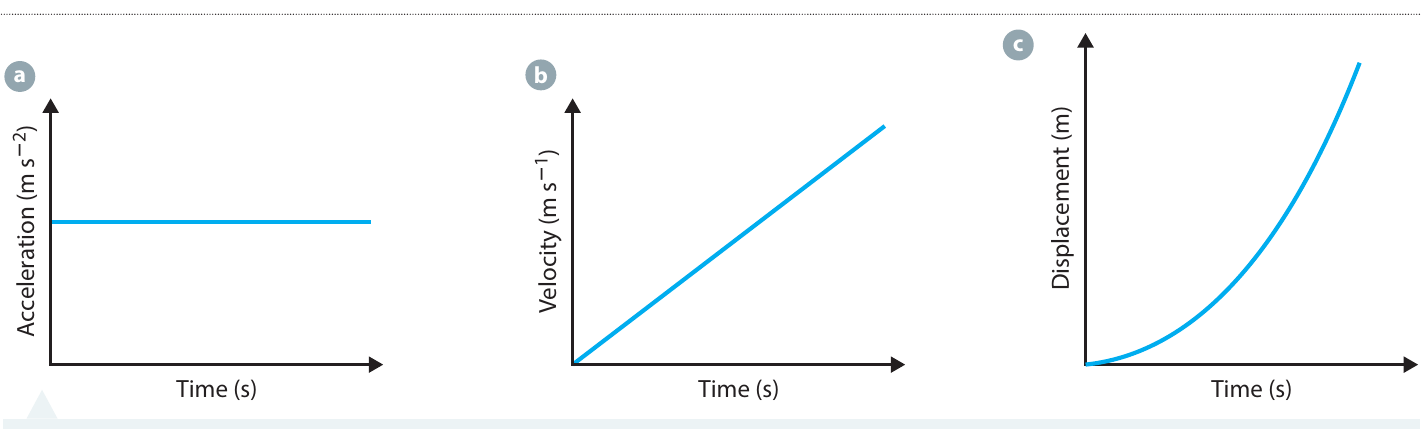
- Acceleration-time graph: A horizontal line (constant acceleration)
- Velocity-time graph: A straight line with positive slope (velocity increases uniformly)
- Displacement-time graph: An upward-curving parabola (displacement increases at an increasing rate)
Forces as vectors and net force
Forces are vector quantities, which means they have both magnitude and direction. To find the net force, we must add all forces acting on an object using vector addition.
Important
Key Principle: Direction Determines Motion
The direction of the net force determines the direction of the acceleration. This also works in reverse: if we know the direction an object is accelerating, we can determine the direction of the net force acting on it. This tells us about the relative sizes of the forces acting on the object.
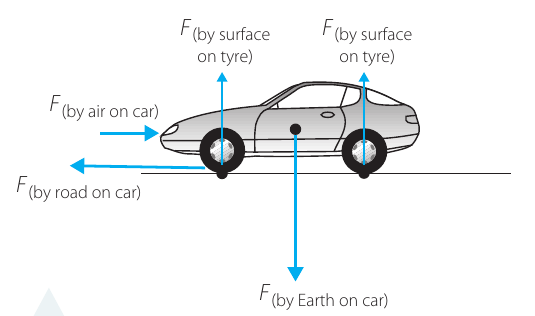
Example: Forces on a speeding car
When a car speeds up, the acceleration points forwards, so the net force must also point forwards.
The forces acting on the car include:
- Normal force from the ground (upward, on each tyre)
- Friction force from the road surface (forward, driving the car)
- Air resistance (backward, opposing motion)
- Gravitational force from Earth (downward)
For the car to accelerate forwards, the forward friction force must be greater than the backward air resistance force.
Example: Forces on a braking car
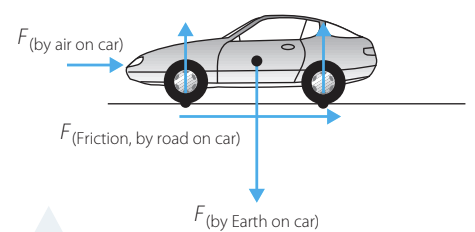
When a car brakes, the acceleration points backwards, so the net force must also point backwards.
The forces acting include:
- Normal force from the road surface (upward, on each tyre)
- Friction force from the road surface (backward, slowing the car)
- Air resistance (backward, also opposing motion)
- Gravitational force from Earth (downward)
Note
In the vertical direction, the normal force balances the gravitational force. In the horizontal direction, both friction and air resistance point backward, creating a net backward force that slows the car.
Worked example: Calculating stopping force
Example
Worked Example: Calculating Stopping Force
Problem: A car with mass kg is travelling at . Calculate the average net force needed to stop the car in a distance of m.
Solution approach:
Given information:
- m
- (car comes to rest)
- kg
Step 1: Use kinematics to find acceleration
We use:
Rearranging for acceleration:
Substituting values:
The negative sign indicates the acceleration is in the opposite direction to the velocity (the car is slowing down).
Step 2: Use Newton's second law to find force
Answer: The force is N in the backward direction (opposing the car's motion).
Note
Exam tip: Always identify your known values first, plan your solution approach, show all working with units, and state your final answer with correct units and direction.
Investigation: Acceleration due to a constant net force
This practical investigation demonstrates how a constant force produces constant acceleration.
Apparatus
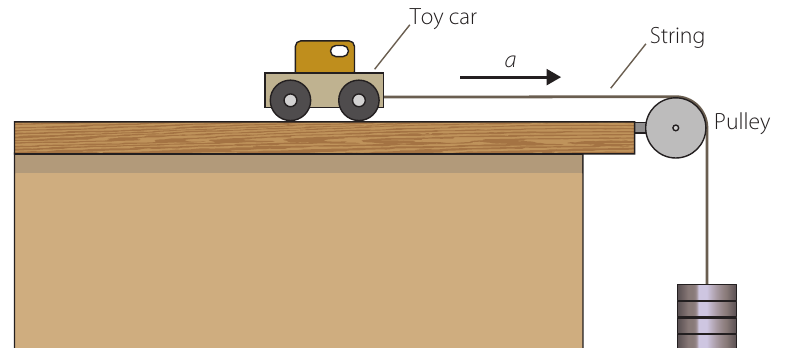
- Pulley attached to table edge
- String
- Masses and mass holder
- Tape measure
- Tape
- Toy car
- Stopwatch or motion sensor with data logger
Method
The experimental setup uses gravity to apply a constant force to a falling weight, which is connected via string over a pulley to a toy car. The pulley changes the direction of the tension force without changing its magnitude (ideal pulley approximation).
- Set up equipment with the car aligned with the pulley
- Mark start and finish lines on the table
- Position the car at the start line
- Release the weights and time how long the car takes to reach the finish line
- Repeat at least twice for each mass value to determine uncertainty
- Repeat with different masses on the mass holder
Risk assessment
Important
Safety Considerations
Consider potential hazards such as falling masses, moving equipment, and pinch points at the pulley. Manage risks by ensuring the setup is stable, keeping clear of moving parts, and catching masses before they hit the floor.
Results
Record your measurements in a table:
| Mass of Weights Used (kg) | Times Taken (s) | Average Time ± Uncertainty (s) | Acceleration ± Uncertainty () |
|---|---|---|---|
Analysis
- Draw a force diagram showing horizontal and vertical forces on the car
- Calculate average time for each mass value, including uncertainty
- Use kinematics equations to calculate the average acceleration: (starting from rest)
- Plot a graph of acceleration versus mass of falling weights
- Fit a trend line and record the gradient
- Derive an expression for the gradient using , distinguishing between the mass of the car and the mass of the falling weights
Note
When analyzing your results, pay special attention to how the acceleration changes with the mass of the falling weights. The relationship should be linear if friction is relatively small.
Discussion
- Does the graph shape match your hypothesis?
- Does the gradient agree with Newton's second law predictions?
- What can the graph tell you about friction forces?
Note
Exam tip: When conducting investigations, always include uncertainty analysis and compare your results with theoretical predictions. Explain any discrepancies by considering factors like friction and air resistance.
Problem-solving strategy
When tackling problems involving constant net force:
- Identify the given information (initial velocity, final velocity, mass, distance, time)
- Determine what you need to find (force, acceleration, distance, velocity, or time)
- Plan your approach:
- Use kinematics equations to find acceleration if needed
- Apply Newton's second law to connect force and acceleration
- Calculate systematically, showing all steps with units
- Check your answer makes physical sense (direction, magnitude, units)
Summary
Remember!
Key Points to Remember:
-
Newton's second law: The acceleration of an object equals the net force divided by its mass:
-
Constant net force produces constant acceleration, allowing us to use kinematics equations
-
Direction matters: The direction of acceleration is always the same as the direction of the net force
-
Forces are vectors: Add all forces using vector addition to find the net force
-
Two-step approach: First find acceleration using Newton's second law, then use kinematics to analyze motion