Forces Are Interactions (HSC SSCE Physics): Revision Notes
📚Revision Notes
Forces are Interactions
Introduction to forces
Forces are the cause of acceleration in objects. They make things move, stop, and change direction. Whenever an object's state of motion changes, a force must be acting on it. Every interaction you have with the world involves forces - from tapping a screen to making air vibrate when you speak.
Note
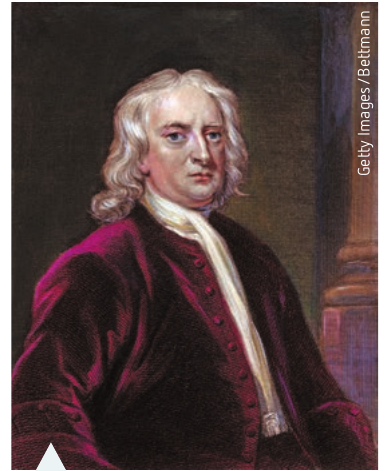
Our understanding of forces was largely developed by Sir Isaac Newton (1642-1727). Newton's three laws of motion describe how objects interact via forces and what happens when objects experience one or more forces. The unit of force, the newton (N), is named in his honour.
What are forces?
Forces are interactions between objects, not properties contained within objects. We don't say an object "has" a force - instead, forces are exerted on one object by another object.
Force notation
When writing force symbols, use subscripts to identify which object exerts the force and which object receives it. For example:
This notation shows that object A is applying a force to object B.
Important
Always use proper force notation with subscripts to clearly identify which object exerts the force and which object receives it. This becomes crucial when applying Newton's third law.
Types of forces
Forces fall into two main categories: contact forces and field forces.
- Contact forces act when objects are touching each other
- Field forces act when objects interact without touching
For example, when you hold a book in your hand, you exert a contact force on the book. The book also experiences a gravitational force from Earth, even though it's not touching Earth - this is a field force.
Contact forces
Contact forces occur whenever objects are in physical contact. Everyday pushes and pulls are examples of contact forces. When you walk, pick something up, or push an object, you're exerting contact forces.
Components of contact forces
Any contact force between surfaces can be broken down into two perpendicular components:
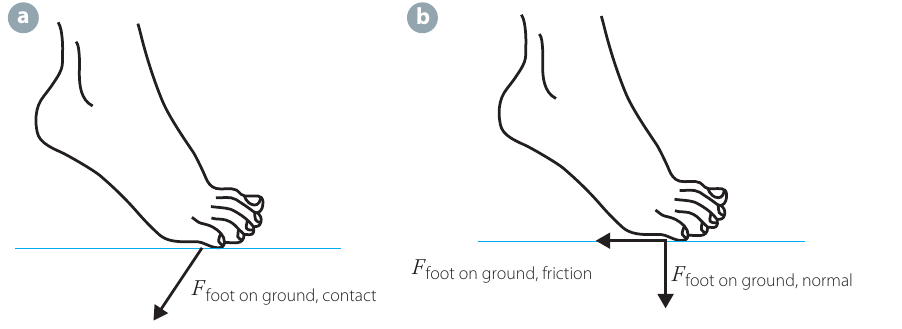
- Normal force - acts perpendicular to the surface
- Friction force - acts parallel to the surface
Normal force
The normal force acts perpendicular to the surface (in mathematics, "normal" means perpendicular). It prevents objects from moving into each other. The normal force results from interactions between atoms on the two surfaces in contact.
Note
For example, when your foot pushes against the ground, the normal force prevents your foot from sinking into the ground. This force is the result of electromagnetic interactions between atoms at the surface level.
Friction force
The friction force acts parallel to surfaces in contact and prevents sliding. Like the normal force, it results from atomic interactions between surfaces.
There are two types of friction:
- Static friction - prevents sliding between surfaces that aren't yet moving relative to each other
- Kinetic friction - occurs when surfaces are already sliding relative to each other and acts to slow the sliding
Important
Friction doesn't prevent movement altogether. Without friction, you couldn't walk or drive a car. Friction opposes the sliding of one surface against another, not movement in general.
Limits of contact forces
Both normal and friction forces have limits:
- If the normal force limit is exceeded, one surface will penetrate the other (e.g., a sharp stone piercing your foot)
- If the static friction limit is exceeded, surfaces will slide relative to each other (e.g., skidding on wet grass)
Contact forces in fluids
Contact forces aren't limited to solids - liquids and gases also exert contact forces. When you swim, you exert contact forces on the water. Air resistance (drag) is the friction force of air on objects moving through it.
Important
Exam tip: In many physics problems, we assume air resistance is negligible to simplify calculations. However, in real situations like driving a car, air resistance is important. Knowing when to make such approximations is a crucial physics skill.
Field forces
Objects can interact and exert forces without touching through fields. Three important fields mediate forces:
- Gravitational field
- Electric field
- Magnetic field
Gravitational field
All objects with mass create a gravitational field. The larger the mass, the stronger the field.
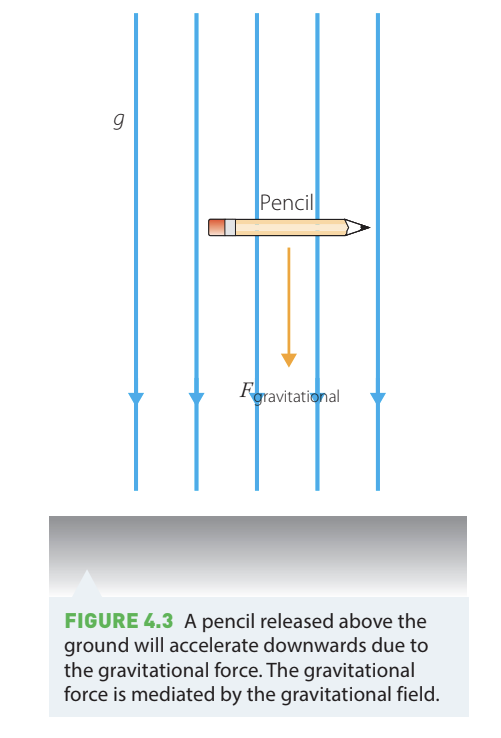
When you release a pencil above the ground, it accelerates downward due to the gravitational force Earth exerts on it. This force is mediated by Earth's gravitational field - the pencil isn't touching Earth, but it's within Earth's gravitational field.
The gravitational field strength near Earth's surface is represented by , which can be expressed in two equivalent units:
- (acceleration due to gravity)
- (gravitational field strength)
The gravitational force on an object near Earth's surface is:
where is the object's mass.
Note
Unit conversion: Since , we can verify that . This shows that the two ways of expressing gravitational field strength are equivalent.
Electric field
Charged objects create electric fields that exert forces on other charged objects.

When you rub a balloon on your hair, charged particles transfer from your hair to the balloon. Both become charged and create electric fields. The electric field of the balloon exerts a force on your hair, causing it to be attracted to the balloon (because they have opposite charges).
- Opposite charges attract via electric fields
- Like charges repel via electric fields
Magnetic field
Moving charged objects and magnetic materials create magnetic fields. These fields exert forces on moving charged objects and magnetic materials.
For example:
- North and south poles of magnets attract each other
- Two north poles or two south poles repel each other
Newton's laws of motion
Newton's three laws describe and predict the effects of forces. They apply to both static situations (objects not moving) and dynamic situations (objects moving, often with acceleration).
Newton's first law
Important
Statement: In the absence of external forces, an object at rest remains at rest, and an object in motion continues with constant velocity.
In other words: when no force acts on an object, its acceleration is zero.
Significance:
- Links force to acceleration - This law explicitly connects force to acceleration, providing the fundamental definition of force as something that causes acceleration
- Revolutionary for its time - Newton's first law contradicted Aristotle's writings, which had been taught for nearly 2000 years
Note
Historical context: Aristotle believed objects "contained" force or "impetus" and moved until this impetus ran out. Newton showed that if an object is slowing down, it's accelerating, so a force (usually friction) must be acting on it.
The Aristotelian view seemed correct because moving objects on Earth do stop eventually - but this is due to friction, not because they "run out of impetus."
Newton's first law deals with a single object with no forces acting. Newton's second law addresses what happens when forces are acting.
Newton's second law
Important
Statement: When a force acts on an object, the acceleration of the object is:
where is the object's mass.
This is commonly written as:
Key points:
- Both force and acceleration are vectors
- The direction of acceleration is the same as the direction of the force
- This law quantifies the relationship between force and acceleration introduced in the first law
Units of force: For the equation to be dimensionally correct:
Therefore:
Newton's third law
Important
Statement: Whenever object A exerts a force on object B, object B exerts an equal and opposite force on object A.
Mathematically:
Or more simply:
These two forces are called a Newton's third law force pair or action-reaction pair. Either force can be the action or reaction - both objects push and both are pushed.
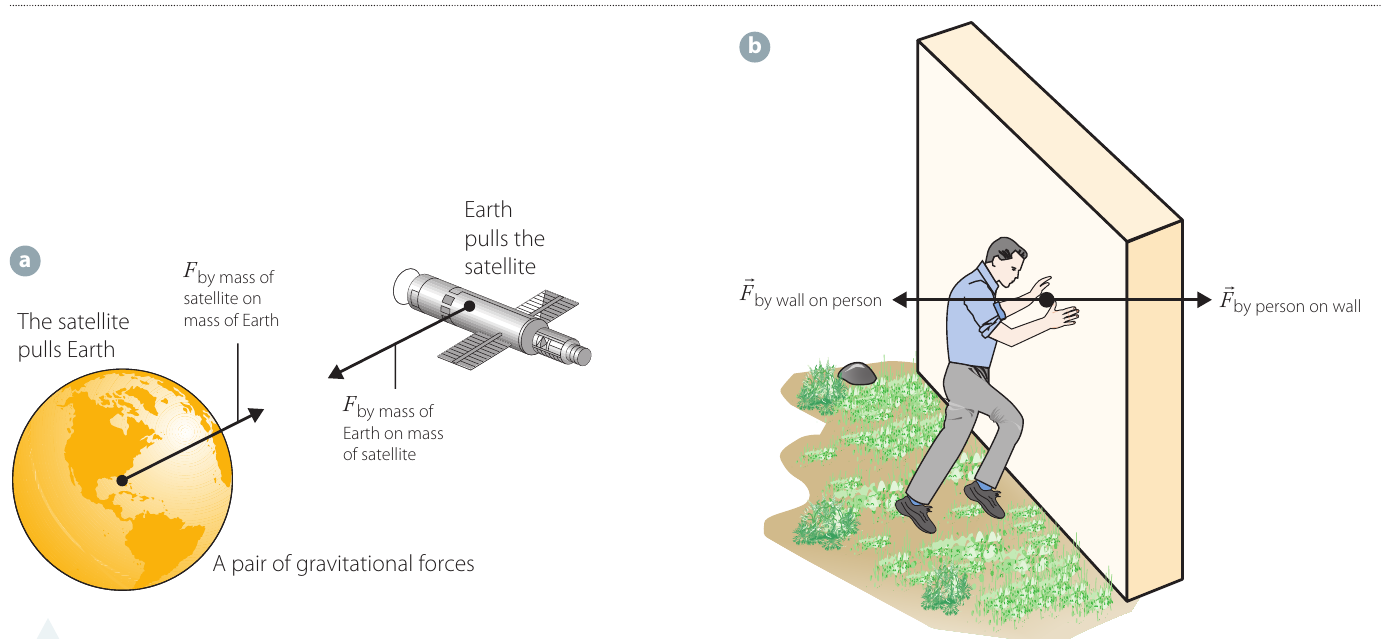
Important characteristics of Newton's third law force pairs:
- They act on different objects - If forces act on the same object, they cannot be a Newton's third law force pair. Using subscript notation helps identify this.
- They are the same type of force - The force pairs are two parts of a single interaction. The Newton's third law pair to a gravitational force is always gravitational. The pair to a contact force is always a contact force. A contact force can never pair with a gravitational force.
- They are equal in magnitude but opposite in direction - The forces have the same strength but point in opposite directions.
Note
Example: A satellite and Earth exert equal and opposite gravitational forces on each other. Even though their masses differ greatly, both experience forces of the same magnitude.
Worked example: Identifying Newton's third law force pairs
Example
Worked Example: Identifying Newton's third law force pairs
A cup sits at rest on a table. The forces acting on the cup are:
- The gravitational force of Earth pulling downward
- The normal force of the table pushing upward
Identify the Newton's third law force pairs to each force.
Solution:
For the gravitational force:
| Step | Working |
|---|---|
| Write the gravitational force in proper notation | |
| Apply Newton's third law | |
| Identify the pair | is the Newton's third law force pair to the gravitational force of Earth on the cup. This must be a gravitational force. |
For the normal force:
| Step | Working |
|---|---|
| Write the normal force in proper notation | |
| Apply Newton's third law | |
| Identify the pair | is the Newton's third law force pair to the normal force of the table on the cup. This must be a normal (contact) force. |
Final answer:
- The gravitational force is the Newton's third law force pair to the gravitational force of Earth on the cup
- The contact force is the Newton's third law force pair to the normal force of the table on the cup
Important: The normal force and gravitational force on the cup are NOT a Newton's third law force pair because:
- They act on the same object (the cup)
- They are different types of forces (one is gravitational, one is contact)
Summary
Summary
Key Points to Remember:
-
Forces are interactions between objects - they are exerted on one object by another
-
Contact forces act when objects touch; field forces act when objects don't touch
-
Contact forces have two components: normal force (perpendicular to surface) and friction force (parallel to surface)
-
Field forces include gravitational, electric, and magnetic forces, which are mediated by their respective fields
-
Newton's first law: No force means no acceleration - objects maintain constant velocity or remain at rest
-
Newton's second law: - force and acceleration are directly related, with acceleration in the same direction as force
-
Newton's third law: Force pairs are equal in magnitude, opposite in direction, act on different objects, and are always the same type of force ()