Zero Net Force: Equilibrium in One and Two Dimensions (HSC SSCE Physics): Revision Notes
📚Revision Notes
Zero Net Force: Equilibrium in One and Two Dimensions
What is equilibrium?
When we analyze forces acting on an object, we can use Newton's second law to find its acceleration. However, when all the forces balance completely so that their sum equals zero, the object has zero acceleration. This special condition is called equilibrium.
Important
An object in equilibrium is not necessarily stationary. It can be either:
- At rest (stationary)
- Moving with constant velocity
In both cases, the acceleration is zero, which means the net force must also be zero.
An object can be in equilibrium when no forces act on it at all, but more commonly, equilibrium occurs because multiple forces acting on the object balance each other perfectly.
Equilibrium in one dimension
Let's look at a simple example of one-dimensional equilibrium: a cup resting on a table.
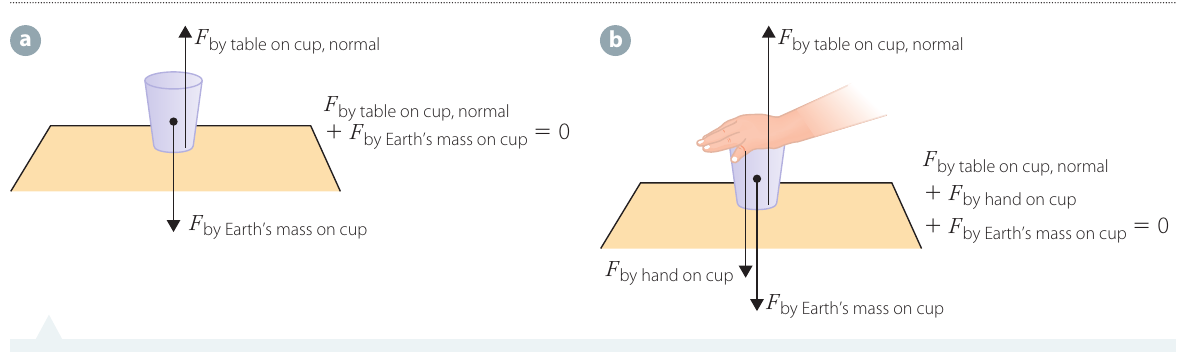
The cup is stationary, so the forces acting on it must balance:
This can also be written as:
The two forces involved are:
- Normal force (upward, from table on cup) - a contact force
- Gravitational force (downward, from Earth on cup) - a field force
These forces have equal magnitudes but point in opposite directions.
Important distinction: not Newton's third law pairs
Important
Although these forces are equal and opposite, they are not a Newton's third law force pair. We can tell because:
- Both forces act on the same object (the cup) - Newton's third law pairs act on different objects
- The forces are of different types - one is gravitational (field force), the other is a contact force
This is a common mistake to avoid!
What happens when you push on the cup?
When you push down on the cup with your hand, the total downward force increases. Now three forces act on the cup:
Rearranging:
Note
The normal force from the table increases to balance both the gravitational force and the additional push from your hand. The cup remains in equilibrium because the forces still sum to zero.
Equilibrium in two dimensions
When an object moves at constant velocity, it is also in equilibrium. Let's consider a person dragging a rock at constant speed along the ground.
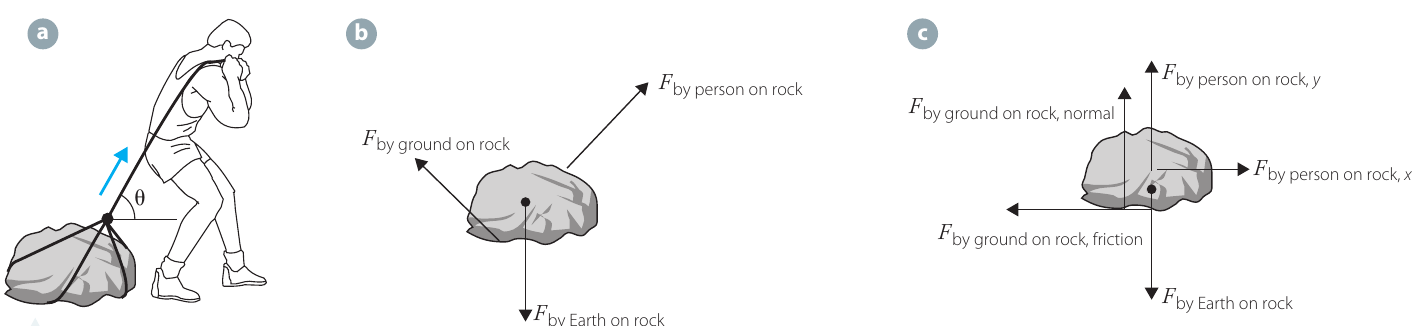
The rock experiences forces in both horizontal and vertical directions. For the net force to be zero, we need:
- Horizontal (x) components must sum to zero:
- Vertical (y) components must sum to zero:
Breaking forces into components
Three forces act on the rock:
- Gravitational force (from Earth) - acts vertically downward
- Normal force (from ground) - acts vertically upward
- Friction force (from ground) - acts horizontally, opposing motion
Note
The person applies a force at an angle to the horizontal, which must be broken into horizontal and vertical components using trigonometry:
- Horizontal component:
- Vertical component:
Equilibrium equations in 2D
Horizontal direction:
Vertical direction:
Worked example: forces on a car
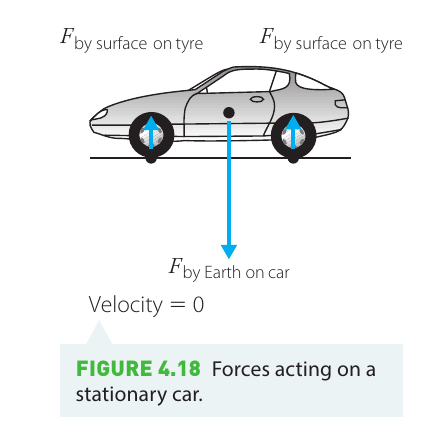
Part 1: Stationary car
When a car is parked (stationary), the forces acting are:
- Normal force from ground on each tyre (upward)
- Gravitational force from Earth on car (downward)
Example
Worked Example: Forces on a Stationary Car
The contact forces (normal forces on tyres) must sum to equal the gravitational force for equilibrium. Since velocity is zero, there is no friction force needed to maintain this state.
Part 2: Car moving at constant velocity
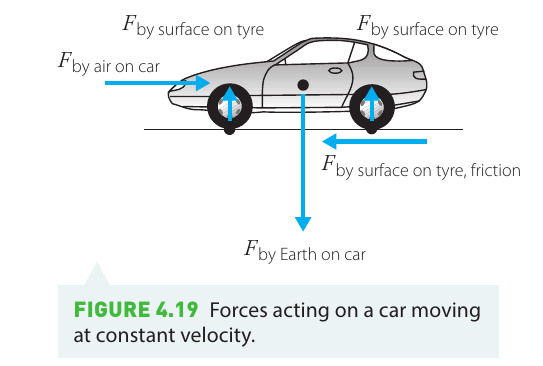
When a car moves at constant velocity (e.g., ), additional horizontal forces appear:
- Friction force from road surface (forward) - this drives the car forward
- Air resistance (backward) - opposes motion
Important
Key insight: A car moves forward because it pushes backward against the road. By Newton's third law, the road pushes forward on the car. This forward push is the friction force from the road on the tyres.
At constant velocity (equilibrium):
- Vertical: Normal forces = Gravitational force
- Horizontal: Friction force = Air resistance
The air resistance increases with speed. At equilibrium, the friction force from the road exactly balances the air resistance.
Worked example: calculating contact forces
Problem: Rob drags a rock with mass through his garden. He exerts a force of at an angle of to the horizontal. The rock moves at constant speed. Calculate the magnitudes of the friction force and normal force from the ground on the rock.
Example
Worked Example: Calculating Forces on a Dragged Rock
Step 1: Identify the data
- Constant speed means (equilibrium)
Step 2: Horizontal equilibrium
Rearranging:
The friction force is 120 N in the direction opposite to motion.
Step 3: Vertical equilibrium
Rearranging:
First, calculate the gravitational force:
Now substitute:
Rounding to two significant figures:
Answer:
- Friction force: 120 N (opposing motion)
- Normal force: 530 N (upward)
Static equilibrium
Static equilibrium is a special case of equilibrium where the object is both:
- In equilibrium (net force is zero)
- At rest (not moving)
This is distinguished from equilibrium of a moving object, which has constant velocity but is not stationary.
Investigation 4.1: Verifying zero net force
Aim: To demonstrate that the net force on a stationary, non-accelerating object is zero (within experimental uncertainty).
Hypothesis: The net force on a stationary ring is zero.
Materials:
- Wooden board
- 3 nails
- Hammer
- String
- Protractor
- 3 spring balances
- Small rigid ring
- Paper
- Pencil
- Tape
- Safety glasses
Important
Risk assessment:
| Risk | Safety measure |
|---|---|
| Spring balances may flick back or flick objects into eyes | Wear safety glasses when working with springs |
Method:
- Tape paper to the middle of the board and place the ring on top.
- Hammer three nails into the board, each near an edge but well separated from each other.
- Hook one spring balance over each nail.
- Use string to tie each spring balance to the ring. Don't tie tight knots yet - you need to adjust the lengths.
- Adjust the string lengths so the ring sits over the paper and each balance reads within its measuring range.
Results:
- Trace the ring's position and the direction of each string on the paper.
- Record the force measured by each balance next to the corresponding string trace.
- Estimate the uncertainty in each spring balance reading (usually smallest division ÷ 2).
- Remove the ring and balances. Draw coordinate axes on the paper with the origin at the ring's position.
- Measure and record the angle of each force (string line) relative to the axes.
Note
You now have a complete force diagram showing three forces acting on the ring.
Analysis:
- Calculate the net force by breaking each force into x and y components:
- (horizontal component)
- (vertical component)
- Sum all x-components and all y-components separately.
- Use Pythagoras' theorem to find the magnitude of the net force:
- Calculate the uncertainty in the net force by considering uncertainties in the individual force measurements and angle measurements.
Discussion:
Was the net force zero within experimental uncertainty? If the net force is not exactly zero, this is expected due to:
- Measurement uncertainties in the spring balances
- Errors in angle measurements
- The ring may not have been perfectly stationary
- Friction in the spring balance mechanisms
Conclusion:
Based on the data analysis, state whether your hypothesis was supported. A typical conclusion would note that the net force was zero (or very close to zero) within the experimental uncertainty, supporting the principle that objects in static equilibrium experience zero net force.
Remember!
Summary
Key Points to Remember:
-
Equilibrium occurs when the net force on an object equals zero, resulting in zero acceleration.
-
Objects in equilibrium can be either at rest (static equilibrium) or moving at constant velocity - both have zero acceleration.
-
For one-dimensional equilibrium, forces in a single direction must balance (e.g., normal force equals gravitational force for a cup on a table).
-
For two-dimensional equilibrium, force components in both horizontal (x) and vertical (y) directions must sum to zero separately.
-
To analyze forces at angles, use trigonometry: horizontal component = , vertical component = .
-
Forces that are equal and opposite but act on the same object are not Newton's third law pairs - third law pairs act on different objects.