Momentum, Energy, and Simple Systems (HSC SSCE Physics): Revision Notes
📚Revision Notes
Momentum and Energy in Inelastic Collisions
Conservation principles in collisions
Momentum is conserved in all interactions, including all collisions. Energy is also a conserved quantity, so energy is conserved in all interactions. However, unlike momentum, energy can change forms. In most collisions, some kinetic energy is transformed into other forms including internal energy and sound.
Note
While both momentum and energy are conserved quantities, their behavior in collisions differs significantly. Momentum always remains as momentum in the system, but energy can transform between different forms such as kinetic energy, thermal energy, sound, and potential energy stored in deformation.
Elastic collisions review
In a perfectly elastic collision, the total kinetic energy of the objects is the same before and after the collision. In reality, perfectly elastic collisions only happen when the collision is due to a field force and the objects don't actually come into contact, such as in interactions of subatomic particles. The elastic collision model is useful for collisions where friction forces are small.
Inelastic collisions
Most real collisions are inelastic collisions. Inelastic collisions involve a loss of kinetic energy of the colliding objects. If sound or heat is produced, that energy must have come from somewhere - the decrease in the objects' kinetic energy. Energy can also be converted to potential energy in a collision, for example, due to deformation of the objects.
Note
Key Characteristics of Inelastic Collisions
The defining features that distinguish inelastic collisions are:
- Momentum is conserved
- Total energy is conserved, but kinetic energy is not
- Some kinetic energy is transformed into other forms (heat, sound, deformation)
- The colliding objects may separate after collision
Perfectly inelastic collisions
A perfectly inelastic collision is when the colliding objects stick together after the collision to form a single object. This represents the maximum possible loss of kinetic energy while still conserving momentum.
Common examples of perfectly inelastic collisions include:
- Vehicle collisions where the vehicles become entangled
- Meteorite impacts with Earth
- A person catching a ball
- A neutron being captured by a nucleus
Worked example: Car-truck collision
Consider a collision between a kg car moving to the right at m s and a kg truck moving to the left at m s. The vehicles collide and stick together.
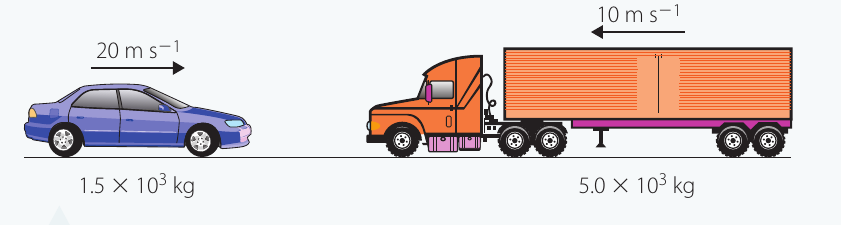
Example
Worked Example: Finding the velocity after collision
Given information:
- kg, m s
- kg, m s
- After collision: combined mass kg
Solution:
Using conservation of momentum:
Rearranging for the final velocity:
Result: The negative sign indicates the combined wreckage moves to the left.
Example
Worked Example: Calculating energy loss
To find the fractional change in kinetic energy:
Before the collision:
After the collision:
Fractional change:
Result: Therefore, 94% of the kinetic energy was transformed to other forms (heat, sound, deformation).
Important
Important Note About Approximations
The calculation asks about "immediately after" the collision because the car and truck cannot be modelled as an isolated system for long. The road exerts significant forces on them, particularly after the collision, changing the momentum of the system.
However, during the very small time that the collision is actually taking place, the forces that the car and truck exert on each other are much greater than the forces due to anything else. Hence, just for those moments, we can reasonably make the approximation that the only significant interactions are between the car and truck.
Vehicle collisions typically show very large fractional energy losses. This is because initial speeds can be quite high but the final speed is typically much lower. Vehicle collisions are always inelastic, and sometimes perfectly inelastic.
Worked example: Neutron collision in nuclear reactor
Subatomic particles can have both perfectly elastic and perfectly inelastic collisions. For example, a neutron can be captured by a nucleus in a perfectly inelastic collision, or be scattered in an elastic collision.
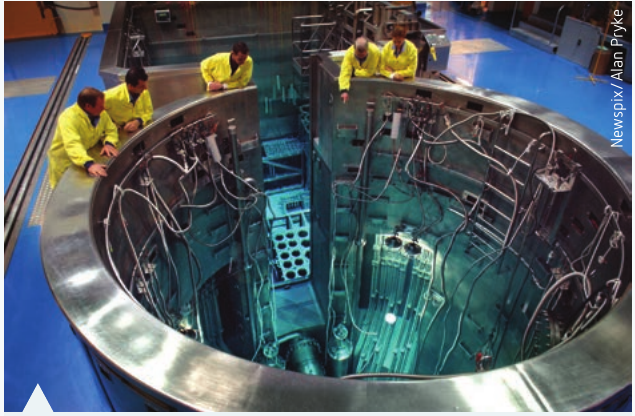
Consider a neutron in the OPAL (Open Pool Australian Light water) reactor in Sydney. The neutron is emitted with a speed of m s and collides with a hydrogen nucleus (proton) in the water, which is initially at rest.
Example
Scenario 1: Perfectly elastic collision
Given:
- m s,
- kg (approximation)
For elastic collisions, we use two equations:
Conservation of momentum:
Elastic collision relation:
Simplifying for equal masses and :
From momentum: , so
From elastic relation: , so
Substituting:
Therefore:
And: m s
Result: In a perfectly elastic collision between equal masses where one is initially at rest, the velocities are exchanged. The neutron stops, and the proton moves off with the neutron's initial velocity.
Example
Scenario 2: Perfectly inelastic collision
In this case, the neutron is captured and forms a deuterium nucleus.
Using conservation of momentum:
Result: The deuterium nucleus moves off at half the speed of the original neutron.
Investigation: Comparing elastic and inelastic collisions
This investigation compares the collisions of different balls with Earth to identify which are closest to elastic or perfectly inelastic behaviour.
Aim
To compare the collisions of different balls with Earth and identify which are closest to elastic or perfectly inelastic.
Materials
- Tape measure or metre ruler
- Several different types of ball of approximately the same size (including super-ball and plasticine or blu-tack ball)
- Scales
- Webcam or video camera
Method
- Attach the ruler or tape measure to the wall with zero at the floor
- Set up the camera so it has a clear view of the ruler and you can read the scale on the recording
- Weigh each ball and record its mass
- Start recording
- Hold a ball just in front of the 1 m mark on the ruler. Drop the ball (don't throw it)
- View the recording and note the maximum height to which the ball bounced. Estimate the uncertainty
- Repeat for each remaining ball
Data collection
Record measurements in a table with columns for:
- Ball type
- Mass (kg)
- Maximum bounce height (m)
- Fractional kinetic energy change
- Momentum before collision (kg m s)
- Momentum after collision (kg m s)
- Change in momentum (kg m s)
Analysis
Note
Key Assumptions:
- The loss of energy due to air resistance is small compared with the loss due to friction forces during the collision
- All balls are dropped from the same height (1 m)
Calculating fractional energy loss:
Using energy conservation, the kinetic energy just before collision equals the gravitational potential energy at the drop height. Similarly, kinetic energy just after collision equals the potential energy at maximum bounce height.
Calculating momentum:
Momentum before collision: (downward)
Momentum after collision: (upward)
Since momentum is a vector, the change in momentum accounts for the direction change.
Discussion points
- Most elastic: The ball with the smallest fractional energy loss (highest bounce) is closest to elastic
- Most inelastic: The ball with the largest fractional energy loss (lowest or no bounce) is closest to perfectly inelastic
- Conservation: While momentum of the ball changes (due to Earth's force), the total momentum of the ball-Earth system is conserved. Energy is conserved overall, with kinetic energy transforming to heat, sound, and deformation
Important
Understanding System Boundaries
While the momentum of the ball alone changes during the collision, this doesn't violate conservation of momentum. The ball-Earth system as a whole conserves momentum - the Earth gains an equal and opposite momentum change, though this is imperceptible due to Earth's enormous mass.
Summary
Key Points to Remember:
- Momentum is conserved in all collisions, including both elastic and inelastic collisions
- Most real collisions are inelastic, involving a loss of kinetic energy which is transformed into other forms (heat, sound, deformation)
- In perfectly inelastic collisions, the objects stick together after collision, representing the maximum possible loss of kinetic energy
- Energy is always conserved overall, but kinetic energy can transform into other forms during collisions
- When solving collision problems, use conservation of momentum as your primary tool, then calculate energy changes to determine the type of collision