Impulse (HSC SSCE Physics): Revision Notes
📚Revision Notes
Impulse
Understanding impulse
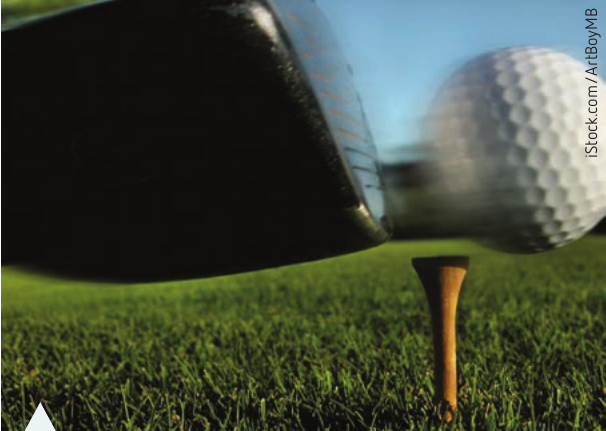
When a golf club strikes a ball, the ball gains kinetic energy and begins moving. This energy transfer happens because the club applies a force over a period of time. While we previously examined force acting through a distance (work), we now consider force acting over time, which leads us to the concept of impulse.
Note
Connecting Concepts: Just as work relates force and distance (W = Fd), impulse relates force and time. Both concepts describe how forces change an object's state—work changes energy, while impulse changes momentum.
Starting with Newton's second law expressed in terms of momentum:
We can rearrange this equation to determine the change in momentum when a force acts on an object:
This quantity—the change in momentum produced by a force acting over time—is called impulse, represented by the symbol .
Impulse is a vector quantity (it has both magnitude and direction) and uses the same units as momentum: kg m s⁻¹ or N s.
Finding impulse from force-time graphs
Just as we can determine work from the area under a force-distance graph, we can find impulse from the area under a force-time graph.
Constant force
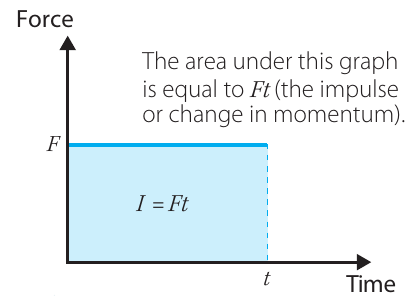
When a constant force acts in the direction of motion for a specific time interval, the force-time graph is a horizontal straight line. The impulse equals the rectangular area beneath this line: .
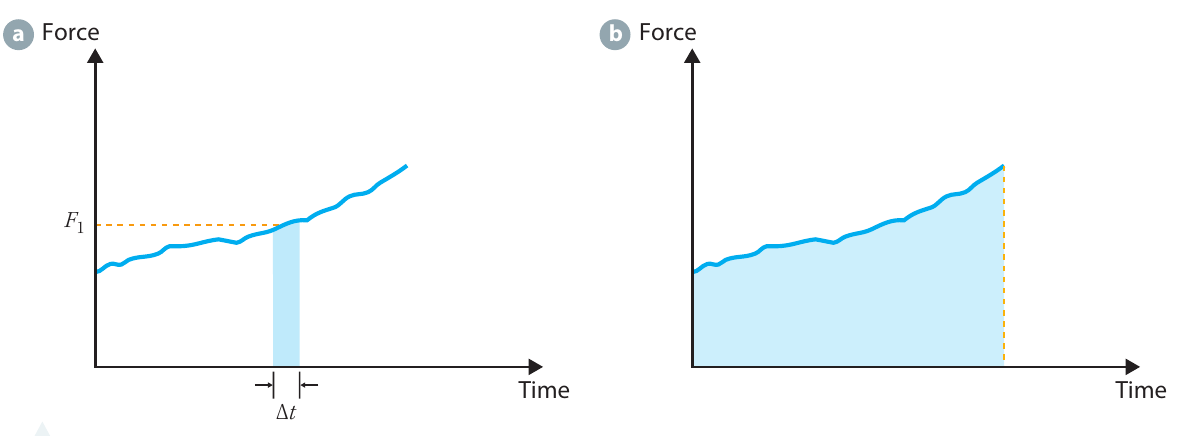
When the force changes with time, we divide the area under the curve into small sections. Each narrow section can be approximated as a small rectangle with area . By summing all these small areas, we obtain the total impulse—the total area under the curve.
Note
Historical Note: This process of breaking an area into infinitesimally small sections and summing them is the foundation of integration in calculus. Newton developed this mathematical technique specifically to solve physics problems like these.
Worked example: Golf ball collision
Example
Worked Example: Calculating Impulse from a Force-Time Graph
Let's calculate the impulse transferred to a golf ball when struck with a long follow-through. The force-time relationship is shown in the graph below.
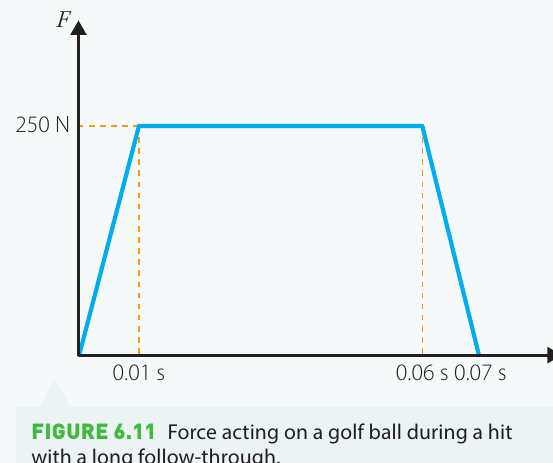
To solve this, we break the area under the curve into three distinct sections: two triangles (A and C) and one rectangle (B).
Given information:
- Maximum force: N
- Time intervals: s, s, s
Calculating each section:
For section A (triangle):
For section B (rectangle):
For section C (triangle):
Total impulse:
Answer: The impulse transferred to the golf ball is 15 kg m s⁻¹ (or 15 N s).
Key Insight: The rectangular section (B) represents the follow-through period when the club maintains contact with the ball. This extended contact time significantly increases the total impulse, resulting in a faster ball speed.
Worked example: Minimum acceleration time
Example
Worked Example: Finding Minimum Time Using Impulse
Consider a car with mass 1950 kg where the coefficient of static friction between the tyres and road is 0.75. What is the minimum time required to accelerate from rest to 100 km h⁻¹, assuming the limiting factor is tyre friction?
Given information:
- Mass: kg
- Coefficient of static friction:
- Initial velocity: km h⁻¹ = 0 m s⁻¹
- Final velocity: km h⁻¹ = m s⁻¹
Solution:
Starting with the impulse equation:
Rearranging for time:
The maximum friction force provides the net force:
Therefore:
The change in momentum (with ):
Substituting:
Answer: The minimum acceleration time is 3.8 seconds.
Key Insight: This represents the theoretical minimum assuming maximum friction force is available throughout acceleration. In practice, engine power limitations result in longer acceleration times.
Impulse and collision safety
Important
Critical Relationship: The impulse equation reveals an important principle for safety: for a given change in momentum, increasing the collision time decreases the force experienced. This fundamental relationship underlies all modern vehicle safety features.
Road safety improvements
Note
Success Story: Between 1980 and 2016, road fatalities in Australia decreased dramatically:
- 1980: 3403 deaths (43 per 100,000 vehicles)
- 2016: 1298 deaths (4.5 per 100,000 vehicles)
This nearly tenfold improvement per vehicle resulted from multiple factors, including reduced speed limits, decreased drink-driving, and significantly improved car safety design.
Seatbelts
According to Newton's first law, vehicle occupants continue moving at the original velocity unless a force acts on them. During a collision, unrestrained passengers may be thrown through the windscreen or collide with the vehicle interior or other occupants.
Seatbelts provide the necessary force to decelerate occupants along with the vehicle. They apply this force across the strongest body regions (chest and hips) and are designed to stretch slightly, which extends the deceleration time and reduces the maximum force experienced. The three-point seatbelt, invented by Volvo engineers in 1959, is now standard in all vehicles.
Crumple zones
Crumple zones are specially designed vehicle sections surrounding the passenger compartment that deliberately deform during collisions.
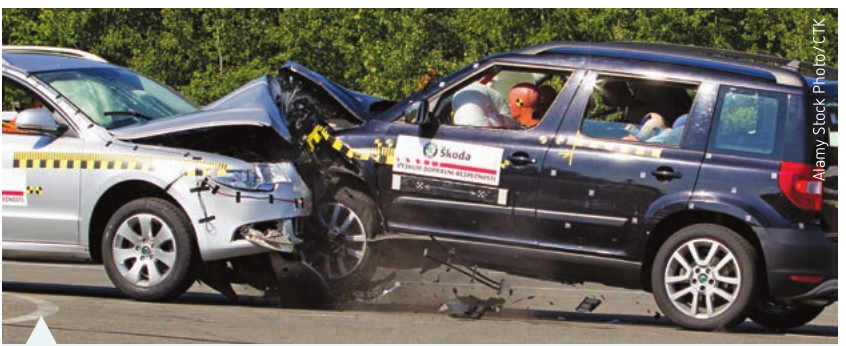
Since the impulse (change in momentum) during a crash is fixed, the relationship shows that increasing collision time decreases the force on occupants. By allowing the vehicle front to crumple, the collision duration increases, substantially reducing forces transmitted to passengers.
Airbags
Supplemental restraint systems (airbags), introduced in the 1980s, serve two purposes:
- Increasing the time over which occupants decelerate
- Distributing the force more evenly across the body
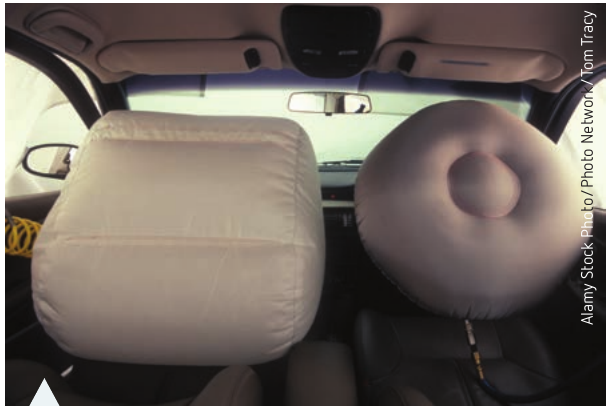
Front airbags reduce peak forces during frontal collisions, while later developments (side and curtain airbags) protect against lateral impacts. In all cases, the extended deceleration time reduces the maximum force experienced by any body part.
Worked example: Force in a car crash
Example
Worked Example: Calculating Forces in a Collision
A 60 kg person in a car travelling at 90 km h⁻¹ collides with a rock wall. The car stops in 0.08 seconds. Assuming constant deceleration and that the person doesn't move relative to the vehicle, calculate the force experienced.
Given information:
- Mass: kg
- Initial velocity: km h⁻¹ = m s⁻¹
- Final velocity: m s⁻¹
- Time interval: s
Solution:
From the impulse equation:
Rearranging for force:
The change in momentum (with ):
Substituting:
Answer: The net force is −19 kN (magnitude of 19 kN).
Key Insights:
- The negative sign indicates the force opposes the motion direction
- This force magnitude is more than 30 times the person's weight!
- If a crumple zone increased the collision time to 0.2 seconds, the force would decrease to approximately 7.5 kN—still substantial, but significantly reduced
Investigation: Crash safety
This investigation applies impulse concepts to design a protective capsule for an egg drop experiment.
Aim
To design, construct, and test an egg capsule that protects an egg during collision with the ground after being dropped.
Materials
- Eggs (raw or boiled—check with your teacher)
- Construction materials (foam, plastic containers, tape, string, balloons, etc.)
- Manufacturing tools
- Tape measure
Risk assessment
Important
Safety First: Identify risks specific to your investigation and develop appropriate management strategies. Consider:
- Potential mess from broken eggs
- Sharp tools during construction
- Working at height during drop tests
Method
- Research modern vehicle safety features and bicycle helmet designs
- Design your egg capsule with these requirements:
- Must be reusable (egg removable without destroying capsule)
- No parachutes permitted
- Create a design summary document that:
- Explains each feature's purpose
- Describes expected protective contributions
- References impulse and force concepts
- Includes detailed diagrams
- Construct your egg capsule
- Test sequence:
- Place egg in capsule
- Drop from 30 cm height
- Remove egg and inspect for cracks
- If intact, replace egg and drop from 10 cm higher
- Repeat until egg cracks
- Record the maximum successful drop height
Results
Document the drop height at which your egg cracked.
Analysis
- Compare your results with other students' designs
- Identify features common to the most successful capsules
- Determine what the least successful designs lacked
- Develop recommendations for improved egg capsule design
Conclusion
Write a conclusion referencing your data and analysis, addressing the investigation aim. Explain how your design applied impulse concepts to protect the egg.
Summary
Key Points to Remember:
- Impulse is the change in momentum when a force acts on an object:
- Impulse is a vector measured in kg m s⁻¹ (or N s)—the same units as momentum
- On force-time graphs, impulse equals the area under the curve
- For a fixed force, longer application time produces greater momentum change
- For a fixed momentum change, longer collision time results in smaller forces
- Vehicle safety features (seatbelts, crumple zones, airbags) work by increasing collision time, thereby reducing the forces experienced by occupants