Momentum (HSC SSCE Physics): Revision Notes
📚Revision Notes
Momentum
What is momentum?
Momentum is a fundamental concept in physics that helps us understand how objects move and interact with each other. Think about the difference between being hit by a tennis ball and being hit by a watermelon, both moving at the same speed. The watermelon would have a much greater effect, even though both are moving at the same velocity. This difference can be explained using momentum.
Note
Real-World Analogy:
The tennis ball versus watermelon example illustrates why momentum depends on both mass and velocity. Even at identical speeds, the watermelon's greater mass gives it significantly more momentum, resulting in a much more forceful impact.

Understanding momentum is particularly important when analysing collisions, such as car crashes. During a collision, there are large forces acting on vehicles and passengers, and energy is transformed as the state of motion changes. Momentum helps us predict and understand these interactions.
Definition and formula
Momentum () is defined as the product of an object's mass () and its velocity ():
Key characteristics of momentum:
- Units: kilogram metres per second ()
- Type: Vector quantity (has both magnitude and direction)
- Direction: Same direction as the object's velocity
Important
Because momentum is a vector, we must consider its direction when performing calculations. An object moving north has different momentum from the same object moving south at the same speed.
Calculating momentum
Let's look at a practical example of calculating momentum.
Example
Worked Example: Momentum of a tomato
During a food fight, a child is hit by a tomato travelling at . What is the magnitude of the momentum of the tomato?
Solution:
| Answer | Logic |
|---|---|
| ; | Identify the relevant data |
| Convert to SI units (grams to kilograms) | |
| Use the momentum formula | |
| Substitute the known values | |
| Calculate the final answer |
The momentum of the tomato is 1.5 kg·m·s⁻¹.
Important
Exam tip: Always convert masses to kilograms before calculating momentum. This is a common source of errors in exams.
Momentum and Newton's laws
Sir Isaac Newton originally formulated his second law using the concept of momentum rather than acceleration. This connection is important for understanding how forces relate to changes in motion.
Newton's second law in terms of momentum
Newton's second law can be written as:
This tells us that the net force acting on an object equals the rate of change of its momentum.
Note
We can show this is equivalent to the more familiar form (). If we substitute the definition of momentum and assume mass is constant:
Connection to Newton's third law
Newton's third law states that forces come in equal and opposite pairs: .
Using the momentum form of Newton's second law:
This leads to an important result:
Note
Key Connection to Conservation:
In any interaction between two objects, the change in momentum of one object is equal in magnitude but opposite in direction to the change in momentum of the other object. This is essentially a statement of conservation of momentum.
The law of conservation of momentum
For any conserved quantity, the total amount of that quantity in the universe, or in any isolated system, remains constant. Momentum is one such conserved quantity.
Important
The law of conservation of momentum states:
The sum of the momentum of all objects in an isolated system remains constant.
Mathematically:
or equivalently:
Important considerations when applying conservation of momentum:
- Vector nature: Momentum is a vector, so we must add momenta using vector addition
- Sign convention: In one dimension, define positive and negative directions carefully
- Components: In two dimensions, use vector decomposition and add components separately
- Isolated system: The law applies to systems with no external forces
Example
Worked Example: Falling textbook and Earth
A maths textbook falls through a height of when dropped from a window. The book falls due to its interaction with Earth through Earth's gravitational field. Assume the book starts at rest and ignore air resistance.
Part 1: What is the change in momentum of the book due to the fall?
| Answer | Logic |
|---|---|
| ; ; ; | Identify relevant data |
| Use conservation of energy | |
| Expand (noting ) | |
| Rearrange for | |
| Expression for momentum change | |
| Substitute values | |
| Calculate | |
| Final answer with correct significant figures |
Part 2: What is the change in momentum of Earth?
Momentum is conserved in any interaction:
Therefore: Δp_Earth = -9.4 kg·m·s⁻¹
Part 3: What is the change in speed of Earth?
| Answer | Logic |
|---|---|
| Relate momentum to velocity | |
| Rearrange | |
| Look up Earth's mass | |
| Substitute values | |
| Calculate | |
| Final answer |
The negative sign indicates that Earth's velocity change is opposite to that of the book. This value is so incredibly small that we cannot observe changes in Earth's velocity due to its interactions with everyday objects.
Conservation of momentum in one dimension
When applying conservation of momentum in one dimension, we must be careful with signs. Define a positive direction (e.g., to the right, upward, north) and ensure all velocity and momentum values have the correct sign.
Investigation 6.1: Conservation of momentum in one dimension
Aim: To verify conservation of momentum in one-dimensional collisions.
Materials:
- 2 dynamics trolley cars
- Weighing scale
- Motion-sensor and data-logger
- Spring with loops at each end
- String
- Scissors
Risk assessment:
| What are the risks? | How to stay safe |
|---|---|
| The spring may flick back or flick an object into a person's eye | Wear safety glasses when working with springs |
Method:
- Weigh the two dynamics trolley cars
- Tie the trolleys together using string with a compressed spring between them (see Figure 6.2)
- Position motion-sensors so you can measure the velocity of each car
- With the cars at rest, cut the string holding them together
- Measure and record the velocities of each trolley after cutting the string
- Repeat at least three times using the same spring compression each time
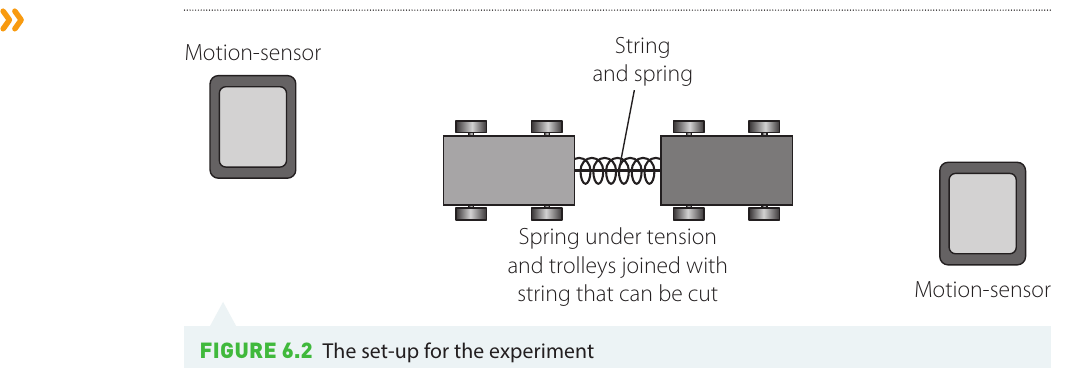
Results:
Record the mass of each car and your measured velocities in a table:
| of Car A () | of Car A () | of Car B () | of Car B () | of system () | |
|---|---|---|---|---|---|
| Trial 1 | |||||
| Trial 2 | |||||
| ... | |||||
| Average |
Analysis:
- Calculate the momentum of each trolley car after the string is cut for each trial
- Define positive and negative directions clearly
- Since the cars started at rest (initial momentum = zero), find the change in momentum of the system
- Calculate average values and uncertainties
Note
Expected Results:
The results should show that the total change in momentum of the system is zero (within experimental uncertainty), confirming conservation of momentum. Any deviations can be attributed to friction, air resistance, or variations in initial conditions.
Conservation of momentum in two dimensions
When dealing with collisions in two dimensions, we apply conservation of momentum separately in each direction:
Note
This approach uses vector decomposition: we break each momentum vector into its and components, apply conservation in each direction separately, then combine the results to find the final velocity vector.
Example
Worked Example: Pool ball collision
In a game of pool, the cue ball moves with initial velocity N30°W and hits a stationary red ball. The red ball moves off with speed N45°W. Calculate the speed and direction of the cue ball's recoil. The balls have the same mass.
Given information:
- (same mass)
- Before collision: N30°W;
- After collision: N45°W;
Step 1: Apply conservation in the x-direction
Since and :
Taking west as negative -direction:
Step 2: Apply conservation in the y-direction
Taking north as positive -direction:
Step 3: Calculate magnitude and direction
For direction:
Final answer: v_c = 0.87 m·s⁻¹, N18°E
Important
Exam tip: Always draw a clear diagram showing the velocity components before and after the collision. This helps prevent sign errors.
Investigation 6.2: Collisions in two dimensions
Aim: To describe and analyse interactions in two dimensions using video analysis.
Materials:
- 2 billiard balls of different colours
- Large sheet of paper (butcher's paper) with grid
- Tape, pencil
- Webcam with stand (or phone with selfie-stick)
- Stopwatch
- Weighing scale
Risk assessment:
| What are the risks? | How to stay safe |
|---|---|
| Billiard balls can hurt your foot if they fall on it | Wear enclosed shoes |
Method:
- Weigh the two billiard balls
- Draw a grid on the paper with lines spaced apart
- Tape the paper to the bench and mark a starting position for the first ball
- Place the stopwatch face-up on the paper
- Mount the camera looking down at the paper to capture the whole area
- Place the first ball on the mark
- Start the stopwatch and camera recording
- Gently roll the second ball towards the first to create a collision
- Repeat several times
Analysis:
- Select frames before the collision to find the initial velocity of the incoming ball
- Use the grid to measure displacement ( and )
- Use the stopwatch reading to find time intervals ()
- Calculate velocities: and
- Calculate momenta: and
- Verify that and
Note
Key Finding:
This investigation confirms that momentum is conserved in each direction independently during two-dimensional collisions.
Summary
Key Points to Remember:
- Momentum is the product of mass and velocity:
- Momentum is a vector quantity with units of
- Conservation of momentum: In any isolated system, total momentum remains constant ()
- Newton's third law is a statement of conservation of momentum: in any interaction,
- In two dimensions, apply conservation separately in and directions using vector components