The Electrostatic Force and the Electric Field (HSC SSCE Physics): Revision Notes
📚Revision Notes
The Electrostatic Force and the Electric Field
Introduction
So far we have represented electric fields using field line diagrams. These provide helpful visual models for understanding electric fields. Now we develop a mathematical model that allows us to calculate and quantify electric field strength precisely.
Note
This section transitions from qualitative field line representations to quantitative mathematical analysis. The equations we develop will allow you to calculate exact field strengths and forces, rather than just visualizing their patterns.
Electric field, force and charge
Defining the electric field mathematically
We define the electric field as the force experienced by each unit of positive charge placed at that point in space. Mathematically, the electric field is given by:
where:
- is the force (a vector)
- is the electric field (also a vector)
- is the amount of positive charge on a small test charge
Both force and field are vector quantities, meaning they have both magnitude and direction.
Important
Key Definition: Electric Field
The electric field represents the force per unit charge at any point in space. This definition is fundamental to all calculations involving electric fields.
Remember: Both and are vectors with magnitude and direction.
The coulomb: measuring charge
Charge is measured in units called coulombs (symbol: C), named after French physicist Charles-Augustin de Coulomb. Unlike units such as metres or kilograms, the coulomb represents a fundamental property of matter that cannot be broken down into combinations of length, mass, and time.
Individual particles carry very small charges when measured in coulombs:
- An electron has charge C
- A proton has charge C
All stable particles have charges that are whole-number multiples of this value, called the elementary charge:
Note
When describing ions, the charge notation refers to multiples of . For example, a Ca²⁺ ion has charge C.
Units of electric field
From the definition , we can determine the units of electric field:
- Force has units of newtons (N)
- Charge has units of coulombs (C)
- Therefore, electric field has units of newtons per coulomb (N C⁻¹)
Examples of electric field strengths
The table below shows typical electric field strengths from various sources:
| Electric field source | Approximate field strength (N C⁻¹) |
|---|---|
| Hairdryer at 20 cm distance | 4 |
| Earth's fair weather field | 100 (downwards) |
| Earth's wet weather field | 200-300 (upwards) |
| Thunderstorms | 1000-10,000 or more (momentary spikes) |
| High voltage overhead power lines at 30 m | 10-1000 |
| Old electric blanket at 10 cm | 2000 |
Note
Notice the enormous range of field strengths - from just a few N C⁻¹ near household appliances to tens of thousands during thunderstorms. This demonstrates how electric fields vary dramatically depending on the source and conditions.
Force on a charged particle
When a charged particle is placed in an electric field, it experiences a force. This force is proportional to both the field strength and the charge on the particle. Rearranging our definition of field gives us the force:
Example
Worked Example 12.4: Force on an electron in a wire
A battery connected across copper wire creates an electric field of N C⁻¹ in the wire. Calculate the force on an electron in this wire.
Solution:
Given:
- N C⁻¹
- C
Using the formula :
The negative sign indicates that the force acts in the direction opposite to the electric field.
Acceleration in an electric field
To understand how a charged particle moves in an electric field, we apply Newton's second law:
Combining this with our electric field definition:
This powerful equation shows that acceleration depends on the charge-to-mass ratio of the particle.
Example
Worked Example 12.5: Acceleration of an electron
What is the acceleration of the electron in the N C⁻¹ field from the previous example? The mass of an electron is kg.
Solution:
Given:
- N C⁻¹
- C
- kg
Using the formula :
The negative sign tells us that the acceleration is in the direction opposite to the field. This is an enormous acceleration - over 50 billion times greater than Earth's gravitational acceleration!
The field due to a charged particle
Point charges and spherical symmetry
Any very small (point-like) charged object creates an electric field that looks the same in all directions - we say it has spherical symmetry. For this to occur, field lines must spread out evenly in all directions around the charge. Particles such as protons and electrons are examples of point charges.
From experimental observations, we know that:
- Larger charges create stronger fields (field is proportional to charge)
- Fields become weaker at greater distances from the charge
- The field has spherical symmetry (no preferred direction)
The inverse square law
We can use field line diagrams to determine exactly how field strength varies with distance. When you draw concentric circles around a point charge, the same number of field lines crosses each circle. However, the density of lines decreases as the circles get larger.
In three dimensions, imagine concentric spheres around a point charge. The number of field lines crossing each sphere is constant, but the surface area increases with the square of the radius:
Therefore:
where is the number of field lines.
Since field strength is proportional to field line density, we conclude that field strength decreases with distance squared:
This relationship is called the inverse square law and applies to all point sources, including gravitational fields and light intensity.
Important
The Inverse Square Law
The electric field strength from a point charge follows an inverse square relationship with distance. This means:
- Doubling the distance reduces the field to one-quarter of its original strength
- Tripling the distance reduces the field to one-ninth
- This pattern arises from the geometry of spreading field lines over the surface of expanding spheres
This is a fundamental property of all point sources in three-dimensional space.
The permittivity of free space
To convert our proportionality into an equation, we need a constant of proportionality. This constant is written as , where is called the permittivity of free space. This fundamental physical constant tells us how electric fields behave in a vacuum and ensures our equation has the correct units.
The value of is:
Therefore:
Electric field equation for a point charge
We can now write the complete equation for the electric field due to a point charge:
where:
- is the electric field strength (N C⁻¹)
- is the charge creating the field (C)
- is the distance from the charge (m)
- is the permittivity of free space
Important
Point Charge Field Equation
This equation applies to any charged spherical object, provided the distance is greater than the radius of the object itself. For distances smaller than the object's radius, you would be inside the charge distribution and this equation no longer applies.
Example
Worked Example 12.6: Electric field in a hydrogen atom
Calculate the electric field due to a proton at a distance of m. This is the average orbital radius of an electron in a hydrogen atom. Since this distance is about 10,000 times larger than the proton's size (approximately m), we can treat the proton as a point charge.
Solution:
Given:
- C
- m
Using the formula :
This is an extremely strong field at the atomic scale!
Visualising electric field variation with distance
The graphs below show how electric field strength varies with distance for both positive and negative point charges:

Note
Understanding the Graphs
-
For a positive charge (graph a): The field is positive (pointing away from the charge) and approaches infinity very close to the charge, then decreases following the inverse square law.
-
For a negative charge (graph b): The field is negative (pointing toward the charge) and approaches negative infinity very close to the charge, then increases (becomes less negative) following the same inverse square relationship.
Both graphs demonstrate the dependence - notice how the curves drop off rapidly near the charge and flatten out at larger distances.
Coulomb's law
Force between two point charges
Now that we can calculate the electric field due to a point charge, we can determine the force that one point charge exerts on another.
Starting with the definition of electric field:
The force exerted by the field is:
For a point charge , the field at distance is:
When we place a second charged particle with charge in this field, it experiences a force:
This relationship is called Coulomb's law. It describes the force that a point charge exerts on a second point charge when they are separated by distance .
Important
Coulomb's Law
The electrostatic force between two point charges is:
This equation gives the magnitude of the force. The direction must be determined separately based on whether the charges attract or repel.
Vector nature of electrostatic forces
Remember that forces are vectors. The form of Coulomb's law given above only calculates the magnitude of the force. The force direction is along the line joining the two charges:
- Like charges (both positive or both negative) repel - forces point away from each other
- Unlike charges (one positive, one negative) attract - forces point toward each other
Note
Always draw a diagram to show force direction clearly. The sign of the product indicates attraction (negative) or repulsion (positive), but you should verify the direction geometrically.
Newton's third law force pairs
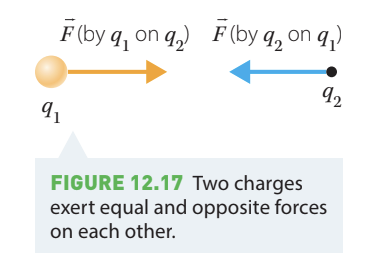
If we calculate the force that charge exerts on charge , we get exactly the same expression. This demonstrates Newton's third law: the forces form an action-reaction pair. They are:
- Equal in magnitude
- Opposite in direction
- The same type of force (electrostatic)
- Acting on different objects
Important
Newton's Third Law and Electric Forces
The electrostatic force between two charges always forms an action-reaction pair. If charge A exerts a force on charge B, then charge B exerts an equal and opposite force on charge A. This is true regardless of:
- Whether the charges are equal or different in magnitude
- Whether the charges attract or repel
- The masses of the charged objects
The forces are always equal in magnitude and opposite in direction.
Example
Worked Example 12.7: Force in a hydrogen atom
Calculate the force exerted by a proton on an electron at a distance of m.
Solution:
Given:
- C
- C
- m
Using Coulomb's law :
The negative sign indicates that the force is attractive (directed toward the proton). We could also have obtained this result by multiplying the electric field from Worked Example 12.6 by the electron's charge.
Remember!
Summary
Key Points to Remember:
-
The electric field is defined mathematically as , representing the force per unit charge at a point in space.
-
Charge is measured in coulombs (C), where the elementary charge C. Electrons have charge and protons have charge .
-
Electric field has units of newtons per coulomb (N C⁻¹). Typical fields range from 4 N C⁻¹ (hairdryer) to over 10,000 N C⁻¹ (thunderstorms).
-
The force on a charged particle in an electric field is , and its acceleration is .
-
Point charges create fields following the inverse square law: , where the permittivity of free space C² N⁻¹ m⁻².
-
Coulomb's law gives the force between two point charges: . These forces form Newton's third law pairs - equal in magnitude but opposite in direction.