Charged Particles in Uniform Electric Fields (HSC SSCE Physics): Revision Notes
📚Revision Notes
Charged Particles in Uniform Electric Fields
Introduction to electric fields
Electric fields are fundamental to understanding how charged particles interact with their environment. An electric field is a region of space where a charged particle experiences an electrostatic force. Charged objects, such as electrons, protons, or any object carrying a net charge, create these fields around themselves.
The electric field is formally defined as the electrostatic force per unit charge exerted on a small positive test charge:
where is the electric field strength (in or ), is the force (in ), and is the charge (in ).
Note
This definition is analogous to gravitational field strength, which is the gravitational force per unit mass. Just as all objects with mass experience gravitational forces, all objects with charge experience electrostatic forces when placed in an electric field.
Earth's electric field
Earth possesses its own electric field, which plays a significant role in atmospheric phenomena. This field varies across Earth's surface and changes with weather conditions, but over small distances (a few hundred metres), it can be treated as uniform - meaning constant in both magnitude and direction.
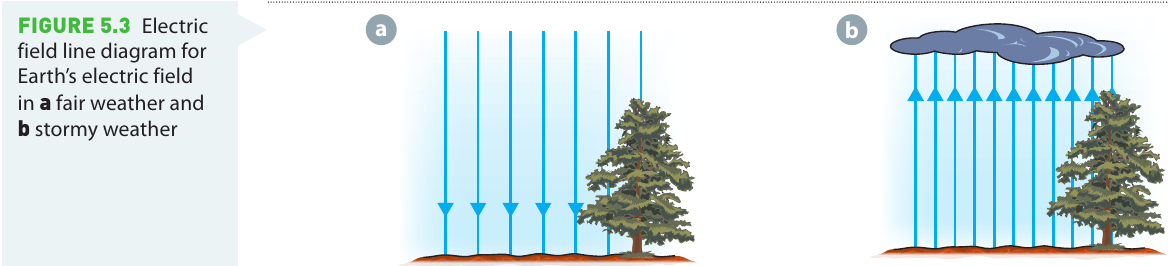
In fair weather conditions, Earth's electric field typically points downward toward the ground and has a magnitude of approximately . During stormy weather, the local electric field can point upward and become much stronger.
Important
The dramatic difference in field strength and direction during storms is what causes lightning strikes when the field becomes strong enough to ionise air particles.
Electric field lines
We can visualise electric fields using electric field lines. These imaginary lines help us understand both the direction and strength of an electric field:
- The direction of field lines indicates the direction of force that would act on a positive charge placed at that point
- The density (closeness) of field lines is proportional to the field strength - closer lines mean a stronger field
Note
For a small charged particle such as an electron, the force due to Earth's electric field is many orders of magnitude greater than the force due to Earth's gravitational field. This demonstrates the relative strength of electromagnetic forces compared to gravitational forces at the particle level.
Creating uniform electric fields with parallel plates
While Earth's natural electric field is useful for understanding field concepts, we can create much stronger and more controllable uniform electric fields in the laboratory using parallel plate capacitors.
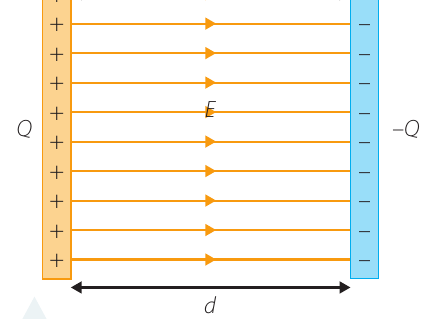
A parallel plate capacitor consists of two flat conducting plates positioned parallel to each other. One plate carries a charge and the other carries an equal but opposite charge . The plates are separated by a distance , and there is a potential difference between them.
Note
Potential difference represents the difference in electric potential between the two plates. Electric potential is the electric potential energy per unit charge at a point in a field, measured in volts (), where:
Calculating electric field strength
The electric field between parallel plates is uniform throughout the region between them (except very close to the edges where edge effects occur). The field strength is related to the potential difference and plate separation by:
where:
- is the electric field strength (in )
- is the potential difference between the plates (in )
- is the separation between the plates (in )
Important
The negative sign in this equation indicates the direction of the field: the electric field always points in the direction of decreasing potential, from the positive plate toward the negative plate.
You may sometimes see this equation written as , but it's important to remember that here represents the change in potential (the potential difference), not the absolute potential at a single point. For an electric field to exist, the potential must be changing with position.
Example
Worked Example: Electric Field Between Parallel Plates
Consider a pair of charged plates at potentials of and , separated by a distance of .
Given information:
Calculation:
The potential difference is:
Using the field equation:
Answer: The electric field has a magnitude of 12 kV·m⁻¹ pointing to the right (from the positive plate toward the negative plate).
Acceleration of charged particles in electric fields
When a charged particle is placed in an electric field, it experiences an electrostatic force. This force causes the particle to accelerate according to Newton's second law of motion.
Force and acceleration relationship
From the definition of electric field, the force on a charged particle is:
Applying Newton's second law () to a charged particle in an electric field:
Rearranging for acceleration:
where:
- is the acceleration (in )
- is the electric field strength (in )
- is the charge of the particle (in )
- is the mass of the particle (in )
Direction of acceleration
Both acceleration () and electric field () are vector quantities, so direction matters:
- When the charge is positive, the acceleration and electric field point in the same direction
- When the charge is negative, the acceleration and electric field point in opposite directions
Note
This means that positive charges accelerate in the direction of the field (toward lower potential), while negative charges accelerate opposite to the field direction (toward higher potential).
Example
Worked Example: Acceleration of an Electron
What is the acceleration of an electron in Earth's fair-weather field of pointing downward?
Given information:
- (negative because downward)
- (electron mass)
- (electron charge)
Calculation:
Converting units (since ):
Answer: The electron accelerates at 1.76 × 10¹³ m·s⁻² pointing upwards. Note that although the field points downward, the electron (being negatively charged) accelerates in the opposite direction.
Work and energy in electric fields
When a charged particle moves through an electric field, the field does work on the particle. This work results in changes to the particle's kinetic energy, following the principle of energy conservation.
Work done by an electric field
Starting from the basic definition of work () and the force on a charged particle (), we can derive:
where is the displacement in the direction of the field.
Since the electric field and potential difference are related by , we can write . Multiplying both sides by gives us an important relationship:
This equation tells us the work done by the electric field when a charged particle moves through a potential difference .
Understanding the negative sign
Important
The negative sign in is crucial and has physical significance:
- When a positive charge moves through a positive potential difference (to higher potential), the field does negative work on it. Either an external force must push it, or it must have initial kinetic energy that decreases.
- When a positive charge moves through a negative potential difference (to lower potential), the field does positive work on it, increasing its kinetic energy.
Important note: You may see the equation written as , but this is incorrect for the work done by the field. The absence of the negative sign and the delta symbol would incorrectly suggest that positive charges attract each other, which is not true.
Energy conservation
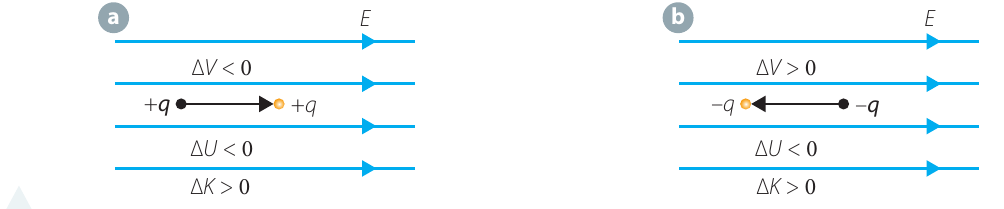
Consider a charged particle moving freely in a uniform electric field (with no external forces acting on it). By the principle of energy conservation, the total energy remains constant:
where is the change in potential energy and is the change in kinetic energy.
This means:
Note
The change in kinetic energy equals the work done by the field:
Behaviour of positive and negative charges
For a positive charge starting from rest:
- It accelerates in the direction of the field lines
- It moves toward lower potential ()
- The potential energy decreases ()
- The kinetic energy increases ()
For a negative charge starting from rest:
- It accelerates opposite to the field lines
- It moves toward higher potential ()
- The potential energy still decreases ()
- The kinetic energy increases ()
Note
In both cases, the particle gains kinetic energy while the particle-field system loses potential energy.
Kinetic energy calculations
Recall that kinetic energy is given by:
If a particle starts from rest (), then:
If the particle has initial kinetic energy, then:
Example
Worked Example: Electron Motion in an Electric Field
An electron enters a region with a uniform electric field of , moving parallel with the field at an initial speed of .
Part (a): How far does the electron travel before coming to a stop?
Given information:
Calculation:
The work done equals the change in kinetic energy:
Since the electron comes to rest:
Therefore:
Solving for distance:
Answer: The electron travels 5.7 × 10⁻⁷ m (or 0.57 μm) before stopping.
Part (b): Through what potential difference has it moved?
Calculation:
Using , we can rearrange for :
Answer: The electron moves through a potential difference of -8.6 × 10⁻⁵ V. The negative sign indicates the electron is moving from a point of higher potential to one of lower potential, which is opposite to the natural direction for a positive charge but expected for a negative charge moving against the field direction.
Summary
Key Points to Remember:
-
Electric field is defined as force per unit charge: , with units of or .
-
Between parallel plates, the electric field is uniform and given by , where is the potential difference and is the plate separation. The field points from high to low potential.
-
A charged particle in an electric field experiences acceleration: . Positive charges accelerate in the direction of the field; negative charges accelerate opposite to the field.
-
An electric field does work on a charged particle: when the particle moves parallel to the field. This work equals the change in kinetic energy.
-
By energy conservation, when a field does positive work on a particle, the field-particle system loses potential energy () and the particle gains kinetic energy (), with .