Further Evidence for Fundamental Particles (HSC SSCE Physics): Revision Notes
📚Revision Notes
Further Evidence for Fundamental Particles
Introduction: discovering new particles
After the initial discoveries of subatomic particles, scientists found many more 'new' particles. These discoveries came from two main sources:
- Cosmic-ray experiments similar to Anderson's positron discovery
- Nuclear decay observations where particles were emitted from unstable nuclei
However, both of these methods had significant limitations that prevented physicists from conducting thorough, controlled studies of these new particles.
Limitations of early methods
Problems with cosmic rays
Cosmic rays are high-energy particles that constantly bombard Earth's atmosphere from space. While useful for initial discoveries, they presented major challenges:
- They arrive at random times making it impossible to predict when a collision might occur
- Their energies vary widely from low to extremely high values
- These factors made it impossible to design well-controlled experiments that could be repeated reliably
Note
The unpredictable nature of cosmic rays meant that scientists could observe interesting particle interactions, but they couldn't systematically study them or repeat experiments under controlled conditions.
Limitations of nuclear decay experiments
Some particles discovered through nuclear decay had better-defined properties, but this method also had drawbacks:
- The energies of particles from nuclear decays are well-defined (predictable)
- However, these energies are generally fairly low
- According to Einstein's equation , creating more massive particles requires more energy
- Nuclear decays simply didn't provide enough energy to create the heavier particles physicists wanted to study
Important
The Energy Barrier
The fundamental limitation of both early methods was energy. Einstein's famous equation tells us that to create a particle of mass , we need at least energy . Both cosmic rays (uncontrolled) and nuclear decays (too low energy) couldn't provide the controlled, high-energy conditions needed for systematic particle physics research.
The development of particle accelerators
Scientists needed a way to produce controlled beams of high-energy particles. The solution came with the invention of particle accelerators.
From the 1950s onwards, particle accelerators revolutionised particle physics by enabling:
- High-energy collisions between known particles
- Discovery of many new particles with greater masses
- A direct relationship: more collision energy → more new particles produced and greater particle masses
Note
Technology Driving Science
This demonstrates how technological advances enable scientific progress. Engineers and physicists worked together to develop huge, complex apparatus that could both create and detect new particles, leading to refinement of particle physics theory. The development of accelerators represents one of the clearest examples of how experimental capabilities directly shape our understanding of fundamental physics.
Characteristics of newly discovered particles
The particles discovered using accelerators have distinctive properties:
- Extremely unstable with very short lifetimes
- Half-lives ranging from s (one millionth of a second) down to s (incredibly brief)
- When they decay, they produce lighter particles, some of which are also unstable
- A single collision between two particles can produce many outgoing particles
- All these particles need to be detected and identified simultaneously
Note
The extremely short lifetimes of these new particles mean they must be created and detected almost instantaneously. A particle with a half-life of s exists for less than the time it takes light to cross an atomic nucleus! This requires incredibly sophisticated detection equipment.
How particle accelerators work
Basic principles
A particle accelerator achieves two main objectives:
- Creates particles with very short half-lives by causing reactions between stable particles (protons, electrons, neutrons)
- Provides the energy needed to create massive particles
Important
Energy-Mass Conversion
To create a particle of large mass , there must be at least energy available to convert into mass. When the reacting particles have less total mass than the target particle, the extra energy must come from their kinetic energy. Particle accelerators provide this extra energy by accelerating particles to speeds approaching the speed of light.
Key components
Particle accelerators use two types of fields:
- Electric fields: Accelerate charged particles to very high speeds
- Magnetic fields: Contain and steer the charged particles within the accelerator
Linear accelerators
A linear accelerator accelerates particles in a straight line.
- Large electric fields accelerate charged particles (electrons or protons)
- The electric force accelerates particles to very high speeds
- Often used to feed high-speed particles into a synchrotron ring
Synchrotron rings
A synchrotron ring uses a circular design to achieve even higher energies.
- Large magnetic fields contain charged particles in a circular path
- Particles may be held at constant speed for storage
- Alternatively, particles can be further accelerated while circulating
Note
Relativistic Effects at High Speeds
At the very high speeds achieved in synchrotrons, we must use the relativistic expression for momentum:
Where:
- = relativistic momentum
- = mass of the particle
- = velocity of the particle
- = speed of light
This formula accounts for the effects of special relativity that become significant at speeds approaching the speed of light. At these speeds, the classical momentum formula is no longer accurate.
The collision process
Once particles reach the desired speeds:
- Magnetic and electric fields steer them toward a target
- Particles smash into the target at very high speed, close to the speed of light
Example
Analogy: The Billiard Ball Model
Think of billiard balls colliding. At normal speeds, they bounce off each other. When smashed together at high speeds, the balls shatter. Similarly, subatomic particles break apart when they collide at high energies.
However, reality is more complex than this analogy because:
- Particles travel at close to the speed of light with relativistic momentum many times greater than normal
- They possess enormous energy
- They break apart into their constituent components: quarks, bosons and other fundamental particles
- Completely new particles also appear, created from the collision energy according to
The Large Hadron Collider
The Large Hadron Collider (LHC) is the world's largest and most powerful particle accelerator.
Location and organisation
- Located 100 m underground in Switzerland
- Operated by CERN (the European Organisation for Nuclear Research)
- Result of international collaboration between many countries
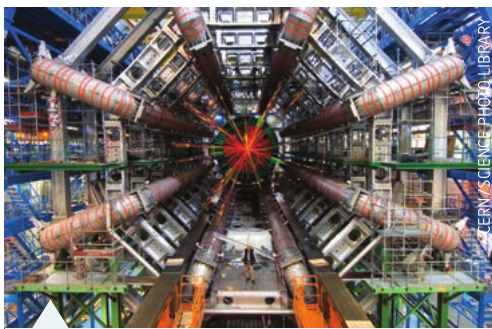
Note
The ATLAS Detector
The image above shows the ATLAS detector, one of the massive detectors at the LHC. The ATLAS detector:
- Weighs 7000 tonnes
- Is one of several detectors at the LHC
- Designed to detect the faintest traces of particles
- Famous for detecting the Higgs boson, the particle responsible for giving mass to matter
Technical specifications
The LHC is not a single device but a large complex of:
- Linear accelerators
- Synchrotron rings working together
It is capable of accelerating protons to speeds of 0.99999999 (99.999999% of the speed of light).
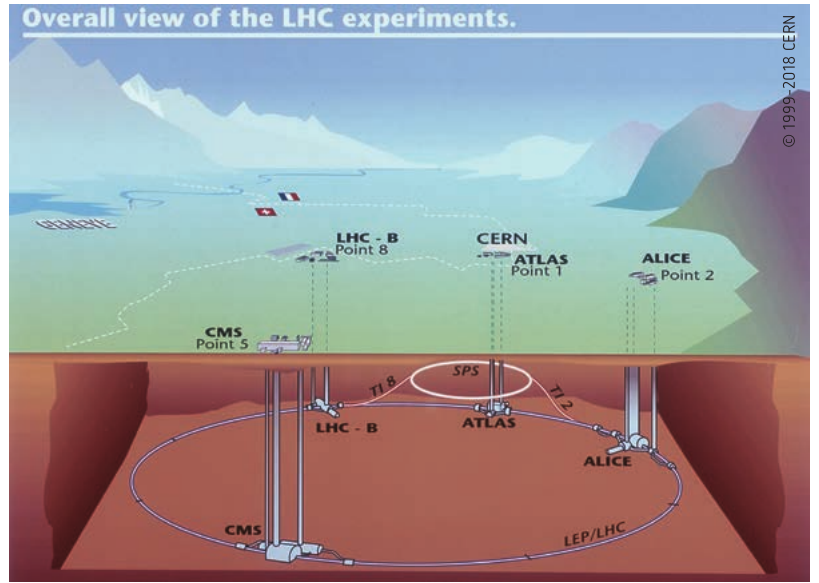
The diagram shows the four main experiments at the LHC:
- ALICE at Point 2
- ATLAS at Point 1
- CMS at Point 5
- LHC-B at Point 8
Note
These experiments are located in huge underground caverns between 50 m and 150 m below the surface. The diagram also shows the SPS (Super Proton Synchrotron), which is the final link in the pre-acceleration chain before particles enter the main LHC ring.
Summary
Key Points to Remember:
-
Particle accelerators solved the problems of cosmic rays (uncontrolled) and nuclear decays (too low energy) by providing controlled, high-energy particle beams for experiments.
-
Two main types of accelerators: linear accelerators (straight line) and synchrotron rings (circular path using magnetic fields), often used together in large facilities.
-
New particles are extremely unstable with half-lives from s to s, and single collisions can produce many different particles simultaneously.
-
Energy creates mass: The equation explains why higher collision energies enable creation of more massive particles; at speeds near light speed, relativistic momentum becomes important.
-
The Large Hadron Collider is the world's most powerful accelerator, operated by CERN, capable of accelerating protons to 99.999999% of light speed and home to major experiments including the ATLAS detector that discovered the Higgs boson.