de Broglie’s Matter Waves (HSC SSCE Physics): Revision Notes
📚Revision Notes
de Broglie's Matter Waves
Introduction to wave-particle duality
For centuries, scientists understood light exclusively as a wave phenomenon. Light displays classic wave behaviours including reflection, refraction, diffraction and interference. However, in 1905, Einstein's explanation of the photoelectric effect required a radical shift in thinking. To explain his observations, Einstein proposed that light behaves as discrete particles (photons), where each photon carries energy equal to Planck's constant multiplied by its frequency: .
This discovery led to the concept of wave-particle duality - the idea that light simultaneously exhibits both wave and particle characteristics. The key to understanding this apparent contradiction lies in recognising that the wave model and particle model complement each other. When examining properties like diffraction and interference, the wave model applies. When explaining phenomena such as the photoelectric effect, the particle model proves more useful.
Note
The wave and particle models are not contradictory but complementary. Which model applies depends on what property or phenomenon we're investigating. This complementarity is fundamental to understanding quantum mechanics.
Deriving the relationship between waves and particles
To describe wave-particle duality quantitatively, physicists combined two fundamental equations. Einstein's mass-energy equivalence states:
Planck's hypothesis for photon energy states:
Setting these equal gives:
Since the frequency and wavelength of light are related by , we can substitute :
Rearranging for wavelength:
where:
- is the wavelength of light (measured in metres)
- is Planck's constant ( J·s)
- is the mass of the photon (in kg)
- is the speed of light ( m·s)
- represents the momentum of the photon (in kg·m·s)
Important
This equation is remarkable because the left side describes a wave property (wavelength) whilst the right side involves a particle property (momentum). This mathematical relationship unifies wave and particle descriptions of light.
de Broglie's matter waves hypothesis
In 1924, French physicist Louis de Broglie made a bold theoretical leap. He proposed that wave-particle duality applies not just to light, but to all matter.
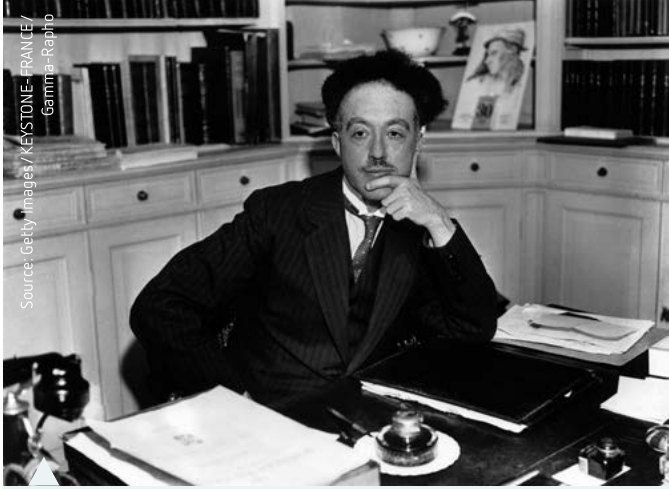
de Broglie generalised the wave-particle equation by replacing (the speed of light) with (the velocity of any particle):
This equation suggests that any particle possessing momentum exhibits wave-like properties. The wavelength associated with a moving particle is called its de Broglie wavelength or matter wave. This concept proves particularly significant for small particles like electrons, as demonstrated in the following calculations.
Note
The significance of de Broglie's proposal cannot be overstated - it extended wave-particle duality from electromagnetic radiation to all matter. This meant that electrons, atoms, and even everyday objects should exhibit wave properties under the right conditions.
Calculating de Broglie wavelengths
For everyday objects, the momentum determines the de Broglie wavelength. Let's examine what this means through a worked example.
Example
Worked Example: Calculating the de Broglie wavelength of a macroscopic object
What is the de Broglie wavelength of an object with mass 1.00 kg moving at velocity 1.00 m·s?
Step 1: Identify the given information
- kg
- m·s
- J·s
Step 2: Select the appropriate formula
Step 3: Substitute values with correct units
Step 4: Calculate the answer
Step 5: Express with appropriate significant figures
This wavelength is extraordinarily small - far too tiny to observe. Although all moving objects technically possess wave characteristics, the wavelengths of massive objects are imperceptibly small. This explains why we don't observe wave behaviour in everyday objects like tennis balls or cars.
Important
Key insight about macroscopic objects:
The de Broglie wavelength is inversely proportional to mass and velocity. As mass increases, wavelength decreases dramatically. This is why we never notice wave behaviour in everyday objects - their wavelengths are far too small to produce observable diffraction or interference effects.
Experimental evidence for matter waves
de Broglie's theoretical proposal required experimental verification. The crucial evidence came from electron diffraction experiments.
Understanding diffraction and interference
To understand these experiments, we must first review two wave properties:
Diffraction is the bending of waves as they pass around obstacles or through narrow openings. When waves encounter a barrier with a slit comparable to their wavelength, they spread out in a characteristic pattern.
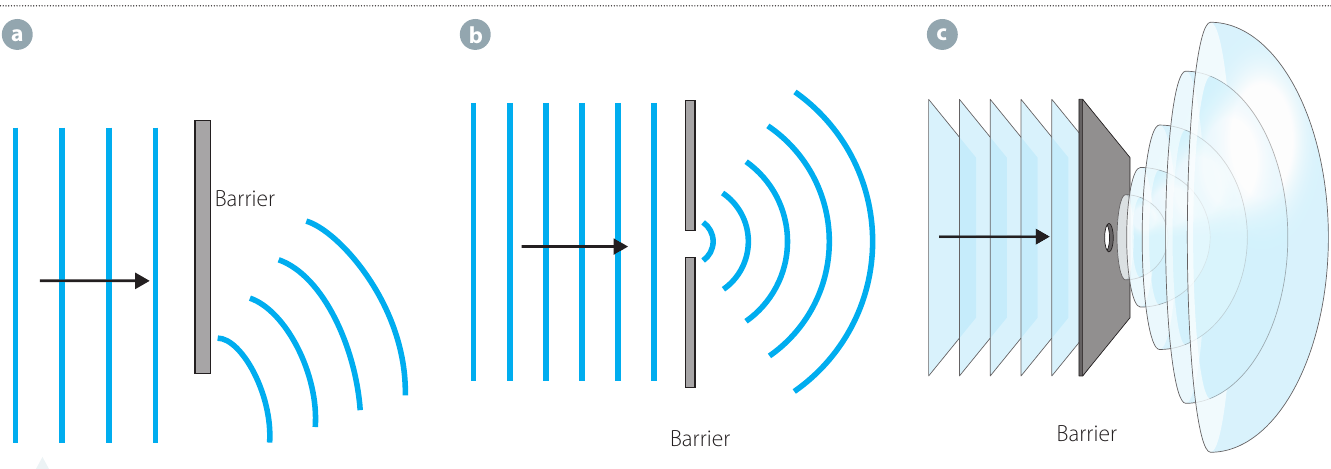
When waves pass through two adjacent slits, the diffracted waves from each slit overlap and interact, causing interference:
- Constructive interference occurs when wave crests align with crests (or troughs with troughs), producing larger amplitudes
- Destructive interference occurs when crests align with troughs, cancelling each other out
This creates an alternating pattern of maximum and minimum intensities. For visible light, this appears as bright and dark bands. For other types of waves, detectors measure varying signal intensities.
Note
Diffraction and interference are exclusively wave phenomena. Particles moving in straight lines cannot produce these patterns. Therefore, observing diffraction or interference provides definitive proof of wave behaviour.
The Davisson-Germer experiment (1927)
Clinton Davisson and Lester Germer designed an experiment to test whether electrons exhibit wave properties.
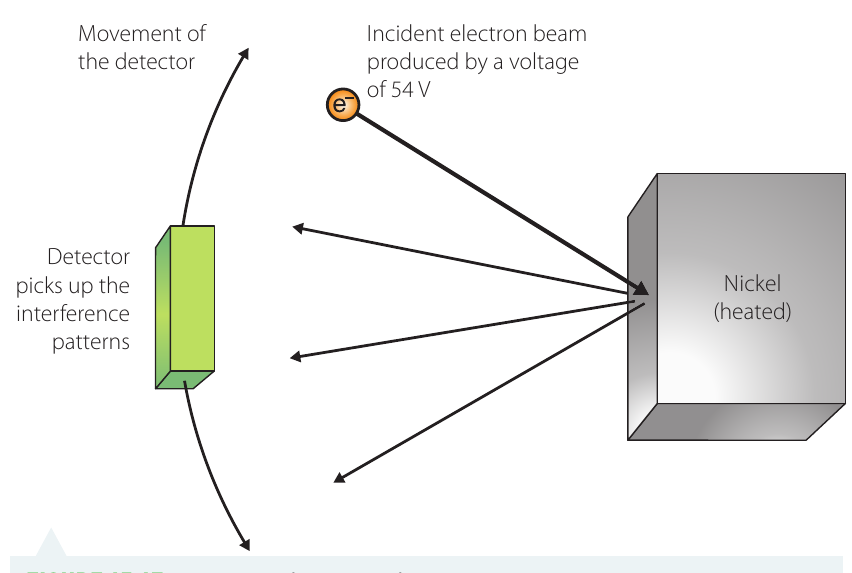
Experimental setup:
- Electrons were accelerated to high velocity using a potential difference of 54 V
- The electron beam was directed at a heated nickel crystal
- A movable detector measured the intensity of scattered electrons at different angles
Key observations:
When electrons struck the nickel crystal surface, they scattered off different atomic planes. Some electrons passed through gaps between nickel atoms, which acted like multiple slits. If electrons behaved as waves, they should undergo diffraction and produce interference patterns.
Results:
The detector measured a series of intensity maxima and minima - exactly the pattern expected from wave interference. This proved that electrons possess wave properties. Furthermore, the measured wavelength from the interference pattern matched the value calculated using de Broglie's equation .
Important
Significance of the Davisson-Germer experiment:
This experiment successfully confirmed both:
- The existence of matter waves - electrons do exhibit wave properties
- The validity of de Broglie's equation - the measured wavelength matched theoretical predictions
This was the first direct experimental evidence that matter exhibits wave-like behaviour.
GP Thomson's experiment (1928)
George Paget Thomson (son of JJ Thomson, who discovered the electron) provided additional evidence for matter waves.
Thomson directed an electron beam through a thin gold foil. The scattered electrons created a pattern on photographic film positioned behind the foil. He then compared this pattern with one produced by X-rays (which were known to exhibit wave properties) scattered from a zirconium oxide crystal.
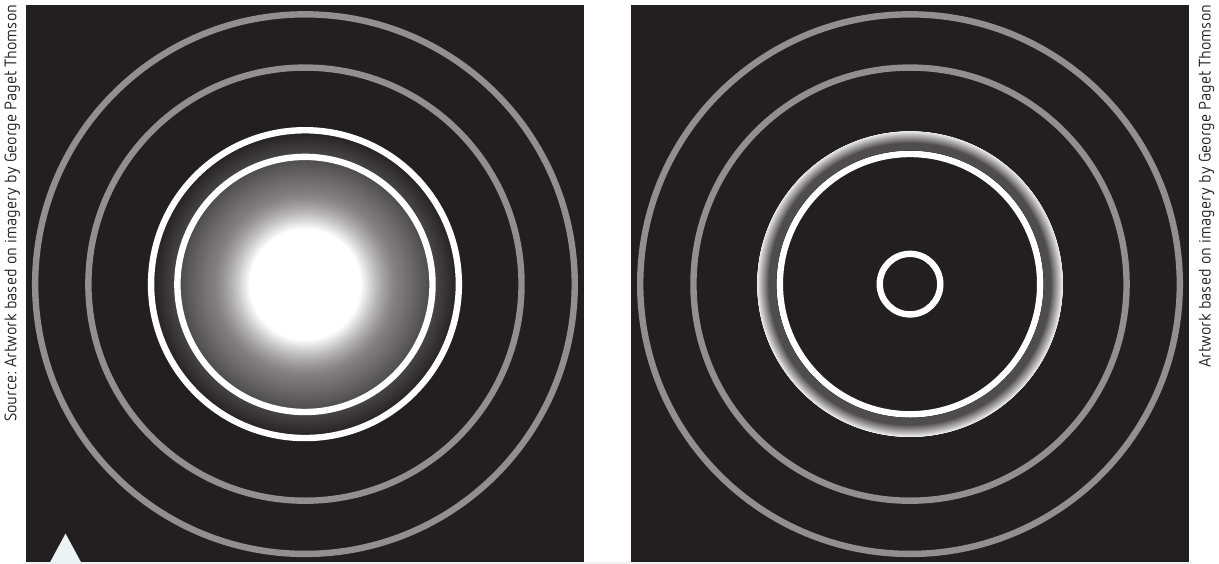
The two patterns were remarkably similar, providing strong evidence for the wave nature of electrons.
Note
A remarkable family legacy:
JJ Thomson won the Nobel Prize for demonstrating electrons are particles, whilst his son GP Thomson won the Nobel Prize for demonstrating electrons are waves - a beautiful illustration of wave-particle duality spanning two generations!
Matter waves and atomic structure
de Broglie extended his matter wave concept to electrons within atoms, proposing that:
Electrons in atoms behave like standing waves, which encircle the nucleus in an integral number of whole wavelengths.
Understanding standing waves
Standing waves are waves confined between boundaries that vibrate in place rather than propagating. They possess:
- Nodes: Points that remain stationary
- Anti-nodes: Points that oscillate between maximum positive and negative displacements
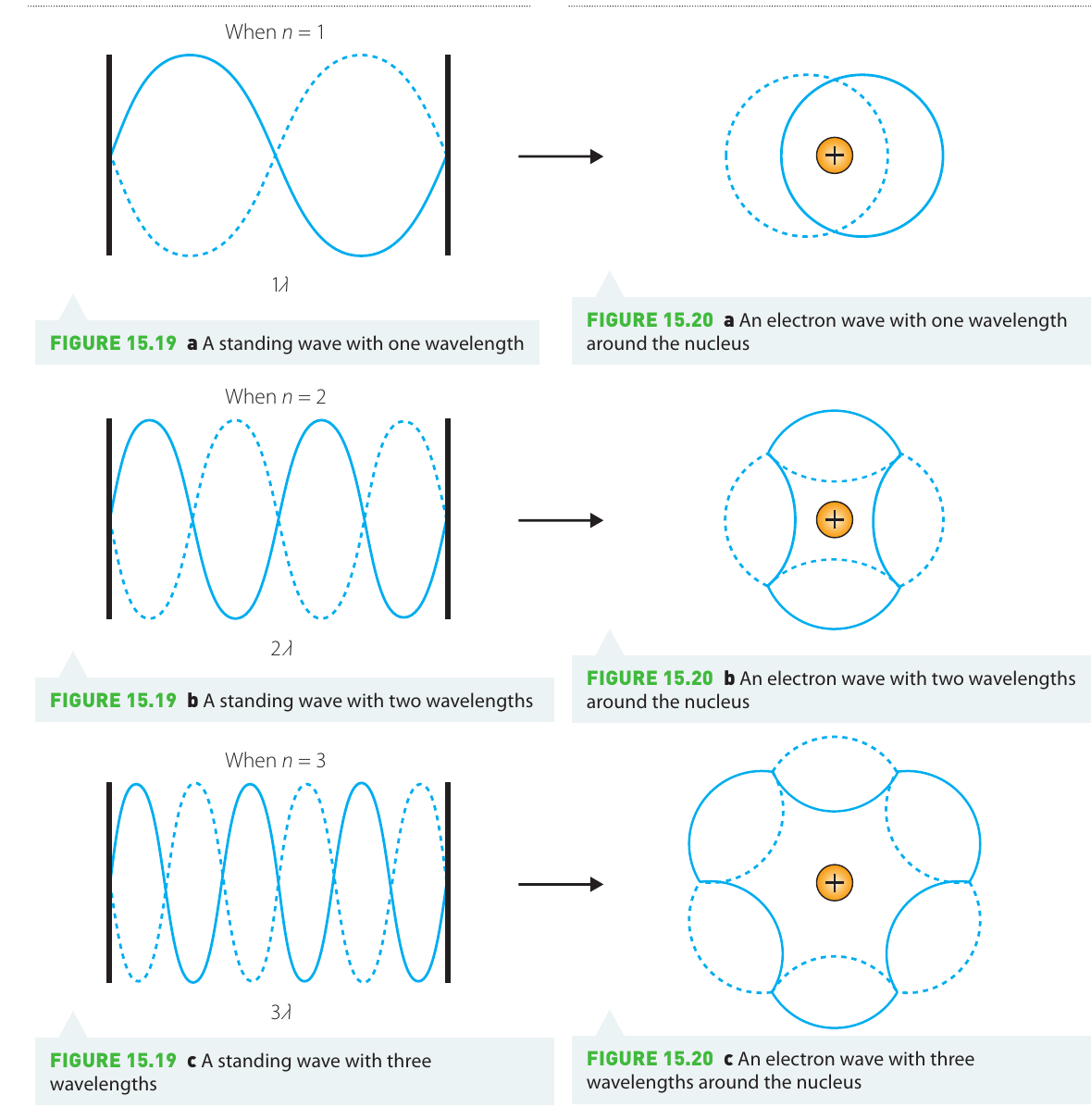
The diagram shows standing waves with different numbers of wavelengths. When these linear standing waves are joined end-to-end to form circles, they resemble electron waves surrounding a nucleus.
Quantisation of electron waves
For electron waves to remain stable around a nucleus, they must satisfy a crucial condition: the wave must complete an integer number of wavelengths as it circles the nucleus. This ensures the wave's beginning and end are in phase. If the wavelength is not an integer multiple, the beginning and end will be out of phase, causing destructive interference that destroys the wave.
Therefore:
- Electrons in the first energy shell () complete one full wavelength
- Electrons in the second energy shell () complete two full wavelengths
- Electrons in the third energy shell () complete three full wavelengths
And so forth for higher energy levels.
Important
The standing wave condition explains quantisation:
Only certain wavelengths (and therefore certain energies) are permitted for electrons in atoms. This quantisation arises naturally from the requirement that electron waves must complete whole numbers of wavelengths to avoid self-destructive interference.
Explaining Bohr's model
de Broglie's electron wave model provides theoretical justification for Bohr's atomic model:
Explaining stability of electron orbits:
In de Broglie's model, electrons are standing waves rather than moving charges. Since standing waves don't propagate, they remain stable and don't emit electromagnetic radiation. This explains Bohr's first postulate about stable electron orbits.
Deriving quantisation of angular momentum:
de Broglie's model enables mathematical derivation of Bohr's third postulate. Starting with the requirement for an integer number of wavelengths:
Substituting de Broglie's equation :
Rearranging:
This is exactly Bohr's quantisation condition for angular momentum, now derived from fundamental wave principles rather than assumed empirically.
Note
Theoretical foundation for Bohr's model:
de Broglie's matter waves transformed Bohr's atomic model from a set of empirical postulates into a theory with solid theoretical foundation. The quantisation of energy levels, which Bohr had to assume, now emerged naturally from wave mechanics.
Modern applications of matter waves
de Broglie's matter wave theory forms the foundation of quantum mechanics and enables several important technologies:
Electron microscopy:
Electron microscopes exploit the wave nature of electrons to create images of extremely small objects. Since we cannot resolve objects smaller than the wavelength used to observe them, and electron wavelengths are much shorter than visible light wavelengths, electron microscopes can image structures far beyond the capability of optical microscopes. This technology has proven invaluable in medical and biological sciences, allowing detailed study of bacteria, viruses, and cellular structures.
Neutron diffraction:
At facilities like the OPAL nuclear reactor in Lucas Heights (near Sydney), scientists use the wave properties of neutrons to create diffraction patterns. These patterns help investigate material properties and detect stress damage in machine components.
Note
Matter waves across scales:
Matter wave behaviour has been demonstrated not only for electrons but also for whole atoms (helium, sodium) and even large molecules like carbon-60 'buckyballs'. However, as mass increases, the de Broglie wavelength decreases, making wave properties progressively harder to observe.
Single particle interference experiments
Despite confirming wave properties of particles, a profound question remained: what exactly is "waving"? How do individual particles, detected at specific points, produce interference patterns?
Taylor's single photon experiment (1909)
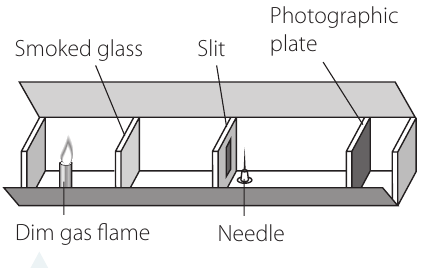
GI Taylor performed a groundbreaking experiment using light so dim that only one photon existed in the apparatus at any moment. Remarkably, an interference pattern still developed on the photographic plate. This result made sense for a wave interpretation - a wave spreads through space and passes through both slits simultaneously, even at low intensity. But how could a single particle pass through both slits at once?
Tonomura's single electron experiment (1989)
Akira Tonomura and colleagues in Japan performed the definitive single-electron interference experiment.
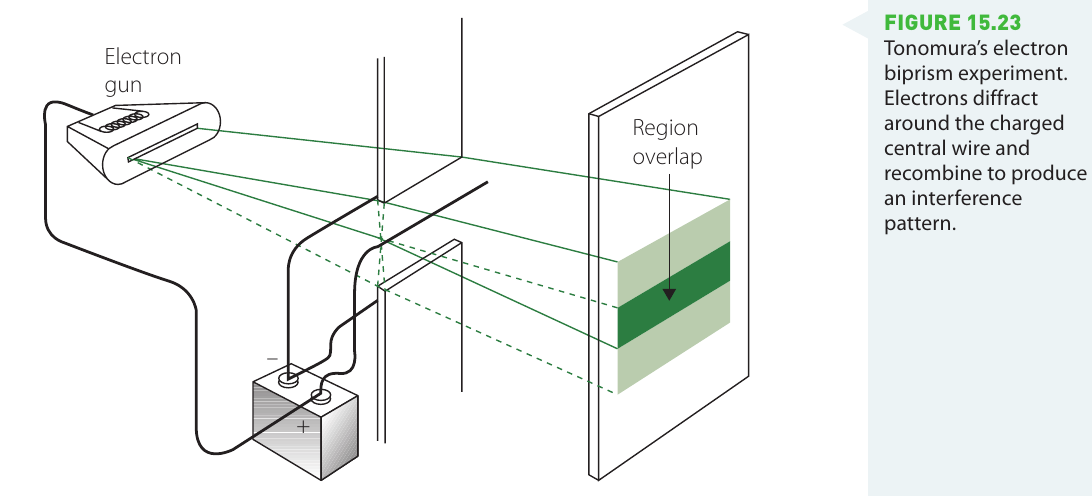
Experimental setup:
- An electron gun fired individual electrons toward an electron biprism (which functions like a double slit)
- Electrons were sent one at a time - never more than one electron in the apparatus simultaneously
- A detector screen recorded where each electron arrived
Results:
Initially, with only a few electrons, arrival positions appeared random. However, as more electrons accumulated, a clear interference pattern emerged - alternating bands of high and low electron density. The pattern matched predictions from the double-slit formula (where ), using the electron's de Broglie wavelength.
Critical finding:
Since electrons arrived individually, they couldn't interfere with other electrons. Each single electron somehow interacted with both slits simultaneously, interfering with itself.
Important
The profound implication of single-particle interference:
These experiments revealed something extraordinary: individual particles create interference patterns characteristic of waves. Since only one particle exists in the apparatus at a time, it cannot be interfering with other particles. The only logical conclusion is that each particle interferes with itself, behaving as a wave that passes through both slits simultaneously.
The probability wave interpretation
These experiments led to the modern quantum mechanical interpretation: particles are described by probability waves. The wave represents the probability of finding the particle at different locations. When these probability waves pass through both slits, they interfere, creating the observed pattern of high and low probability regions. Individual particles still arrive at discrete points (exhibiting particle behaviour), but their collective distribution follows the wave interference pattern.
Experiments testing this interpretation revealed a startling result: when detectors determined which slit an electron passed through, the interference pattern disappeared. The act of observation fundamentally changed the electron's behaviour - it could no longer simultaneously pass through both slits. This remains one of the most puzzling and profound aspects of quantum mechanics.
Note
The observer effect in quantum mechanics:
The disappearance of the interference pattern when we measure which slit the electron passes through demonstrates a fundamental principle: observation affects the system being observed. This is not simply a limitation of our measurement technology - it's a fundamental feature of quantum reality.
Summary
Key Points to Remember:
-
Wave-particle duality states that particles can exhibit both wave and particle properties, depending on how they're observed
-
de Broglie's equation relates a particle's wavelength to its momentum, where J·s
-
Matter waves were experimentally confirmed by the Davisson-Germer experiment (1927) and GP Thomson's electron diffraction experiment (1928), both showing interference patterns characteristic of waves
-
Electrons in atoms behave as standing waves with integer numbers of wavelengths, explaining the quantisation of energy levels and providing theoretical support for Bohr's atomic model
-
Single-particle interference experiments demonstrated that individual electrons create interference patterns, leading to the probability wave interpretation of quantum mechanics
-
The act of observation can fundamentally change quantum behaviour - measuring which slit a particle passes through destroys the interference pattern