Modern Quantum Mechanics (HSC SSCE Physics): Revision Notes
📚Revision Notes
Modern Quantum Mechanics
Introduction to modern quantum mechanics
Modern quantum mechanics emerged in the 1920s through the groundbreaking work of several physicists including Niels Bohr, Louis de Broglie, Werner Heisenberg, and Erwin Schrödinger. The term 'modern' distinguishes this framework from earlier quantum theories, such as the Bohr model of the atom.
Note
The distinction between "modern" quantum mechanics and earlier quantum theories is important. While early theories like Bohr's model introduced quantum concepts, modern quantum mechanics represents a complete mathematical framework that fundamentally changed our understanding of the atomic world.
This new approach to understanding the atomic world introduced a revolutionary concept: uncertainty. Unlike earlier models that attempted to precisely describe particle behaviour, modern quantum mechanics embraces the inherently unpredictable nature of subatomic particles.
Fundamental principles of modern quantum mechanics
The concept of uncertainty
While all experiments involve some degree of uncertainty due to equipment limitations and measurement errors, Werner Heisenberg proposed something far more profound. He suggested that there exists an intrinsic uncertainty in nature itself – a fundamental limit to what we can know about particles, regardless of how precise our instruments become.
Important
Heisenberg's uncertainty is not about experimental limitations or measurement errors. It is a fundamental property of nature itself. No matter how advanced our technology becomes, this uncertainty cannot be eliminated because it exists at the most basic level of reality.
According to Heisenberg, the behaviour of particles is probabilistic rather than certain. This means that no matter how much information we gather about a particle, we cannot predict its behaviour with complete certainty. This represents a fundamental shift in how we understand the physical world.
Classical mechanics vs quantum mechanics
The distinction between classical and quantum mechanics lies at the heart of modern physics:
Classical mechanics (describing everyday objects and phenomena) is deterministic. This means that given sufficient information about a system, you can predict its future behaviour with certainty. If you know the position, velocity, and forces acting on an object, you can calculate exactly where it will be at any future time.
Modern quantum mechanics, by contrast, is probabilistic. It states that it is fundamentally impossible to predict the outcome of an experiment with complete certainty, even with perfect knowledge of the system. This represents a profound philosophical and practical difference in how we understand nature at the quantum scale.
Important
Exam tip: Be prepared to explain the key difference between classical and quantum mechanics – deterministic versus probabilistic behaviour. This is a fundamental concept that underpins all of modern quantum theory.
Schrödinger's contribution
Schrödinger's equation
In 1926, Erwin Schrödinger made a pivotal contribution to quantum mechanics by developing a mathematical framework that incorporated probability into our understanding of electron behaviour. His famous Schrödinger's equation provides solutions for any quantum mechanical system.
When applied to electrons in atoms, solutions to Schrödinger's equation reveal the likelihood (probability) that an electron will be found at a particular location around the nucleus. Rather than telling us exactly where an electron is, the equation tells us where it is most likely to be found.
The electron cloud model
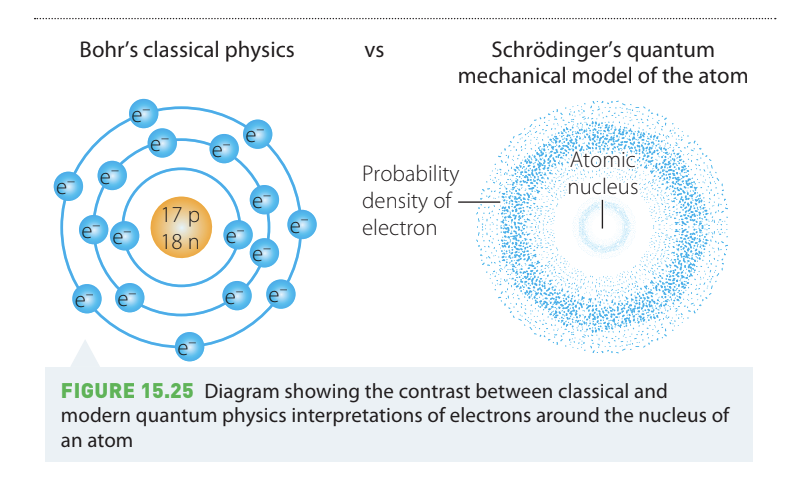
Schrödinger's work gave rise to a new way of visualising electrons around the nucleus: the electron cloud or orbital model. In this model:
- Electrons don't follow fixed, circular paths as in the Bohr model
- Instead, electrons exist as a "cloud" of probability around the nucleus
- Different orbitals have different cloud shapes
- The density (thickness) of the electron cloud at any point represents the probability of finding the electron at that location
- Denser regions indicate higher probability, while less dense regions indicate lower probability
Note
The diagram above illustrates the stark contrast between the two models:
- Bohr's classical physics model (left): Shows electrons as particles moving in fixed, circular orbits around the nucleus
- Schrödinger's quantum mechanical model (right): Shows electrons as a probability cloud surrounding the nucleus, where the density indicates the likelihood of finding an electron
This quantum mechanical model can only predict the probability of finding an electron at a certain position, never its exact location at a given time. This reflects the fundamental uncertainty inherent in quantum mechanics.
Schrödinger's cat thought experiment
Purpose of the experiment
Interestingly, Schrödinger himself was uncomfortable with some interpretations of quantum mechanics. To illustrate what he saw as the absurdity of applying quantum mechanical principles to everyday, large-scale systems, he proposed a famous thought experiment known as Schrödinger's cat.
Note
This is a thought experiment – it was never actually performed and was not intended as a real experimental proposal. Schrödinger created it to highlight philosophical problems with certain interpretations of quantum mechanics.
Description of the setup
The thought experiment involves the following scenario:
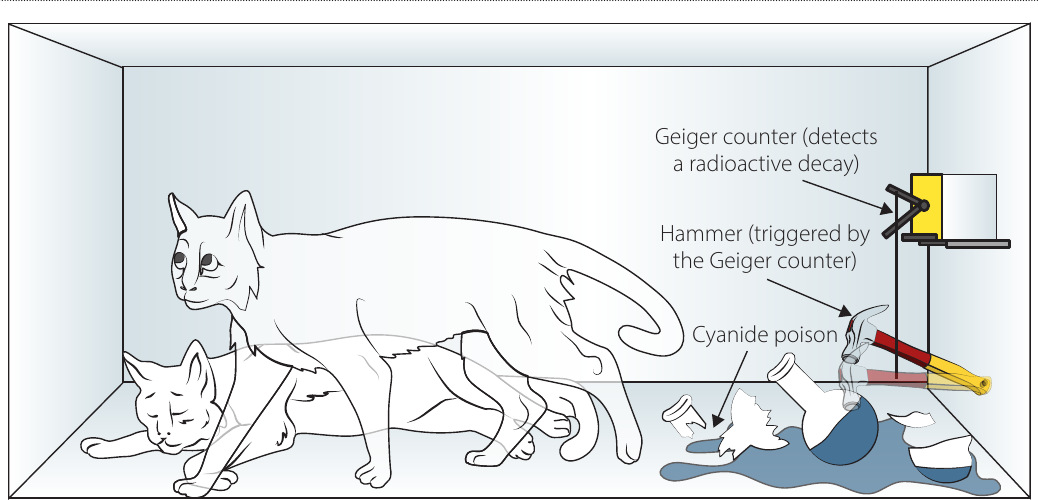
A cat is placed inside a sealed box along with:
- A small amount of radioactive substance with exactly a 50% probability of decaying within a given time
- A Geiger counter that detects radioactive decay
- A hammer mechanism triggered by the Geiger counter
- A vial of cyanide poison
If the radioactive substance decays:
- The Geiger counter detects the radioactivity
- This triggers the hammer to fall
- The hammer smashes the vial of poison
- The poison kills the cat
If the substance doesn't decay, the cat remains alive.
Quantum mechanical interpretation
According to quantum mechanics, before we open the box and observe the cat, the system exists in a superposition of states. This means the cat is simultaneously both alive and dead! Only when we open the box and observe the cat does the wave function collapse, forcing the system into one definite state – the cat is then either alive or dead, but no longer both.
The Copenhagen interpretation
This interpretation of quantum mechanics is known as the Copenhagen interpretation. According to this view, a quantum system can exist in all possible states simultaneously until it is observed. The act of observation forces the system to "choose" one particular state.
In the cat experiment:
- Before observation: The cat exists in a superposition of alive and dead states
- During observation: The wave function collapses
- After observation: The cat is definitely either alive or dead
Schrödinger's reservations
Despite popular belief, Schrödinger was not entirely satisfied with the Copenhagen interpretation. He proposed this thought experiment to highlight what he perceived as the absurdity of applying quantum mechanical reasoning to large-scale, everyday objects. The experiment was meant to challenge physicists to reconsider whether quantum superposition could truly apply to macroscopic systems like a living cat.
Important
Exam tip: Schrödinger's cat is often used to explain quantum superposition. Be clear that this is a thought experiment (never actually performed) designed to illustrate the strange implications of quantum mechanics at the macroscopic scale.
Remember!
Summary
Key Points to Remember:
-
Modern quantum mechanics developed in the 1920s by physicists including Bohr, de Broglie, Heisenberg, and Schrödinger, introduced the concept of fundamental uncertainty into physics.
-
The key difference between classical and quantum mechanics is that classical mechanics is deterministic (outcomes can be predicted with certainty given enough information), while quantum mechanics is probabilistic (outcomes cannot be predicted with certainty, only as probabilities).
-
Schrödinger's equation (1926) provides mathematical solutions for quantum systems. When applied to electrons, it gives the probability of finding an electron at any position around the nucleus, leading to the electron cloud model.
-
In the electron cloud model, the density of the cloud represents the probability of finding an electron at that location, fundamentally different from Bohr's fixed orbits.
-
Schrödinger's cat thought experiment illustrates quantum superposition and the Copenhagen interpretation, where a system can exist in multiple states simultaneously until observed, at which point the wave function collapses into a single definite state.