Describing Motion Using Vectors (HSC SSCE Physics): Revision Notes
📚Revision Notes
Describing Motion Using Vectors
Introduction to velocity in two dimensions
In earlier work on one-dimensional motion, we learned that velocity is found by dividing displacement by time. This fundamental principle remains true when analysing motion on a two-dimensional plane. However, working in two dimensions requires us to consider both the magnitude and direction of motion more carefully.
When describing motion on a plane, we need coordinate systems with perpendicular axes (such as x-y axes or north-east directions). This allows us to break down complex motion into manageable components that can be analysed mathematically.
Note
Coordinate systems with perpendicular axes are essential for analyzing two-dimensional motion because they allow us to separate complex motion into independent components that can be handled using familiar one-dimensional techniques.
Velocity is a vector quantity
At any instant during motion, an object travels in a specific direction with a specific speed. To fully describe this motion, we must specify both the magnitude (the speed value) and the direction. For example, stating that a car travels south at provides complete information about its velocity at that moment.
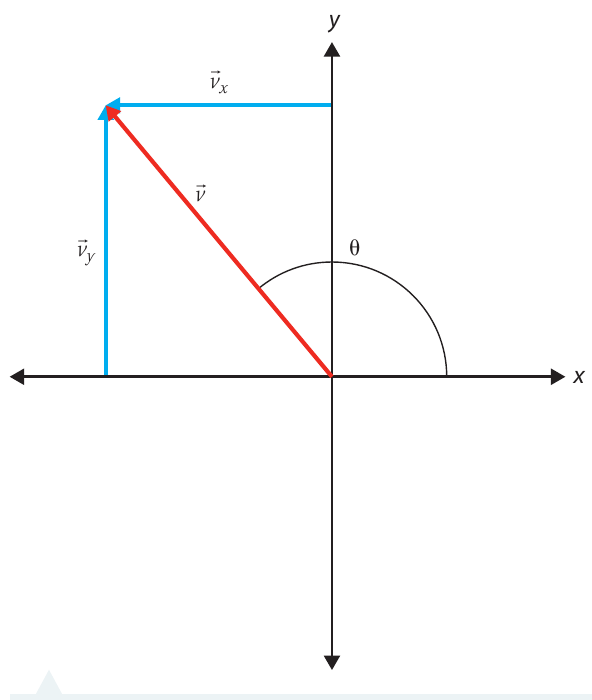
Like displacement, velocity is a vector quantity that can change with time. When velocity changes, the object experiences acceleration. This acceleration can involve changes in speed, direction, or both simultaneously.
Resolving velocity into components
A velocity vector can be broken down into perpendicular components along chosen axes. If a car travels north-west at , it has both a northward component and a westward component of velocity. We use trigonometry to calculate these individual components and can recombine them to find the resultant velocity.
For a velocity vector with components along the x and y directions, we write:
Important
Pythagoras' Theorem for Vector Components
The magnitudes of perpendicular velocity components are related through Pythagoras' theorem:
where represents the magnitude of the velocity vector. This fundamental relationship allows us to find the total velocity from its components.
Calculating components using trigonometry
When a velocity vector makes an angle with the x-axis, we can find its components using:
To find the angle when components are known, we use:
Note
These trigonometric relationships allow you to switch seamlessly between two equivalent descriptions of velocity:
- A single vector with magnitude and direction (e.g., at 30° north of east)
- Separate perpendicular components (e.g., east and north)
Both descriptions contain exactly the same information about the motion.
Drawing velocity vectors
When illustrating velocity vectors on graph paper, we must specify an appropriate scale (for example, '1 cm represents '). While the drawing technique mirrors that used for displacement vectors, the units differ.
Important
Critical Unit Consideration
Because velocities and displacements have different units, they cannot be added together directly. Velocity has units of distance per time (e.g., ), while displacement has units of distance (e.g., m). Always ensure you are working with quantities that have compatible units.
Adding and subtracting velocities
Motion can involve multiple simultaneous velocity components, particularly when dealing with relative motion. Consider passengers moving inside a vehicle that is itself in motion. The passenger's total velocity relative to the ground equals the vector sum of their motion within the vehicle plus the vehicle's motion relative to the ground.
Example
Worked Example: Perpendicular Velocities
Consider Mario travelling on a train moving east at along a straight track. He walks across the carriage from left to right (south direction) in s. The carriage width is m. We need to find Mario's net velocity while moving.
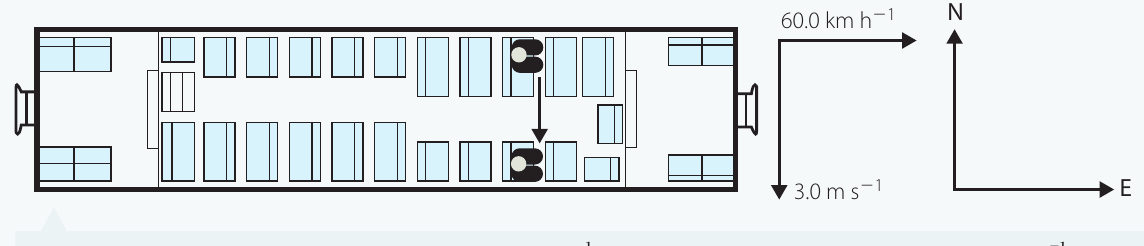
Given information:
- Train velocity: east
- Mario's velocity relative to train: south
Solution approach:
Step 1: Convert units to SI:
Step 2: Recognize that the net velocity combines both components:
Step 3: Since the velocities are perpendicular, apply Pythagoras' theorem:
Step 4: Calculate the angle from east:
Final answer: Mario's velocity is 17.0 m⋅s⁻¹ at E10°S (or equivalently, S80°E).
Example
Worked Example: Non-perpendicular Velocities
Now suppose Mario moves across the carriage but also forward by two seats. He travels m in s at an angle of 56° south of east relative to the carriage. The train still moves at . What is Mario's resultant velocity relative to the tracks?
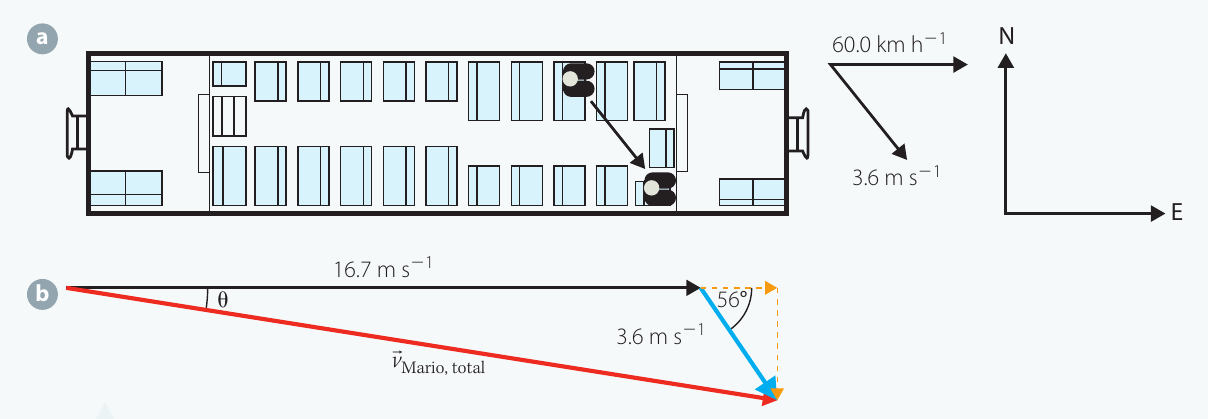
Given information:
- to the east
- at 56° south of east
Solution approach:
For non-perpendicular vectors, we must resolve each velocity into components and then add the components separately.
Step 1: Express the total velocity as:
Step 2: Break this into components:
Step 3: Resolve Mario's velocity relative to the train:
Step 4: Identify the train's components:
Step 5: Combine the components:
Step 6: Apply Pythagoras' theorem to find the magnitude:
Step 7: Calculate the direction:
Final answer: vₘₐᵣᵢₒ,ₜₒₜₐₗ = 18.9 m⋅s⁻¹ at S81°E
General method for adding velocities
Note
Systematic Approach to Vector Addition
When adding two velocities and to find their resultant :
Step 1: Resolve each velocity into components:
Step 2: Add the x-components together and the y-components together:
Step 3: Calculate the magnitude using Pythagoras' theorem:
Step 4: Find the direction using trigonometry:
This method works for any two velocities, regardless of their relative directions.
Change in velocity
The change in a velocity vector is determined by subtracting the initial velocity from the final velocity. We denote this change as (read as "delta-vee"):
This change in velocity can be positive or negative. Importantly, because this involves vector subtraction, the direction of Δv̄ need not align with either the initial or final velocity direction. The magnitude of the change is written as (without the vector arrow).
Note
Vector subtraction is performed by adding the negative of the vector being subtracted. That is:
The negative of a vector has the same magnitude but points in the opposite direction.
Relationship to acceleration
When the change in velocity occurs over a time interval , the average acceleration is:
This relationship connects velocity changes to the acceleration experienced by an object.
Example
Worked Example: Ball Bouncing off a Wall
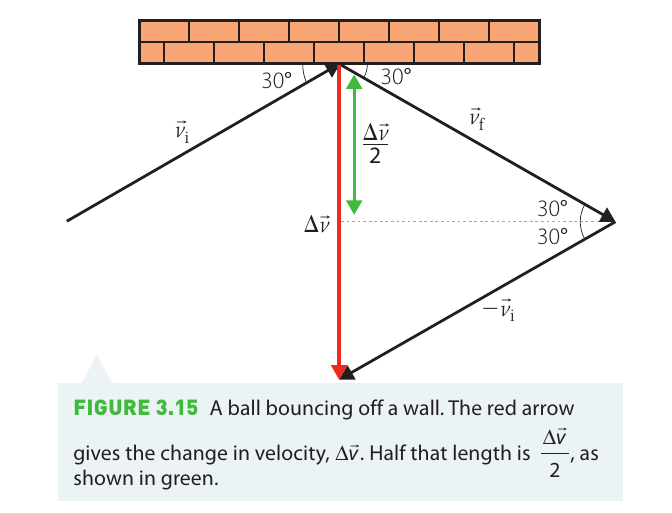
A tennis ball strikes a wall at an angle of 30° to the wall surface, with a velocity of . It bounces off at the same speed and angle. We need to determine the change in velocity.
Solution approach:
Step 1: Express the change in velocity:
To subtract vectors, we add the negative of the initial vector to the final vector.
Step 2: Analyze the components. Drawing this carefully, we notice that the velocity components parallel to the wall cancel out (they have equal magnitudes but opposite directions when comparing and ). Only the perpendicular components remain.
Step 3: Using the right-angled triangle formed by the vectors:
Therefore:
Final answer: The change in velocity is 6.0 m⋅s⁻¹ perpendicular to the wall, directed away from it.
Key insight: Although the ball's speed remained constant, its velocity changed significantly because the direction changed. This demonstrates the crucial difference between speed (a scalar) and velocity (a vector).
Investigation: Measuring velocity vectors and components
This practical investigation explores the relationship between velocity components, total velocity, and the angle of motion.
Aim
To experimentally verify the mathematical relationships between velocity components and total velocity magnitude using measurements of a rolling ball.
Materials
- Tape measure
- Chalk
- Large protractor
- Stopwatch
- Ball
- Basketball court or tennis court
Risk assessment
| What are the risks in doing this investigation? | How can you manage these risks to stay safe? |
|---|---|
| Excess sun exposure is dangerous | Wear a hat and any other appropriate sun protection |
Important
Consider other potential risks such as trip hazards from equipment or collision with the ball, and implement appropriate safety measures before beginning the investigation.
Method
- Measure the width and length of the court to determine and . Use chalk and a protractor to mark the angle between the long side and the diagonal.
- One person positions themselves at a corner of the court with the ball. A second person stands at the opposite corner with a stopwatch to record times.
- The first person slowly rolls the ball toward the second person, who measures the time taken for the ball to arrive.
- Repeat step 3 at least 10 times, progressively increasing the rolling speed each time to obtain different velocity values.
Note
Experimental Technique Tips
- Ensure the ball rolls smoothly without bouncing for more accurate results
- Start timing when the ball begins moving and stop when it reaches the opposite corner
- Keep the rolling path as straight as possible along the diagonal
- Record all measurements immediately to avoid errors
Results
Record the measured distances and , then create a data table:
| Trial | Time (s) | (m⋅s⁻¹) | (m⋅s⁻¹) | (m⋅s⁻¹) |
|---|---|---|---|---|
| 1 | ||||
| 2 | ||||
| ... |
Analysis of results
- Complete the table by calculating:
- for each time using
- for each time using
- for each time using
- Using spreadsheet software, plot a graph of versus . Display the line of best fit and its equation on the graph. Record the gradient.
- Similarly, plot a graph of versus . Display the line of best fit and equation, then record the gradient.
Discussion questions
- Does your calculated gradient agree with what you would expect from your measurements of the court dimensions? If not, what factors might explain the discrepancy?
- Evaluate whether your hypothesis was supported by the experimental data.
- Suggest improvements or extensions to this experiment that could increase accuracy or explore related concepts.
Note
Expected Results
The gradients of your graphs should relate to the trigonometric ratios based on the angle of the diagonal:
- The gradient of vs should equal
- The gradient of vs should equal
where is the angle you measured at the corner of the court.
Conclusion
Summarise your experimental findings and state clearly whether the results supported or contradicted your initial hypothesis. Discuss the validity of using vector component relationships to describe motion on a plane.
Summary
Key Points to Remember:
-
Velocity is a vector quantity with both magnitude (speed) and direction. Speed alone is a scalar quantity.
-
Vector components follow Pythagoras' theorem: For a velocity with perpendicular components and , the magnitude is .
-
Trigonometry relates components to angles: Use , , and to switch between component and angle-magnitude representations.
-
Adding velocities requires component analysis: Resolve each velocity into components, add corresponding components separately, then recombine using Pythagoras' theorem and trigonometry.
-
Change in velocity involves vector subtraction: , and the direction of change may differ from both initial and final velocities. This change divided by time gives acceleration.