Maxwell’s Contributions to the Theory of Electromagnetism (HSC SSCE Physics): Revision Notes
📚Revision Notes
Maxwell's Contributions to the Theory of Electromagnetism
Introduction
For thousands of years, scientists and philosophers have tried to understand what light actually is. Early ideas were quite different from what we know today:
- Empedocles (around 490 BCE) believed light shot out from our eyes and touched objects, allowing us to see them
- René Descartes thought space was filled with tiny invisible spheres called "plenum" that light pushed against, creating pressure on our eyeballs
- Isaac Newton believed light consisted of particles
- Christiaan Huygens (1678) proposed that light behaved as a wave
Note
This particle-versus-wave debate continued for hundreds of years. However, nobody recognised a fundamental connection between light, electricity and magnetism until James Clerk Maxwell developed his famous equations in the 1860s.
Early discoveries about electricity
The relationship between electricity and magnetism
By the early 19th century, scientists knew there was some relationship between electricity and magnetism. Henry Elles claimed in 1757 that he had noticed similarities between magnetic and electrical phenomena, though he believed they were actually different things. Over the next century, scientists began developing theoretical frameworks supported by experimental evidence.
Wheatstone's measurement of electrical velocity
In 1834, Charles Wheatstone conducted an important experiment to measure how fast electricity travels through a wire. He used a Leyden jar (an early type of capacitor that stores electrical charge) as his electricity source.
Note
Wheatstone's Experimental Setup
Wheatstone's experimental setup was clever:
- Two wires were arranged with small gaps between their ends and the jar's terminals (one positive, one negative)
- A third gap existed between the two wires themselves
- When activated, sparks would jump across all three gaps
- A tiny mirror mounted on watch mechanics rotated rapidly to observe the sparks
If the sparks occurred simultaneously, they would appear in a straight line when viewed in the rotating mirror. However, Wheatstone observed that the middle spark lagged behind the others, proving that electricity takes a tiny but measurable amount of time to travel along the wire.
By knowing the mirror's rotation speed and the wire's length, Wheatstone calculated the speed of electricity as . We now know this value is far too high (it exceeds the speed of light), but it was an important first step.
Weber and Kohlrausch's breakthrough
In 1856, Wilhelm Eduard Weber and Rudolf Kohlrausch performed a crucial experiment. They discharged a Leyden jar to measure the ratio between two fundamental constants:
- Permeability of free space (): relates to magnetic fields
- Permittivity of free space (): relates to electric fields
Important
Critical Discovery
They discovered that was very close to the speed of light that had been measured by Fizeau.
The next year (1857), Gustav Kirchhoff built upon Wheatstone's work and showed that the speed of electricity in a resistanceless wire was also the same value. These findings were crucial for Maxwell's later work.
Maxwell's work
Maxwell was an exceptional scientist who combined skills in:
- Experimental science
- Natural philosophy
- Advanced mathematics
As the Cavendish Professor of Mathematics at Cambridge University, Maxwell was fascinated by electricity, magnetism and light. He took work done by Gauss, Faraday and Ampère and combined it, making suitable modifications, to create four equations that described the complete theory of electromagnetism. He published these equations in 1865.
Maxwell's key insight
Maxwell's theory predicted that electromagnetic radiation could travel through space at a speed of , given by the ratio that Weber and Kohlrausch had measured.
Important
Light is Electromagnetic Radiation
Since this matched Fizeau's measured speed of light, and dimensional analysis confirmed this ratio represented a velocity, Maxwell concluded that light is actually electromagnetic radiation.
Maxwell also predicted that electromagnetic waves could exist at many different frequencies, far beyond what the human eye can see (the visible spectrum).
Maxwell's four equations
Maxwell identified four fundamental laws that, when combined mathematically, describe all electromagnetic phenomena.
1. Gauss's law for electricity
Formulated in 1813, this law relates the electric flux (flow of electric field) through a closed surface to the electric charge enclosed by that surface.
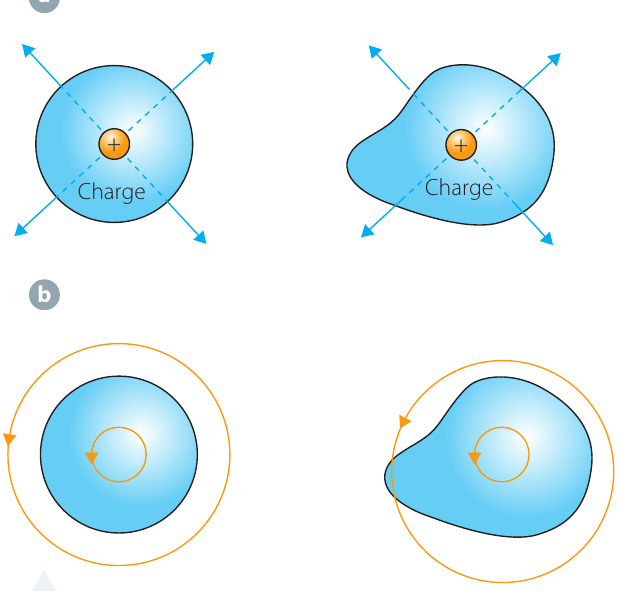
A Gaussian surface is an imaginary closed surface used to calculate electric fields. The key principle is: if there is a net electric charge inside a Gaussian surface, there will always be some electric flux leaving it.
Note
Understanding Electric Flux
Think of it like this: positive charges act like sources of electric field lines that radiate outward. The more charge you enclose, the more field lines emerge from the surface.
2. Gauss's law for magnetism
Also formulated by Gauss, this law states that there are no magnetic monopoles - no independent north or south magnetic poles exist in isolation.
This fundamental principle was first proposed in 1269 by Petrus Peregrinus de Maricourt. The practical consequence is that magnetic field lines always form complete loops. If magnetic field lines leave a Gaussian surface, they must also enter it somewhere else. Therefore, the net magnetic flux through any closed surface is always zero.
Important
No Isolated Magnetic Poles
This is why when you break a magnet in half, you don't get separate north and south poles - you get two smaller magnets, each with both poles.
3. Faraday's law of induction
Michael Faraday discovered electromagnetic induction in 1831. This law reveals the intimate relationship between magnetism and electricity, and it's the principle behind many modern technologies (generators, transformers, electric motors).
Maxwell formulated Faraday's ideas mathematically as the third equation. The key principle is: a changing magnetic field creates a changing electric field.
Note
Visualising Fields
Faraday originated the concept of "lines of force" to visualise these fields. Maxwell's mathematical formulation made these ideas precise and quantitative.
4. Ampère's circuital law (with Maxwell's addition)
In 1826, André-Marie Ampère discovered how the magnetic field around a closed loop relates to the electric current flowing through it.
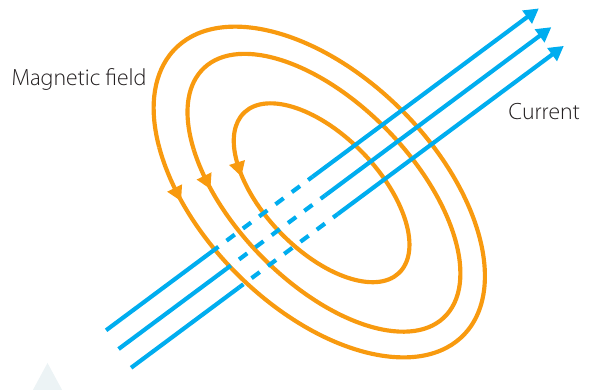
Maxwell formalised this in 1855, but initially it only worked for steady (non-changing) currents and magnetic fields.
Maxwell's crucial modification
To make the equation work for varying currents and charges (like in a capacitor), Maxwell had to add a correction term. He introduced the displacement current, which represents the slight separation of electrons from their atoms in a material when a changing electric field passes through it.
Important
Revolutionary Addition
This addition was revolutionary because it required using the permeability and permittivity of free space ( and ). It allowed the equation to describe both magnetic and electric fields changing through space as waves - thus permitting electromagnetic radiation.
The wave equations show that:
This meant the speed of electromagnetic wave propagation could be predicted if and could be measured, which Weber and Kohlrausch had already done.
Summary of Maxwell's equations
While the full mathematical form of Maxwell's equations is complex, the four equations state:
- Point charges radiate an electric field outward (like spokes from a wheel)
- Magnetic field lines always form closed loops - there are no isolated magnetic poles
- A changing magnetic field creates a changing electric field
- A changing electric field creates a changing magnetic field (this includes both real currents and Maxwell's displacement current)
Note
The Key to Electromagnetic Waves
The fourth equation is particularly important because it involves both and , which can be measured experimentally. This connection allowed Maxwell to predict the speed of electromagnetic waves theoretically.
The significance of Maxwell's work
Maxwell's equations had profound implications:
- They unified electricity, magnetism and light into a single theoretical framework
- They showed that light is electromagnetic radiation
- They predicted the speed of light could be calculated from measurable constants ( and )
- They predicted the existence of electromagnetic waves beyond the visible spectrum
- They provided the foundation for modern physics and technology
Important
Experimental Confirmation
The fact that the predicted speed () matched the measured speed of light was strong evidence that Maxwell's theory was correct.
Remember!
Summary
Key Points to Remember:
-
Wheatstone first measured the speed of electricity in 1834, showing it had a finite (not instantaneous) value
-
Weber and Kohlrausch measured the ratio of magnetic and electric constants, finding , very close to the speed of light
-
Maxwell unified four separate laws (two from Gauss, one from Faraday, one from Ampère) into a complete theory of electromagnetism
-
Maxwell's fourth equation required adding the "displacement current" term to work for changing fields
-
The speed of electromagnetic waves can be predicted from , connecting the speed of light to measurable constants
-
Maxwell concluded that light is electromagnetic radiation and predicted the existence of electromagnetic waves beyond the visible spectrum