Competing Models (HSC SSCE Physics): Revision Notes
📚Revision Notes
Competing Models
Historical perspectives on light
For centuries, scholars debated the fundamental nature of light. As early as the 5th century BCE, Greek philosopher Democritus—who proposed the original concept of atoms—argued that light, like everything else, consisted of indivisible particles.
Around 1000 CE, Arab scholar Ibn al-Haytham (also known as Alhazen) made significant contributions through his seven-volume work, the Book of Optics. He disproved Ptolemy's theory that light emanated from our eyes by noting that bright light damages eyes. Ibn al-Haytham studied light's behaviour, including reflection and refraction, but always viewed light as composed of particles.
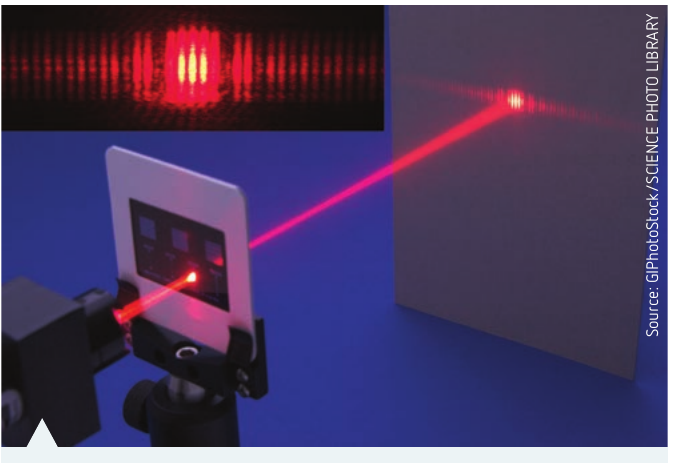
Note
The major limitation of these early ideas was the lack of experimental evidence beyond the observation that light appeared to travel in straight lines. Without the ability to measure light's properties directly, scholars could only theorize based on its visible behaviour.
Newton's corpuscular theory
By the 17th century, two competing models emerged to explain light's behaviour. Isaac Newton championed the corpuscular theory (particle model), whilst Christiaan Huygens developed the undulatory theory (wave model).
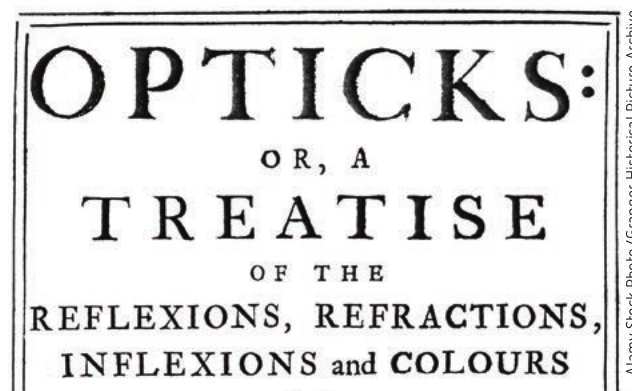
In 1704, Newton published Opticks, his comprehensive treatise on light. The work examined refraction, diffraction, and colour mixing. Newton's model proposed that light consisted of tiny particles called corpuscles that possessed mass.
Basic principles of Newton's model
Important
Newton's corpuscular theory rested on three fundamental principles:
- Light is composed of small particles with mass
- These particles follow the same physical laws as any other objects, whether billiard balls or planets
- The particles are extremely small, so when two light beams cross, the particles don't scatter each other
Explaining optical phenomena with particles
Rectilinear propagation and shadows
Newton viewed the straight-line travel of light (rectilinear propagation) as strong evidence for his particle theory. If light particles moved in straight lines, they would create sharp shadows—exactly what he observed. An interesting consequence of this theory is that light particles, having mass, would be subject to gravity and should follow parabolic trajectories in Earth's gravitational field.
Diffraction
Since particles travelling in straight lines cannot bend around corners, Newton explained diffraction (the slight bending of light around edges) as particles colliding with each other at object boundaries.
Reflection
The corpuscular theory successfully explained the law of reflection: the angle of incidence equals the angle of reflection. This matched how a particle, such as a ball bearing, bounces off a smooth surface in an elastic, frictionless collision.
Refraction and Snell's Law
Newton's explanation of refraction required an additional assumption: light particles experience attraction to matter particles. Deep within a transparent material, a light particle would experience equal attraction in all directions, resulting in no net force. However, as a particle approaches the surface of a denser medium at an angle, the short-range attractive forces create a net force perpendicular to the surface (normal to the surface).
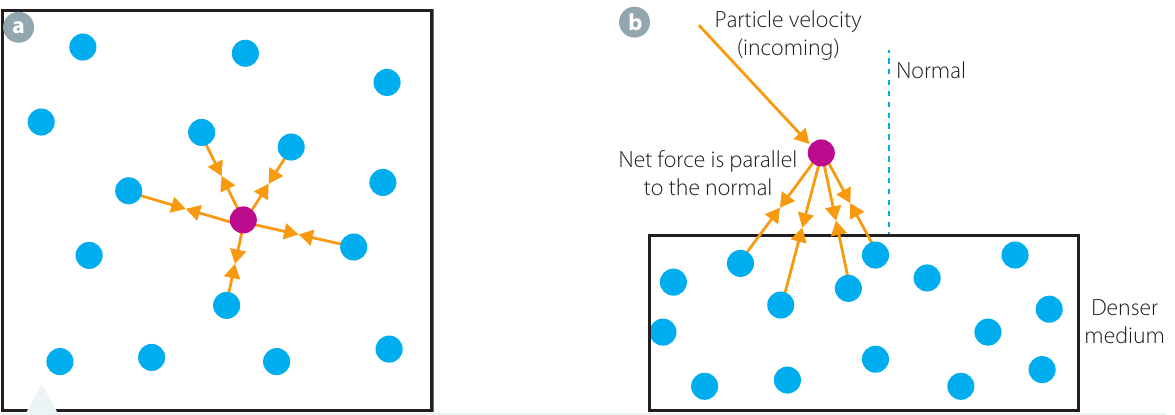
This net force causes the particle to accelerate, bending its path in a parabolic arc toward the normal as it enters the denser medium—matching experimental observations.
The component of the light particle's velocity parallel to the boundary remains unchanged by the normal force. Newton showed that the ratio of the sines of the incident angle () and refracted angle () equals the ratio of light velocities in the two media:
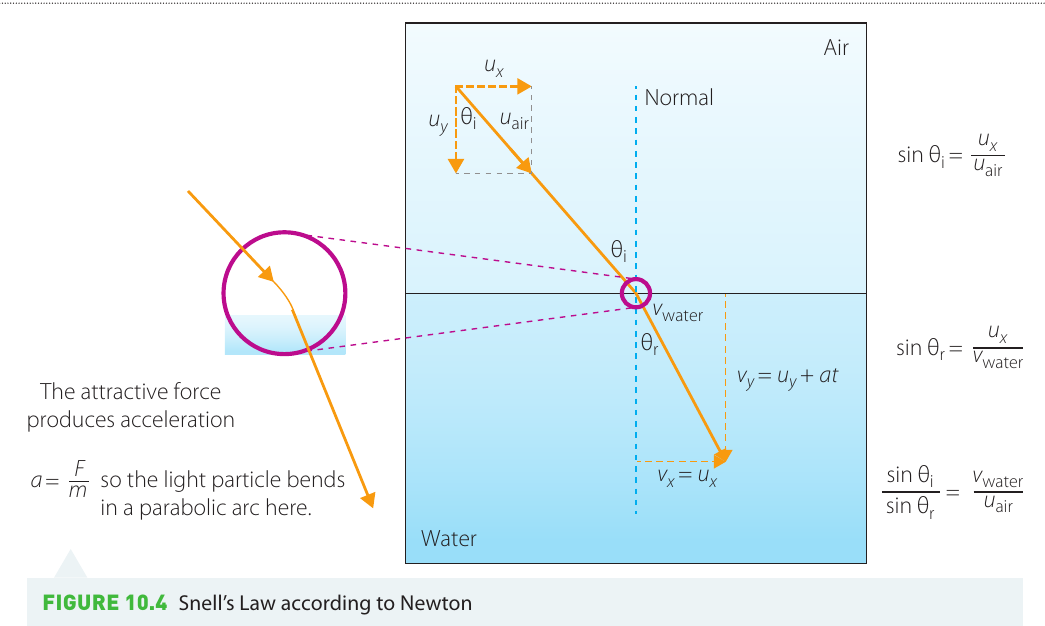
Important
Newton's Critical Assumption
This mathematical relationship explained why different transparent materials have different refractive indices—Newton simply needed to propose that light speed varied between materials. Crucially, his theory required that light travels faster in optically denser media than in less dense media.
He considered this a major success, writing in Opticks that he took it to be "a very convincing argument of the full truth of this proposition." However, this assumption would later prove to be the theory's fatal flaw.
Partial reflection during refraction
Newton observed that when light refracts, some light also reflects. He explained this through his Theory of Fits: some particles could "fit" between atoms and would refract, whilst others couldn't fit and would reflect instead.
Colours
Newton noted that different colours refract by different amounts—red light bends least, violet most. He explained this by proposing that light particle mass varies with colour. Different masses would have different inertia, so the same force would produce different accelerations as particles approached an optical interface, causing varying amounts of bending.
Polarisation
When you observe a light source through two sheets of polarised material and rotate one, the light intensity varies from maximum to minimum with 90° rotation, then returns to maximum. This demonstrates polarisation. If light particles were spherical, this couldn't occur. Newton therefore proposed that light particles must have sides, though he found it difficult to visualise their exact shape—whether rectangular or plate-like.
The decisive test: Foucault's experiment
In the 19th century, French physicist Léon Foucault used a rotating mirror to measure light's speed. He then applied this technique to test Newton's particle theory, which depended critically on the assumption that light travels faster in water than in air.
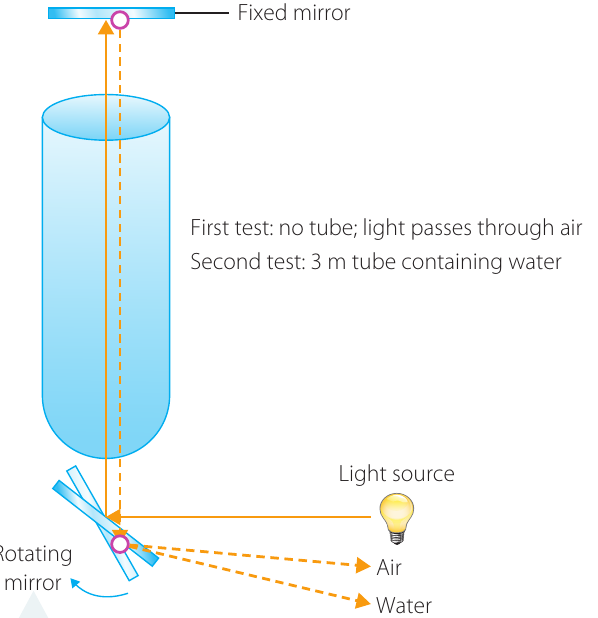
Foucault then introduced a 3-metre tube filled with water into the light path between the mirrors, so light passed through it twice. If Newton's theory were correct—if light travelled faster through water—the mirror would rotate less during the journey, and the return beam should deflect closer to the source.
Important
The Decisive Result
The result was precisely the opposite. Light travelling through water deflected to a point further from the source than the reference beam, proving that light travelled more slowly in water than in air.
This experiment was decisive. Since Newton's entire theory depended on light moving faster in optically denser media, the theory had to be abandoned.
This exemplifies how scientific theories work. As Albert Einstein later observed in 1919:
Note
"A theory can thus be recognised as erroneous if there is a logical error in its deductions, or as inadequate if a fact is not in agreement with its consequences. But the truth of a theory can never be proven."
This is often paraphrased as: "No amount of experimentation can ever prove me right; a single experiment can prove me wrong."
Huygens' wave model
Robert Hooke initially proposed the wave model of light in 1665, which Christiaan Huygens later refined and developed. Huygens' model explained aspects of light behaviour where Newton's theory struggled, particularly diffraction. However, it appeared weak on rectilinear propagation, which is why Newton rejected it. The scientific community largely ignored Huygens until 1802, when Thomas Young performed his famous double-slit experiment and measured the wavelengths of visible light, vindicating Huygens' ideas.
Huygens' principle
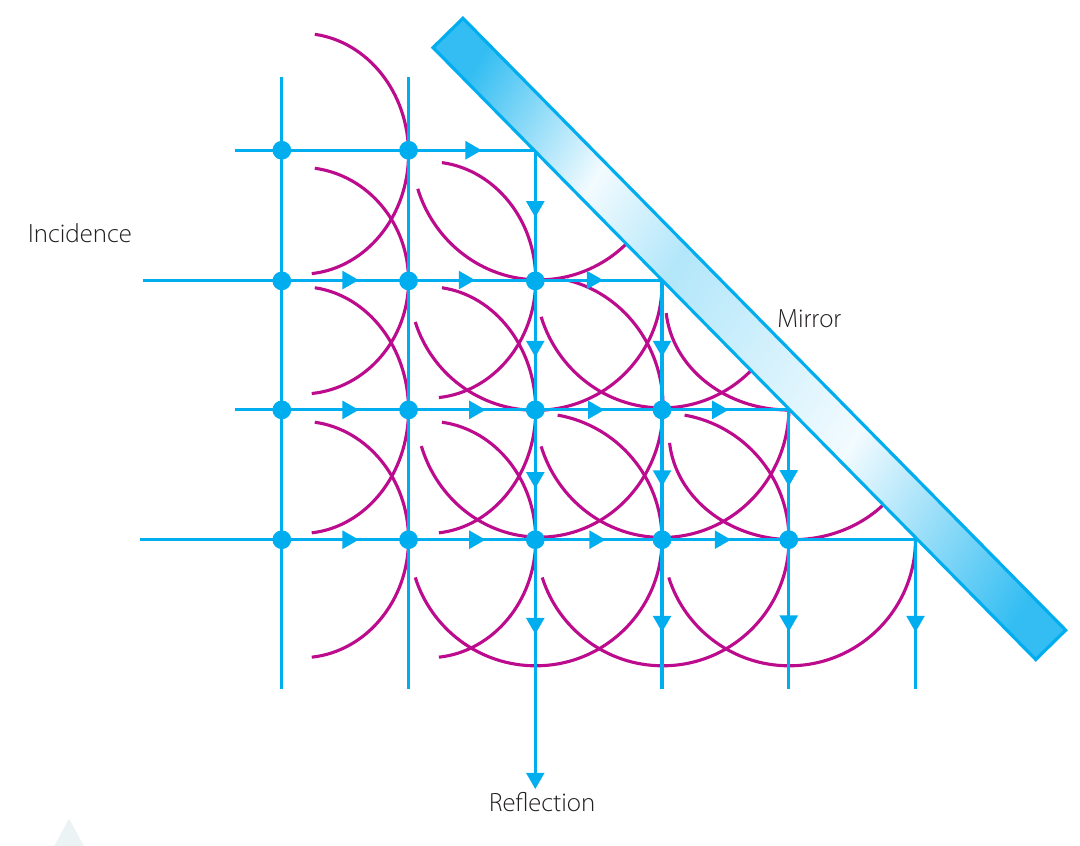
Huygens' principle states that each point on a wave acts as a point source, generating waves in the direction of propagation. The line tangent to these circular wavelets represents the new position of the wavefront a moment later. We don't observe the individual circular wavelets because of the principle of superposition—the wavelets combine to form the overall wavefront.
Wave explanation of reflection
When wavefronts meet a reflecting surface at the angle of incidence, new wavelets form at that point. The associated wavefront leaves the surface at the angle of reflection. Remember that Huygens' principle describes propagation direction.
Wave explanation of refraction
Huygens used his principle to propose that waves slow down when entering an optically denser medium, bending toward the normal and obeying Snell's Law. Importantly, Huygens didn't need to explicitly connect optical density with material density as Newton did.
Note
The observation that mechanical waves show both partial refraction and partial reflection when wave velocity changes strongly supported Huygens' model. This effect depends on the angle of incidence and is most pronounced when wave velocity increases—exactly what happens with light.
Diffraction and rectilinear propagation
Diffraction is the bending of light as it passes an object's edge or travels through a gap. The amount of diffraction depends on the relationship between the opening size and the wavelength.
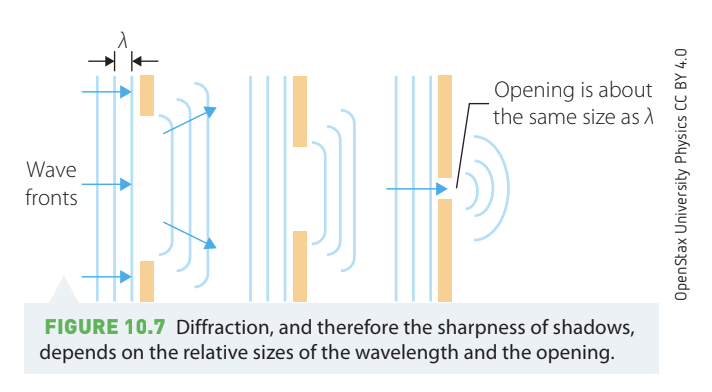
Consider light rays passing through an open doorway into a room—they create sharp shadows. However, sound coming through the same doorway can easily be heard throughout the room. This occurs because sound wavelengths are approximately the same order of magnitude as doorways.
Important
Resolution of the Rectilinear Propagation Problem
Once scientists determined that visible light wavelengths range between 400 and 700 nanometres, it became clear that the wave model better explained diffraction than the particle model.
This also resolved Huygens' issue with rectilinear propagation. With such small wavelengths, very little diffraction would occur, so light would appear to travel in straight lines in most situations—explaining why Newton's observation of straight-line propagation was correct, even though light behaves as a wave.
Summary
Key Points to Remember:
-
Two competing models existed in the 17th century: Newton's corpuscular (particle) theory and Huygens' undulatory (wave) theory.
-
Newton's particle theory assumed: light consists of small particles with mass that obey physical laws; it successfully explained reflection and refraction but required light to travel faster in denser media.
-
Foucault's decisive experiment used rotating mirrors to prove light travels slower in water than air, completely disproving Newton's theory since it depended on the opposite being true.
-
Huygens' principle states each point on a wave acts as a point source, with the tangent line to these wavelets forming the new wavefront position.
-
The wave model's strength was explaining diffraction once light's wavelength (400-700 nm) was measured—such small wavelengths explained why light appears to travel in straight lines whilst still behaving as a wave.