The Main Schools of Buddhism (HSC SSCE Studies of Religion): Revision Notes
📚Revision Notes
The Main Schools of Buddhism
Overview of Buddhist schools
Buddhism has evolved into three major schools or variants since the Buddha's death. These schools developed in different geographical regions and have distinct characteristics, though all share core Buddhist principles.
The three main schools are:
- Theravada Buddhism - primarily found in Sri Lanka, Burma (Myanmar), Thailand, Cambodia and Laos
- Mahayana Buddhism - dominant in Vietnam, China, Korea and Japan
- Vajrayana Buddhism - a specialised form of Mahayana Buddhism centred in Tibet
In recent centuries, all three schools have spread beyond their traditional Asian heartlands to Europe, the Americas and Australia. Today, approximately 100 million people practise Theravada Buddhism, while Mahayana Buddhism claims up to one billion followers worldwide, making it by far the largest Buddhist tradition.
Note
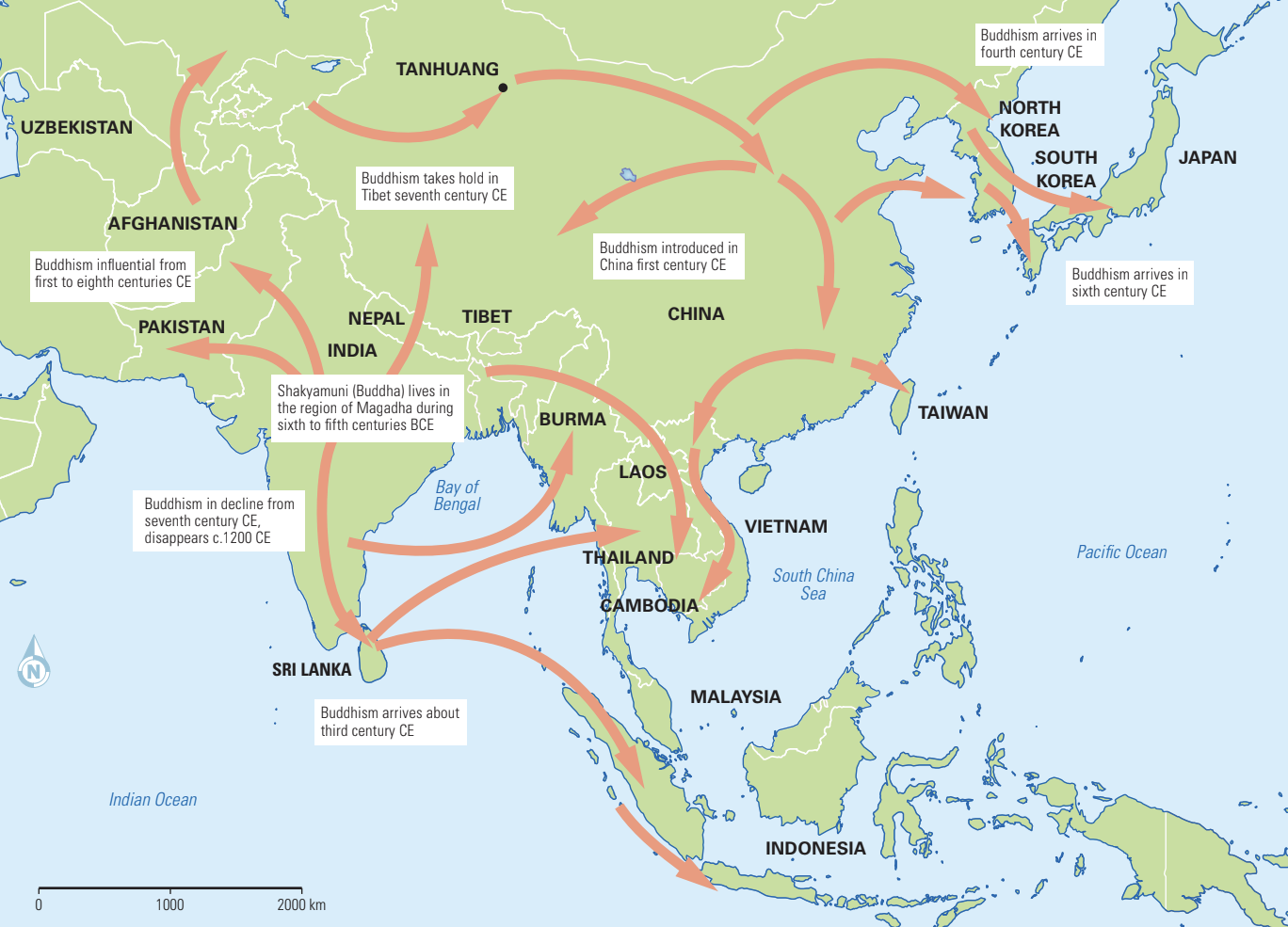
The geographical spread of Buddhism began in India (where the Buddha lived in the 6th-5th centuries BCE) and gradually moved outward. Buddhism arrived in Sri Lanka around the third century CE, reached China by the first century CE, Korea by the fourth century CE, and Japan by the sixth century CE. Tibet saw Buddhism take hold in the seventh century CE. Interestingly, Buddhism declined in its Indian homeland from the seventh century CE and had virtually disappeared by around 1200 CE.
Theravada Buddhism
Core characteristics
Theravada Buddhism, which translates literally as "way of the elders", is considered the orthodox or traditional school of Buddhism. Theravada Buddhists maintain that their teachings and monastic practices represent the oldest and most authentic form of Buddhism, staying closest to what the Buddha originally taught.
Note
Key term: Theravada - from Pali language meaning "teaching of the elders"; refers to the school claiming to preserve the Buddha's original teachings most faithfully.
The Theravada tradition emphasises that achieving nirvana (liberation from the cycle of rebirth and the realm of desire) requires total dedication to the Buddha's message. Practitioners believe this goal is reached through personal experience, careful analysis, disciplined thought and sustained meditation (the practice of training and regulating the mind).
The arhat ideal
Central to Theravada Buddhism is the concept of the arhat (Sanskrit) or arhant (Pali). An arhat is an individual who has completely eliminated their desire for rebirth and has thus achieved enlightenment. This represents someone who has reached the final goal of Buddhist practice and attained nirvana - becoming an enlightened and saintly person.
Note
Historically, most Theravada Buddhists today require guidance from wise members of the Sangha (monastic community) to progress toward enlightenment, though some exceptional individuals, like the Buddha himself, can achieve enlightenment independently.
Monastic emphasis and gender issues
Theravada Buddhism places strong emphasis on monastic life. This focus has had significant implications that shape the tradition's character and accessibility.
Important
Gender Imbalance in Theravada Practice:
The tradition generally accepts that only male monks can reach enlightenment, which has led to:
- Many nunneries in Theravada countries closing down over time
- Women's roles in achieving spiritual liberation remaining limited
- Ongoing debates about gender equality in Buddhist practice
This gender imbalance stems partly from ambiguous statements attributed to the Buddha in scripture. Some passages encourage the establishment of nunneries and female spiritual practice, while others suggest that accepting women into the Sangha would harm Buddhism's future. Modern Western Buddhist scholars have proposed that these negative passages may have been added later by men uncomfortable with women becoming arhats.
Theological approach
Theravada Buddhism generally rejects supernatural elements such as gods, spirits and mystical forces that appear in Mahayana Buddhism. This makes it often characterised as an atheistic form of Buddhism, focused purely on the Buddha's rational teachings about suffering, impermanence and the path to liberation.
Critics from the Mahayana tradition sometimes call Theravada Buddhism Hinayana, meaning "small vehicle", suggesting it is limited because it restricts the profound experiences of enlightenment primarily to monks rather than making them accessible to all people.
Mahayana Buddhism
Origins and development
Mahayana Buddhism began as a breakaway movement within the early Buddhist community in India, centuries after the Buddha's death. The word Mahayana translates literally as "great vehicle", contrasting with the "small vehicle" label applied to Theravada.
Note
Key term: Mahayana - literally "great vehicle"; refers to Buddhist schools that emphasise helping all beings achieve enlightenment, not just individual practitioners.
This movement introduced significant changes including modified monastic rules, adapted and expanded sacred texts, and rejection of certain decisions made at the first Buddhist council.
Mahayana Buddhism subsequently developed into several distinct schools. The two main philosophical schools are:
- Madhyamika - maintains a middle way between asserting that things exist or don't exist, resolving an early Buddhist philosophical controversy
- Yogacara - focuses on consciousness and meditation practices
The Bodhisattva path
What fundamentally distinguishes Mahayana from Theravada is the Bodhisattva ideal. A Bodhisattva is someone who has achieved complete enlightenment but chooses not to enter final nirvana. Instead, they take an oath to either remain in spiritual form to guide others, reincarnate repeatedly in physical form, or postpone their own final liberation.
Note
Key term: Bodhisattva - an enlightened being who delays entering nirvana in order to help all other beings achieve enlightenment; embodies compassion and selfless service.
This represents a major shift from Theravada's focus on individual liberation (the arhat path). The Bodhisattva delays their own ultimate peace for the sake of every other sentient being, making this a path of universal compassion rather than personal achievement.
Example
The Bodhisattva's Choice: Understanding Universal Compassion
Consider the difference between these two paths:
Arhat path (Theravada):
- Individual achieves enlightenment
- Enters final nirvana immediately
- Personal liberation is complete
Bodhisattva path (Mahayana):
- Individual achieves enlightenment
- Chooses to delay entering nirvana
- Remains to guide others toward enlightenment
- Liberation becomes a gift to all beings
This shift transforms enlightenment from a personal goal into a selfless act of service.
Early Mahayana thinkers questioned how individual enlightenment could truly help humanity. The Bodhisattva ideal resolved this by creating enlightened beings dedicated to guiding others. Mahayana Buddhism follows a 10-stage path of the Bodhisattva, each stage representing deeper levels of wisdom and compassion.
Geographical spread
From India, Mahayana Buddhism spread to multiple regions, adapting to local cultures while maintaining core principles:
-
Tibet - where it developed into Vajrayana
-
Vietnam - where it remains the dominant form
-
China - where it adapted to local culture from around the first century CE
-
Korea - passed from China
-
Japan - transmitted from Korea around the sixth century CE
Note
The success of Mahayana in China was partly because its Madhyamika philosophical thinking shared common ground with Taoism (Daoism), an established Chinese religion. By the Sui Dynasty (from approximately 580 CE), Buddhism had been adopted as a major court religion in China.
Theological and philosophical features
Mahayana Buddhism presents the Buddha not merely as a human teacher but as an all-knowing, transcendent being with cosmic significance. This represents a major theological development from Theravada's view of the Buddha as an enlightened human.
Key philosophical developments in Mahayana include:
Emptiness doctrine (Sunyata): Mahayanists developed the teaching that most phenomena on Earth are empty of inherent substance. This doctrine (body of teachings forming the basis of a belief system) suggests that what appears real is actually illusory, as the Buddha taught.
Spiritual beings: Unlike Theravada's atheistic approach, Mahayana Buddhism accepts that various spiritual beings or deities can assist followers in their search for enlightenment. This makes it a more theistic form of Buddhism.
Sudden enlightenment: Many Mahayana schools teach that nirvana can be achieved easily and sometimes suddenly, rather than requiring lifelong monastic dedication. Enlightenment becomes available to everyone: monks, nuns, laypeople, farmers and rulers alike.
Inclusivity
Mahayana Buddhism is notably more inclusive than Theravada, which has contributed significantly to its widespread adoption:
- Most Mahayana schools agree that women can achieve enlightenment as easily as men
- Enlightenment is accessible outside monasteries, in ordinary life
- Some schools suggest enlightenment can occur suddenly, without years of preparation
- The tradition adapts more flexibly to local cultural influences
This flexibility and inclusivity helps explain why Mahayana became far more popular than Theravada, spreading successfully across diverse East Asian cultures and becoming the largest Buddhist tradition globally.
Criticisms from Theravada
Theravada Buddhists argue that much of Mahayana practice extends beyond what the Buddha actually taught. Their specific concerns reflect fundamental differences in interpreting Buddhist authenticity.
Important
Theravada Concerns About Mahayana Practice:
- The concept of Bodhisattvas - no clear precedent in early Buddhism
- The idea of sudden enlightenment - contradicts the Buddha's teaching of gradual progress
- The worship of spiritual beings - contradicts the Buddha's rational, non-theistic approach
- Adaptation to local cultures - may compromise core teachings
These criticisms highlight the tension between preserving original teachings and adapting Buddhism to new contexts.
Vajrayana Buddhism
Origins and meaning
Vajrayana, which translates literally as "thunderbolt" Buddhism, developed mainly in Tibet as a variant within Mahayana Buddhism. The word vajra also refers to a bright, indestructible substance (like diamond), so Vajrayana came to be known as "diamond Buddhism". These metaphors reflect the tradition's goal: cutting through the illusions people construct about themselves, their status and desires, to access the real core of existence.
Note
Key term: Vajrayana - literally "thunderbolt" or "diamond vehicle"; refers to Tibetan Buddhist traditions emphasising mystical practices and rapid transformation.
Core concept: Prajna
A key element of Vajrayana Buddhism is prajna (Sanskrit word meaning wisdom), which is also significant in Mahayana Buddhism generally. This special kind of wisdom involves developing the ability to discriminate clearly between reality and illusion. Prajna encompasses both compassion for all beings and recognition that the world is ultimately illusory.
This wisdom allows practitioners to see through surface appearances and understand the true nature of existence.
Mystical and syncretic character
Vajrayana Buddhism is the most spiritualised and mystical of the three major Buddhist schools. It incorporates elements from multiple religious traditions, creating a unique syncretic approach.
Note
Vajrayana's Religious Synthesis:
Vajrayana incorporates elements from:
- Hinduism - various practices and concepts
- Animism - belief in spirits inhabiting natural objects
- Occultism - hidden spiritual knowledge and practices
- Magic - ritual practices to influence spiritual forces
- Bon religion - the indigenous pre-Buddhist religion of Tibet
This syncretic (blending) character makes Vajrayana distinct from both Theravada and mainstream Mahayana. The tradition emphasises direct spiritual experience over abstract philosophical emptiness.
Sacred texts and practices
The Tibetan Book of the Dead is a key Vajrayana text that serves as a manual for both the soul of the deceased (guiding them through the intermediate state between death and rebirth) and mourners and spiritual practitioners (helping them assist the deceased).
This text exemplifies Vajrayana's mystical approach, providing detailed descriptions of visions, spiritual beings and states of consciousness encountered after death.
The Dalai Lama
Vajrayana Buddhism has gained global recognition largely through the 14th Dalai Lama, who has lived in exile since fleeing Tibet in 1959. As a well-travelled Buddhist spokesperson, he has introduced Vajrayana teachings to worldwide audiences.
Note
The Dalai Lama holds special significance in Vajrayana tradition as he is considered a reincarnation of Avalokiteshvara, the Bodhisattva of Compassion. This belief that highly realised spiritual teachers deliberately reincarnate to continue helping beings is characteristic of Vajrayana's mystical worldview.
Comparing the three schools
The three schools of Buddhism share fundamental principles but differ significantly in their approaches to practice, enlightenment, and the role of monasticism. Understanding these differences helps clarify how Buddhism adapted to diverse cultural contexts.
| Feature | Theravada | Mahayana | Vajrayana |
|---|---|---|---|
| Meaning | "Way of the elders" | "Great vehicle" | "Thunderbolt/Diamond vehicle" |
| Geographic base | Sri Lanka, Burma, Thailand, Cambodia, Laos | Vietnam, China, Korea, Japan | Tibet, Mongolia, Bhutan |
| Followers | ~100 million | ~1 billion | Part of Mahayana count |
| Spiritual ideal | Arhat (individual enlightenment) | Bodhisattva (enlightenment to help others) | Bodhisattva with mystical practices |
| Monasticism | Heavily emphasised, especially for males | Important but enlightenment possible for laypeople | Important but includes tantric practices |
| Women's access | Generally restricted | Generally equal access | Generally equal access |
| View of Buddha | Enlightened human teacher | Transcendent, cosmic being | Transcendent being, multiple Buddha-forms |
| Supernatural elements | Generally rejected (atheistic) | Accepted (spiritual beings, deities) | Strongly emphasised (mystical, magical) |
| Path to enlightenment | Gradual, requiring monastic discipline | Can be sudden, available to all | Rapid transformation through special practices |
| Character | Conservative, orthodox | Flexible, inclusive | Mystical, syncretic |
Exam guidance
When answering questions about Buddhist schools, structure your responses carefully and demonstrate understanding of the complex relationships between the traditions.
Important
Exam Question Approaches:
For "explain" questions: Provide clear definitions and examples of key differences between schools. Focus on the arhat versus Bodhisattva distinction and the implications for practice.
For "analyse" questions: Examine why these schools developed differently. Consider factors like:
- Geographical spread and cultural adaptation
- Different interpretations of what the Buddha taught
- Varying emphasis on monasticism versus lay practice
- Debates about accessibility of enlightenment
For "evaluate" questions: Assess claims such as "Theravada is more authentic" or "Mahayana is more compassionate". Consider:
- What evidence exists for Theravada's claim to preserve original teachings?
- Does the Bodhisattva ideal represent genuine development or deviation from Buddhism?
- How have cultural factors shaped each school's character?
- What are the strengths and limitations of each approach?
Common exam mistakes to avoid:
- Oversimplifying - Don't reduce schools to simple labels like "strict" or "liberal"
- Confusing terms - Keep clear distinctions between arhat and Bodhisattva
- Ignoring geography - Remember how cultural contexts shaped each school
- Making value judgements - Present different views fairly without assuming one school is "better"
Summary
Key Points to Remember:
-
Three main schools: Buddhism divided into Theravada (Southeast Asia), Mahayana (East Asia) and Vajrayana (Tibet), with all three now spread globally
-
Population: Approximately 100 million Theravada Buddhists versus up to one billion Mahayana Buddhists (including Vajrayana)
-
Central distinction: Theravada follows the arhat path (individual enlightenment), while Mahayana follows the Bodhisattva path (enlightenment to help all beings)
-
Theravada characteristics: Claims to be most orthodox and traditional, emphasises monastic life, generally restricts full enlightenment to male monks, rejects supernatural elements
-
Mahayana characteristics: More flexible and inclusive, developed Bodhisattva ideal, accepts spiritual beings, teaches enlightenment is available to all regardless of gender or monastic status, adapted successfully to various Asian cultures
-
Vajrayana characteristics: Tibetan variant of Mahayana, highly mystical and syncretic, incorporates elements from Hinduism, Bon and other traditions, emphasises rapid transformation through special practices, represented globally by the Dalai Lama