The Sangha and the Councils (HSC SSCE Studies of Religion): Revision Notes
📚Revision Notes
The Sangha and the Councils
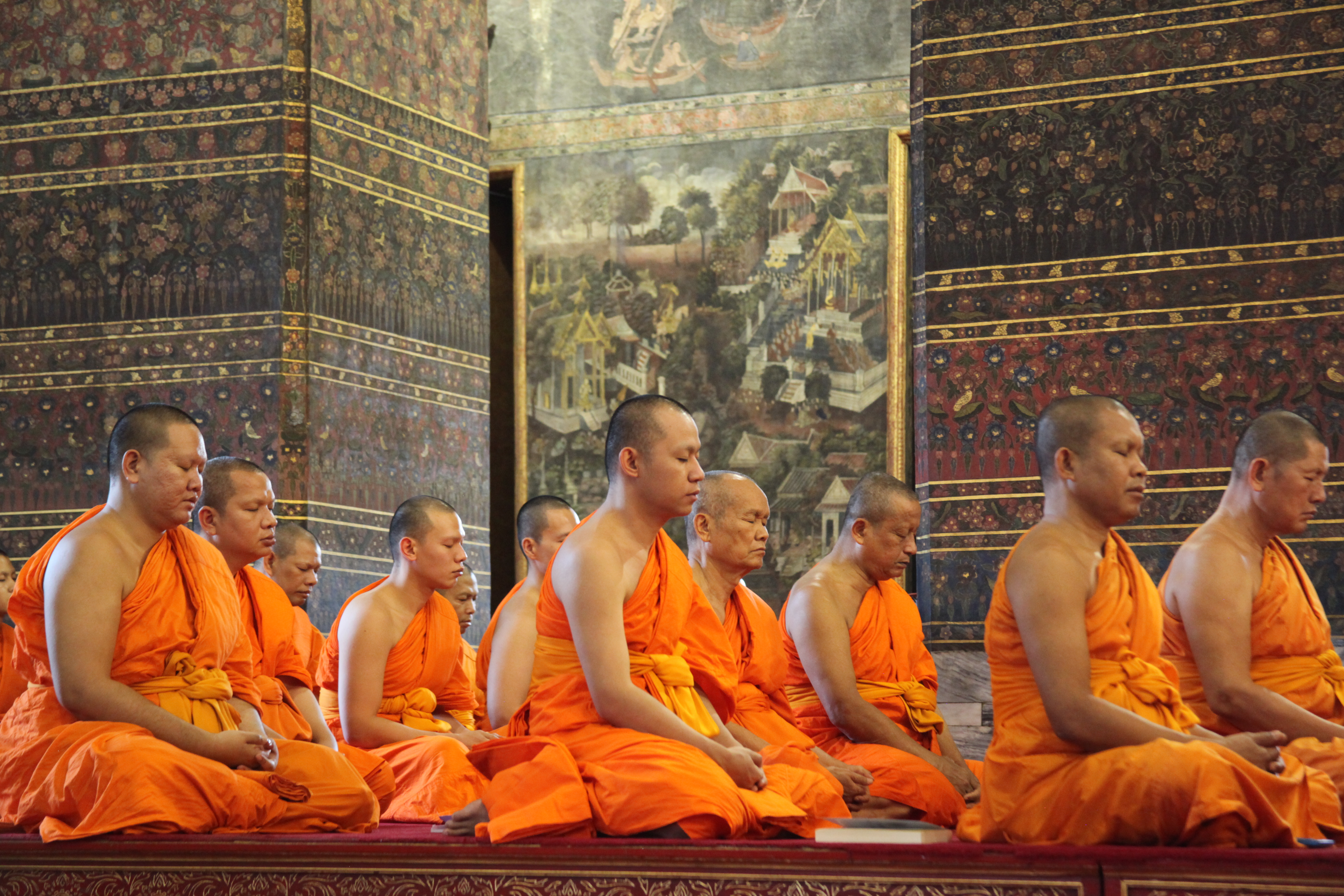
Formation of the Sangha
Origins of the monastic community
Following his enlightenment, the Buddha attracted a group of followers who became his disciples. These individuals formed the original Buddhist community, known as the Sangha. According to Buddhist tradition, after achieving enlightenment beneath the Bodhi tree, the Buddha remained in a state of bliss for several weeks. During this period, he was joined by five companions who had previously abandoned him when he resumed normal eating practices during his ascetic period.
The first disciples
The Buddha taught these five men the Four Noble Truths, marking the beginning of his teaching ministry. Ajnata Kaundinya became the first recognised disciple of the Buddha, establishing the foundation for what would become a significant religious movement. This initial group of followers represented the starting point of organised Buddhist practice and community life.
Purpose and activities of the Sangha
The Sangha served several vital functions in early Buddhism:
Preservation of teachings: The most important responsibility was to accurately preserve and transmit the Buddha's words. Members worked collectively to agree upon what the Buddha had taught, ensuring consistency and authenticity in his message.
Missionary work: For part of each year, Sangha members travelled throughout India on foot. They shared the Buddha's philosophy with people they encountered, spreading Buddhist teachings beyond their immediate community.
Communal living: During the rainy season, members returned to communal areas such as parks and purpose-built monasteries. This seasonal pattern created a distinctive rhythm to Buddhist monastic life.
Note
The seasonal pattern of the Sangha's activities was particularly practical for ancient India. During the rainy season, travel became difficult and potentially dangerous, making it the ideal time for monks to gather in monasteries for study and meditation. This rhythm of travel and retreat became a defining characteristic of early Buddhist monastic life.
Development of monastic Buddhism
The practices of the Sangha led Buddhism to become closely associated with monastic life. This development was significant because it differed from existing religious patterns in India:
- Traditional wandering ascetics moved constantly without stable communities
- Brahmin priests lived at temples or royal courts but did not form monastic orders
- The Buddhist Sangha created a new model: a dedicated monastic community focused on teaching and pursuing enlightenment
The monastery became the central institution of early Buddhism. Buddhist teachers and their communities provided stability and continuity for the developing tradition.
Monastic rules and the Vinaya texts
Early Buddhist discussions and texts increasingly focused on regulating monastic conduct rather than simply recording the Buddha's original teachings. These regulations became known as the Vinaya texts.
Rules for monks: Male monastics must follow several hundred rules governing their behaviour. Key prohibitions include:
- No consumption of alcohol
- No handling or use of money
- No sexual activity
Rules for nuns: Female monastics follow dozens of additional rules beyond those required of monks. This discrepancy reflects historical attitudes towards gender, though the Buddha's acceptance of female monastics was itself progressive for the time.
Differentiation: Sangha vs sangha
Important
Buddhist texts and scholars make an important distinction in terminology:
- Sangha (capital 'S'): Refers specifically to the monastic community of ordained monks and nuns
- sangha (lowercase 's'): Refers to the wider Buddhist community, including lay followers
This distinction helps clarify discussions about different aspects of Buddhist community life and organisation. When reading Buddhist texts or scholarly works, pay attention to the capitalisation as it signals which community is being discussed.
Mahapajapati and the female Sangha
Who was Mahapajapati?
Mahapajapati held a unique relationship to the Buddha. She served as both his aunt and stepmother, having married his father (the king) alongside her elder sister, Mahamaya, who was the Buddha's birth mother. When Queen Mahamaya died several days after giving birth, Mahapajapati raised the young prince from infancy. This close familial connection gave her significant influence in the Buddha's life.
The request for a female order
Mahapajapati was determined to establish a female order within the Sangha. According to Buddhist accounts, she approached the Buddha three times requesting that women be permitted to join the monastic community. On each occasion, the Buddha refused her request. His reluctance likely stemmed from concerns about the safety of female wandering monastics in that society.
Buddha's agreement
Note
Mahapajapati's persistence eventually succeeded. She approached the Buddha again, but this time employed a powerful demonstration. She waited nearby with other women, all with shaved heads and dressed in monastic robes. This visual presentation of their commitment convinced the Buddha to accept a female Sangha.
This story illustrates an important theme in Buddhism: the power of determined practice and demonstration of commitment, rather than mere verbal requests.
Significance for gender equality
The establishment of the female Sangha was remarkably progressive for its time:
Social context: In ancient India, the idea of women joining a wandering order of philosopher-monks challenged prevailing social norms. Women typically had limited independence and restricted social roles.
Buddhist inclusivity: The Buddha had already demonstrated his commitment to social equality by welcoming people from all castes, not just the priestly Brahmin class. By accepting women into the Sangha, Buddhism began to address gender inequality alongside class discrimination.
Historical impact: This decision established Buddhism as one of the earliest organised religions to formally include women in its ordained community.
Ongoing challenges
Despite this progressive beginning, gender equality in Buddhism remains incomplete:
Persistent attitudes: Some Buddhist traditions maintain that women cannot achieve the same spiritual development as men. This view contradicts the Buddha's acceptance of female monastics.
Regional variations: Theravada Buddhism in countries such as Thailand, Burma (Myanmar), and Sri Lanka presents particular challenges. In these regions, monasteries for women are rare, and full ordination for nuns is often not recognised or available.
Modern developments: Contemporary Buddhist communities continue to debate and address these gender-related issues, with varying degrees of progress across different traditions and countries.
The early councils
Purpose of Buddhist councils
After the Buddha's death, the Buddhist community faced a critical challenge: how to maintain authentic teachings without their original teacher. Buddhist councils served to address this need by:
- Establishing agreed-upon versions of the Buddha's teachings
- Debating and codifying rules for monastic behaviour
- Resolving disputes within the community
- Ensuring the authority and authenticity of Buddhist texts
The first council
Timing: Held immediately after the Buddha's death
Key outcomes: The first council achieved several foundational results for Buddhism:
Settlement of the Dharma: Participants agreed upon the content of the Buddha's teachings (the Dharma, also spelled dhamma). This established what would be considered authentic Buddhist doctrine.
Codification of monastic rules: The council formalised most rules governing monk and nun behaviour in the Vinaya texts.
Note
Ananda's recitation: One of the Buddha's closest companions, Ananda, recited from memory all Buddhist scriptures known at that time. The assembled monks accepted his recitation as accurate and authoritative.
Ananda's role was crucial because he had served as the Buddha's personal attendant for many years and had reportedly heard all of the Buddha's teachings. His exceptional memory made him the ideal person to preserve the Buddha's words for future generations.
Beginning of the Pali Canon: This council initiated the formation of the Pali Canon (also called the Tripitaka, meaning 'three baskets'). The name 'Pali Canon' refers to the Pali language in which it was written.
The second council
Timing: Held at Vaishali, approximately 70 years after the first council
Key events: Another major recitation of texts took place at this council. However, the second council became particularly significant due to controversy within the community.
The money controversy: Some monks were criticised for accepting and handling money, which violated the Buddha's teachings and monastic rules. This issue sparked intense debate among council participants.
Important
Resolution and consequences: The council ultimately judged that monks who had handled money were in the wrong. However, the disputes at this council created divisions within Buddhism that would have lasting effects.
Origin of Buddhist schools: The disagreements at the second council eventually led to the formation of two major variants of Buddhism:
- Theravada Buddhism ('way of the elders') - emphasising traditional monastic practice
- Mahayana Buddhism ('great vehicle') - developing a more flexible approach that would later spread throughout East Asia (China, Japan, Vietnam, and Korea)
This schism represents one of the most significant turning points in Buddhist history, creating the two major branches that exist today.
The third council
Timing: Held during the reign of Emperor Asoka, approximately 200 BCE to 100 CE
Historical context: Emperor Asoka had inherited or conquered most of northern India. As a convert to Buddhism, he used his authority to support and spread the religion.
Key outcomes:
Affirmation of Theravada: The council officially confirmed 'the approved teaching of the elders' (Theravada) as orthodox Buddhism.
Completion of the Tripitaka: The council added the third part of the Pali Canon, the Abhidharma (or Abhidhamma). This section consists of discussions and commentaries on the Buddha's sermons, completing the three-part structure of the Tripitaka.
Note
Expansion of Buddhism: During and after this council, Buddhism experienced its greatest period of growth in India. Emperor Asoka sent missionaries both eastward and westward, spreading Buddhism beyond India's borders for the first time.
Emperor Asoka's conversion to Buddhism and his subsequent missionary efforts were pivotal in transforming Buddhism from a regional Indian religion into a world religion. His support provided both legitimacy and resources for Buddhist expansion.
Importance of the councils
The early Buddhist councils served crucial functions for the developing religion:
Establishing authority: After the Buddha's death, the community needed a new source of religious authority. The councils provided this by authenticating teachings and creating authoritative texts.
Resolving disputes: Councils offered a mechanism for addressing disagreements within the community, though they did not always prevent schisms.
Preserving authenticity: By carefully agreeing on the Buddha's words and codifying his teachings, the councils helped maintain the integrity of Buddhist doctrine across generations.
Creating sacred texts: The councils were instrumental in forming the Pali Canon, which remains central to Buddhist practice today.
Exam guidance
Analytical approaches
When analysing the Sangha and councils, consider:
Continuity and change: How did the councils help maintain Buddhist teachings while also allowing the religion to evolve?
Authority and authenticity: Evaluate how Buddhism established religious authority without its founder. What role did collective agreement play?
Social inclusion: Assess the significance of Buddhism's approach to class and gender equality. How revolutionary were these practices?
Common exam questions
Evaluate questions might ask you to assess the importance of the councils in Buddhism's development. Consider both their successes (preserving teachings, creating texts) and limitations (causing schisms, incomplete gender equality).
Analyse questions might focus on the relationship between monastic rules and Buddhist philosophy. Think about how the Vinaya texts reflect broader Buddhist principles.
Assess questions might examine the role of women in Buddhism. Consider the gap between the Buddha's acceptance of female monastics and ongoing gender inequality in some Buddhist traditions.
Remember!
Summary
Key Points to Remember:
- The Sangha originated with the Buddha's first five disciples after his enlightenment, establishing the monastic community central to Buddhism
- Mahapajapati, the Buddha's aunt and stepmother, successfully advocated for a female order, making Buddhism progressive on gender equality for its time
- The first council (immediately after Buddha's death) established the Dharma and Vinaya texts, with Ananda reciting scriptures from memory
- The second council (at Vaishali, ~70 years later) debated monks handling money, leading to divisions that eventually created Theravada and Mahayana Buddhism
- The third council (under Emperor Asoka, ~200 BCE-100 CE) completed the Tripitaka with the Abhidharma and expanded Buddhism beyond India
Highlighted Key Terms:
- Sangha (capital S) = monastic community of monks and nuns
- sangha (lowercase s) = wider Buddhist community including lay followers
- Vinaya texts = rules governing monastic behaviour
- Pali Canon/Tripitaka = Buddhist sacred texts ('three baskets')
- Dharma/dhamma = the Buddha's teachings
- Theravada = 'way of the elders', orthodox Buddhist school
- Mahayana = 'great vehicle', more flexible Buddhist school
- Abhidharma = commentaries on Buddha's sermons, third part of Tripitaka
Critical Framework:
The councils demonstrate Buddhism's solution to the challenge of maintaining religious authenticity after a founder's death: collective agreement within the community, codification of teachings, and creation of authoritative texts. However, this process also reveals tensions between preserving tradition and adapting to change, evident in the emergence of different Buddhist schools.