From Cells to Systems (VCE SSCE Biology): Revision Notes
📚Revision Notes
From Cells to Systems
Introduction to biological organisation
Complex living things like plants and animals are made up of many specialised cells working together. These cells cannot survive on their own - they must cooperate with other cells to meet the needs of the whole organism. This cooperation is achieved through organisation into increasingly complex structures.
Note
Understanding biological organisation is fundamental to comprehending how complex organisms function. Each level of organisation builds upon the previous one, creating a hierarchy that allows life to exist at scales ranging from microscopic cells to entire organisms.
Key definitions:
- Organism: A living thing made up of one or more cells
- Cell: The smallest functional unit of a living organism
- Specialised cells: Cells which serve a unique, particular function
- Tissue: A cluster of cells which perform a shared function
- Organ: The combination of tissues and cells into a distinct structure that performs a specific function
- System: A collection of organs and tissues that perform specific functions necessary for survival
Levels of biological organization
Complex multicellular organisms arrange their cells into four levels of increasing complexity:
- Cells - Individual specialised cells
- Tissues - Groups of similar cells working together
- Organs - Multiple tissues combined into recognisable structures
- Systems - Collections of organs working together for vital functions
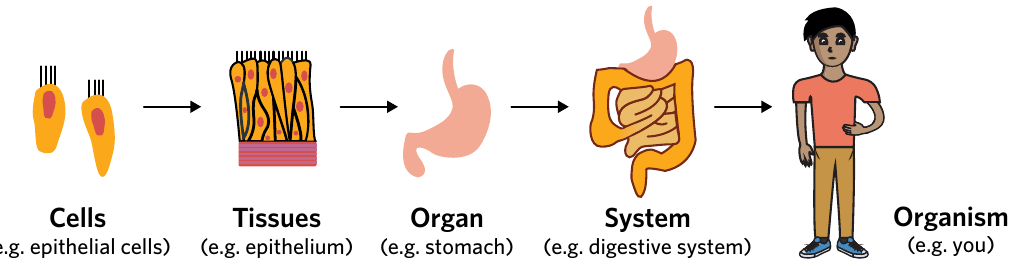
This hierarchical arrangement allows organisms to carry out complex processes that individual cells cannot perform alone. Each cell requires nutrients, oxygen, waste removal, and stable conditions (temperature, pH). Meeting these needs becomes increasingly challenging as organisms grow larger and more complex, requiring greater coordination between cells.
Note
The hierarchical organisation of cells into tissues, organs, and systems is not just for efficiency - it's essential for survival. As organisms become larger, the distance between cells and the external environment increases, making direct exchange of materials impossible. This necessitates the development of specialised systems for transport, waste removal, and maintaining stable internal conditions.
Why organisms need this organization
As organisms increase in size and complexity, individual cells can no longer directly exchange materials with the environment. Greater cooperation and coordination becomes essential for survival. Some simple organisms (like jellyfish and corals) only require tissues for their survival needs, but more complex organisms need the full hierarchy of organisation.
Important
The size of an organism directly affects its organisational requirements. Simple organisms like jellyfish can survive with only tissue-level organisation, but larger, more complex organisms require the complete hierarchy of cells → tissues → organs → systems to meet the needs of all their cells.
Organisation of plants
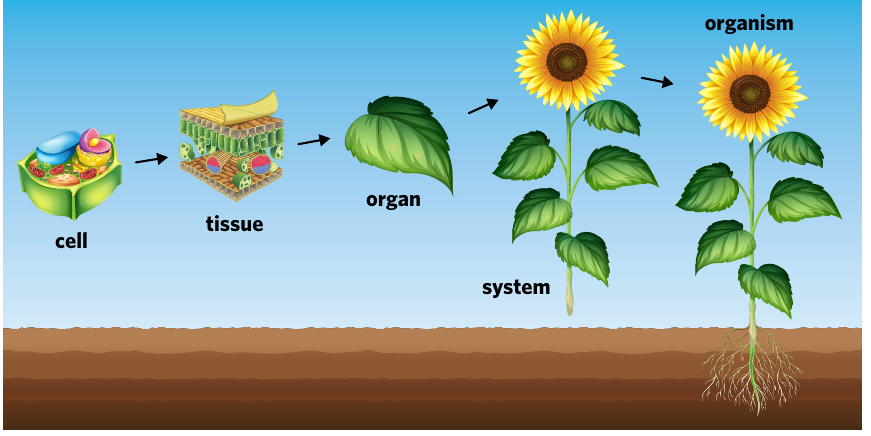
Plant cells are organised into specialised tissues, distinct organs, and two major systems that allow them to survive and reproduce.
Plant cells
Vascular plants are plants that contain vascular tissue responsible for transporting water and minerals throughout the plant. Non-vascular plants (such as moss) lack this tissue and only require simpler tissues to function.
The major types of vascular plant cells include:
| Cell type | Function |
|---|---|
| Parenchyma cells | The major cells of plants, responsible for photosynthesis and other metabolic activity |
| Sclerenchyma cells | Provide support to the plant |
| Collenchyma cells | Provide support to the plant |
| Xylem cells | Responsible for the transport of water and minerals from the roots to the leaves |
| Phloem cells | Responsible for the transport of sugars and other nutrients throughout the plant |
Key definitions:
- Vascular tissues: Conducting tissues that transport water and nutrients throughout a plant. An encompassing term for xylem tissue and phloem tissue
Note
The distinction between vascular and non-vascular plants is crucial. Vascular tissue allows plants to grow tall and transport resources efficiently over long distances. This is why trees can reach enormous heights, while non-vascular plants like mosses remain small and close to the ground where they can absorb water directly.
Plant tissues
Plant cells combine to form three main types of tissue:
- Dermal tissue: A single layer of cells covering the outside of the plant. It secretes a waxy film called a cuticle that forms a physical barrier between the plant and its environment, reducing water loss and physical damage.
- Ground tissues: Make up the majority of the plant's interior and carry out metabolic functions like photosynthesis and storage.
- Vascular tissues: Run through the ground tissue, carrying water and nutrients throughout the plant.
Plant organs
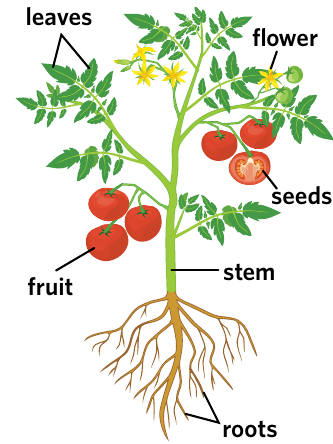
Plants have five major organs, each performing specific functions:
| Organ | Function |
|---|---|
| Leaves | Sites of gas exchange and responsible for photosynthesis. Usually organised to increase sunlight exposure |
| Flowers | The sexual reproductive organs of flowering plants (angiosperms). After fertilisation of male and female gametes in pollen, seeds develop and the ovary grows into a fruit |
| Fruits | Grown from a flower after fertilisation. Protect seeds and are often specialised to attract animals that help with seed dispersal |
| Stems | Support the leaves, flowers, and fruits, as well as transport water and nutrients between roots and shoots |
| Roots | Absorb and store water and nutrients from the soil. Also anchor the plant to the ground and provide structural support |
Plant systems
Vascular plants have two major organ systems:
- Root system: Typically underground. Absorbs water and nutrients from the soil and provides the plant with support and structure.
- Shoot system: Made up of:
- Reproductive sections: Flowers and fruit
- Non-reproductive sections: Leaves and stems
The shoot system is the above-ground portion of the plant responsible for photosynthesis, reproduction, and connecting different parts of the plant.
Note
The division of vascular plants into root and shoot systems reflects the dual challenge plants face: obtaining resources from the soil while simultaneously capturing light energy from the sun. The root system is specialised for underground resource acquisition, while the shoot system is optimised for above-ground photosynthesis and reproduction.
Organisation of animals
Animal cells combine to form four major tissue types, which are organised into organs and ultimately into complex systems.
Animal cells
Complex animals contain hundreds of different specialised cell types, each responsible for specific functions. Common examples include skin cells, muscle cells, blood cells, nerve cells, and fat cells.
Animal tissues
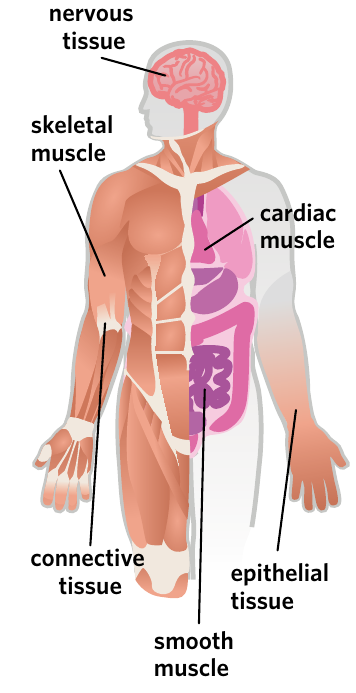
In animals, cells are grouped into four main tissue types:
| Tissue type | Function |
|---|---|
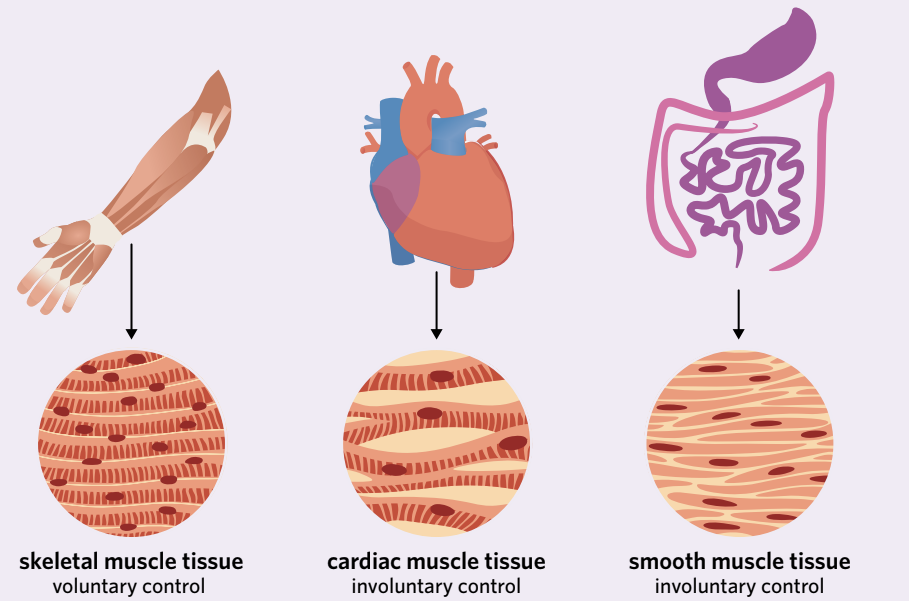
| Muscle tissue | Contracts to exert a force. The three major types are skeletal, cardiac, and smooth muscle tissue |
| Nervous tissue | Detects stimuli and transmits electrical signals. Composed of neurons that detect stimuli and carry signals, plus glia that assist neuron signal transmission |
| Connective tissue | Connects and supports other tissues and organ structures of the body |
| Epithelial tissue | Forms the external and internal layers of the body. These tissues assist in protection, secretion, and absorption |
Types of muscle tissue
There are three distinct types of muscle tissue in animals:
- Skeletal muscle tissue:
- Attached to bones via connective tissues called tendons
- Under voluntary (conscious) control
- Contracts to assist movement
- Cardiac muscle tissue:
- Found entirely in the heart
- Contracts to pump blood around the body
- Under involuntary (unconscious) control
- Smooth muscle tissue:
-
Found in the linings of hollow organs and structures (stomach, intestines, blood vessels)
-
Contracts slowly to change the shape and size of these structures
-
Under involuntary control
-
Important
Understanding the difference between voluntary and involuntary muscle control is crucial. Skeletal muscle is under voluntary control, meaning we consciously decide to move it. However, cardiac and smooth muscle operate automatically, controlled by the nervous system without conscious thought. This is why your heart keeps beating and your digestive system keeps working even when you're asleep!
Key definitions:
- Muscle tissue: Collection of animal cells that are capable of contraction. Includes skeletal, cardiac, and smooth muscle
- Nervous tissue: Collection of animal cells that sense stimuli and initiate responses. Also known as nerve tissue
- Connective tissue: Collection of many different animal cells that bind and support the other major tissue types
- Epithelial tissue: One of the basic tissue types in animals that line the outer surface of organs and blood vessels
Animal organs
Animal organs are easily recognisable structures inside the body that perform specialised tasks. Major human organs include:
- Brain
- Heart
- Lungs
- Liver
- Stomach
- Pancreas
- Kidneys
- Intestines
- Bladder
Note
It is rare for a single organ to function independently - instead, organs and tissues work together to form larger systems. This interconnection ensures that the body operates as a coordinated whole, with multiple systems supporting each other to maintain life.
Animal systems
Complex animals have multiple systems that perform vital tasks essential for survival. The 11 major systems in humans are:
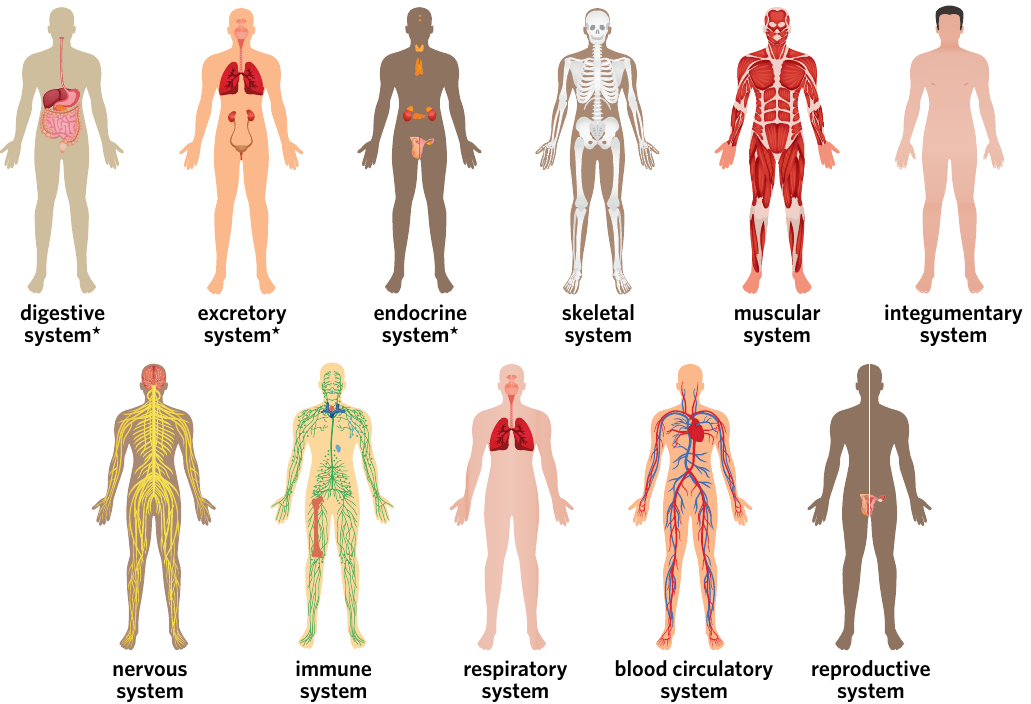
The 11 major human body systems
| System | Function | Example organs/tissues |
|---|---|---|
| Digestive system | Breaks down and processes food to be used by the body. Eliminates food waste that is not digested via egestion | Stomach, liver, pancreas, small intestine, large intestine |
| Excretory system | Removes waste substances from the blood via excretion. Also assists in controlling water balance in the body | Kidneys, bladder, lungs |
| Endocrine system | Responsible for the production and secretion of hormones which control and regulate bodily processes | Hypothalamus, pituitary gland, thyroid gland, thymus, pancreas, adrenal glands |
| Skeletal system | Provides an internal structure to support the body. Works together with the muscular system to enable movement | Bones, joints, cartilage |
| Muscular system | Responsible for contractions in skeletal muscle, the heart, and other contractions throughout the body. Works together with the skeletal system to enable movement | Skeletal muscles, cardiac muscles, tendons |
| Integumentary system | Protects internal body structures from the external environment | Skin, hair, nails, subcutaneous fat |
| Nervous system | Detects and processes sensory information to activate responses in the body | Brain, spinal cord, peripheral nerves |
| Immune system | Defends the body against infection. Contains the lymphatic system which transports lymph fluid around the body | Bone marrow, spleen, thymus, tonsils, lymph nodes |
| Respiratory system | Responsible for removing carbon dioxide from the body and delivering oxygen to the blood via respiration | Lungs, nasal passage, trachea |
| Blood circulatory system | Delivers oxygen and nutrients to the tissues of the body via blood | Heart, blood vessels (arteries, veins, and capillaries) |
| Reproductive system | In males, regulates the production of sperm and certain hormones. In females, regulates the production of egg cells, certain hormones, ovulation, and nurturing offspring during development. In both sexes, coordinates action for reproduction | Testes, penis, ovaries, vagina, uterus, mammary glands |
Key definitions:
- Hormone: A signalling molecule released from endocrine glands that regulates the growth or activity of target cells
Note
The 11 major systems don't operate in isolation - they are highly interconnected. For example, the respiratory system works closely with the blood circulatory system to transport oxygen throughout the body, while the digestive system provides nutrients that the circulatory system then distributes to all cells. This integration allows the body to function as a unified whole.
Gas exchange in animals
All animals need to absorb oxygen for aerobic cellular respiration and expel carbon dioxide to prevent toxic buildup. This process is known as respiration and is typically carried out by the respiratory and blood circulatory systems.
Very simple animals (such as sponges, coral, and flatworms) can exchange gases directly with the environment. They do not require a respiratory system for gas exchange or a blood circulatory system to transport gases throughout their body.
Complex animals are often too large to passively exchange gases with the environment, and therefore require more advanced respiratory and blood circulatory systems:
- Humans: The lungs carry out gas exchange, whilst the trachea carries gas between the lungs and the environment.
- Insects: Air enters through tiny holes called spiracles, which attach to a network of internal tubes called trachea. This network, combined with an insect's open blood circulatory system, allows oxygen to reach all cells of the body.
- Fish: Fish have extremely efficient gas exchange systems to compensate for the low oxygen content of water (about 1% O₂ compared to 21% in air). Their gills, located on the sides of their throat, are made of gill arches composed of specialised rows of filaments, which are made of tightly packed lamellae. Water taken in through the mouth is pushed out between the gill arches and lamellae. The high surface area of the lamellae allows oxygen and carbon dioxide to quickly diffuse in and out of the gills. Oxygen is then transported around the body via the blood circulatory system.
Important
The complexity of an animal's respiratory system is directly related to its size and metabolic needs. Simple, small animals can rely on diffusion alone, but larger animals need specialised respiratory surfaces (like lungs or gills) with large surface areas and efficient circulatory systems to deliver oxygen to all cells.
Comparing plant and animal organization
Both plants and animals follow the same hierarchical pattern of organization, but with different specific structures:
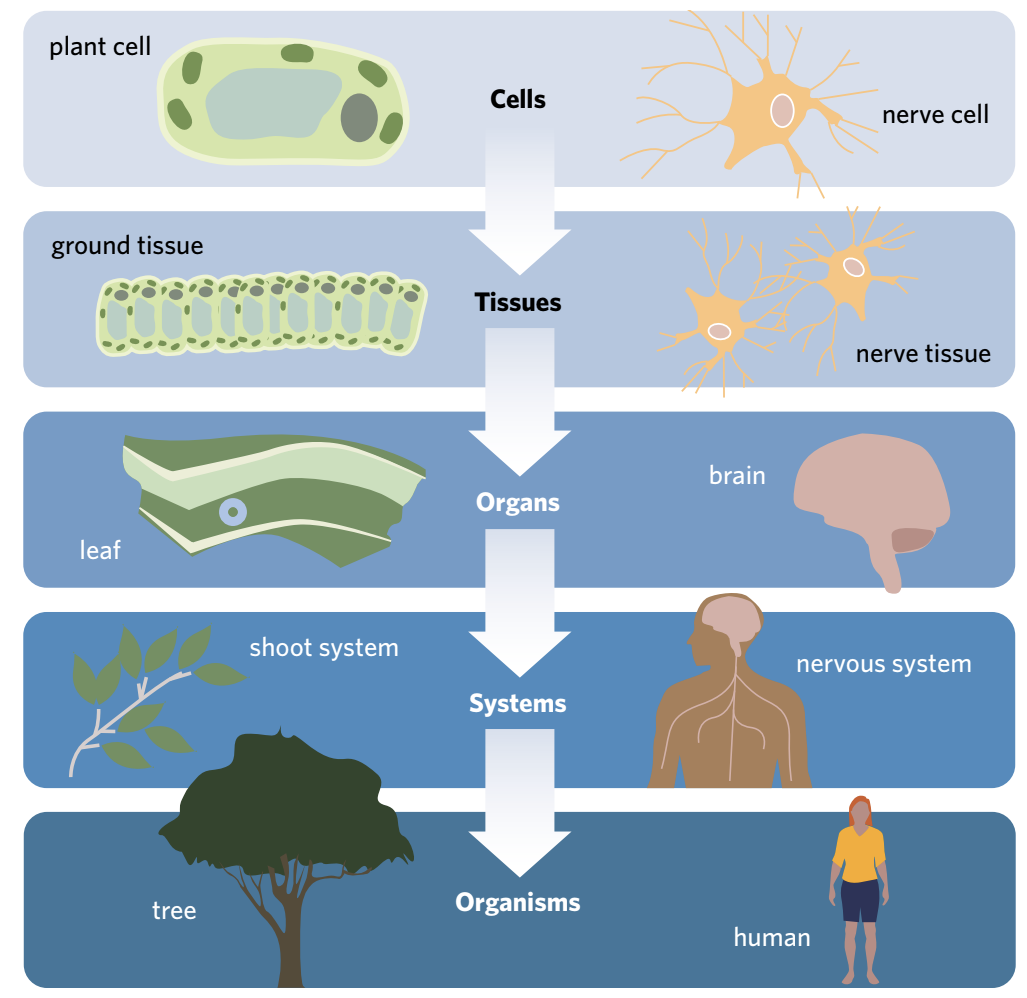
Plants: Cell → Tissue (e.g. ground tissue) → Organ (e.g. leaf) → System (e.g. shoot system) → Organism
Animals: Cell → Tissue (e.g. nerve tissue) → Organ (e.g. brain) → System (e.g. nervous system) → Organism
This organisation allows both plants and animals to coordinate sophisticated functions that individual cells cannot perform alone. With increased organisation, cells, tissues, organs, and systems are able to perform specific and vital body functions necessary for the survival of the whole organism.
Note
While plants and animals have evolved different specific structures, they both rely on the same fundamental principle of hierarchical organisation. This convergent pattern demonstrates that building complexity through levels of organisation is a universal solution to the challenges faced by multicellular life.
Remember!
Summary
Key Points to Remember:
- Complex organisms organise their cells into four levels: cells → tissues → organs → systems
- Plants have two major systems: the root system (underground) and the shoot system (above ground)
- Plant vascular tissue includes xylem (transports water and minerals) and phloem (transports sugars and nutrients)
- Animals have four tissue types: muscle, nervous, connective, and epithelial
- There are three types of muscle: skeletal (voluntary), cardiac (involuntary), and smooth (involuntary)
- Humans have 11 major body systems, each performing vital functions necessary for survival