The Endocrine System (VCE SSCE Biology): Revision Notes
📚Revision Notes
The Endocrine System
Introduction to cell communication
In multicellular organisms like humans, cells throughout the body need to communicate with each other to coordinate their activities. This communication is essential for performing many synchronized functions and responding to environmental changes. Cells achieve this communication by sending and receiving special chemical messengers called signalling molecules.
A signalling molecule is a molecule which can interact with and initiate a response in a target cell. These molecules can instruct cells to perform various tasks, including:
- Altering gene expression
- Opening and closing protein channels
- Releasing other signalling molecules
- Triggering cell death when necessary
Note
Cell communication is the foundation of how multicellular organisms function as coordinated systems rather than just collections of individual cells. Without this communication, the body couldn't respond to changes in the environment or maintain internal balance.
Hormones: Key signalling molecules
One of the most important groups of signalling molecules is hormones. A hormone is a signalling molecule released from endocrine glands that regulates the growth or activity of target cells.
Hormones play crucial roles in:
- Growth and development
- Metabolism (how the body uses energy)
- Maintaining a stable internal environment
- Sexual development and reproductive function
How hormones work: Receptor specificity
Hormones function through a highly specific mechanism. Each hormone molecule binds to a particular receptor on target cells. A receptor is a structure (usually a protein) that detects a signal or external change. Think of it like a lock and key system - each hormone (key) only fits specific receptors (locks).
A target cell is a cell that will receive and respond to a specific signalling molecule. Only cells with the appropriate receptor can respond to a particular hormone. This makes hormonal communication very specific and precise.
Important
The Lock and Key Mechanism
Hormone specificity works like a lock and key system:
- Each hormone (the "key") has a unique shape
- Only target cells with the matching receptor (the "lock") can respond
- This ensures hormones only affect their intended targets, even though they travel throughout the entire bloodstream
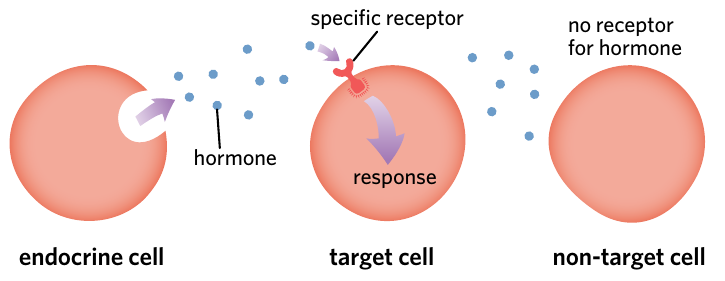
As shown in the diagram above, when a hormone encounters:
- A target cell with the specific receptor - the hormone binds and triggers a cellular response
- A non-target cell without the receptor - the hormone has no effect and simply passes by
This specificity ensures that hormones only affect the intended cells and organs, even though they travel throughout the entire body.
The endocrine system: Organs and glands
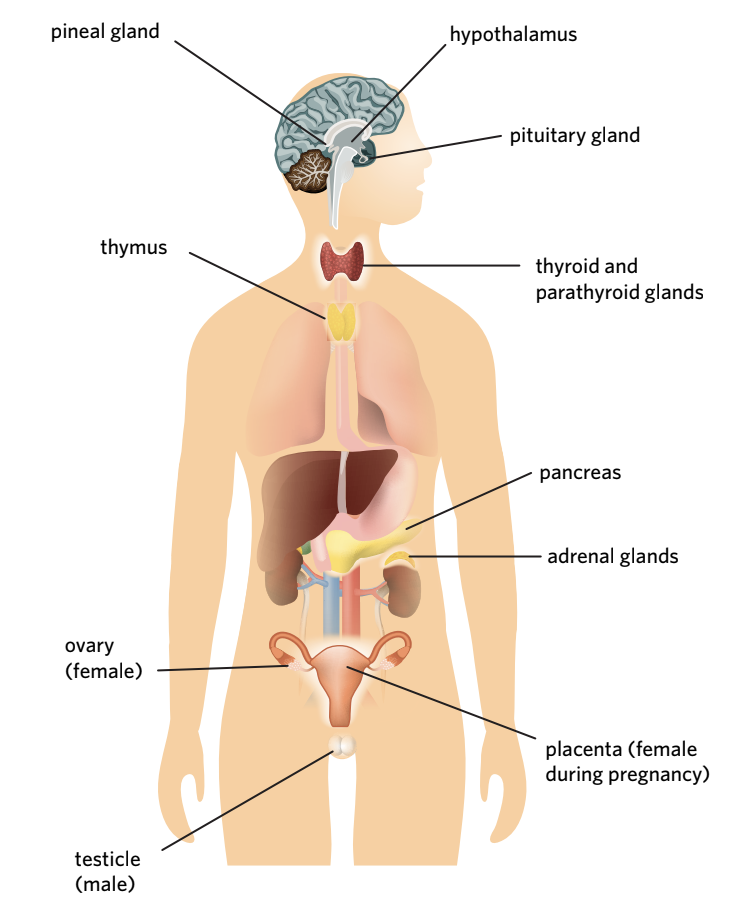
The endocrine system is the collection of glands in animals responsible for producing hormones that can be transported in the bloodstream to regulate distant organs/cells. A gland is a group of cells that secretes chemical substances to regions of the body or discharges them into the surroundings.
After endocrine glands produce hormones, these chemical messengers are released into the bloodstream. The blood circulatory system - the network consisting of blood vessels and the heart that pumps blood around the body - then transports the hormones to wherever they are needed. This allows hormones to reach target cells throughout the entire body.
Note
Hormone Transport
Unlike nerve signals that travel through specific pathways, hormones are released into the bloodstream and circulate throughout the entire body. However, they only affect cells with the appropriate receptors - this is what makes hormonal communication both widespread and specific at the same time.
Major endocrine organs
The human endocrine system includes several major glands and organs, each with specific functions:
| Organ | Function and description |
|---|---|
| Hypothalamus | A section of the brain in mammals that controls much of the body's internal environment via hormone secretion. This small brain region helps maintain body temperature and influences the pituitary gland's function. |
| Pituitary gland | A gland in the brain that plays a large role in maintaining bodily functions by controlling the activity of several other endocrine glands. Often called the 'master gland', this pea-sized structure regulates the thyroid glands, adrenal glands, and reproductive organs (ovaries or testes). |
| Pineal gland | A small gland in the brain which helps regulate sleep patterns. Located in the brain, it may also influence the pituitary gland and regulate bone metabolism. |
| Thyroid gland | A butterfly-shaped gland in the neck that produces hormones that influence metabolic rate. Works with the parathyroid glands to control growth rate, metabolic rate, and body development. |
| Parathyroid glands | Four small glands in the neck that control the levels of calcium in the body. These small glands are located at the base of the neck. |
| Thymus | A gland found between the lungs that plays a role in the body's endocrine and immune systems. Produces the hormone thymosin, which stimulates immune cell development. The thymus is only active until puberty. |
| Pancreas | An organ of the digestive and endocrine system that releases both digestive juices and hormones to regulate blood glucose. Located across the back of the abdomen, it maintains blood glucose levels by releasing insulin and glucagon. |
| Adrenal glands | Collection of endocrine cells located above the kidneys that produce a variety of hormones involved in the stress response, including cortisol, aldosterone, and adrenaline. Also involved in metabolic regulation, blood pressure control, and immune system function. |
| Placenta | An organ that develops during pregnancy and provides oxygen and nutrients to a foetus. Located in the uterus, it maintains healthy pregnancy and stimulates mammary gland growth. (Only present in pregnant females) |
| Ovaries | Female reproductive organ in which both egg cells and hormones such as oestrogen are produced. Play a major role in developing and regulating the reproductive system. |
| Testes | Male reproductive organ in which both sperm cells and hormones such as testosterone are produced. Play a major role in developing and regulating the reproductive system. |
Examples of hormones and their functions
Each endocrine gland produces specific hormones that affect particular target organs or cells. Here are some important examples:
| Endocrine gland | Hormone | Target organs/cells | Response |
|---|---|---|---|
| Pituitary gland | Growth hormone | Bone and muscle | Promotes protein synthesis and growth |
| Thyroid gland | Thyroxine | Many cells throughout the body | Regulates the rate of cellular metabolism |
| Adrenal glands | Adrenaline (epinephrine) | Many cells throughout the body | Increases heart rate and blood pressure, increases respiratory rate, increases muscle contractions |
| Pancreas | Insulin | Many cells throughout the body | Regulates blood glucose levels (lowers glucose) |
| Ovaries | Oestrogen (estrogen) | Female reproductive tissues | Sexual development, breast development, regulation of the menstrual cycle |
| Testes | Testosterone | Male reproductive tissues | Sexual development, increased muscle mass, body hair growth |
Important
Multiple Hormones and Multiple Targets
- Most endocrine glands produce multiple different hormones - for example, the ovaries produce testosterone as well as oestrogen
- The hormones produced typically affect many different organs, tissues, and cells throughout the body, as long as these cells have the specific receptor for that hormone
- This means one hormone can have widespread effects across the body, while still maintaining specificity through the receptor mechanism
Special focus: The pancreas
The pancreas deserves special attention because it functions as both a digestive organ and an endocrine gland. It contains two major types of tissue:
- Exocrine acini tissue - produces and secretes digestive enzymes directly to the duodenum (first section of the small intestine), rather than into the bloodstream
- Pancreatic islets - clusters of endocrine cells that produce and secrete hormones into the bloodstream
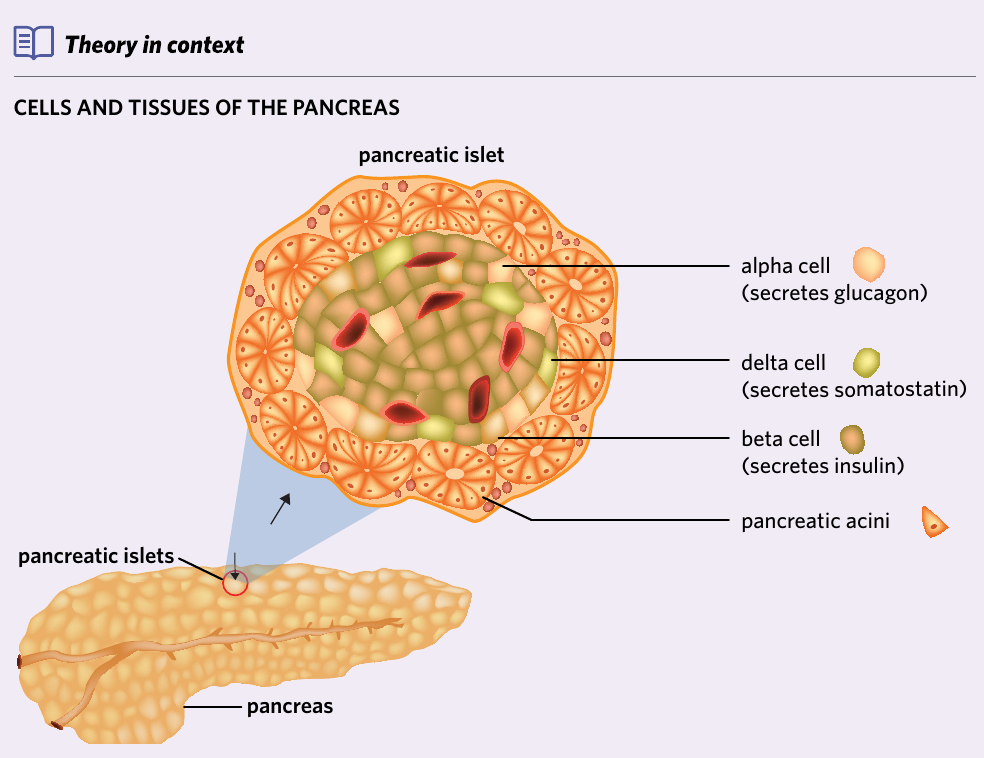
Pancreatic islet cells
The pancreatic islets contain three main types of specialized endocrine cells:
- Alpha cells - produce the hormone glucagon, which signals the liver to convert stored glycogen into glucose and release it into the bloodstream. This raises blood glucose levels.
- Beta cells - produce the hormone insulin, which encourages cells throughout the body to take in glucose from the bloodstream. This lowers blood glucose levels.
- Delta cells - produce somatostatin, which has various effects including inhibiting hormone secretion and influencing gastrointestinal tract activity.
Together, these three cell types work to regulate blood glucose levels and maintain homeostasis in the body.
Example
How the Pancreas Regulates Blood Glucose
The pancreatic cells work together in a coordinated system:
Scenario 1: Blood glucose is too high (e.g., after eating a meal)
- Beta cells detect the high glucose level
- Beta cells release insulin into the bloodstream
- Insulin signals body cells to take in glucose
- Result: Blood glucose levels decrease back to normal
Scenario 2: Blood glucose is too low (e.g., during exercise or fasting)
- Alpha cells detect the low glucose level
- Alpha cells release glucagon into the bloodstream
- Glucagon signals the liver to break down stored glycogen and release glucose
- Result: Blood glucose levels increase back to normal
This demonstrates how the pancreas maintains homeostasis through opposing hormonal actions.
Note
Helpful Memory Aid
Remember the difference between insulin and glucagon:
- Insulin IN - takes glucose into cells (lowers blood glucose)
- Glucagon GO - glucose goes out from stores (raises blood glucose)
Summary
Key Points to Remember:
-
The endocrine system consists of glands throughout the body that produce hormones - chemical messengers that regulate bodily functions.
-
Hormones are highly specific - they only affect target cells that have the appropriate receptors, like a lock and key mechanism.
-
Hormones travel through the bloodstream to reach their target cells anywhere in the body, allowing distant cells to communicate.
-
Major endocrine organs include the hypothalamus, pituitary gland, thyroid gland, pancreas, adrenal glands, and reproductive organs (ovaries/testes).
-
The pancreas contains specialized cells: alpha cells (produce glucagon), beta cells (produce insulin), and delta cells (produce somatostatin) that work together to regulate blood glucose levels.