Anaerobic Fermentation (VCE SSCE Biology): Revision Notes
📚Revision Notes
Anaerobic Fermentation
Introduction
Cells require a constant supply of energy in the form of ATP to carry out vital processes. Normally, aerobic cellular respiration produces most of this ATP using oxygen. However, when oxygen is not available, cells face a serious challenge. This note explores how cells continue to produce ATP under anaerobic conditions through a process called anaerobic fermentation.
What is anaerobic fermentation?
Anaerobic fermentation is a metabolic pathway that occurs in the absence of oxygen. It involves glycolysis, followed by further reactions that convert pyruvate into lactic acid in animals, or ethanol and carbon dioxide in yeasts.
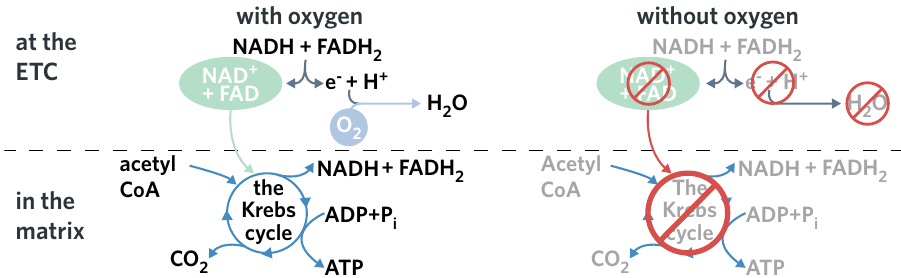
When oxygen is absent from the environment, cells that need large amounts of energy face difficulties. The electron transport chain (ETC), which produces the majority of ATP during aerobic cellular respiration, requires oxygen to accept free protons and electrons. Without oxygen, the ETC cannot function properly.
Important
When the electron transport chain stops working, loaded coenzymes such as NADH and FADH₂ cannot drop off their electrons and be converted back to their unloaded forms (NAD⁺ and FAD). These unloaded coenzymes are required as inputs for the Krebs cycle. Therefore, both the electron transport chain and the Krebs cycle are disrupted under anaerobic conditions, and this major source of ATP is lost.
How do cells produce ATP without oxygen?
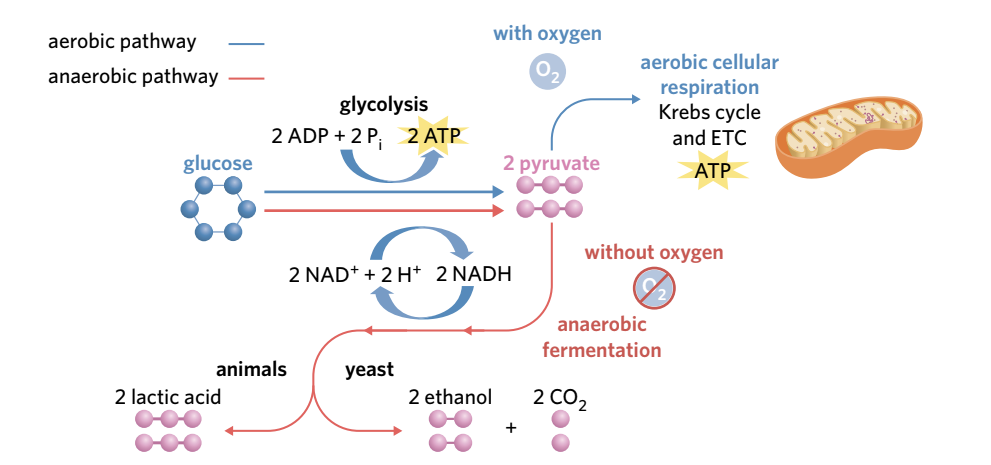
Even though the Krebs cycle and electron transport chain are blocked, cells can still produce ATP through glycolysis. Glycolysis breaks down glucose into two pyruvate molecules, converting two NAD⁺ molecules to NADH and producing two molecules of ATP - all without requiring oxygen.
However, there's a problem: glycolysis requires NAD⁺ as an input. To keep glycolysis running and maintain ATP production, cells must find a way to regenerate NAD⁺ from NADH without using oxygen. This is where anaerobic fermentation becomes essential.
Note
The Two-Step Strategy of Anaerobic Fermentation:
Anaerobic fermentation consists of:
- Glycolysis - to generate ATP
- Additional fermentation reactions - to recycle NADH back to NAD⁺
The extra fermentation steps differ between animals and yeasts, producing different end products. Both pathways occur in the cytosol of the cell, allowing the coenzymes to move freely and be recycled efficiently without crossing any membranes.
Lactic acid fermentation in animals
When oxygen availability is insufficient, such as during intense physical activity, animal cells undergo lactic acid fermentation after glycolysis.
Lactic acid fermentation is the process of anaerobic fermentation in animals, where pyruvate produced via glycolysis is converted to lactic acid.
The process
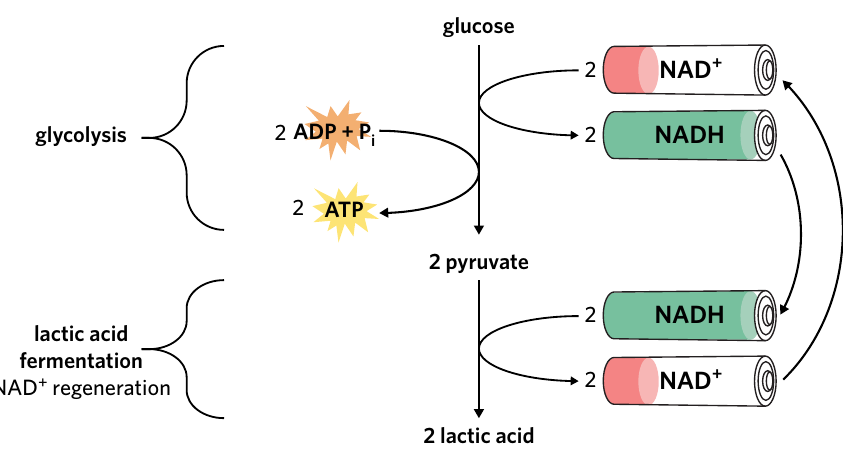
The process can be summarised as:
- Glucose is broken down via glycolysis (in the cytosol)
- This produces 2 pyruvate, 2 ATP, and converts 2 NAD⁺ to 2 NADH
- Each pyruvate is then converted to lactic acid
- During this conversion, 2 NADH molecules are oxidised back to 2 NAD⁺
- The regenerated NAD⁺ can be reused in glycolysis
Word equation: glucose → 2 lactic acid + 2 ATP
Location: Cytosol
Why lactic acid can be problematic
Lactic acid (also known as lactate) is a 3-carbon molecule that is the product of anaerobic fermentation in animals.
Important
Toxicity of Lactic Acid
Lactic acid cannot accumulate indefinitely because it lowers the pH of cells and blood. Enzymes require a narrow pH range to function properly, and the acidic conditions caused by lactic acid can decrease enzyme activity or even cause denaturation.
Once oxygen becomes available again, lactic acid is metabolised back into pyruvate and used for aerobic cellular respiration.
Real-world example: muscle stress
Example
Worked Example: Lactic Acid Production During Exercise
You may notice a heavy feeling in your muscles after intense bursts of physical activity - this indicates the presence of lactic acid.
What's happening:
- During activities like sprinting, muscle cells need to produce large amounts of ATP very quickly
- They rapidly use up all available oxygen
- Once oxygen is depleted, muscle cells must rely on anaerobic fermentation to produce the ATP needed for powerful movements
- This generates lactic acid as a by-product, causing the characteristic burning sensation and muscle fatigue
Ethanol fermentation in yeasts
Yeasts are unicellular eukaryotic organisms from the kingdom Fungi. In the absence of oxygen, yeasts undergo a different form of anaerobic fermentation that produces ethanol and carbon dioxide.
Ethanol fermentation (also called alcohol fermentation) is the process of anaerobic fermentation in yeasts, where pyruvate produced via glycolysis is converted to ethanol and carbon dioxide.
The process
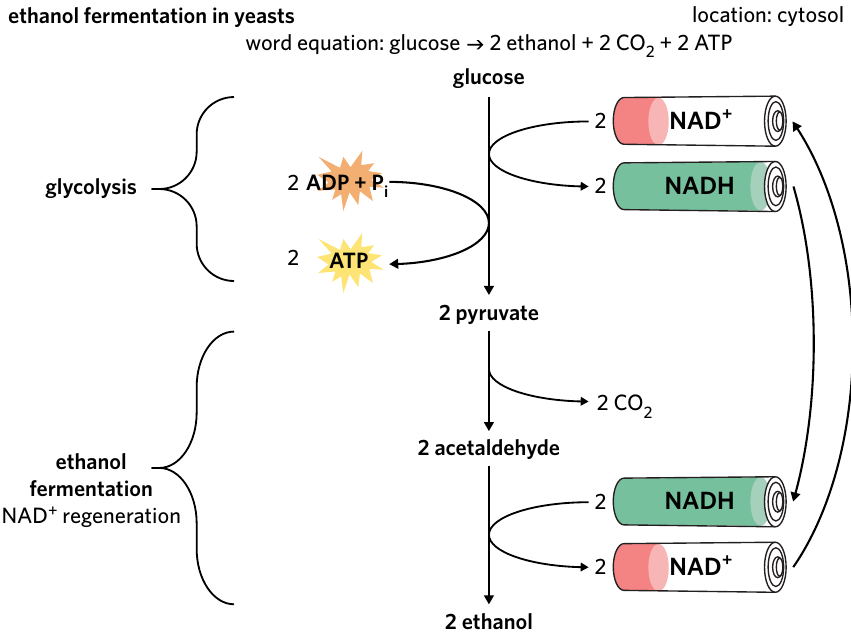
Ethanol fermentation is a two-step process:
- Glucose is broken down via glycolysis (in the cytosol)
- This produces 2 pyruvate, 2 ATP, and converts 2 NAD⁺ to 2 NADH
- Each pyruvate is converted to acetaldehyde, releasing CO₂
- Each acetaldehyde is then converted to ethanol
- During the conversion from acetaldehyde to ethanol, 2 NADH molecules are oxidised back to 2 NAD⁺
- The regenerated NAD⁺ can be reused in glycolysis
Word equation: glucose → 2 ethanol + 2 CO₂ + 2 ATP
Location: Cytosol
Ethanol is a 2-carbon alcohol molecule that is produced along with carbon dioxide during anaerobic fermentation in yeast, bacteria, and plants.
Applications in food and drink production
Note
Practical Applications of Ethanol Fermentation:
Ethanol fermentation by certain yeast species has important applications:
- Alcoholic beverages: The ethanol produced is responsible for the alcohol content in wine, beer, and whiskey
- Bread making: The carbon dioxide produced by yeasts as they metabolise sugars in the dough allows the bread to expand and rise. The ethanol produced evaporates during the baking process.
Toxicity concerns
Yeasts cannot metabolise ethanol into any useful products. Instead, ethanol diffuses out of the cells. However, in a confined environment such as a fermentation vessel, ethanol concentration can build up to toxic levels that can eventually kill the yeast cells.
Comparing aerobic and anaerobic respiration
Understanding the key differences between aerobic cellular respiration and anaerobic fermentation is important for VCE Biology exams.
| Feature | Aerobic cellular respiration | Anaerobic fermentation |
|---|---|---|
| Stages | Glycolysis, Krebs cycle, electron transport chain | Glycolysis, lactic acid fermentation (animals) or ethanol fermentation (yeasts) |
| Location | Cytosol and mitochondria | Cytosol only |
| Inputs | Glucose and oxygen | Glucose only |
| Outputs | Carbon dioxide and water | Lactic acid (animals) or ethanol and carbon dioxide (yeasts) |
| ATP efficiency | 30 or 32 ATP per glucose molecule | 2 ATP per glucose molecule |
| Speed | Slow | Fast |
| Sustainability | Can continue indefinitely | Cannot continue indefinitely due to toxic build-up of lactic acid or ethanol |
Key points from the comparison
Note
Understanding the Trade-offs:
- Efficiency: Anaerobic fermentation produces far less ATP (only 2 per glucose) compared to aerobic respiration (30-32 per glucose)
- Speed: Anaerobic fermentation is much faster than aerobic respiration because it involves fewer steps
- Location: Fermentation occurs entirely in the cytosol, while aerobic respiration requires mitochondria
- Sustainability: The toxic products of fermentation (lactic acid or ethanol) prevent the process from continuing indefinitely
Summary of products in animals versus yeasts
The main difference between anaerobic fermentation in animals and yeasts is the end products formed:
| Animal cells | Yeast cells |
|---|---|
| Lactic acid | Ethanol and carbon dioxide |
Both pathways:
- Start with glucose
- Use glycolysis
- Produce 2 ATP per glucose molecule
- Regenerate NAD⁺ for continued glycolysis
- Occur in the cytosol
Remember!
Summary
Key Points to Remember:
- Anaerobic fermentation is a metabolic pathway that allows cells to produce ATP when oxygen is not available
- The process involves glycolysis followed by additional reactions that regenerate NAD⁺ from NADH
- Animals convert pyruvate to lactic acid (lactic acid fermentation)
- Yeasts convert pyruvate to ethanol and carbon dioxide (ethanol fermentation)
- Both pathways occur in the cytosol and produce only 2 ATP per glucose molecule (much less efficient than aerobic respiration)
- The products (lactic acid or ethanol) can be toxic when they accumulate, so anaerobic fermentation cannot continue indefinitely
- Practical applications include muscle energy during intense exercise (animals) and bread making and alcohol production (yeasts)