Genotypes and Phenotypes (VCE SSCE Biology): Revision Notes
📚Revision Notes
Genotypes and Phenotypes
Introduction to genetic notation
Understanding how genetic information is passed from parents to offspring requires learning how to represent and interpret genetic data. This involves two key concepts: genotypes (the genetic makeup) and phenotypes (the observable characteristics).
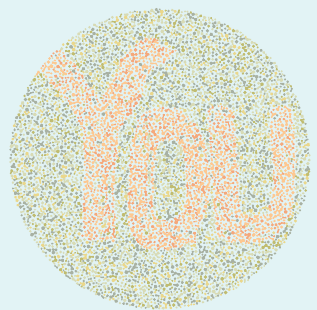
Note
The image above shows an Ishihara colour blindness test. People with normal colour vision can see a letter 'S' in this pattern, but those with red-green colour blindness find this much more difficult. Interestingly, this condition affects males and females at different rates due to its pattern of inheritance.
Dominant and recessive genotypes
Understanding homozygous and heterozygous individuals
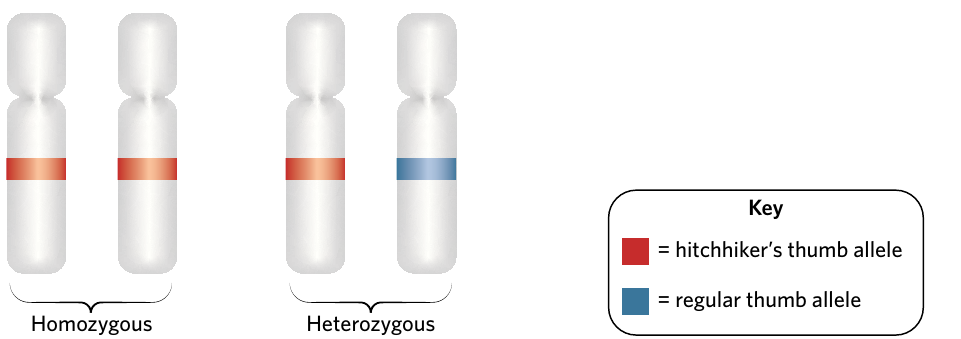
Every diploid organism (having two sets of each chromosome, one from each parent) inherits two alleles for each gene - one from their mother and one from their father. The combination of these alleles determines whether an individual is homozygous or heterozygous for that particular gene.
Homozygous individuals have identical alleles for the same gene on homologous chromosomes. This means both parents passed on the same version of the gene. For example, if both parents give an allele for hitchhiker's thumb (a hyper-flexible thumb), the offspring will be homozygous for this trait.
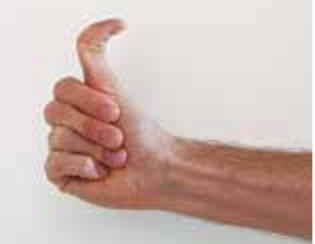
Note
When a person is homozygous for a gene, all their gametes (sex cells) will carry the same allele for that trait. This is because during meiosis, both homologous chromosomes carry identical information for that gene.
Heterozygous individuals have different alleles for the same gene on homologous chromosomes. Using the same example, a person might inherit a hitchhiker's thumb allele from their mother but a regular thumb allele from their father. In this case, the gametes produced will be of two types - approximately half will contain the hitchhiker's thumb allele and half will contain the regular thumb allele.
Dominant and recessive alleles
When an individual is heterozygous (has two different alleles), we need to understand which trait will be expressed. This depends on whether the alleles are dominant or recessive.
A dominant allele is the variant of a gene that masks the effect of a recessive allele of the same gene on a homologous chromosome. It can be thought of as the stronger form in a pair of alleles. Importantly, a dominant allele will be expressed even if only one copy is present (as in heterozygotes). The dominant allele is represented using a capital letter.
For example, brown eye colour is controlled by a dominant allele. This means you only need to inherit one copy of the brown eye allele from one parent to have brown eyes.
A recessive allele is the variant of a gene that is masked by a dominant allele on a homologous chromosome. It represents the weaker form in a pair of alleles and is represented using a lowercase letter. A recessive allele will only be expressed when an individual has two copies of that allele (homozygous recessive).
For example, blue eye colour is controlled by a recessive allele. To have blue eyes, you must inherit two copies of the blue eye allele (one from each parent).
Complete dominance
Complete dominance is a pattern of dominance where only the dominant allele from the genotype of a heterozygous individual is expressed in the phenotype of that organism. In other words, the dominant allele completely masks the recessive allele.
Important
Being dominant doesn't mean an allele is more common in a population. For instance, achondroplasia (a form of dwarfism) is a dominant trait, yet only approximately 1 in 25,000 people have this condition.
Carriers
A carrier is an organism that has inherited a copy of a recessive allele for a genetic trait but does not display the trait due to it being masked by the presence of a dominant allele. Although carriers don't show the recessive trait themselves, they can pass the recessive allele to their offspring. If two carriers have children together, their offspring may inherit two copies of the recessive allele and express the trait.
Representing genotypes using symbols
A genotype is the genetic composition of an organism at one particular gene locus, as represented using letter symbols. Genotypes show us whether an individual is homozygous dominant, homozygous recessive, or heterozygous for a specific trait.
The notation system follows these rules:
- Dominant alleles are written using capital letters
- Recessive alleles are written using lowercase letters
- Any letter can be used, though typically we choose letters related to the trait
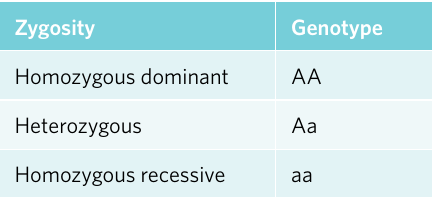
Example
Example: Thumb Flexibility Notation
If we're looking at thumb flexibility, we might use 'T' for the dominant allele and 't' for the recessive allele:
- TT = homozygous dominant (both alleles are dominant)
- Tt = heterozygous (one dominant, one recessive)
- tt = homozygous recessive (both alleles are recessive)
Case study: sickle cell anaemia and heterozygote advantage
Sometimes carrying a recessive allele can provide a biological advantage, even if having two copies causes problems. This is called heterozygote advantage and helps explain why some harmful alleles persist in populations.
Sickle cell trait results from a mutation in the gene that codes for haemoglobin. This mutation causes red blood cells to become sickle-shaped (crescent-shaped) when exposed to low oxygen levels. These misshapen cells are poor at carrying oxygen and can block small blood vessels.
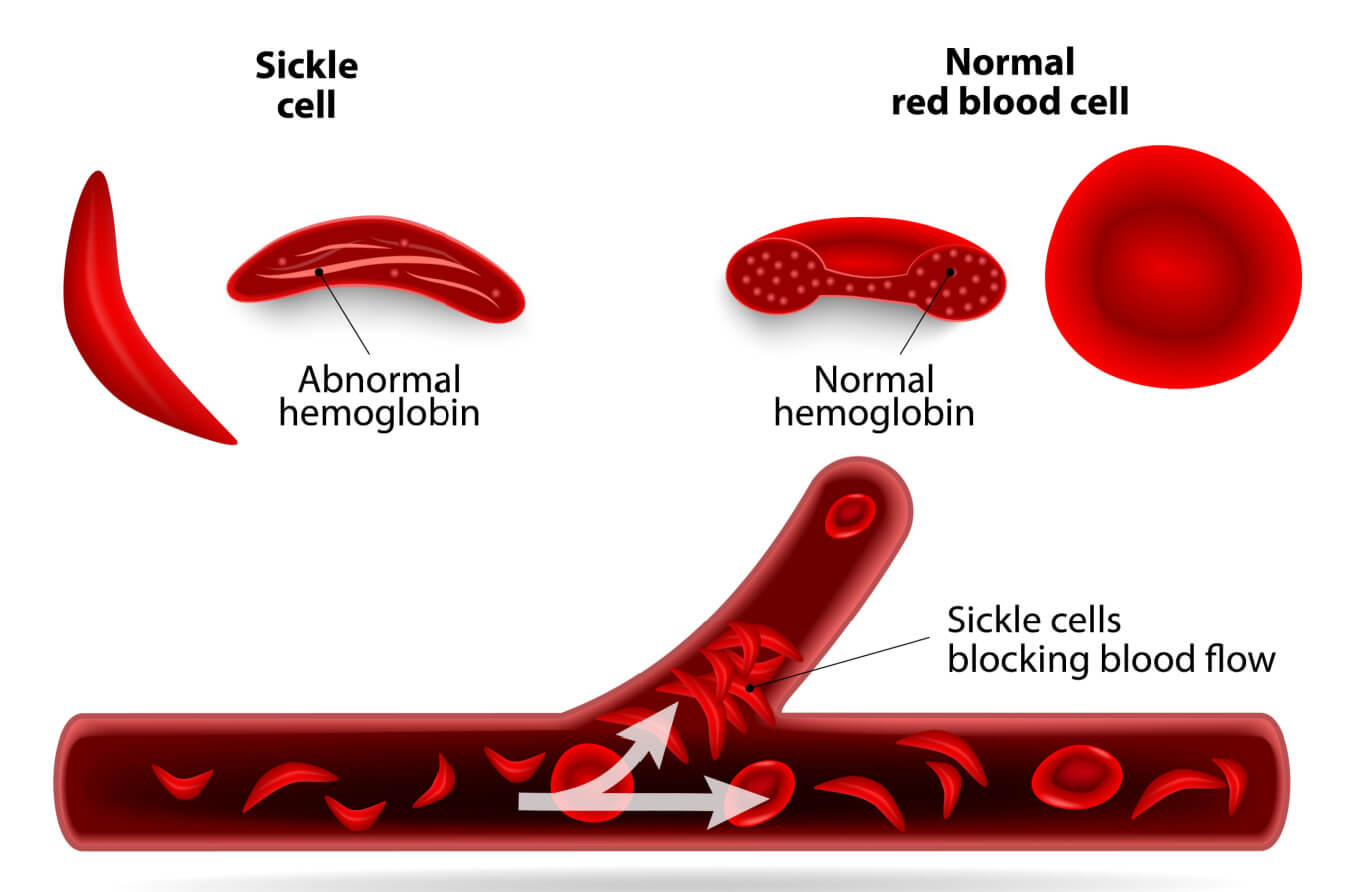
Individuals with two copies of the sickle cell allele (homozygous recessive) suffer from sickle cell anaemia, which often leads to premature death from organ damage or stroke. However, this genotype provides strong resistance to malaria.
Note
The Heterozygote Advantage in Action
Individuals heterozygous for the sickle cell allele have a unique advantage. They experience only low levels of red blood cell sickling and don't suffer from sickle cell anaemia. Despite this, they still gain increased resistance to malaria compared to individuals with two normal haemoglobin alleles. When infected with malaria, their sickled red blood cells are more likely to be destroyed by the immune system, which helps eliminate the malaria parasite.
This heterozygote advantage explains why the sickle cell allele remains common in regions where malaria is prevalent, such as parts of Africa and Asia. In these areas, being heterozygous provides the best outcome - protection from malaria without the severe health consequences of sickle cell anaemia.
Understanding phenotypes
A phenotype is the physical or biochemical characteristics of an organism that are the result of gene expression (or set of genes) and the environment. While a genotype tells us which alleles an organism has, the phenotype tells us what we can actually observe.
Phenotypes include:
- Physical appearance (height, eye colour, hair colour)
- Structural features (earlobe attachment, tongue rolling ability)
- Biochemical processes (enzyme production, blood type)
- Behaviour patterns
Important
Phenotypes result from both genetics and environment. For example, a person's weight is influenced by their inherited genes but also by environmental factors like diet and exercise levels.
Example: earlobe attachment
Earlobe attachment is controlled by a single gene with two possible phenotypes:
- Free earlobes - hang below the attachment point
- Attached earlobes - attach directly to the side of the head
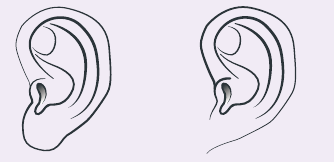
The free earlobe allele (A) is dominant, while the attached earlobe allele (a) is recessive. This means:
- AA (homozygous dominant) = free earlobes
- Aa (heterozygous) = free earlobes
- aa (homozygous recessive) = attached earlobes
Note
Notice that both AA and Aa individuals show the same phenotype (free earlobes) despite having different genotypes. This demonstrates how dominant alleles mask recessive alleles.
Example: tongue rolling
The ability to roll your tongue into a tube shape is controlled by a gene that exhibits complete dominance.
There are two possible phenotypes:
- Able to roll tongue into a tube shape
- Unable to roll tongue into a tube shape
The tongue rolling allele (T) is dominant, while the non-rolling allele (t) is recessive. Therefore:
- TT or Tt = can roll tongue
- tt = cannot roll tongue
Important
Determining Genotype from Phenotype
You cannot determine someone's exact genotype just by observing their phenotype. If someone can roll their tongue, they could be either TT or Tt - you would need additional information (such as family history or genetic testing) to distinguish between these possibilities.
Codominance and incomplete dominance
Complete dominance is not the only way alleles can be expressed. Two alternative patterns exist: codominance and incomplete dominance.
Understanding codominance
Codominance is a pattern of dominance where both alleles from the genotype of a heterozygous individual are dominant and expressed in the phenotype of that organism. Neither allele masks the other - instead, both are fully expressed at the same time.
Example
Example: Codominance in Flowers
If a flower gene showed codominance, where one allele codes for red petals and another for white petals, a heterozygous individual would display both red AND white petals (perhaps as spots or stripes), not a blend of the two colours.
Understanding incomplete dominance
Incomplete dominance is a pattern of dominance where neither allele from the genotype of a heterozygous individual is dominant and both are expressed in an intermediate phenotype. The result is a blending of the two traits rather than both appearing separately.
Example
Example: Incomplete Dominance in Flowers
Using the same flower example, if the gene showed incomplete dominance, a heterozygous individual with one red allele and one white allele would produce pink flowers - a mixture of the two colours.
Notation for codominance and incomplete dominance
Because neither allele is completely dominant in these patterns, we use a different notation system. Instead of using capital and lowercase versions of the same letter, we use:
- A standard capital letter as the base (representing the gene)
- Different superscript letters to represent the different alleles
For example:
- = homozygous for allele A
- = heterozygous (carries both allele A and allele B)
- = homozygous for allele B
Case study: ABO blood typing (codominance)
The human ABO blood group system provides an excellent example of codominance in action. This system is controlled by a single gene with three possible alleles:
- - codes for antigen A on red blood cells
- - codes for antigen B on red blood cells
- - codes for neither antigen A nor B
These three alleles create four possible blood types:
- Blood type A
- Blood type B
- Blood type AB
- Blood type O
Note
The allele (blood type O) is recessive to both and . However, and show codominance with each other - neither is dominant over the other. This means heterozygous individuals with genotype will express both antigens on their red blood cells, resulting in blood type AB.
Example
Example: ABO Blood Type Genotypes and Phenotypes
The possible genotypes and their corresponding phenotypes are:
- or = Blood type A
- or = Blood type B
- = Blood type AB (demonstrates codominance)
- = Blood type O
Case study: pink snapdragons (incomplete dominance)
The snapdragon plant (Antirrhinum majus) demonstrates incomplete dominance in flower colour.

Example
Example: Snapdragon Flower Colour Inheritance
If you cross a homozygous white-flowered snapdragon () with a homozygous red-flowered snapdragon (), all offspring will have the genotype . Because neither allele is fully dominant, the phenotype is an intermediate - pink flowers.
This differs from codominance because the offspring don't show both red and white (as separate colours) but instead show a blended colour (pink).
Sex-linked genotypes
Not all genes are located on autosomal chromosomes (chromosomes 1-22 in humans). Some genes are located on the sex chromosomes (X and Y), and these are inherited differently from autosomal traits.
What are sex-linked genes?
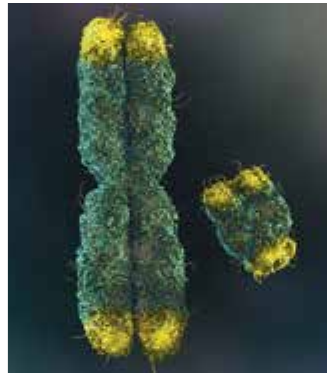
Sex-linked genes are genes that are located on a sex chromosome. These genes are often closely related to an organism's biological sex.
Note
Chromosome Size Differences
The X and Y chromosomes differ significantly in size and gene content. The X chromosome is much longer than the Y chromosome and contains approximately 4,000 more genes. Because of this size difference, when discussing sex-linked inheritance, we're usually referring to X-linked traits (traits controlled by genes located on the X chromosome), as these are far more common than Y-linked traits (traits controlled by genes located on the Y chromosome).
Why X-linked traits affect males more frequently
X-linked traits are more likely to be expressed in males than in females. This occurs because:
Important
Male X-linked Expression
Males have only one X chromosome (inherited from their mother) and one Y chromosome (inherited from their father). Whatever allele a male inherits on his X chromosome will be expressed in his phenotype, regardless of whether that allele is dominant or recessive. There is no second X chromosome to potentially mask a recessive allele.
Females have two X chromosomes (one from each parent). For a female to express an X-linked recessive trait, she must inherit two copies of the recessive allele - one on each X chromosome. If she inherits even one dominant allele, it will mask the recessive allele.
Note
Inheritance Pattern from Affected Males
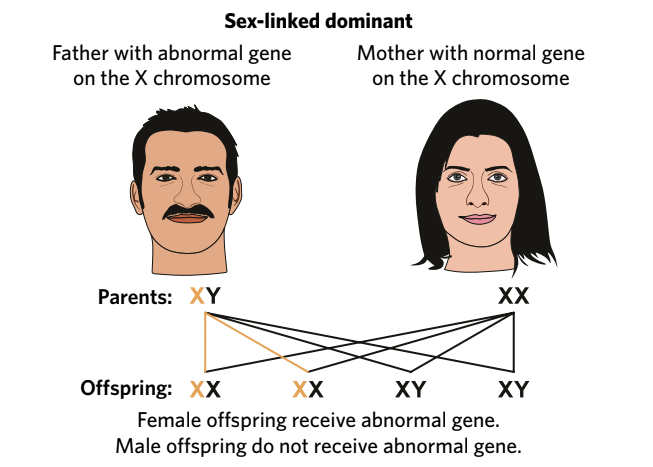
Males with X-linked traits cannot pass these traits to their sons. This is because sons inherit their Y chromosome from their father, not the X chromosome. However, affected males will always pass the X-linked allele to their daughters.
Notation for sex-linked genotypes
Sex-linked genotypes use a notation system similar to codominance and incomplete dominance, but the base letter is always X or Y (representing the sex chromosome). Superscript letters indicate which allele is present.
Example
Example: Colour Blindness Notation
Red-green colour blindness is an X-linked recessive trait. We can write this as:
- = X chromosome with the dominant allele (normal colour vision)
- = X chromosome with the recessive allele (colour blindness)
- = Y chromosome (carries no allele for this gene)
The possible genotypes and phenotypes are:
For females:
- = unaffected female (normal colour vision)
- = unaffected female but carrier (normal colour vision, can pass trait to offspring)
- = affected female (colour blind)
For males:
- = unaffected male (normal colour vision)
- = affected male (colour blind)
Important
Notice that males only need one copy of the recessive allele to be colour blind, while females need two copies. This explains why colour blindness is much more common in males (approximately 8% of males of European descent) than in females (approximately 0.5% of females of European descent).
Case study: haemophilia A (X-linked recessive disorder)
The F8 gene, located on the X chromosome, provides instructions for producing proteins essential for blood clot formation. After an injury, these proteins help form clots that protect the body by sealing damaged blood vessels and preventing excessive blood loss.
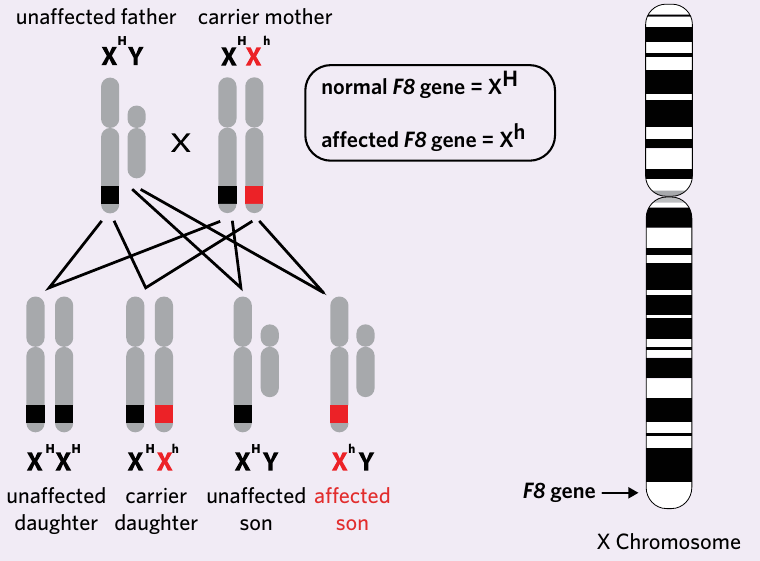
A mutation in the F8 gene leads to haemophilia A, a condition where affected individuals have reduced ability to form blood clots and are prone to excessive bleeding. This condition is inherited in an X-linked recessive pattern.
Example
Example: Haemophilia A Genotypes
Using the notation:
- = X chromosome with normal F8 gene
- = X chromosome with mutated F8 gene
For females:
- = unaffected
- = carrier (unaffected but can pass to offspring)
- = affected (has haemophilia A)
For males:
- = unaffected
- = affected (has haemophilia A)
Important
Because males have only one X chromosome, inheriting one copy of the mutated gene results in haemophilia A. Females must inherit two copies of the mutated gene to be affected. A female with only one mutated copy is a carrier - she doesn't have the condition but can pass the allele to her children.
Remember!
Summary
Key Points to Remember:
-
Genotype refers to the genetic makeup (the alleles present), while phenotype refers to the observable characteristics that result from both genes and environment.
-
Homozygous individuals have two identical alleles (AA or aa), while heterozygous individuals have two different alleles (Aa) for the same gene.
-
In complete dominance, dominant alleles (represented by capital letters) mask recessive alleles (lowercase letters) in heterozygous individuals. In codominance, both alleles are fully expressed together. In incomplete dominance, neither allele is fully expressed, creating an intermediate trait.
-
Sex-linked traits (especially X-linked traits) affect males more frequently because males have only one X chromosome, so they express whatever allele is present. Females need two copies of a recessive X-linked allele to express the trait.
-
Understanding different patterns of inheritance (complete dominance, codominance, incomplete dominance, and sex-linkage) is essential for predicting how traits are passed from parents to offspring.