Meiosis (VCE SSCE Biology): Revision Notes
📚Revision Notes
Meiosis
Introduction
Meiosis is a specialised type of cell division that produces reproductive cells called gametes. Unlike regular cell division (mitosis), which creates identical copies of cells, meiosis produces four unique cells, each containing half the genetic material of the original parent cell. This reduction in chromosome number is essential for sexual reproduction because when two gametes combine during fertilisation, they restore the full chromosome number in the offspring.
Note
The reduction from diploid to haploid during meiosis is crucial - without it, chromosome numbers would double with each generation! For example, if human gametes were diploid (46 chromosomes), fertilisation would produce offspring with 92 chromosomes.
In this revision note, you will learn how meiosis works, why it differs from mitosis, and how it creates genetic diversity through two important mechanisms: crossing over and independent assortment.
What is meiosis?
Meiosis is "a specialised form of cell division used to produce gametes in sexually reproducing organisms". The process involves a single parent cell dividing twice to produce four daughter cells, each with unique genetic combinations.
Gametes are "reproductive cells that arise from germline cells and contain half the genetic material (n) of a somatic cell. The gametes in animals are sperm and egg cells". In humans, male gametes are sperm cells and female gametes are egg cells (also called ova).
The cell that undergoes meiosis is called a germline cell, which are "cells that are involved in the generation of gametes in eukaryotes". These specialised cells are located in the gonads, which are "the organs that produce gametes from germline cells. In humans these are the testes (male) and ovaries (female)".
When two gametes combine during fertilisation, they form a zygote, which is "the diploid cell formed by the combination of two haploid gamete cells". The zygote contains a complete set of chromosomes and will develop into a new organism.
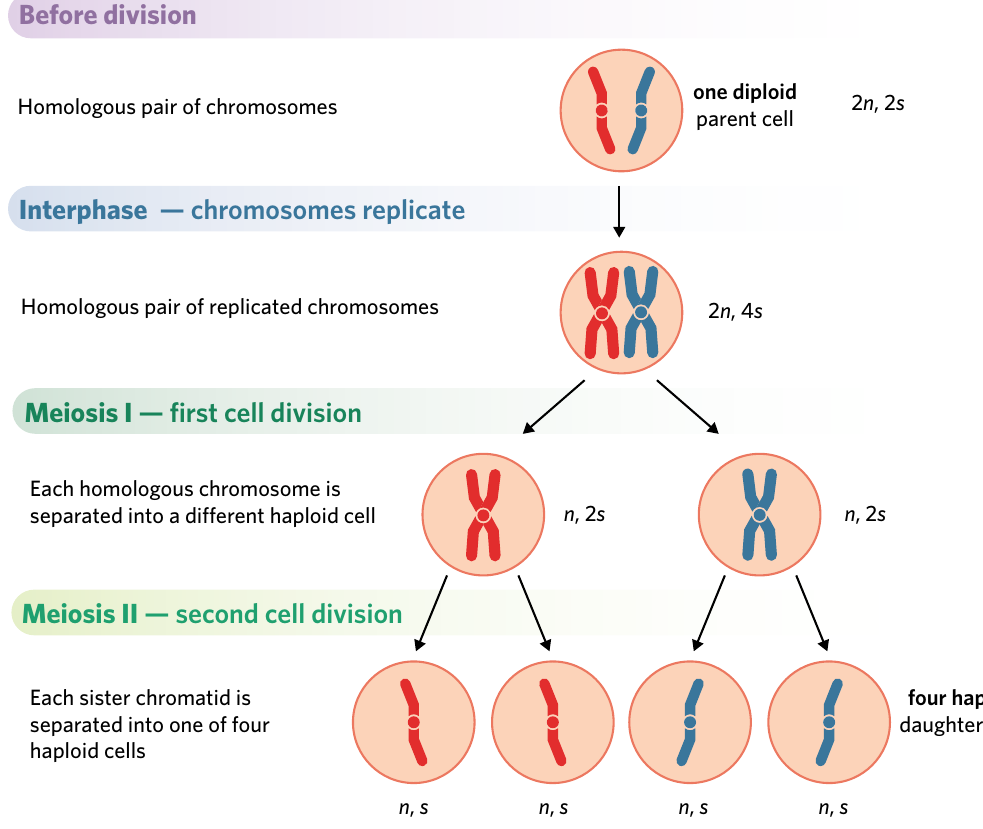
Understanding chromosome numbers
Chromosome numbers are described using specific notation:
- Diploid (2n): Contains two complete sets of chromosomes (one from each parent). Most human cells are diploid with 46 chromosomes (23 pairs).
- Haploid (n): Contains only one complete set of chromosomes. Human gametes are haploid with 23 chromosomes.
Note
The 's' notation refers to the number of sister chromatids:
- 2s: Chromosomes have been replicated, so each consists of two sister chromatids joined at the centromere
- s: Single chromatids (not replicated)
The two divisions of meiosis
Meiosis achieves the reduction from diploid to haploid through two consecutive divisions:
- Meiosis I separates homologous chromosomes (the pair of chromosomes, one from each parent) into two different cells. Each resulting cell is haploid but still contains replicated chromosomes (sister chromatids joined together).
- Meiosis II separates the sister chromatids within each chromosome, producing four haploid cells, each with unreplicated chromosomes.
Homologous chromosomes are chromosome pairs that carry the same genes but may have different versions (alleles) of those genes. For example, both chromosomes in the pair might carry a gene for eye colour, but one might code for brown eyes whilst the other codes for blue eyes.
Sister chromatids are identical copies of a single chromosome produced during DNA replication. They remain attached at the centromere until separated during cell division.
Important
Key distinction to remember:
- Meiosis I separates homologous pairs (chromosomes from different parents)
- Meiosis II separates sister chromatids (identical copies of the same chromosome)
Think: "I separates pairs, II separates sisters"
Meiosis versus mitosis
Understanding the difference between mitosis and meiosis is crucial for exam success. Whilst both are forms of cell division, they serve entirely different purposes and produce different outcomes.
Mitosis is used by almost every cell in your body for growth, development, and repair. During mitosis, a single diploid cell divides once to produce two genetically identical diploid daughter cells. This maintains the chromosome number and ensures that replacement cells are exact copies of the original.
Meiosis, on the other hand, has one specific purpose: producing gametes for sexual reproduction. A single diploid germline cell divides twice to produce four genetically unique haploid gametes. The reduction in chromosome number is essential so that when two gametes fuse during fertilisation, the resulting offspring has the correct diploid number rather than double the chromosomes.
Comparison of inputs and outputs
| Process | Input (start of G1) | Output (end of cytokinesis) |
|---|---|---|
| Mitosis | 1 × somatic cell (2n) | 2 × identical somatic cells (2n) |
| Meiosis | 1 × germline cell (2n) | 4 × genetically unique gamete cells (n) |
Important
Common exam mistake to avoid:
Students often confuse the number of divisions and daughter cells produced. Remember:
- Mitosis = ONE division → TWO identical cells (2n → 2n)
- Meiosis = TWO divisions → FOUR unique cells (2n → n)
The key differences to remember are:
- Number of divisions: Mitosis involves one division; meiosis involves two
- Number of daughter cells: Mitosis produces two cells; meiosis produces four
- Genetic composition: Mitotic daughter cells are identical to the parent; meiotic daughter cells are genetically unique
- Chromosome number: Mitosis maintains the diploid number (2n → 2n); meiosis reduces it by half (2n → n)
- Cell types produced: Mitosis produces somatic (body) cells; meiosis produces gametes (sex cells)
The process of meiosis
Interphase: preparation for division
Before meiosis begins, the cell must undergo interphase. This stage is identical to the interphase that occurs before mitosis. During interphase, the cell grows and replicates all its DNA in preparation for division. Each chromosome is duplicated, forming sister chromatids that remain attached at the centromere. After interphase, the cell contains the diploid number of chromosomes (2n), but each chromosome consists of two sister chromatids (4s total DNA content).
Meiosis I: the first division
Meiosis I is often called the "reduction division" because it reduces the chromosome number from diploid (2n) to haploid (n). However, each chromosome at this stage still consists of two sister chromatids. The key feature of meiosis I is the separation of homologous chromosome pairs.
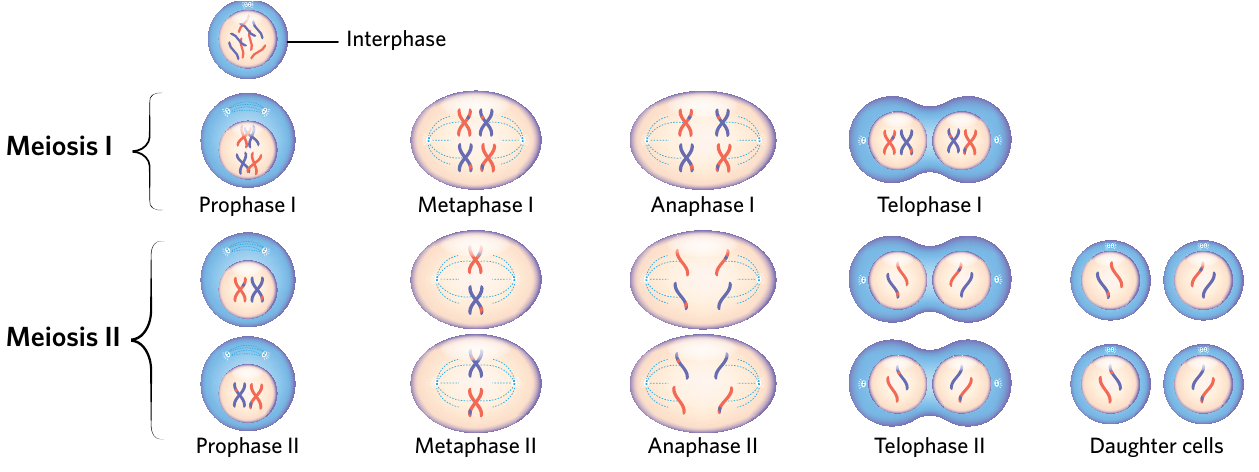
Prophase I
Prophase I is the longest and most complex stage of meiosis. Several critical events occur:
- The nuclear membrane breaks down
- Chromosomes condense, becoming visible under a microscope
- Homologous chromosomes pair up, a process called synapsis
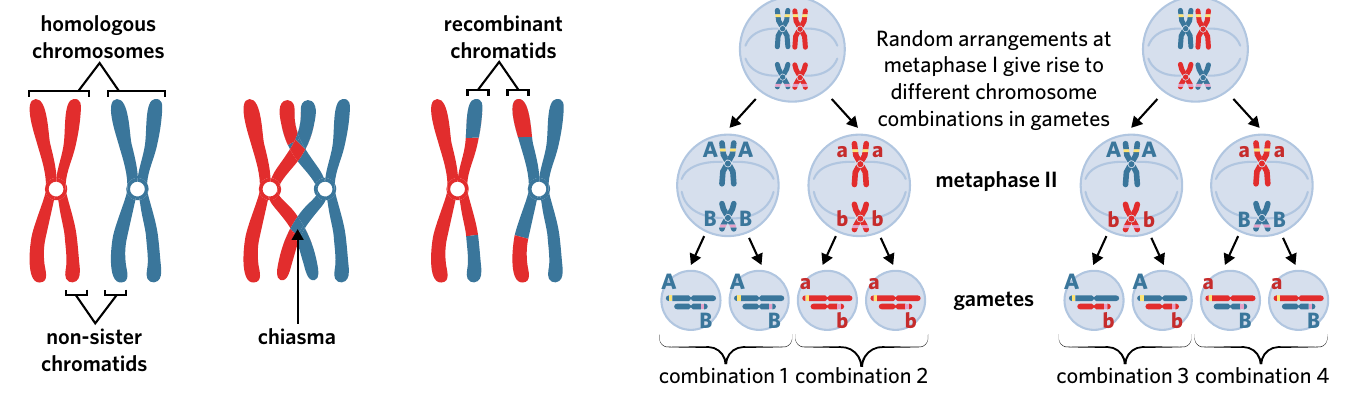
- Crossing over occurs between non-sister chromatids
Crossing over is "the exchange of genetic material between non-sister chromatids during prophase I of meiosis, resulting in new combinations of alleles in daughter cells". The homologous chromosomes physically overlap at points called chiasmata (singular: chiasma), which is "the point/location of overlap between two non-sister chromatids". At these crossing points, segments of DNA are exchanged between the chromosomes, creating new combinations of genetic information.
Note
Think of chiasmata as the "X marks the spot" where genetic material is swapped! The chromosomes form an X-shape at these crossing points, making them easy to identify under a microscope.
Metaphase I
During metaphase I, the paired homologous chromosomes line up along the metaphase plate, which is "the equator of a dividing cell where chromosomes will line up during metaphase".
A crucial process called independent assortment occurs at this stage. Independent assortment is "the random orientation of homologous chromosomes along the metaphase plate during metaphase I". Each homologous pair aligns randomly, with either the maternal or paternal chromosome facing each pole of the cell. This random arrangement is independent for each chromosome pair.
Microtubules, which are "long tube-like fibre proteins that form part of the cytoskeleton of a eukaryotic cell and help give the cell its structure. Microtubules are used for a variety of cell movements, including transport of cell organelles and the movement of chromosomes during cell division", attach to the centromeres of each chromosome, preparing to separate the homologous pairs.
Anaphase I
The homologous chromosomes are pulled apart and move toward opposite poles of the cell. Unlike in mitosis, the sister chromatids remain attached to each other at the centromere during this stage. Each pole of the cell now has a haploid set of chromosomes (n), but each chromosome still consists of two sister chromatids (2s).
Telophase I
The chromosomes arrive at opposite ends of the cell. The nuclear membrane reforms around each set of chromosomes, creating two nuclei. A cleavage furrow forms across the middle of the cell in preparation for cytokinesis, which is "the division of the cytoplasm and formation of two daughter cells".
After cytokinesis, two haploid cells have formed, each containing half the number of chromosomes of the original cell. However, because each chromosome still consists of two sister chromatids, these cells will undergo a second division.
Note
Checkpoint after Meiosis I:
- Number of cells: 2
- Chromosome number per cell: n (haploid)
- Sister chromatids: Still attached (2s)
- Genetic diversity: Already introduced through crossing over and independent assortment
Meiosis II: the second division
Meiosis II is similar to mitosis in many ways. The two haploid cells produced in meiosis I each divide again, separating the sister chromatids within each chromosome. No DNA replication occurs between meiosis I and meiosis II.
Prophase II
The cells prepare for another division:
- The nuclear envelope breaks down again
- Chromosomes condense once more
- Spindle fibres form in preparation to separate the sister chromatids
Metaphase II
Each chromosome (still consisting of two sister chromatids) lines up along the metaphase plate. Microtubules from opposite poles attach to the centromere of each chromosome, preparing to pull the sister chromatids apart.
Anaphase II
The sister chromatids finally separate and are pulled toward opposite poles of the cell by the microtubules. Each chromatid is now considered an individual chromosome. The cell now has the haploid number of chromosomes (n), with each being a single, unreplicated chromosome (s).
Telophase II and cytokinesis
Individual chromatids reach opposite poles of each cell, and nuclear membranes form around each set of chromosomes. The chromosomes begin to decondense and unravel. Cytokinesis occurs, splitting each cell into two. The result is four haploid daughter cells, each genetically unique and each containing unreplicated chromosomes (n, s).
Important
Remember PMAT for both divisions:
Meiosis I: Prophase I → Metaphase I → Anaphase I → Telophase I
Meiosis II: Prophase II → Metaphase II → Anaphase II → Telophase II
This mnemonic helps you remember the order of stages in both meiotic divisions!
Genetic diversity in meiosis
One of the most important functions of meiosis is generating genetic diversity. The gametes produced are not only different from the parent cell but also different from each other. This genetic variation is crucial for evolution and the survival of species. Two mechanisms during meiosis create this diversity: crossing over and independent assortment.
Crossing over
Crossing over occurs during prophase I when homologous chromosomes pair up. The chromosomes physically overlap at points called chiasmata, and segments of DNA are exchanged between non-sister chromatids (chromatids from different homologous chromosomes).
This exchange creates recombinant chromatids – chromatids with new combinations of alleles that differ from both the original maternal and paternal chromosomes. Because the sister chromatids within each chromosome are no longer identical after crossing over, the resulting gametes will inherit different genetic combinations.
Example
Example: How Crossing Over Creates New Combinations
Imagine a chromosome carrying alleles for eye colour and hair colour:
- Maternal chromosome: Brown eyes (B) and Blonde hair (b)
- Paternal chromosome: Blue eyes (b) and Brown hair (B)
Through crossing over, a single chromatid might end up with:
- Brown eyes (B) from maternal + Brown hair (B) from paternal
- This is a new combination that didn't exist in either parent chromosome!
The result: gametes with unique combinations like BB or bb, rather than just Bb or bB.
Independent assortment
Independent assortment occurs during metaphase I when homologous chromosome pairs line up along the metaphase plate. Each pair aligns randomly, with either the maternal or paternal chromosome facing each pole. Importantly, the orientation of one pair doesn't influence the orientation of other pairs.
This random arrangement means that the resulting gametes receive a random mix of maternal and paternal chromosomes. In humans, with 23 pairs of chromosomes, the number of possible combinations is , which equals approximately 8 million different combinations. This means that a single individual can produce over 8 million genetically different gametes through independent assortment alone.
When you combine the effects of independent assortment with crossing over, the number of possible genetic combinations becomes astronomically large, ensuring that each gamete produced is virtually unique.
Why genetic diversity matters
The genetic diversity created through meiosis has several important implications:
- Evolution: Genetic variation provides the raw material for natural selection. Different combinations of alleles may be advantageous in different environments, allowing populations to adapt over time.
- Survival: If all offspring were genetically identical, a single disease or environmental change could potentially wipe out an entire population. Genetic diversity increases the likelihood that some individuals will survive challenges.
- Individual variation: This explains why siblings from the same parents can look and behave quite differently. Each child inherits a unique combination of parental alleles, creating individual variation within families.
Note
Exam tips:
- Always clearly distinguish between crossing over (occurring in prophase I) and independent assortment (occurring in metaphase I)
- Remember that crossing over involves exchange of DNA segments, whilst independent assortment involves random positioning of whole chromosomes
- Be able to explain how each mechanism contributes to genetic diversity
- Understand that both mechanisms together produce far more variation than either could alone
Remember!
Summary
Key Points to Remember:
-
Meiosis is a specialised cell division that produces four genetically unique haploid gametes from one diploid germline cell, essential for sexual reproduction.
-
Two divisions occur in sequence: Meiosis I separates homologous chromosomes (reducing chromosome number from 2n to n), whilst Meiosis II separates sister chromatids (producing four cells from two).
-
Crossing over during prophase I exchanges DNA segments between homologous chromosomes at chiasmata, creating recombinant chromatids with new allele combinations.
-
Independent assortment during metaphase I randomly orientates homologous pairs along the metaphase plate, producing approximately 8 million possible chromosome combinations in humans ().
-
Meiosis differs fundamentally from mitosis: Mitosis produces two identical diploid cells for growth and repair, whilst meiosis produces four unique haploid gametes for sexual reproduction, maintaining chromosome numbers across generations.