Selective Breeding (VCE SSCE Biology): Revision Notes
📚Revision Notes
Selective Breeding
Introduction
Selective breeding is a powerful tool that humans have used for thousands of years to shape the characteristics of plants and animals. From the vegetables we eat to the pets we keep, many organisms around us have been modified through this process. Understanding selective breeding helps us appreciate both the benefits and potential risks of human intervention in natural populations.
Note
The practice of selective breeding predates our understanding of genetics by thousands of years. Ancient farmers were selecting for desirable traits long before scientists discovered DNA or understood how inheritance works.
What is selective breeding?
Selective breeding (also called artificial selection) is the changing of a population's gene pool due to humans altering the breeding behaviour of animals and plants to develop a selected trait.
This process differs from natural selection, which is a mechanism through which organisms that are better adapted to their environment have an increased chance of surviving and passing on their alleles. In selective breeding, humans take control of which organisms reproduce, rather than leaving this to environmental pressures.
A desirable trait is a heritable phenotype that humans select for during selective breeding. This could be anything from wool density in sheep to disease resistance in crops.
Important
The key distinction: In natural selection, the environment determines which traits are advantageous. In selective breeding, humans decide which traits are desirable, regardless of whether those traits would help the organism survive in the wild.
Requirements for selective breeding
Selective breeding shares many similarities with natural selection. Both processes require three key conditions to work:
| Requirement | Description |
|---|---|
| Variation | Individuals in a population vary genetically, which leads to phenotypic differences. Without variation, there would be no different traits to select from. |
| Selection pressure | Direct human intervention places an artificial selection pressure upon a population of individuals, only allowing certain individuals with desirable traits to breed together. This is where humans make deliberate choices about which organisms reproduce. |
| Heritability | The trait selected must be heritable, allowing it to be passed on from the parents to their offspring. Therefore, after the breeding population reproduces, the frequency of the selected allele will increase. If a trait cannot be inherited, selecting for it would have no lasting effect. |
Note
Memory aid - VSH: Remember the three requirements with the acronym VSH:
- Variation in the population
- Selection pressure (artificial, controlled by humans)
- Heritability of the trait
Selective breeding versus natural selection
While selective breeding and natural selection share the same three requirements, they differ fundamentally in the source of the selection pressure:
| Mechanism | Selection pressure | Description |
|---|---|---|
| Selective breeding | Artificial | Involves human-induced selection pressures in the form of humans directly selecting desirable traits or removing particular traits from a population. |
| Natural selection | Environmental | Involves naturally occurring environmental selection pressures such as predation, disease, and climate change, which select individuals with a selective advantage within their environment. |
The key difference is control. In natural selection, the environment determines which traits are advantageous. In selective breeding, humans decide which traits are desirable, regardless of whether those traits would help the organism survive in the wild.
How selective breeding works
Selective breeding follows a systematic process that gradually changes the genetic makeup of a population. Here's how it works, using sheep wool density as an example:
Example
Worked Example: Selective Breeding for Wool Density in Sheep
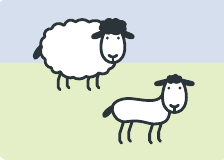
Step 1: Variation
A population starts with natural genetic variation. In a sheep population, some individuals naturally have denser wool than others due to genetic differences.
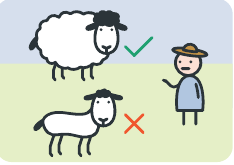
Step 2: Selection pressure
Humans identify individuals with the desired trait (in this case, high wool density) and choose only these individuals to breed. Those without the desired trait are prevented from reproducing.
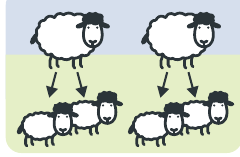
Step 3: Heritability
Because wool density is heritable, the offspring inherit genes for dense wool from their parents. Over multiple generations, the frequency of alleles for high wool density increases in the population. Repeated selection reinforces the expression of the desired trait.
This process can also work in reverse. Instead of selecting for a desirable trait, humans can select against an unwanted trait to remove it from the population. For example, selectively removing large-bodied fish from a population (through overfishing) will eventually result in a population dominated by small-bodied fish.
Examples of selective breeding
Russian fox domestication experiment
Modern dogs descended from wild wolves, but the exact process of domestication was not well understood until recently. Since the 1960s, Russian zoologist Dmitry Belyaev has conducted an ongoing experiment that demonstrates how selective breeding can domesticate wild animals.
Belyaev began with a population of wild silver foxes. He ranked individuals based on traits associated with tameness, such as low aggression and affection towards people. The tamest individuals were bred together, and this process was repeated over many generations.
The results were remarkable. After just ten generations, almost 20% of bred foxes could be categorised as 'domesticated elite', displaying behaviour similar to modern dogs. Interestingly, selecting for tameness also changed other characteristics that weren't directly selected for. Some foxes developed changes in coat colour, developmental patterns, tail shape, floppy ears, and jaw structure. These changes mirrored some traits that distinguish modern dogs from wolves, suggesting that selecting for behavioural traits can inadvertently affect physical characteristics.
Note
The fox experiment demonstrates an important principle: when you select for one trait, you may unintentionally select for other traits that are genetically linked. This is why selective breeding can produce unexpected changes in appearance, behaviour, or physiology.
Maize development from teosinte
Maize (also known as corn) has been a staple crop in agriculture for thousands of years. For a long time, biologists were puzzled about the origin of maize. It was eventually discovered that maize descended from the wild grass teosinte.
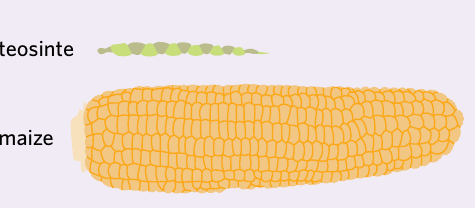
Teosinte is generally a poor crop species with small seed cases and few kernels. However, through selective breeding over millennia, humans selected for suitable farming characteristics such as soft kernels, large cobs, many kernels, and kernel permanence (kernels that don't fall off easily). This gradual process transformed teosinte into the modern maize we recognise today.
Effects on genetic diversity
While selective breeding can produce desirable traits, it can have significant negative effects on genetic diversity. When breeding practices are poorly implemented, selective breeding can cause a human-induced genetic bottleneck.
Important
Think of a bottleneck as literally narrowing the opening of a bottle - only certain individuals (those with desired traits) can pass through to become parents of the next generation. This dramatically reduces the genetic diversity of the population.
In large populations, only a small percentage of individuals typically express the traits that humans desire. By restricting breeding to only these individuals, the process reduces the variety of alleles in the population. As the frequency of the selected allele increases over generations, genetic diversity decreases because the population's phenotypes are driven towards a specific allele combination.
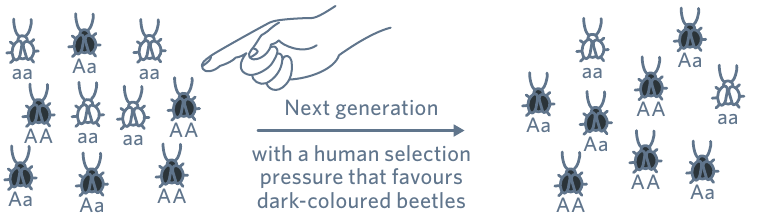
The diagram above shows how selecting for dark-coloured beetles (AA or Aa genotypes) increases their frequency in the next generation, whilst the frequency of light-coloured beetles (aa genotype) decreases. This demonstrates how artificial selection pressure changes the gene pool over time.
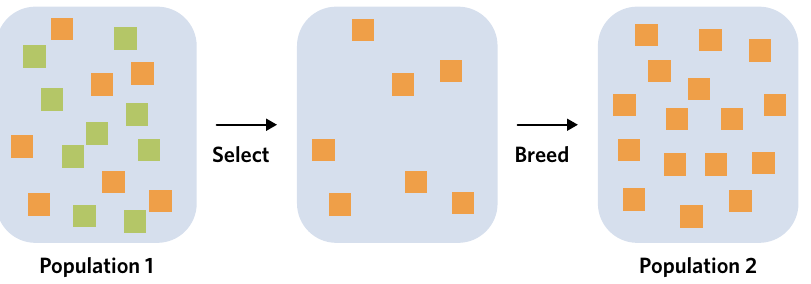
This simplified diagram illustrates the same concept. Starting with a genetically diverse population (Population 1) containing both orange and green individuals, humans select only the orange individuals. After breeding, Population 2 has much less genetic diversity, containing almost exclusively orange individuals.
Negative consequences of selective breeding
Reduced genetic diversity from selective breeding creates two major problems that can threaten a population's survival:
Increased inbreeding
When genetic diversity is low, individuals in a population are more closely related to each other. This increases the likelihood of inbreeding (breeding between closely related individuals). Inbreeding raises the frequency of homozygous individuals (those having identical alleles for the same gene on homologous chromosomes), which can reveal harmful recessive traits.
Expression of deleterious alleles
A deleterious allele is an allele that has an overall negative effect on individual fitness when expressed. Many deleterious alleles are recessive, meaning they can remain hidden in a population when individuals carry only one copy.
A recessive allele is a trait that can be masked by a dominant allele on a homologous chromosome. When inbreeding increases homozygosity, previously hidden deleterious recessive alleles become expressed in the phenotype, causing health problems.
Important
Common misconception: The negative effects of inbreeding rarely stem from the expression of one massively harmful allele, but rather from hundreds of slightly deleterious ones working together. This cumulative effect can be devastating to a population's health.
Reduced adaptive potential
Adaptive potential is the ability for a population to adjust to new environmental selection pressures. When genetic diversity is low, a population has fewer genetic variations available to respond to environmental changes. This makes the population more vulnerable to diseases, climate change, and other environmental challenges.
Note
A population with high genetic diversity is like having many different tools in a toolbox - when a new challenge arises, there's likely to be a genetic variant that can help. With low genetic diversity, the population has fewer "tools" to work with, making it harder to adapt to changes.
These effects are detrimental to the survival of a population and demonstrate why careful management of breeding programmes is essential.
Case study: English bulldogs
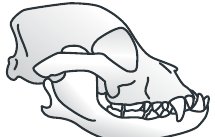
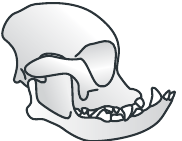
English bulldogs provide a striking example of the negative consequences of selective breeding. Over 100 years of selective breeding has dramatically changed the skull shape of English bulldogs.
Important
Warning from history: Comparing bulldog skulls from 1908 and 2008 shows dramatic changes. Inbreeding has led to the accumulation of deleterious recessive alleles, which have increased the prevalence of:
- Respiratory problems (due to shortened snouts and airways)
- Cardiovascular problems
- Poor immune systems
These health issues significantly reduce the quality of life for modern English bulldogs and demonstrate how selecting for aesthetic traits without considering genetic diversity can have serious consequences.
Remember!
Summary
Key Points to Remember:
-
Selective breeding (artificial selection) is the process by which humans control breeding to develop desirable traits in plants and animals by altering a population's gene pool.
-
The three requirements for selective breeding mirror those of natural selection: variation (genetic differences in the population), selection pressure (human intervention choosing which individuals breed), and heritability (traits must be able to pass to offspring).
-
The key difference between selective breeding and natural selection is the source of selection pressure: artificial (human-controlled) versus environmental (nature-controlled).
-
Selective breeding can reduce genetic diversity by creating a genetic bottleneck, where only a small number of individuals with desired traits are allowed to breed.
-
Reduced genetic diversity increases inbreeding, which can lead to the expression of deleterious recessive alleles and reduced adaptive potential, threatening population survival and health.