Evidence of Relatedness (VCE SSCE Biology): Revision Notes
📚Revision Notes
Evidence of Relatedness
Scientists use various types of evidence to determine how closely related different species are to each other. This evidence falls into two main categories: structural morphology (comparing physical features) and molecular homology (comparing DNA and protein sequences). Understanding these methods helps us trace evolutionary relationships and identify common ancestors.
Structural morphology
Structural morphology is the study of physical structures to establish relatedness between different species. By examining the physical features of organisms, such as their skeletal structures, scientists can identify similarities that suggest shared ancestry.
Homologous structures
Homologous structures are features present in two or more species that may look and function very differently in each species, but are derived from a common ancestor.
Even though homologous structures may serve completely different purposes in different species, they share the same basic underlying structure. This similarity indicates that these species evolved from a common ancestor that possessed this structure.
A classic example is the upper limb structure found in humans, cats, whales, and bats. Each species uses its limbs differently:
- Humans use their arms to carry objects
- Cats use their legs to walk
- Whales use their flippers to swim
- Bats use their wings to fly
Despite these different functions, all four limbs share a remarkably similar bone structure. The same bones are present in each limb, just modified in size and shape.
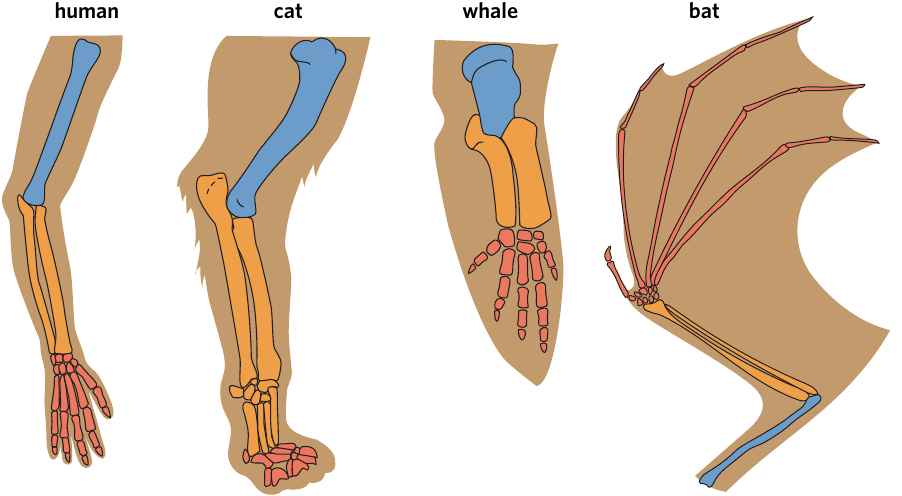
This similarity suggests that humans, cats, whales, and bats all descended from a common ancestor that had this particular limb structure. Over time, through evolution, each species adapted the basic structure for different purposes.
Note
Memory aid: The word 'homo' means 'same' in Greek, so homologous structures originate from the same ancestor.
Divergent evolution
Homologous structures provide physical evidence of divergent evolution, which is the process in which a common ancestor evolves into two or more descendant species. This occurs when populations of a single species become separated and adapt to different environments or selection pressures. Over extended periods, the accumulated genetic differences become so great that the populations are classified as separate species.
Note
Divergent evolution explains why species that look very different today (like humans and whales) can share similar underlying structures. They started from the same ancestral blueprint but adapted it for different purposes over millions of years.
Analogous structures (for comparison)
It's important to distinguish homologous structures from analogous structures. Analogous structures are features present in two or more species that fulfil the same function but do not originate from a common ancestor.
Analogous structures arise through convergent evolution, which is the process in which distantly related species evolve similar traits over time due to the action of similar selection pressures. Species facing similar environmental challenges may independently evolve similar solutions, even though they don't share a recent common ancestor.
Important
Don't confuse these terms:
- Homologous structures = Same origin (common ancestor), different functions
- Analogous structures = Different origins, same function
Think of it as: Homologous = Heritage, Analogous = Adaptation
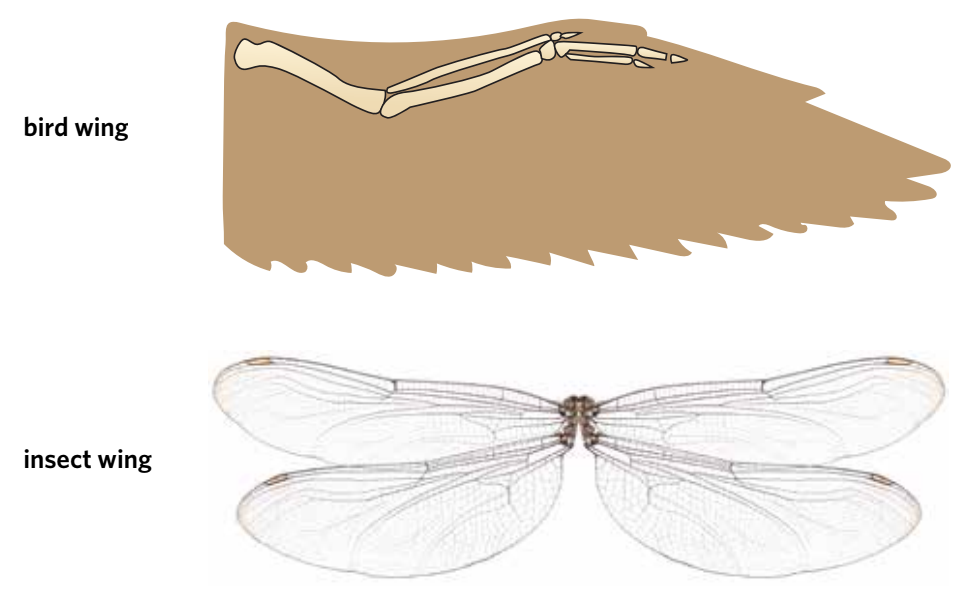
For example, bird wings and insect wings are analogous structures. Both are used for flight, but they evolved completely independently:
- Bird wings contain bones and are modified forelimbs
- Insect wings are thin membranes without any bones
The similarity in function doesn't indicate shared ancestry - it indicates that flight was advantageous in both lineages, so similar structures evolved separately.
Vestigial structures
Vestigial structures are features that have lost all or most of their usefulness as a result of evolution by natural selection.
These structures once served an important purpose in an organism's ancestors, but changing environmental conditions and selection pressures meant they were no longer necessary for survival. However, because they weren't harmful enough to be selected against, they remained in the species.
Vestigial structures provide evidence of evolutionary relationships because they reveal information about an organism's ancestral history.
Note
Vestigial structures persist not because they're useful, but because they're not harmful enough to be removed by natural selection. Evolution doesn't work toward perfection—it works with what's already there.
The human coccyx
The human coccyx (commonly called the tailbone) is a vestigial structure that serves no significant function in modern humans.
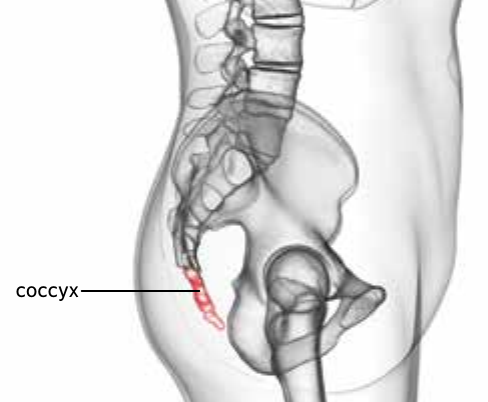
The coccyx is a remnant of our ancestors' tails. Early human ancestors lived in trees and used their tails for balance. As humans evolved, more sophisticated features developed to help with balance, including the cerebellum (a brain structure) and the inner ear. These new features made the tail unnecessary for survival.
Although the tail lost its function, the small tailbone remained because there was no strong selection pressure against it. Its presence demonstrates our evolutionary connection to tailed ancestors.
Pelvic bones in snakes and whales
Vestigial structures aren't unique to humans. Many other animals possess structures that no longer serve their original purpose.
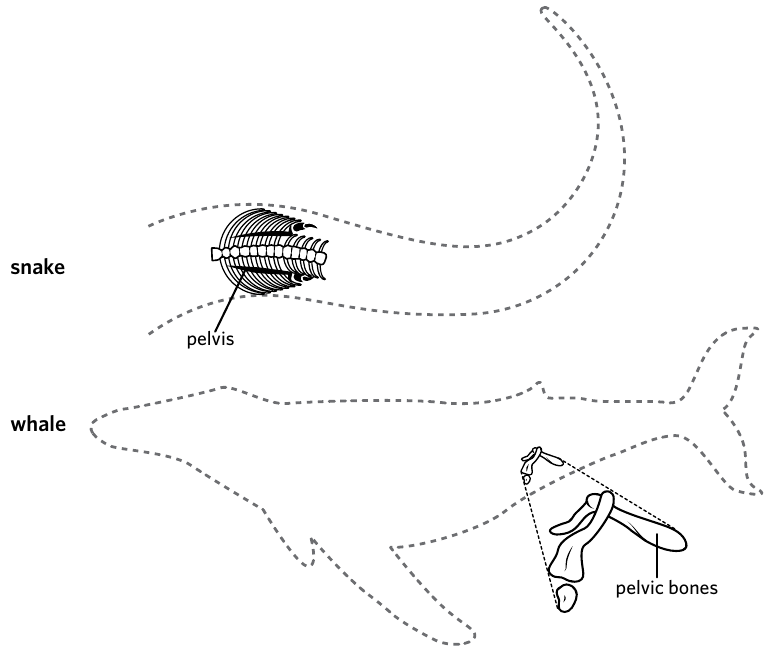
Both snakes and whales have pelvic bones, despite neither having legs:
- Snakes are descendants of reptiles that had legs
- Whales are descendants of land-dwelling mammals that had legs
The presence of these vestigial pelvic bones provides evidence of these species' evolutionary history and their descent from legged ancestors.
Molecular homology
While structural morphology examines physical features, molecular homology looks at the biochemical level. Molecular homology is the study of the similarities in the nucleotide sequences of DNA or amino acid sequences in proteins between organisms to establish relatedness.
Molecular evidence can reveal evolutionary relationships that aren't obvious from physical features alone. By comparing the sequences of specific genes or proteins across different species, scientists can determine how closely related they are.
Amino acid sequence similarity
Proteins are made of chains of amino acids. The sequence of amino acids in a protein is determined by the DNA sequence of the gene that codes for it. When studying relatedness, scientists focus on conserved genes—genes that have remained largely unchanged throughout evolution and are found across the genomes of many different species.
By comparing the amino acid sequences of the same protein in different species, researchers can assess how closely related those species are. Species with more similar amino acid sequences are more closely related and share a more recent common ancestor.
Haemoglobin analysis
Haemoglobin (Hb) is a protein found in red blood cells that is responsible for the transport of oxygen in the body. It's found in many different species, making it useful for comparison.
Haemoglobin consists of four polypeptide chains:
- 2 alpha chains (141 amino acids each)
- 2 beta chains (146 amino acids each)
The table below shows a portion of the haemoglobin amino acid sequence in humans and four other vertebrates:
| Position | 1 | 2 | 3 | 4 | 5 | 6 | 7 | 8 | 9 | 10 | 11 | 12 | 13 | 14 |
|---|---|---|---|---|---|---|---|---|---|---|---|---|---|---|
| Human | Arg | Leu | Leu | Gly | Asn | Val | Leu | Val | Cys | Val | Leu | Ala | His | |
| Chimpanzee | Arg | Leu | Leu | Gly | Asn | Val | Leu | Val | Cys | Val | Leu | Ala | His | |
| Gorilla | Lys | Leu | Leu | Gly | Asn | Val | Leu | Val | Cys | Val | Leu | Ala | His | |
| Kangaroo | Lys | Leu | Leu | Gly | Asn | Ile | Ile | Val | Ile | Cys | Leu | Ala | Glu |
Example
Worked Example: Interpreting Haemoglobin Sequence Data
Looking at the table above, we can analyze the differences:
Step 1: Count the differences between humans and each species
- Chimpanzees vs humans: 0 differences (identical sequence)
- Gorillas vs humans: 1 difference (Lys instead of Arg at position 1)
- Kangaroos vs humans: 4 differences (positions 1, 6, 7, and 9)
Step 2: Interpret the results
- Chimpanzees have an identical sequence to humans—indicating they are the most closely related
- Gorillas show minimal differences—suggesting close relationship but slightly more distant than chimpanzees
- Kangaroos show the most differences—indicating they are more distantly related
Conclusion: This suggests that chimpanzees share the most recent common ancestor with humans, while kangaroos diverged from our lineage much earlier.
Cytochrome c analysis
Cytochrome c is an enzyme found in mitochondria that carries electrons in aerobic and anaerobic respiration reactions. It consists of 104 amino acids encoded by a conserved gene in mitochondrial DNA (mtDNA), which is circular DNA found in mitochondria.
The table below shows a segment of the cytochrome c amino acid sequence in three species:
| Position | 1 | 2 | 3 | 4 | 5 | 6 | 7 | 8 | 9 |
|---|---|---|---|---|---|---|---|---|---|
| Human | Ser | Tyr | Thr | Gly | Ala | Asn | Ala | Lys | Asn |
| Rat | Ser | Tyr | Thr | Gly | Asp | Asn | Ala | Lys | Asn |
| Yeast | Ser | Tyr | Thr | Gly | Asp | Asn | Ala | Lys | Lys |
In this segment, rats show more similarity to humans than yeast does, with only one difference compared to two differences for yeast.
When we examine the complete cytochrome c sequence, we can compare the total number of amino acid differences between humans and various species:
| Species pairing | Number of amino acid differences |
|---|---|
| Human – chimpanzee | 0 |
| Human – rhesus monkey | 1 |
| Human – horse | 12 |
| Human – pigeon | 12 |
| Human – rattlesnake | 14 |
| Human – snapping turtle | 15 |
| Human – tuna | 21 |
| Human – fruit fly | 29 |
| Human – wheat | 43 |
Note
Understanding the Pattern
This data clearly shows that:
- Chimpanzees are most closely related to humans (zero differences)
- Primates (rhesus monkey) are more closely related than other mammals
- Vertebrates (horse, pigeon, reptiles, fish) show moderate differences
- Invertebrates (fruit fly) show greater differences
- Plants (wheat) show the greatest differences
The pattern reflects the evolutionary distance between humans and each species—the more time since divergence from a common ancestor, the more amino acid differences have accumulated.
DNA sequence similarity
Just as amino acid sequences can be compared, DNA (deoxyribonucleic acid) sequences can also be used to determine evolutionary relatedness. DNA is a double-stranded nucleic acid chain made up of nucleotides. DNA carries the instructions for proteins which are required for cell and organism survival.
A nucleotide is the monomer subunit of nucleic acids. It's made up of a nitrogen-containing base, a five-carbon sugar molecule (ribose in RNA and deoxyribose in DNA), and a phosphate group.
DNA contains four different nitrogenous bases:
- Adenine (A)
- Cytosine (C)
- Guanine (G)
- Thymine (T)
Scientists compare DNA sequences between species by examining the order of these bases in corresponding gene regions. The more similar the sequences, the more closely related the species.
Comparing DNA sequences
The table below shows a comparison of a DNA sequence segment from the cytochrome c gene in three species:
| Species | DNA Sequence (5' to 3') |
|---|---|
| Human | AGA ATA TGA CGG CGA TTG TTC TTA |
| Rat | AGA ATA TGA CTG CGT TTG TTT TTA |
| Yeast | AGA ATG TGG CTG CGT TTG TAT TTC |
Example
Worked Example: Comparing DNA Sequences
Step 1: Count the nucleotide differences (highlighted in bold)
- Humans vs rats: 3 nucleotide differences
- Humans vs yeast: 7 nucleotide differences
Step 2: Interpret the relatedness
Rats are more closely related to humans than yeast, as indicated by fewer nucleotide differences.
Step 3: Compare with amino acid analysis
This DNA analysis confirms what we found from amino acid sequence comparison—rats and humans are more closely related to each other than either is to yeast.
Advantages of using mitochondrial DNA
Mitochondria contain their own DNA, separate from the DNA in the cell nucleus. This mitochondrial DNA (mtDNA) is approximately 17,000 nucleotides long in humans and contains 37 genes, compared to over 24,000 genes in nuclear DNA (DNA that is located in the nucleus of a cell).
Important
Why mtDNA is Especially Useful for Studying Relatedness
mtDNA offers two key advantages:
1. Higher mutation rate: mtDNA mutates much faster than nuclear DNA. For very closely related species (where nuclear DNA might be nearly identical), the higher mutation rate in mtDNA ensures there are still enough differences to make comparisons meaningful.
2. No recombination: mtDNA is only inherited from the mother (maternal inheritance). Because there's no mixing of DNA from both parents, mtDNA remains largely unchanged from generation to generation. This makes it much easier to trace lineages back through time.
Memory aid: MUM
- Mutation rate higher
- Unchanged (no recombination)
- Maternal inheritance
These advantages make mtDNA particularly useful for tracing human evolutionary history. Research using mtDNA has shown that all modern humans share a common female ancestor who lived in Africa approximately 160,000 years ago.
Choosing between amino acid and DNA sequence analysis
Both methods help determine relatedness, but each has advantages in different situations:
Note
When to Use Each Method
DNA sequence analysis is better for:
- Closely related species
- When amino acid sequences are too similar to show differences
- Detecting silent mutations (changes in DNA that don't change the amino acid due to the redundancy of the genetic code)
Amino acid sequence analysis is better for:
- More distantly related species
- When sequences are easier to interpret
- When a broader view of evolutionary relationships is needed
Whole genome comparison
Beyond individual genes, scientists can compare entire genomes (the complete set of DNA housed within an organism) between species. Higher similarity between genomes indicates closer evolutionary relationship and more recent divergence from a common ancestor.
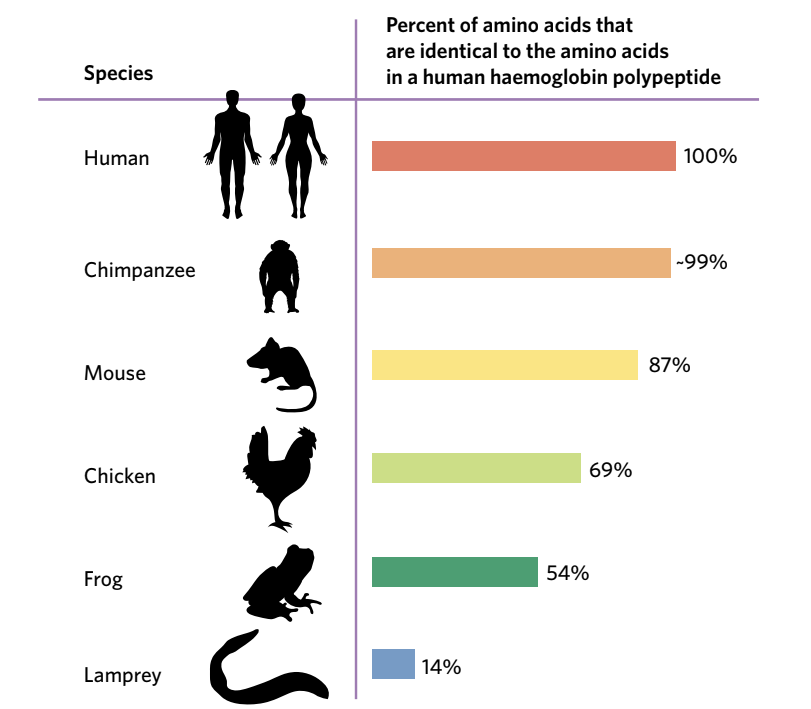
For example, comparing the percentage of amino acids identical to human haemoglobin across species shows:
- Chimpanzees: ~99% similarity
- Mice: 87% similarity
- Chickens: 69% similarity
- Frogs: 54% similarity
- Lampreys: 14% similarity
This clearly illustrates the evolutionary distance between humans and each species.
Summary of evidence types
The table below summarises the two main approaches to determining relatedness:
| Structural morphology | Molecular homology |
|---|---|
| Homologous structures: Features that have the same underlying structure but different functions. The presence of homologous structures in different species suggests they share a common ancestor. | Amino acid sequences: Researchers examine shared proteins between species and measure the degree of amino acid similarity to demonstrate relatedness. Higher similarity suggests closer relationship. |
| Vestigial structures: Structures that remain within a species despite losing their function and necessity. Like homologous structures, their presence suggests the organisms being compared share a common ancestor. | DNA sequences: Researchers examine corresponding gene regions (or entire genomes) between species and demonstrate relatedness based on nucleotide differences. Higher similarity suggests closer relationship. |
Both structural and molecular evidence complement each other to provide a comprehensive picture of evolutionary relationships between species.
Summary
Key Points to Remember:
-
Homologous structures are features that look and function differently but share the same underlying structure due to common ancestry—they're evidence of divergent evolution
-
Vestigial structures are non-functional remnants of features that were useful in ancestors—they reveal evolutionary history
-
Amino acid sequence comparison works by analysing shared proteins like haemoglobin and cytochrome c—fewer differences mean closer relationships
-
DNA sequence comparison examines nucleotide order in genes—it's more sensitive than amino acid analysis for closely related species
-
Mitochondrial DNA is especially useful for tracing lineages because it has a higher mutation rate and is only inherited from the mother