Dihybrid Crosses (VCE SSCE Biology): Revision Notes
📚Revision Notes
Dihybrid Crosses
Introduction
A dihybrid cross is a genetic cross used to observe the inheritance of alleles and phenotypes for two genes. Whilst monohybrid crosses examine the inheritance pattern of a single trait, dihybrid crosses allow us to predict the genetic outcomes when tracking two different traits simultaneously.
There are two types of dihybrid crosses depending on the location of the genes:
- Unlinked dihybrid crosses (for genes on different chromosomes or far apart on the same chromosome)
- Linked dihybrid crosses (for genes close together on the same chromosome)
Unlinked dihybrid crosses
What are unlinked genes?
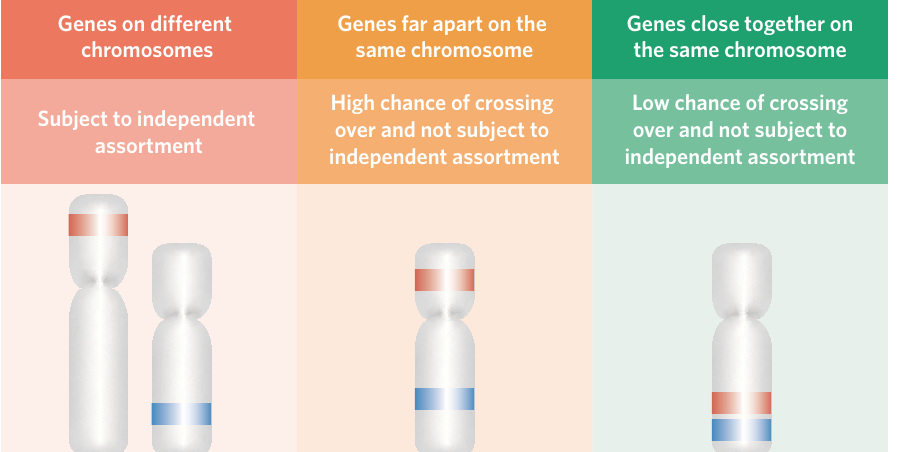
Unlinked genes are genes located on different chromosomes, or far apart on the same chromosome. Because of their location, unlinked genes have less chance of being inherited together.
During meiosis, unlinked genes undergo independent assortment, which is the random orientation of homologous chromosomes along the metaphase plate during metaphase I. This means each gene is inherited independently of the other.
Note
Independent assortment is a key principle of Mendelian genetics that only applies to unlinked genes. This random orientation during metaphase I ensures that the inheritance of one gene doesn't influence the inheritance of another gene on a different chromosome.
Example: dimples and cleft chin
Consider two traits in humans:
- Gene for dimples: D = dimples, d = no dimples
- Gene for cleft chin: C = cleft chin, c = no cleft chin
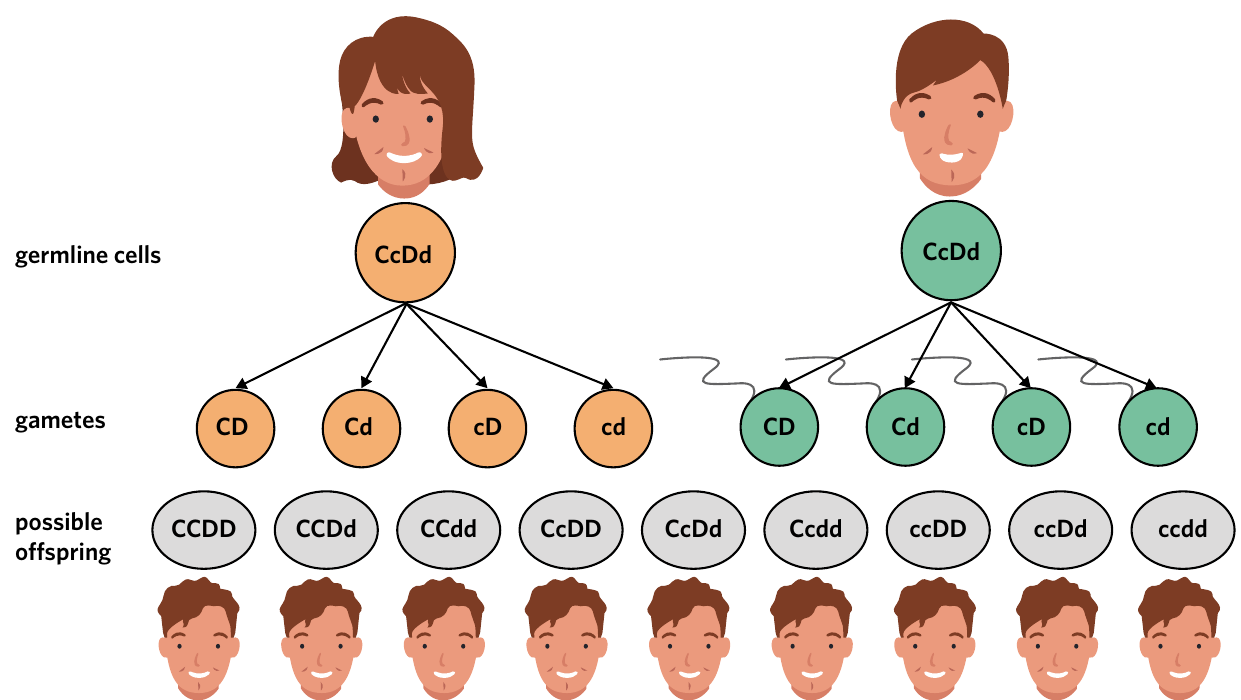
When writing genotypes for two genes, we write one trait followed by the other. For example, an individual heterozygous for both traits would have the genotype CcDd.
The FOIL method
To determine which gametes an individual can produce during meiosis, we use the FOIL method:
- F = First alleles
- O = Outside alleles
- I = Inside alleles
- L = Last alleles
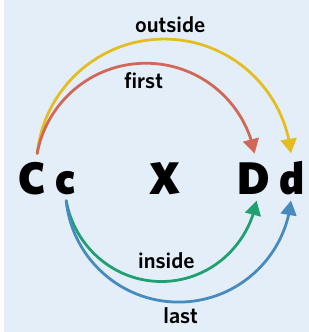
For an individual with genotype CcDd, the FOIL method gives us four possible gamete combinations:
- First: CD
- Outside: Cd
- Inside: cD
- Last: cd
Important
The FOIL method is essential for determining all possible gamete combinations in dihybrid crosses. Without using FOIL correctly, you may miss gamete combinations and get incorrect results in your Punnett square. Always work through all four combinations systematically: First, Outside, Inside, Last.
How to complete an unlinked dihybrid cross
To predict the genetic outcomes for two unlinked genes, we use a 4×4 Punnett square. Here are the steps:
Step 1: Assign letters to each allele
Choose letters to represent the dominant and recessive alleles for both genes.
Example:
- C = cleft chin, c = no cleft chin
- D = dimples, d = no dimples
Step 2: Draw a 4×4 grid
Create a grid with 4 rows and 4 columns (16 squares total).
Step 3: Write the father's allele combinations above the columns
Use the FOIL method to determine all possible gamete combinations from the father, and write one above each column.
Step 4: Write the mother's allele combinations beside the rows
Use the FOIL method to determine all possible gamete combinations from the mother, and write one beside each row.
Note
You can place mother's and father's gametes on either side - it doesn't matter which. Choose whichever arrangement is most convenient for you, as the genetic outcome will be identical.
Step 5: Complete the cross
Fill in each square by combining the gametes from that row and column. Always write the dominant allele first in heterozygous offspring (e.g., Cc not cC).
Step 6: Calculate genotype proportions
Count the frequency of each genotype and divide by the total number of squares (16). Multiply by 100 to get a percentage.
Step 7: Determine phenotype proportions
Group genotypes by their phenotype, count the frequency of each phenotype, divide by 16, and multiply by 100 to get percentages.
Example
Worked Example: Dihybrid Cross for Dimples and Cleft Chin
Let's work through a cross between two parents who are both heterozygous for dimples and cleft chin (CcDd × CcDd).
| Step | Details | Result |
|---|---|---|
| 1. Assign letters | C = cleft chin, c = no cleft chin, D = dimples, d = no dimples | Letters assigned |
| 2. Draw grid | Create 4×4 grid | 16 squares |
| 3. Father's gametes | Using FOIL on CcDd: CD, Cd, cD, cd | Written above columns |
| 4. Mother's gametes | Using FOIL on CcDd: CD, Cd, cD, cd | Written beside rows |
| 5. Complete cross | Combine alleles in each square | All 16 genotypes filled |
The completed Punnett square gives these genotypes:
| Genotype | Number | Fraction | Percentage |
|---|---|---|---|
| CCDD | 1 | 1/16 | 6.25% |
| CCDd | 2 | 2/16 | 12.5% |
| CCdd | 1 | 1/16 | 6.25% |
| CcDD | 2 | 2/16 | 12.5% |
| CcDd | 4 | 4/16 | 25% |
| Ccdd | 2 | 2/16 | 12.5% |
| ccDD | 1 | 1/16 | 6.25% |
| ccDd | 2 | 2/16 | 12.5% |
| ccdd | 1 | 1/16 | 6.25% |
For phenotypes:
- Cleft chin and dimples (C_D_): 9/16 = 56.25%
- Cleft chin, no dimples (C_dd): 3/16 = 18.75%
- No cleft chin, dimples (ccD_): 3/16 = 18.75%
- No cleft chin, no dimples (ccdd): 1/16 = 6.25%
Phenotypic ratio:
The 9:3:3:1 ratio
Whenever you conduct a dihybrid cross between two heterozygous individuals for unlinked genes, the phenotypic ratio will always be 9:3:3:1. This is a crucial pattern to remember for exam questions.
Important
The phenotypic ratio is the hallmark of an unlinked dihybrid cross between two heterozygous parents. If you see this ratio in your results, you can be confident that:
- The genes are unlinked
- Both parents were heterozygous for both traits
- Independent assortment occurred
This ratio represents: 9 offspring with both dominant traits, 3 with the first dominant trait only, 3 with the second dominant trait only, and 1 with both recessive traits.
Linked dihybrid crosses
What are linked genes?
Linked genes are genes that are found close together on the same chromosome and are likely to be inherited together. Because they sit on the same chromosome, linked genes are not separated by independent assortment during meiosis.
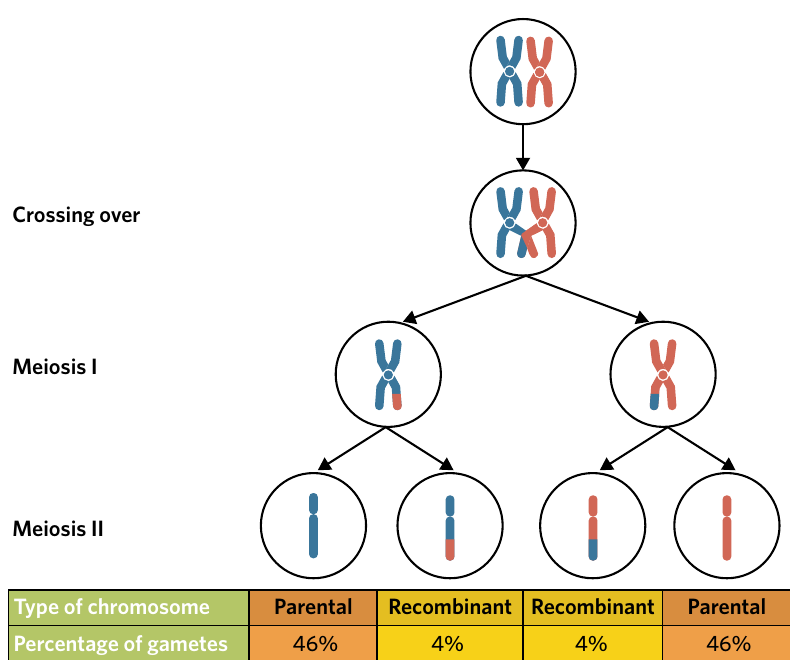
However, linked genes can occasionally be separated through crossing over, which is the exchange of genetic material between non-sister chromatids during prophase I of meiosis, resulting in new combinations of alleles in daughter cells.
Map units and recombination
The distance between genes is measured in map units. Map units are a measure of the distance between two genes on the same chromatid. Genes that are closer together are more likely to be linked genes.
Note
Understanding Map Units
One map unit equals a one per cent chance of crossing over occurring. This direct relationship makes it easy to calculate recombination frequencies:
- If two genes are 8 map units apart, there is an 8% chance of crossing over
- This means 8 in 100 gametes will contain a recombinant chromosome
- The remaining 92% will contain parental chromosomes
The key formula to remember: 1 map unit = 1% crossing over chance
Parental vs recombinant chromosomes
- Parental chromosome: A chromosome which contains the same combination of alleles as one of the parents' chromosomes
- Recombinant chromosome: A chromosome which is not identical to one of the homologous chromosomes in a diploid cell (created through crossing over)
Example: Drosophila melanogaster
Fruit flies (Drosophila melanogaster) have several linked genes on their second chromosome, including genes for body colour and eye colour:
- B = grey body, b = black body
- E = red eyes, e = brown eyes
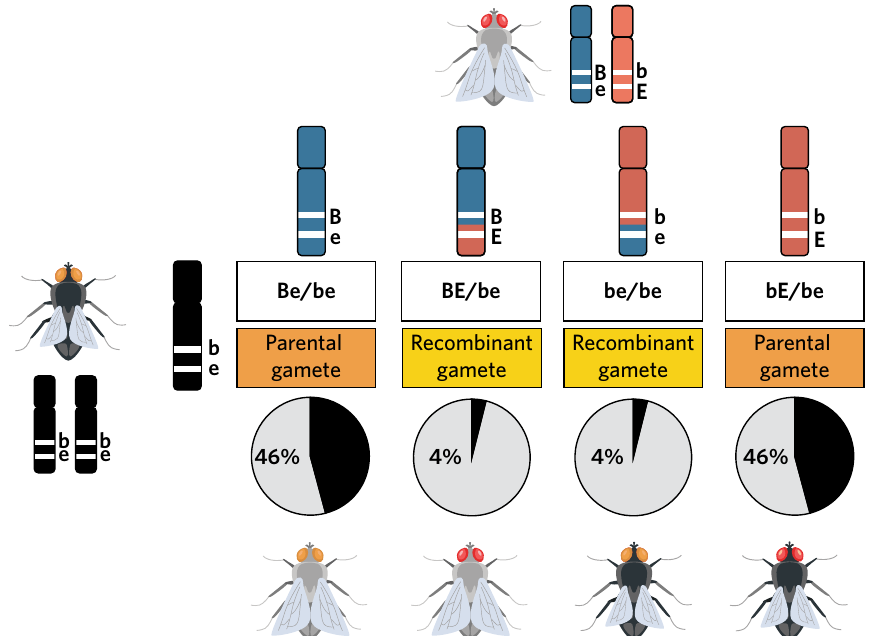
If these genes are 8 map units apart:
- 8% of gametes will be recombinant (BE or be)
- 92% of gametes will be parental (Be or bE)
- Since there are two parental types: each
- Since there are two recombinant types: each
This gives us gamete frequencies of 46% : 4% : 4% : 46%.
How to complete a linked dihybrid cross
For linked genes, we typically cross a heterozygous individual with a homozygous recessive individual (a test cross). This uses a 1×4 grid rather than a 4×4 grid.
Step 1: Assign letters to each allele
Choose letters for the dominant and recessive alleles of both genes.
Step 2: Determine possible gametes and their frequencies
Work out the parental and recombinant gametes for the heterozygous parent, accounting for crossing over using map units. The homozygous recessive parent can only produce one type of gamete.
Step 3: Draw a 1×4 grid
Create a grid with 1 row and 4 columns.
Step 4: Write the heterozygous parent's allele combinations above columns
Label which are parental gametes and which are recombinant gametes.
Step 5: Write the homozygous recessive alleles beside the row
This parent contributes the same gamete to all offspring.
Step 6: Complete the cross
Combine alleles using the correct notation for linked genes (alleles on one chromosome/alleles on other chromosome).
Step 7: Write percentage chances
Below each square, write the percentage chance of that genotype occurring based on the gamete frequencies.
Genotype notation for linked genes
For linked genes, we use a different notation system. Write the alleles on one chromosome first, add a forward slash (/), then write the alleles on the second chromosome.
Important
Special Notation for Linked Genes
For linked genes, use the slash notation: Be/be
This means:
- One chromosome carries B and e alleles
- The other chromosome carries b and e alleles
This notation is essential because it shows which alleles are physically linked together on the same chromosome. Never use the standard notation (BbEe) for linked genes, as it doesn't convey which alleles are together.
Example
Worked Example: Linked Dihybrid Cross in Drosophila
Cross between a heterozygous male (Be/bE) and homozygous recessive female (be/be), with 8 map units between genes:
| Step | Details |
|---|---|
| 1. Letters | B = grey, b = black, E = red eyes, e = brown eyes |
| 2. Gametes | Mother: be only; Father: Be (46%), bE (46%), BE (4%), be (4%) |
| 3. Grid | 1×4 grid drawn |
| 4. Father's gametes | Be (parental), BE (recombinant), be (recombinant), bE (parental) |
| 5. Mother's alleles | be beside the row |
The completed cross gives:
| Gamete | Be | BE | be | bE |
|---|---|---|---|---|
| be | Be/be | BE/be | be/be | bE/be |
| Type | Parental | Recombinant | Recombinant | Parental |
| Percentage | 46% | 4% | 4% | 46% |
Notice how the parental gametes (46% each) are far more common than the recombinant gametes (4% each). This unequal distribution is characteristic of linked genes.
Identifying linked vs unlinked genes
How can you tell if genes are linked or unlinked in a problem?
Note
Clues for Linked Genes:
- Unusual genotypic ratios (e.g., 11.5:1:1:11.5 instead of 1:1:1:1)
- Some genotypes appear very rarely in offspring
- Genotypes present in offspring that weren't in the parents
- The question mentions map units or crossing over percentages
Clues for Unlinked Genes:
- Standard Mendelian ratios ( for heterozygous crosses, for test crosses)
- All gamete combinations equally likely
- Genes on different chromosomes
Summary
Key Points to Remember:
-
Dihybrid crosses predict the inheritance of two genes simultaneously, extending the concept of monohybrid crosses.
-
Unlinked genes (on different chromosomes or far apart) use 4×4 Punnett squares and the FOIL method to determine gametes. Heterozygous crosses always give a 9:3:3:1 phenotypic ratio.
-
Linked genes (close together on the same chromosome) use 1×4 grids and require knowledge of map units to calculate recombination frequency.
-
Map units tell us the percentage chance of crossing over: 1 map unit = 1% chance. This creates both parental chromosomes (high frequency) and recombinant chromosomes (low frequency).
-
For linked genes, use special notation: Write alleles on one chromosome, add a slash (/), then write alleles on the other chromosome (e.g., Be/bE).
-
The ratio is your indicator for unlinked genes with heterozygous parents, while unusual ratios with very common and very rare genotypes suggest linked genes.