Monohybrid Crosses (VCE SSCE Biology): Revision Notes
📚Revision Notes
Monohybrid Crosses
Introduction
A monohybrid cross is a genetic cross performed to observe the inheritance of alleles and phenotypes for a single gene. This technique allows us to predict what traits offspring might inherit from their parents by tracking how one specific gene is passed down through generations.
Note
Understanding monohybrid crosses is essential for predicting genetic outcomes. For example, Huntington's disease is an autosomal dominant disorder caused by a single gene mutation. Because it follows complete dominance inheritance, having just one copy of the mutated allele means a person will develop the disease. If one parent tests positive for Huntington's disease, we can use a monohybrid cross to predict the likelihood of their children inheriting the condition.
How to perform a monohybrid cross
Understanding Punnett squares
A Punnett square is a square diagram used to predict the genotypes of offspring. It provides a clear, organised method for working out all possible genetic combinations that could result from a cross between two parents.
When parents reproduce, they pass on alleles through their gametes (sex cells). Each parent contributes one allele for each gene, and the Punnett square shows us all the possible ways these alleles can combine in the offspring.
Autosomal complete dominance
In complete dominance, one allele (the dominant allele) completely masks the effect of another allele (the recessive allele). When an individual is heterozygous (has one dominant and one recessive allele), only the dominant trait is expressed.
Steps to complete a Punnett square
Follow these seven steps to create an accurate Punnett square:
Step 1: Assign letters to each allele
Choose a letter that represents the gene. Use an uppercase letter for the dominant allele and a lowercase letter for the recessive allele. For example, for widow's peak: = widow's peak allele (dominant), = straight hairline allele (recessive).
Step 2: Draw a 2 × 2 grid
Create a square divided into four equal boxes. This will show the four possible combinations of alleles.
Step 3: Write the father's alleles above the columns
Place one of the father's alleles above the left column and the other above the right column.
Step 4: Write the mother's alleles beside the rows
Place one of the mother's alleles beside the top row and the other beside the bottom row.
Note
You can put the mother's alleles on top and father's on the side instead - it doesn't matter which parent goes where.
Step 5: Complete the cross
Fill in each box by combining the alleles from the corresponding row and column. Always write the dominant allele first when writing heterozygous genotypes (e.g., , not ).
Step 6: Calculate genotype proportions
Count how many boxes contain each genotype. Divide each count by the total number of boxes (4) to get the fraction, then multiply by 100 to get the percentage.
Step 7: Determine phenotype proportions
Look at the genotypes and determine what phenotype each would produce. Count how many boxes show each phenotype, divide by 4, and multiply by 100 for the percentage.
Example
Worked Example: Widow's Peak Inheritance
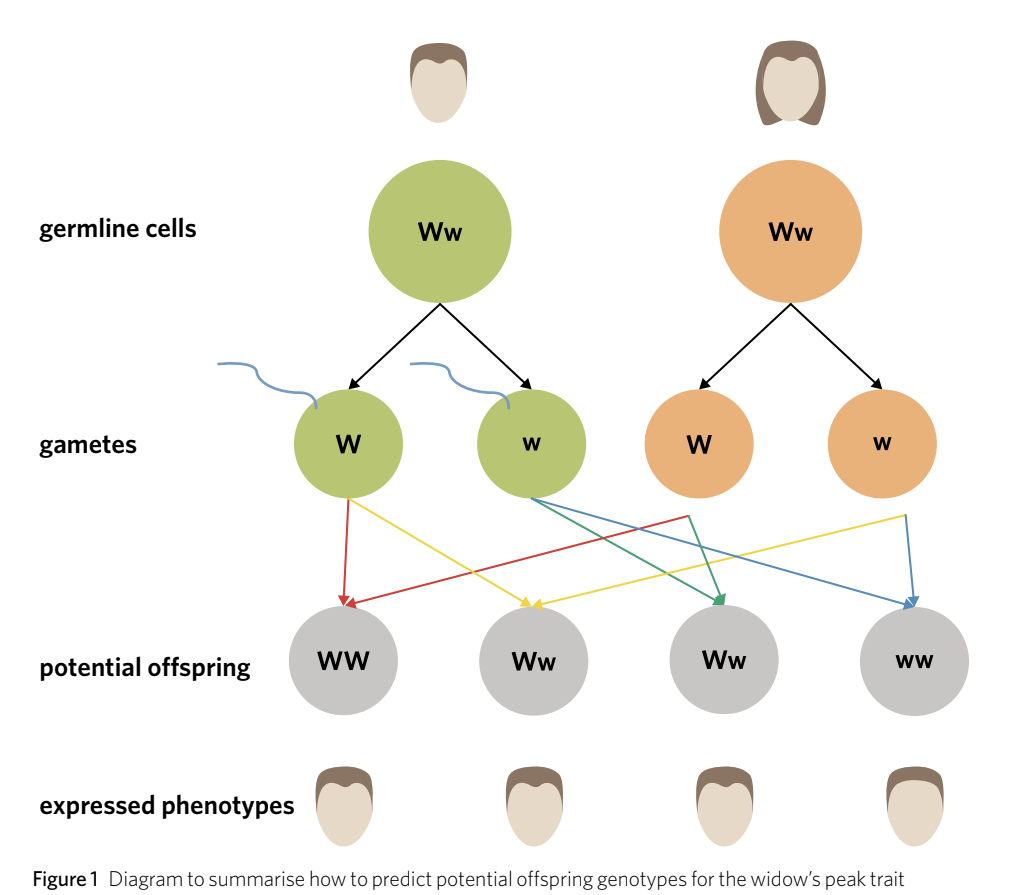
Let's work through a complete example using the widow's peak trait, where = widow's peak (dominant) and = straight hairline (recessive). We'll cross two heterozygous parents ().
Genotype calculations:
- Total squares = 4
- Homozygous dominant () offspring = 1
- Heterozygous () offspring = 2
- Homozygous recessive () offspring = 1
Genotype proportions:
- :
- :
- :
Phenotype calculations:
- Total squares = 4
- Offspring with widow's peak ( and ) = 3
- Offspring with straight hairline () = 1
Phenotype proportions:
- Widow's peak:
- Straight hairline:
Phenotypic ratio: 3:1 (widow's peak to straight hairline)
Autosomal codominance
Codominance happens when two traits are independently and equally expressed. Unlike complete dominance where one allele masks the other, in codominance both alleles are visible in the phenotype.
Important
When completing Punnett squares for codominant traits, you must use correct notation with superscripts to show that both alleles can be expressed. The process is similar to complete dominance, but the results show different phenotypic patterns.
Example: ABO blood groups
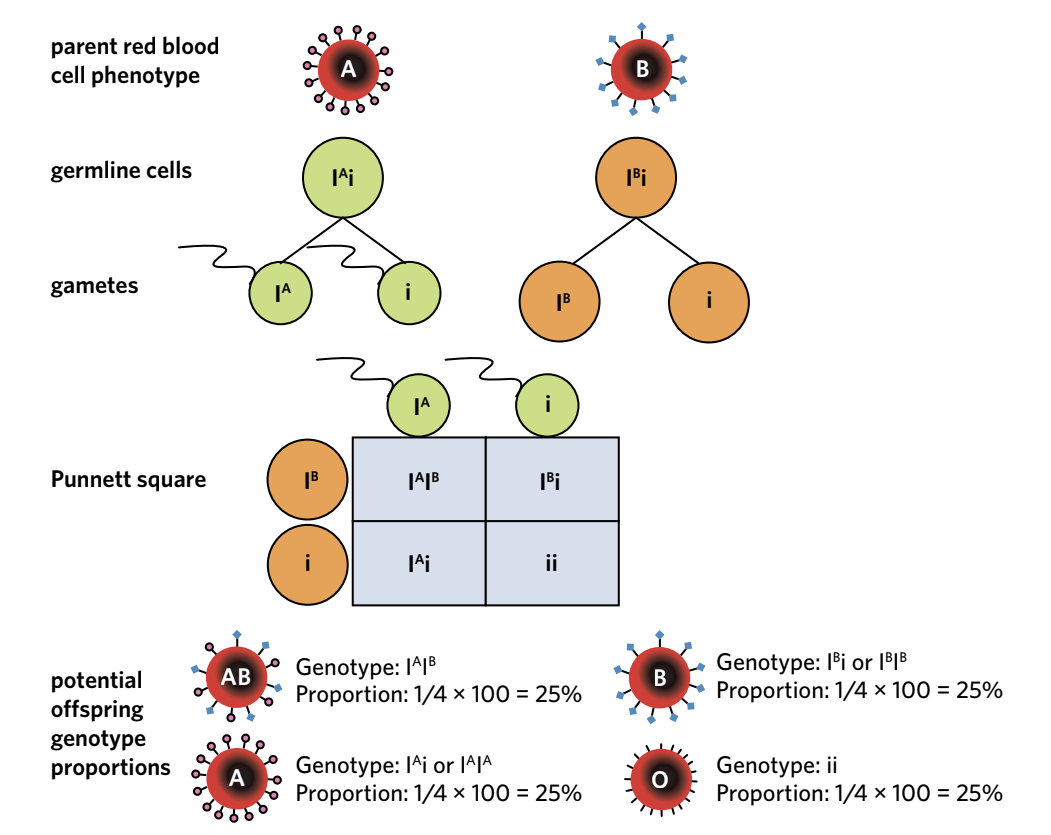
ABO blood grouping is a classic example of codominance. The A and B blood group alleles are both dominant and are written as and respectively. When both are present (), the individual has blood type AB - both antigens are expressed. The O blood group allele is recessive and written as .
Example
Worked Example: ABO Blood Group Cross
In this example, a parent with blood type A (heterozygous ) crosses with a parent with blood type B (heterozygous ). The possible offspring are:
- Blood type AB (): 25%
- Blood type A (): 25%
- Blood type B (): 25%
- Blood type O (): 25%
Each blood type has an equal probability of occurring in the offspring.
Sex-linked alleles
Sex-linked traits involve alleles located on sex chromosomes (X or Y chromosomes). Most sex-linked traits are found on the X chromosome because it is much larger than the Y chromosome and carries more genes.
The method for completing Punnett squares for sex-linked traits is similar to autosomal traits, but the notation and interpretation differ. You must include the sex chromosomes (X and Y) in your notation, and you calculate proportions separately for each sex.
Example: red-green color blindness
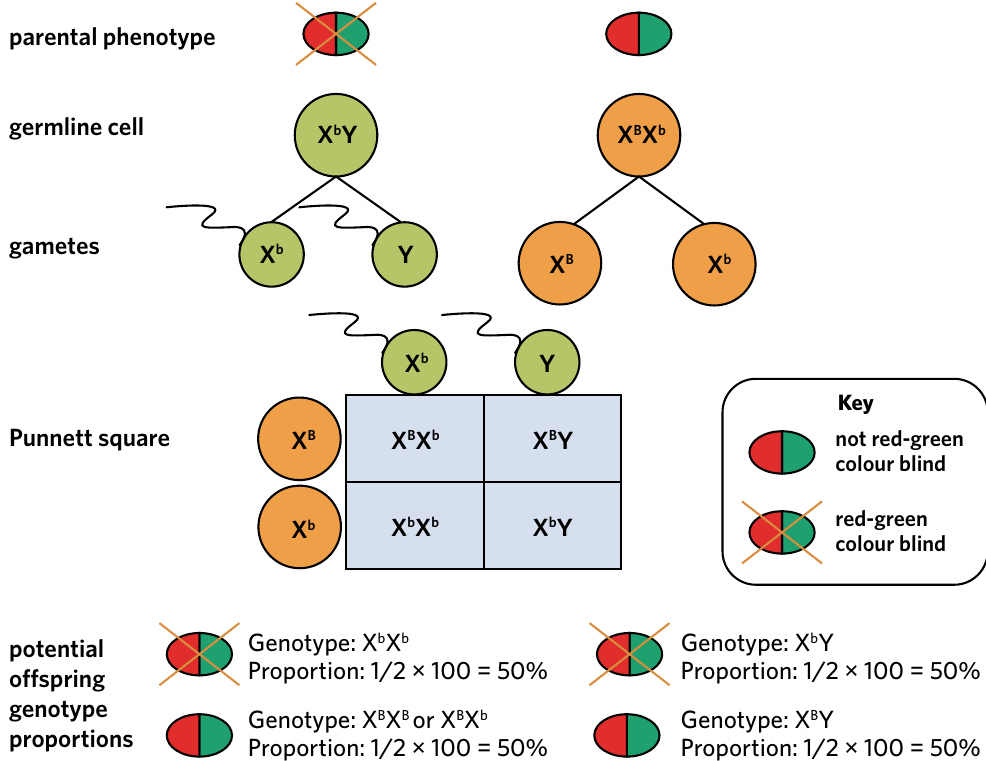
Red-green color blindness is a sex-linked recessive trait found on the X chromosome. The allele for normal color vision () is dominant, while the allele for color blindness () is recessive. Because males only have one X chromosome, they only need one copy of the recessive allele to be color blind.
Example
Worked Example: Sex-Linked Color Blindness
In this cross between a carrier female () and an affected male ():
Female offspring:
- Carrier with normal vision (): 50%
- Color blind (): 50%
Male offspring:
- Normal vision (): 50%
- Color blind (): 50%
Important
With sex-linked traits, always calculate proportions separately for male and female offspring, as shown above. This is because males and females have different sex chromosome compositions, leading to different inheritance patterns.
Monohybrid test crosses
What is a test cross?
A test cross is when an individual expressing the dominant phenotype but with an unknown genotype is crossed with a homozygous recessive individual. The results indicate whether the individual with the dominant phenotype is homozygous dominant or heterozygous.
For traits showing complete dominance, we cannot tell just by looking whether an organism showing the dominant phenotype is homozygous dominant or heterozygous - they look identical. A test cross solves this problem by revealing the hidden genotype.
How test crosses work
The principle behind test crosses is simple: a homozygous recessive individual can only pass on recessive alleles. Therefore:
- If the unknown parent is homozygous dominant, all offspring will receive one dominant allele from that parent and one recessive allele from the homozygous recessive parent. Result: all offspring show the dominant phenotype.
- If the unknown parent is heterozygous, half the offspring will receive the dominant allele and half will receive the recessive allele from that parent. Result: approximately 50% of offspring show the dominant phenotype and 50% show the recessive phenotype.
Example: sheep coat color
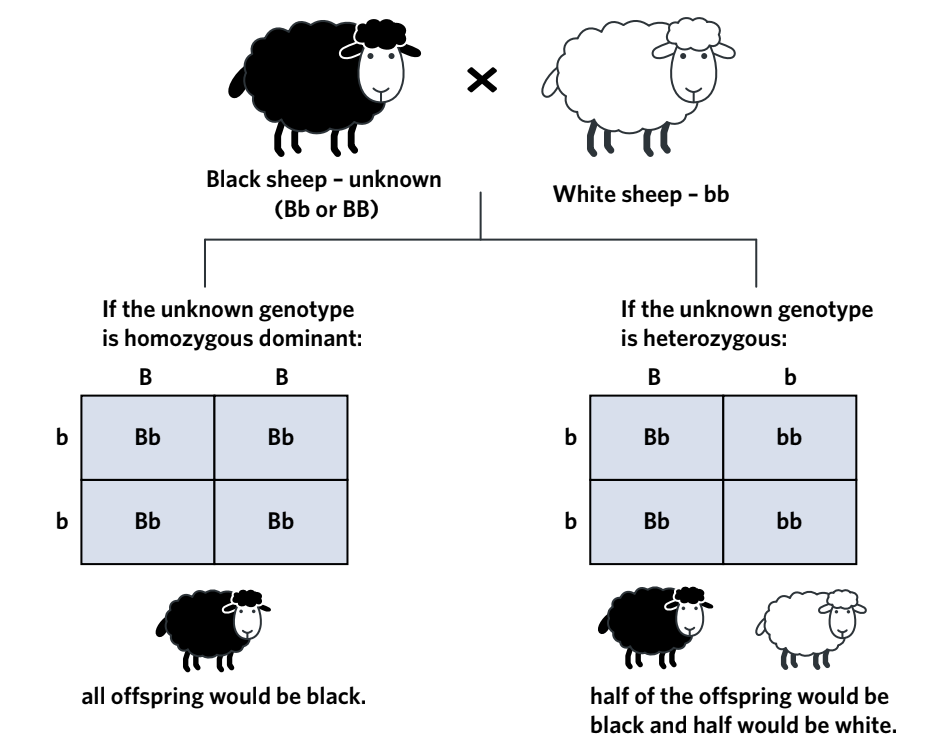
Consider a black sheep with unknown genotype (either or ) crossed with a white sheep (), where = black coat (dominant) and = white coat (recessive).
Example
Worked Example: Sheep Coat Color Test Cross
Scenario 1: If the black sheep is homozygous dominant ()
- All offspring receive from the black parent and from the white parent
- All offspring have genotype
- All offspring are black (100%)
Scenario 2: If the black sheep is heterozygous ()
- Half the offspring receive from the black parent, half receive
- All offspring receive from the white parent
- Offspring genotypes: 50% (black), 50% (white)
Conclusion: If you observe even one white offspring, you can immediately determine the black sheep must be heterozygous (). If all offspring are black, the black sheep is likely homozygous dominant (), though you would need a larger sample size to be certain.
Summary
Key Points to Remember:
-
A monohybrid cross tracks the inheritance of a single gene from parents to offspring using a Punnett square.
-
Punnett squares have seven key steps: assign letters, draw grid, write father's alleles, write mother's alleles, complete crosses, calculate genotype proportions, and calculate phenotype proportions.
-
In complete dominance, a 3:1 phenotypic ratio typically results from crossing two heterozygous parents.
-
Codominance occurs when both alleles are equally expressed, requiring special superscript notation (e.g., and for blood types).
-
Sex-linked traits require including X and Y chromosomes in notation, and proportions must be calculated separately for male and female offspring.
-
A test cross (crossing with homozygous recessive) reveals whether an organism showing the dominant phenotype is homozygous dominant or heterozygous - if any offspring show the recessive trait, the parent must be heterozygous.