Ethics in Biology (VCE SSCE Biology): Revision Notes
📚Revision Notes
Ethics in Biology
Understanding how to make ethical decisions is a crucial skill for any biologist. From developing new medical treatments to managing endangered species, biological research constantly raises questions about what is right and what is wrong. This study note will introduce you to the frameworks and concepts that help scientists navigate these complex ethical dilemmas.
Introduction
Scientists have been making remarkable progress in understanding the aging process. In recent years, researchers have identified specific genes involved in aging and are working towards developing medications that could potentially extend human lifespan significantly. Some scientists suggest we might one day live for hundreds of years in good health.
This raises important questions: Should we interfere with the natural biology of our cells? How do we decide whether such interventions are ethical? What framework can help us make confident decisions about these complex issues?
Throughout your VCE Biology studies, you will need to apply ethical thinking when answering questions, analysing scenarios, and designing experiments. The approaches and concepts in this note form your essential bioethical toolkit.
Note
Ethics is not just about personal beliefs or opinions. It's a structured system of knowledge that provides frameworks and tools for making well-reasoned decisions about complex moral dilemmas in biology and medicine.
What is ethics?
Ethics is a field of knowledge that helps individuals exercise moral judgement and determine what is right and wrong.
At its core, ethics provides us with a working system of moral principles. This system helps us question our own actions and those of others whilst defending our personal values, beliefs, and principles.
Applied ethics in science
Applied ethics is the application of ethical theories to real-life moral problems and contexts.
Applied ethics serves as a bridge between abstract theories learned in the classroom and concrete situations faced in real-world scientific practice. Scientists use applied ethics to implement ethical theories and moral principles when making decisions about specific problems and contexts.
Ethical situations typically arise when different stakeholders—such as scientists, organisations, patients, or the public—hold different opinions about what is right or wrong. These stakeholders must choose between alternative viewpoints when deciding how to act.
Why ethics matters in biology
Science is rarely a solo endeavour. It constantly involves interactions with colleagues, employers, and the wider public. An essential part of conducting scientific research involves not just learning theories and concepts, but also applying that knowledge in ways that produce the best ethical outcomes.
This requires scientists to engage in metathinking, which is the practice of reflecting upon and evaluating the way we think, including the different strategies and tools for problem-solving and learning.
Some people might assume that ethical thinking develops naturally through upbringing, education, and community involvement. However, this incidental learning is insufficient.
Important
Ethics must be actively taught and practiced within scientific education. Scientists learn ethical frameworks to guide their decision-making process and justify their actions. For this reason, ethical understanding is integrated throughout the entire VCE Biology course.
Bioethical issues
Bioethics is the study of ethical issues pertaining to biology and medicine.
A bioethical issue is an ethical dilemma pertaining to biology that typically involves a decision-making process between two or more choices or options for an action.
Biologists frequently encounter bioethics in their work across various fields, including biotechnology, environmental conservation, and healthcare research. When faced with these situations, they must navigate specific bioethical issues.
Recognising a bioethical issue
A bioethical issue typically has three defining features:
- Decision-making between alternatives - The situation involves choosing between two or more possible courses of action
- External influences - Social, economic, legal, and political factors affect the decision
- Conflicting stakeholder perspectives - Different people or groups hold opposing opinions, values, or ideals about the situation
Each option in a bioethical scenario requires ethical justification. For example: "I should choose action X in this scenario because it will lead to outcome Y." The available options usually conflict with one another and can be evaluated using different bioethical approaches and ethical concepts. These tools help individuals consider the various factors that might be relevant when determining what is ethical (right) and what is unethical (wrong).
Examples of bioethical issues
Bioethical issues appear across many areas of biological research and practice. Here are some current examples organized by discipline:
| Biological discipline | Bioethical issues |
|---|---|
| Biotechnology | - Using artificial intelligence in biology, including disease-tracking software and facial recognition - Applying bioengineering techniques, such as creating synthetic vaccines or replacement organs - Exploring potential applications of stem cell research, including disease management and human enhancement |
| Healthcare | - Using human embryos to research new therapies for diseases - Considering implications of prenatal testing for genetic defects during pregnancy - Deciding whether organ donation should be voluntary or state-imposed - Determining best care for individuals at end of life, including availability of euthanasia - Allocating medical resources correctly, including dedicating physician time to hospital patients - Protecting privacy of medical data, including limits on sharing personal health data with governments and insurers |
| Environmental conservation | - Evaluating potential of 'de-extinction' processes to bring back extinct species like mammoths - Determining best methods for ecosystem management and maintaining health of endangered species - Deciding how best to tackle climate change, including funding for research and changes to energy company operations - Balancing impact of industry and agriculture on natural environments, including laws controlling deforestation and habitat removal |
Case study: Patents in biomedical research
A patent is a legally enforceable right to an invention that gives its owner the ability to prevent others from making, using, or selling that discovery. In science and medicine, patents protect innovation by assigning legal ownership of developments such as vaccines and medical equipment.
However, debate exists about whether patents help or hinder research and development. Manufacturers argue that patent protection provides incentive to invest time and resources into further development, and allows for increased financial returns that can support additional research. Critics counter that patents restrict free research by preventing access to patented equipment or methods that might help other studies. This can lead to extremely high costs for the general public when pharmaceutical companies heavily inflate prices of prescription medications.
Approaches to bioethics
A bioethical approach is a decision-making framework that helps guide ethical behaviour.
To make informed ethical decisions, scientists need specific tools. One type of tool is an approach to bioethics. In VCE Biology, you need to understand three specific approaches. Depending on the bioethical issue being considered, you may use one or more of these approaches to inform your decision-making process.
Consequences-based approach
A consequences-based approach is an approach to bioethics that aims to maximise positive outcomes whilst minimising negative outcomes.
When using a consequences-based approach, an individual focuses on the outcomes that are likely to result from their actions. The aim is to produce the greatest good for the greatest number of stakeholders.
This approach emphasizes the circumstances surrounding an action. It may sometimes allow an individual to break rules if doing so achieves the greatest benefit for the most people.
Key terms associated with consequences-based thinking: outcomes, benefits, consequences, effects
Duty/rule-based approach
A duty/rule-based approach is an approach to bioethics that promotes the responsibility of the agent above all else, and places importance on the duty of each individual.
When using a duty/rule-based approach, an individual is driven by a fundamental responsibility to act in a certain way. The aim is to follow established rules and responsibilities, with less regard for the consequences that may result.
This approach argues that an action cannot be justified simply because it produces good consequences. Instead, certain actions must be followed because they are the responsibility of the individual, regardless of what outcomes occur.
Key terms associated with duty/rule-based thinking: obligation, duty, responsibility, commitment
Virtues-based approach
A virtues-based approach is an approach to bioethics that emphasises the individual goodness of the agent, and promotes acting in accordance with the values of a 'moral' person, such as honesty and compassion.
When using a virtues-based approach, an individual is driven by their character rather than by rules or consequences. The aim is to emphasize the moral nature of the individual and provide guidance about behaviours a morally good person would hope to achieve.
This approach argues that an action can be justified simply because it is charitable, caring, or good. Here, emphasis is given to the virtues involved in making a decision, rather than following a rule or being driven by consequence.
Key terms associated with virtues-based thinking: any reference to virtues, such as good, honest, caring, compassionate
Case study: Coronavirus 2020 – Italian hospital ethics
To see these approaches in action, consider a bioethical dilemma during the early coronavirus pandemic. Italian hospitals faced the ethical decision of whom to treat and whom to turn away when resources became overwhelmed.
Example
Case Study: Applying Bioethical Approaches in a Crisis
Background: On 1 March 2020, Italy had 1,701 coronavirus cases nationwide. Within just 30 days, this skyrocketed to 110,574 cases. Hospitals and doctors could not treat everyone, leaving them with an incredibly difficult decision: who do we treat first and how do we decide who to turn away?
The ethical implications were immense, as people denied treatment were sometimes at increased risk of dying. Denying patients access to treatment seemed to contradict professional medical ethics and required ethically trained professionals to develop the most moral course of action in these extraordinary circumstances.
The Italian College of Anesthesia, Analgesia, Resuscitation, and Intensive Care (SIAARTI) published guidelines for doctors and nurses to follow. These guidelines were rigorously examined against various bioethical considerations.
How each approach might guide decisions:
Consequences-based approach: This approach might argue that each hospital should aim to maximize good for the most number of people. If demand for care outweighs resources, then maximizing good outcomes might mean focusing resources on patients most likely to recover and respond to treatment. In this case, that would mean prioritizing young and otherwise healthy individuals over older patients who may be less likely to survive.
Duty/rule-based approach: This approach might argue that doctors and healthcare providers have a moral obligation to provide treatment to whoever needs it. This could mean focusing resources in a first-come-first-serve manner, where care is distributed sequentially based on when patients arrive at the hospital. This approach might suggest this is the fairest means of distributing care, and that hospitals have a duty to act without discrimination rather than turning away patients based on age.
Virtues-based approach: This approach might argue that doctors ought to follow the moral guidance of their own value judgements about who is most in need. Distribution of care would be left to the moral virtues of a good doctor—such as kindness, fairness, and good judgement. In this case, hospitals would not follow a certain rule (such as first-come-first-serve), nor focus solely on maximizing consequences. Instead, each doctor acts as their own moral agent deciding how best to distribute resources.
Outcome: In this case, the SIAARTI recommendations and Italian hospital responses most closely aligned with a consequences-based approach. However, the three approaches rarely act in isolation. Each approach often works in conjunction with others to inform individuals about the best or most ethical course of action in the circumstances.
Why approaches matter: The toolbox analogy
Think of bioethical approaches as tools in a toolbox. Sometimes, a single hammer suffices for a job, such as hammering a nail. Other times, however, the job might be more complex and require not only a hammer but also a saw and a wrench. The same is true of the three approaches. We must consider each one in our quest to make ethical decisions and judgements.
Note
Just as a skilled tradesperson knows which tool to use for each job, a skilled biologist knows which ethical approach (or combination of approaches) best suits each bioethical dilemma. The key is having all tools available and understanding when to use each one.
Using approaches: A five-step process
The three approaches serve as broad frameworks for considering bioethical issues and help guide us when evaluating different potential outcomes. An approach can be useful throughout the ethical decision-making process:
- Identifying the issue - Why is this an important bioethical concern? Why are we considering this?
- Exploring the issue in context - What situational factors surround the issue? What do we need to be aware of?
- Considering different perspectives - Who are the stakeholders involved in this issue? What do they think and how might this affect them?
- Deciding on a position or course of action - What is the most ethical way to proceed? What position am I going to take on this issue?
- Reflecting on chosen course of action - How did my position or course of action affect stakeholders? What was the impact of my judgement? Do I need to revise my position?
Important
We should use all three approaches in conjunction wherever possible. This often happens between steps 3 and 4, when analysing the strength of different perspectives and reaching a position or course of action.
Ethical concepts
An ethical concept is a specific perspective or lens used to consider multiple angles of an ethical dilemma.
In addition to the three overarching approaches to bioethics, there are also various ethical concepts that may be used when exploring bioethical issues. Each concept serves as a unique perspective for considering different angles of an ethical dilemma. The concepts may be used either in isolation or in conjunction with each other alongside the three approaches.
There are five specific bioethical concepts you need to understand in VCE Biology. Depending on the bioethical issue being considered, you may use one or more of the following concepts to help analyse the situation.
The five ethical concepts
Integrity is an ethical concept that encourages a full commitment to knowledge and understanding as well as the honest reporting of all sources of information and results.
This concept relates to the commitment to knowledge. It encourages individuals to act honestly and truthfully, especially when presenting findings or results. Integrity prioritizes accurate understanding and representation of facts, whether favourable or unfavourable to an individual's personal position, and encourages scrutiny and criticism.
Justice is an ethical concept that encourages fair consideration of competing claims, and ensures that there is no unfair burden on a particular group from an action.
This concept relates to the commitment to fairness. It encourages consideration of different people's opinions and positions, especially those directly affected or marginalized by a course of action. Justice prioritizes fair distribution of resources, as well as equal access to the benefits of an action, policy, investigation, or research.
Beneficence is an ethical concept that seeks to maximise benefits when taking a particular position or course of action.
This concept relates to the commitment to maximizing benefits. It encourages individuals to act in ways that benefit others. Beneficence promotes the personal wellbeing and good of other persons, particularly direct stakeholders such as patients and research subjects.
Non-maleficence is an ethical concept that discourages causing harm – or when harm is unavoidable, ensuring that the harm is not disproportionate to the benefits from any position or course of action.
This concept relates to the commitment to minimizing harm. It encourages individuals to act in ways that remove as much harm as possible. While actions may always involve some degree of possible harm, non-maleficence prioritizes minimizing this harm, sometimes even limiting people's freedom of choice and autonomy to protect them.
Respect is an ethical concept that encourages the acknowledgment of the intrinsic value of living things, and considers the welfare, beliefs, customs, and cultural heritage of both the individual and the collective.
This concept relates to the commitment to consideration. It encourages individuals to consider the value of others, including their personal welfare, beliefs, freedom, and autonomy. Respect prioritizes the freedom of others to make their own decisions and be protected from persecution or exploitation.
Memory device for ethical concepts
When using the five concepts to evaluate a bioethical issue, use this helpful mnemonic memory device:
Note
I Joke But No-one Reacts
- I - Integrity
- J - Justice
- B - Beneficence
- N - Non-maleficence
- R - Respect
This simple phrase helps you remember all five ethical concepts in order, making it easier to systematically consider each perspective when analysing bioethical dilemmas.
Application example: Vaccine development
Consider a research laboratory developing a new vaccine to help cure a terrible disease. Throughout research and trial stages, the team acts ethically and is informed by the three approaches to bioethics. Now, when releasing the vaccine to the public, the team considers how each of the five bioethical concepts applies:
Example
Practical Application: Ethical Vaccine Development
-
Integrity - The lab publicly releases the research and results that went into developing the vaccine to allow for public scrutiny.
-
Justice - The lab provides free access to their vaccine for people in low socioeconomic communities.
-
Beneficence - The lab produces excess vaccines for storage in all hospitals.
-
Non-maleficence - The lab minimizes unnecessary harm and distress to animals used during the testing phase.
-
Respect - During human trials to check vaccine efficiency, the lab gains informed consent from all research participants.
This example demonstrates how all five ethical concepts can be applied simultaneously to ensure comprehensive ethical consideration in scientific research and practice.
Case study: Genetically modified organisms (GMOs)
A genetically modified organism (GMO) is an organism whose DNA has been altered using genetic engineering techniques. This typically occurs in laboratories or agriculture, and is usually used to favour expression of some trait, such as pest/pesticide/disease/drought tolerance, higher yields, larger size, greater nutritional content, longer shelf lives, or brighter colour.
The use of GMOs for human and animal food represents a bioethical issue. Here are some common arguments for and against GMOs:
| Pros | Cons |
|---|---|
| - GM crops typically have better crop productivity than non-GM crops, meaning more food can be grown using less land, reducing habitat loss due to land clearing | - GM crops may lose their effectiveness if weeds or pests evolve resistance |
| - GM foods can be made to have improved nutritional content, improving individual health | - Widespread use of GM crops could result in loss of genetic diversity within crop populations |
| - GM crops can sometimes grow in more adverse conditions (e.g. drought-tolerant corn), protecting against famine and improving food security | - Cross-pollination between GM crops and wild species or weeds may cause GM genes to spread accidentally |
| - Increased crop yields result in larger profits for farmers, whilst herbicide-tolerant crops reduce labour demands as farmers don't need to pull weeds by hand | - Some people consider GMOs to be unnatural, or like we are 'playing God' |
| - Some people believe that genetically modifying animals for human benefit is inhumane – many anti-animal GMO arguments apply to animal agriculture in general | |
| - GM animals can have health issues |
How might the bioethical concepts inform this debate?
Important
Applying Ethical Concepts to GMOs
-
Integrity - Manufacturers need to clearly label their products as GMOs, allowing consumers to be better informed about what they're purchasing and consuming.
-
Justice - GMOs might create inequity between larger agricultural companies who have resources to genetically alter their crops versus small family farms that do not have such resources.
-
Beneficence - There are positive health outcomes for people who consume GM foods that have been nutritionally enhanced, such as added vitamins or minerals.
-
Non-maleficence - GMOs might cause unintended disruptions to the food web, such as insect-resistant crops that may alter population levels of different pests or beneficial insects.
-
Respect - It is important to promote the right of individuals to freely choose whether or not they use GMOs, and be provided with equal representation of alternatives.
By weighing up the considerations raised by each ethical concept, scientists can determine the best or most ethical course of action.
Summary: Your bioethical toolkit
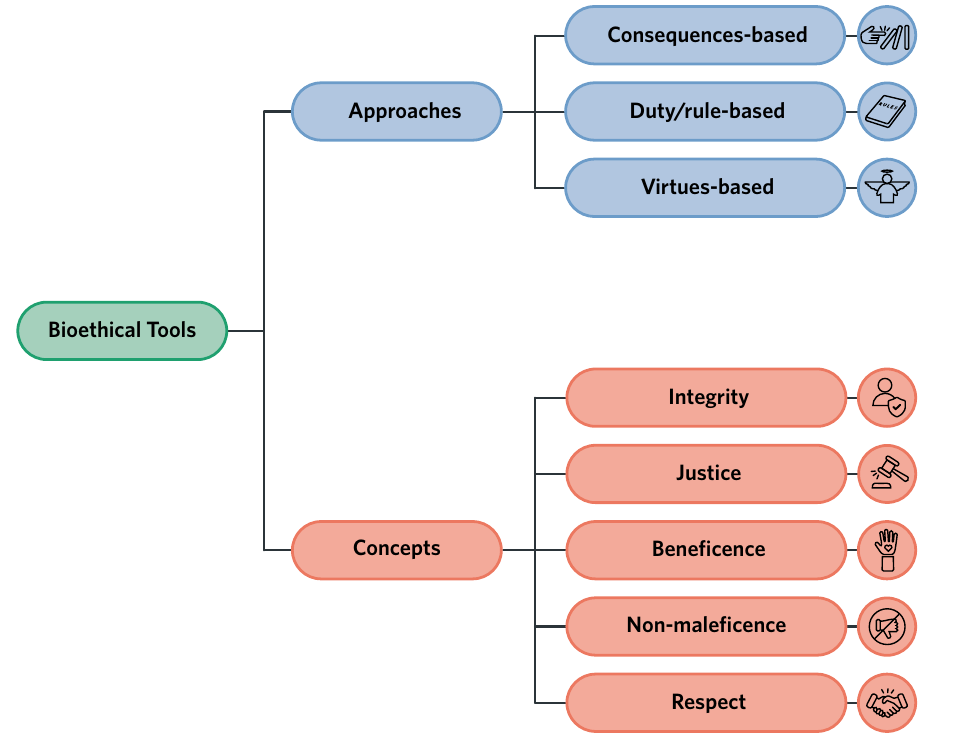
Ethics provides a system of knowledge that helps us understand right and wrong. In VCE Biology, you need to be aware of different strategies and tools to help you think and behave ethically. These include three bioethical approaches and five bioethical concepts.
Each approach serves as an overarching framework for tackling a bioethical issue. The bioethical concepts may be used in conjunction with these frameworks, or as standalone means for evaluating a position or course of action.
Summary
The three approaches:
- Consequences-based - Focuses on outcomes and maximizing good for the greatest number
- Duty/rule-based - Emphasizes following responsibilities regardless of consequences
- Virtues-based - Centers on the moral character of the individual
The five concepts:
- Integrity - Commitment to knowledge and honest reporting
- Justice - Commitment to fairness and equitable distribution
- Beneficence - Commitment to maximizing benefits
- Non-maleficence - Commitment to minimizing harm
- Respect - Commitment to consideration of others' values and autonomy
Remember!
Summary
Key Points to Remember:
-
Ethics is essential in biology - Scientists must actively learn and practice ethical thinking, not just rely on incidental learning from their upbringing or education.
-
Bioethical issues have three key features - They involve choosing between alternatives, are influenced by external factors, and involve conflicting stakeholder perspectives.
-
Use all three approaches together - Like tools in a toolbox, the consequences-based, duty/rule-based, and virtues-based approaches often work together to inform the most ethical course of action.
-
Apply the five concepts systematically - Remember "I Joke But No-one Reacts" (Integrity, Justice, Beneficence, Non-maleficence, Respect) to ensure you consider all relevant ethical angles.
-
Approaches and concepts work together - The five ethical concepts can be used alongside the three approaches to thoroughly evaluate bioethical dilemmas and make well-informed ethical decisions.