How to Design and Conduct a Scientific Investigation (Units 3 & 4) (VCE SSCE Biology): Revision Notes
📚Revision Notes
How to Design and Conduct a Scientific Investigation (Units 3 & 4)
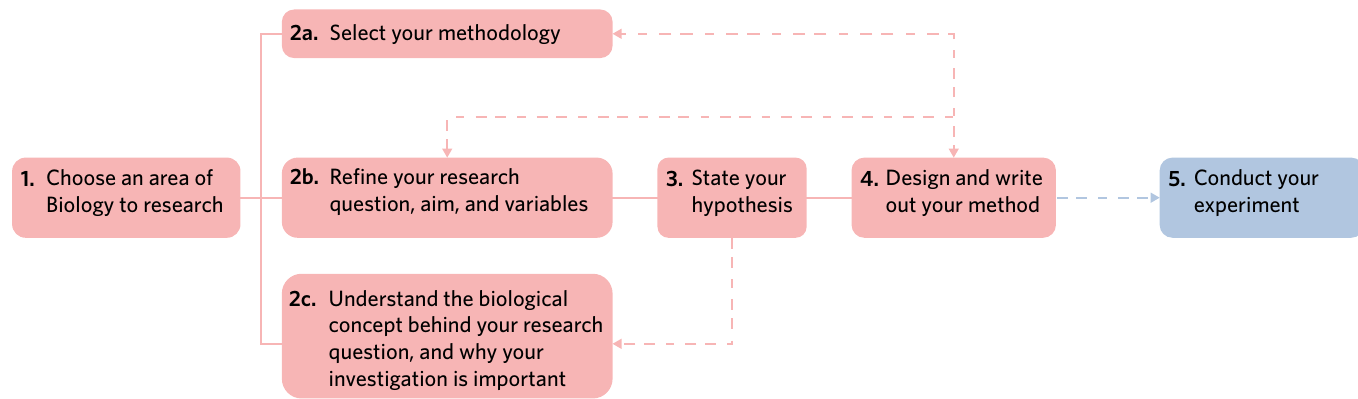
Overview of the task
As part of your Unit 4 assessment, you will design and conduct your own scientific investigation, then present your findings as a scientific poster. Your investigation must relate to content from Units 3 and 4, specifically focusing on cellular processes and/or how life changes and responds to challenges.
This task allows you to demonstrate three key abilities: designing your own experiment, generating your own primary quantitative data, and drawing conclusions based on the evidence you collect. The task is organised into three main stages that mirror the VCE Biology study design requirements.
The three stages are:
- Investigation design
- Scientific evidence
- Scientific communication
A high-quality investigation will demonstrate generation of primary quantitative data, thorough analysis and evaluation of that data, identification and discussion of limitations, connection of results to broader scientific concepts, and a clear conclusion that answers your research question.
Important
The entire scientific investigation process is interconnected - each stage builds upon the previous one. Taking time to thoroughly plan your investigation in Stage 1 will make data collection and communication much smoother in later stages.
Stage 1: Investigation design
The first stage involves designing your experiment before you begin collecting data. This stage demonstrates the creative aspects of scientific inquiry and includes several important steps that build upon each other. The information you develop during this stage will form the foundation of your introduction and methodology sections.
Developing a research question
Your research question must explore something you learned in Units 3 and 4 about cellular processes and/or how life changes and responds to challenges. When choosing your research question, think about topics you found particularly interesting or questions that arose during your studies.
Criteria for a good research question:
A strong research question should be testable, achievable, and specific. You want to choose a topic that lends itself to a controlled experiment that can be conducted in a classroom setting, as this is the most likely methodology you will use.
Note
Possible research topics include:
- Gene regulation or expression
- Factors affecting enzyme activity
- DNA manipulation techniques (CRISPR, PCR, genetic engineering)
- Factors affecting photosynthesis and/or cellular respiration rates
- Immunity and pathogen response, including lines of defence
- How species evolve and respond to selection pressures
- Evidence of relatedness between species (structural morphology)
Creating a specific, testable question:
Your research question should be specific enough to allow you to reach a clear conclusion. For example, asking "At what temperature does plant species X photosynthesise most efficiently?" is better than asking "What factors affect photosynthesis in plant species X?" The first question has a specific answer you can determine from your data, whilst the second is too broad.
Example
Running Example: Fiddle-Leaf Fig Investigation
Throughout this guide, we will follow an example investigation. The research question chosen is:
"Does the growth of an indoor mini fiddle-leaf fig (Ficus lyrata bambino) increase when exposed to more sunlight?"
This question is:
- Testable - we can measure plant growth
- Achievable - we can set up different light conditions
- Specific - it focuses on one plant species and one variable
Understanding biological concepts behind your research question
An essential part of designing your investigation is clearly explaining the biological concepts relevant to your research question. This serves two important purposes. First, it demonstrates your understanding of the theory you learned in class and helps you identify what factors are important to investigate. Second, it helps your reader understand the scientific context of your investigation.
When discussing biological concepts, you should explain key terms, describe relevant processes, and outline why different factors affect the system you are studying. However, you need to balance providing enough information with staying within word limits.
Note
Key biological concepts for the example investigation:
For the fiddle-leaf fig investigation, the key concepts to explain would include:
- What photosynthesis is and why it is important for plant growth
- How photosynthesis uses light energy to produce glucose
- The chemical equation for photosynthesis:
- Why light availability affects photosynthetic rate
- How photosynthesis connects to plant growth
By explaining these concepts, you demonstrate understanding of why sunlight would be expected to affect plant growth, which helps justify your hypothesis and experimental design.
Selecting methodology and defining variables
Now that you have your research question and understand the relevant biology, you need to determine how to conduct your investigation. You will need to select an appropriate scientific methodology and clearly define all variables.
Choosing your methodology:
Given that you are required to generate primary quantitative data in the classroom, you will most likely conduct a controlled experiment. A controlled experiment allows you to investigate cause and effect by examining how an independent variable affects a dependent variable whilst keeping all other variables constant.
Other methodologies exist (case studies, correlational studies, literature reviews, simulations), but controlled experiments are most suitable for this assessment task.
Defining your variables:
Every controlled experiment has three types of variables that must be clearly identified:
- Independent variable (IV): The variable you deliberately change or manipulate. This is the factor you want to investigate.
- Dependent variable (DV): The variable that is affected by changes to the independent variable. This is what you measure.
- Controlled variables: All other variables that could affect the dependent variable, which you keep constant throughout the experiment.
Important
Always include units of measurement
When describing your variables, always include the units of measurement. For example, don't just say "plant height" - specify "plant height measured in millimetres (mm)".
Example
Example variables for the fiddle-leaf fig investigation:
- Independent variable: Amount of sunlight exposure (measured as three conditions: no sunlight, moderate sunlight 10m from window, direct sunlight)
- Dependent variable: Plant growth (measured as height in millimetres from soil surface to stem tip)
- Controlled variables: Water exposure (20mL per plant), watering frequency, soil quality, temperature, fertiliser use (none used), plant species and initial health
By clearly defining these variables before starting your experiment, you ensure your investigation will be valid and your results will be meaningful.
Stating your hypothesis
Your hypothesis is a testable statement predicting how your independent variable will affect your dependent variable. Based on your understanding of the relevant biological concepts, you should be able to predict what you expect to observe.
A hypothesis should be stated clearly and concisely, and it should be specific to your investigation. At the end of your experiment, you will determine whether your results support or refute your hypothesis.
Example
Example hypothesis:
"The growth of a mini fiddle-leaf fig will increase when exposed to more sunlight."
This hypothesis is based on understanding that photosynthesis requires light and that increased photosynthesis provides more energy for growth.
Note
Your hypothesis is not right or wrong - it is simply supported or refuted by your data. Even if your results don't support your hypothesis, you can still have a successful investigation.
Designing your experiment
After selecting your methodology and defining your variables, you need to design the specific steps of your experiment. This involves answering several key questions that will help you write a detailed, reproducible method.
Questions to address when designing your experiment:
- What will you measure and how? Identify your measurement technique, how long your experiment will run, and your sample size.
- What experimental conditions will you test? Determine how you will create different levels of your independent variable and how many experimental groups you will have.
- How will you control other variables? List all controlled variables and explain how you will keep them constant.
- How will you address replication? Determine how many replicates you will have for each experimental condition.
- How will you prevent or minimise errors? Consider what could go wrong and how you will reduce the impact of errors on your results.
- How will you generate your sample? Decide how you will select and allocate specimens to different experimental groups.
- What ethical and safety guidelines apply? Identify any health, safety, or ethical considerations relevant to your investigation.
Example
Example experimental design:
For the fiddle-leaf fig investigation, the design addresses these questions as follows:
1. Measurement approach: Vertical plant growth will be measured using a tape measure from soil surface to stem tip, after two weeks of exposure to different light conditions. Fifteen plants total will be used, with five plants per light condition.
2. Experimental conditions: Three experimental groups will be created:
- Group A (no light - plants in closed cupboard) - control group
- Group B (moderate light - plants 10m from window)
- Group C (direct light - plants in front of window)
3. Controlled variables:
- Same amount of water (20mL)
- Watering at the same time of day
- No fertiliser used
- All plants are the same species
- Similar initial size and health
4. Replication: Five replicates per experimental condition provides statistical reliability.
5. Error minimisation:
- Same tape measure with clear 1mm markings used throughout
- Same person measures all plants
6. Sample generation: Plants will be randomly selected from a larger population of similar plants, then randomly allocated to experimental groups.
7. Safety considerations: Wearing gloves when handling plants, as the sap of Ficus lyrata bambino is a known skin irritant.
Once you have answered these questions, you can write a step-by-step method that another person could follow to replicate your experiment exactly.
Considering internal measures
Before conducting your investigation, you should consider five important internal measures that help evaluate the quality of scientific investigations. These measures will be important both when designing your method and later when evaluating your results.
Important
The Five Internal Measures (APRRV):
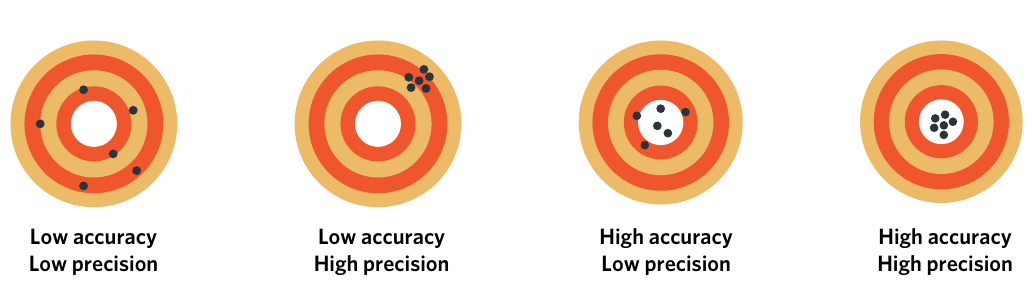
Accuracy refers to how close your results are to the 'true' value of the quantity being measured. For example, if a plant species typically photosynthesises optimally at 35°C, accurate results would be close to this value.
Precision refers to how close your results are to each other. If you get similar results across all replicates, your measurements are precise. Wide variation between replicates indicates imprecise measurements.
Reproducibility refers to how reproducible your results are. A reproducible experiment means that other scientists could follow your method and get the same results over and over again.
Repeatability refers to how repeatable your results are. A repeatable experiment means that you personally could repeat your experiment and get the same results over and over again.
Validity refers to how valid your experimental design is. A valid experiment actually measures what it claims to be measuring.
Health, safety, and ethical considerations:
When planning your investigation, you must identify and address any relevant health, safety, and ethical guidelines. This might include sterilising work stations, safely storing equipment and materials, protecting participant data, obtaining informed consent, or following specific safety protocols.
Note
For the example investigation, safety considerations include providing personal protective equipment (gloves and eye protection) because Ficus lyrata bambino sap is a skin irritant. Additionally, checking for plant allergies among team members is important.
Stage 2: Scientific evidence
Having designed your investigation, you now move to collecting scientific evidence to answer your research question. This stage involves maintaining proper documentation and generating your own primary data. By the end of this stage, you should have collected qualitative and/or quantitative data that can be analysed to support or refute your hypothesis.
Establishing a logbook
Before beginning any practical work, establish a logbook to document your research and data collection. A logbook serves as an ongoing record of your investigation and is essential for authenticating your primary data.
What is a logbook?
A logbook is a record of all practical activities, research, and data collection undertaken during your investigation. It provides a chronological account of your work and helps you track sources, record results, and note observations. There is no single required format - you can maintain a handwritten notebook or electronic document, whichever works best for you.
Important
VCAA Logbook Requirements:
According to the VCAA, students must maintain a logbook for all Units 1-4, with all entries dated and clearly documented. Teachers must regularly sight and monitor logbooks, particularly for student-designed investigations.
For assessment tasks, hard copy logbooks are recommended to avoid falsification or alteration of results, reflecting standard scientific practice.
Your logbook should include:
- Research notes
- Experimental observations
- Raw data
- Calculations
- Unusual occurrences during experiments
- Any thoughts or questions that arise during your investigation
Collecting your data
When conducting your experiment, you need a reliable, clear, and valid system for collecting and recording data. Record all results in your logbook, even if they seem unusual or unexpected. Unexpected results may provide valuable insights or help identify experimental limitations.
Recording observations:
In addition to numerical measurements, record anything out of the ordinary that occurs during your experiment. These events may influence your results and should be documented so you can account for them in your analysis. For example, if equipment malfunctions, specimens are accidentally disturbed, or environmental conditions change unexpectedly, note these observations with dates and times.
Understanding types of evidence:
This investigation requires you to generate primary quantitative data.
Note
Definition: Primary Quantitative Data
Primary quantitative data is data collected from experiments, interviews, or surveys undertaken by the researcher themselves, presented in numerical or empirical form (quantities, amounts, or ranges).
This contrasts with:
- Secondary data - collected by others
- Qualitative data - descriptive rather than numerical
Evaluating evidence strength:
Not all scientific evidence is equally strong. When evaluating your study's strength, consider your sample size and how representative it is of a wider population. A controlled clinical trial with a large, randomised sample is considered stronger evidence than a case study with a small sample. Be honest about the limitations of your investigation.
Example
Example data collection:
For the fiddle-leaf fig investigation, plant heights were measured at the start of the experiment and again after two weeks. All measurements were recorded in a table, and an observation was noted that plant C1 was accidentally knocked over during initial measurement and had to be re-planted.
Stage 3: Scientific communication
After designing your experiment and collecting data, you communicate your research and present results in a scientific poster. This stage involves using your collected data to answer your research question and either support or refute your hypothesis.
Poster structure and requirements
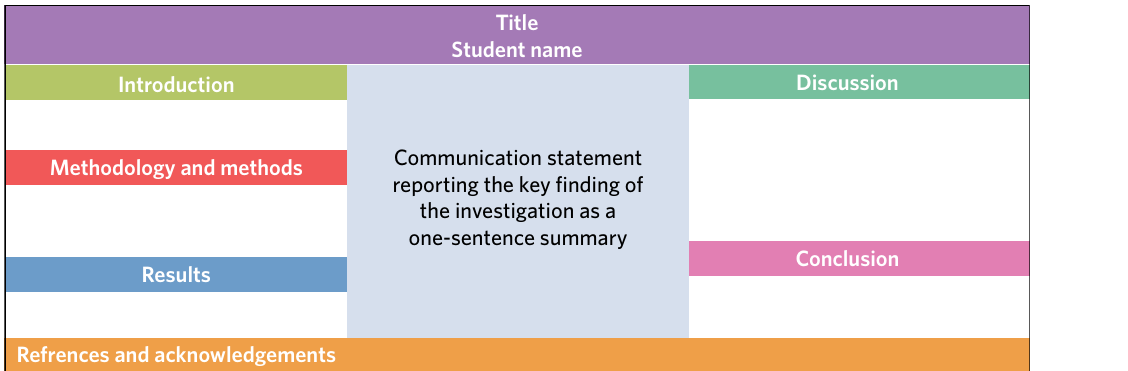
The VCAA provides specific guidelines for structuring your scientific poster. The poster may be produced electronically or in hard copy and should not exceed 600 words. The centre of the poster (20-25% of poster space) contains a one-sentence summary of your major finding.
Important
Required poster sections:
Your poster must include the following sections, each serving a specific purpose:
| Section | Content Requirements |
|---|---|
| Title | The research question under investigation |
| Introduction | Explanation for undertaking the investigation, relevant background biological concepts, clear aim, and hypothesis |
| Method | Summary outlining methodology and steps, authenticated by logbook entries; identification and management of relevant risks including health, safety, and ethical guidelines |
| Results | Presentation of collected data in appropriate format to illustrate trends, patterns, and relationships |
| Discussion | Analysis and evaluation of primary data; linking results to relevant biological concepts; identification of outliers and their treatment; identification of limitations and suggested improvements |
| Conclusion | A conclusion providing a response to the research question |
| References and acknowledgements | Referencing and acknowledgment of all quotations and sourced content |
Writing your title
Your title can be your original research question or a slight rewording of it. Keep it short and simple - a clear title is better than an elaborate one.
Example
Example title:
"Does sunlight affect the growth of Ficus lyrata bambino?"
Writing your abstract (optional)
An abstract is a short summary helping readers quickly understand your investigation. Whilst not compulsory according to the VCAA, an abstract can be valuable for engaging your audience. One approach is to summarise each main section of your report in one sentence, then combine these into a cohesive paragraph.
Note
Check with your teacher whether you should include an abstract in your poster.
Writing your introduction
Your introduction should include several components that provide context and justification for your investigation.
Explanation for undertaking the investigation:
Begin by justifying why your investigation matters. Why should anyone care about your results? Connect your research to real-world applications or broader scientific questions. Reference prior research to demonstrate that your investigation fits within the wider context of biology and to prove that your findings are important.
After reading your introduction, there should be no doubt that your investigation addresses an important question.
Background biological concepts:
Introduce the key theoretical concepts from your VCE Biology course that are relevant to your investigation. Explain key terms, describe relevant processes, and outline why different factors affect the system you are studying. This helps readers understand the scientific foundation of your work.
Aim and hypothesis:
After providing context and background information, state your investigation's aim and your hypothesis. When stating your aim, you can also introduce your independent and dependent variables. Your hypothesis shows the relationship you expected between variables before starting your investigation.
Note
Introductions are typically written in present or future tense, as you are walking readers through your investigation as if they are experiencing it alongside you.
Example
Example introduction elements:
For the fiddle-leaf fig investigation, the introduction would explain that office plants improve employee morale and reduce stress, making it important to understand optimal growing conditions.
It would then explain photosynthesis, including the simplified chemical equation:
Finally, it would state the aim (measuring the effect of sunlight on plant growth) and hypothesis (increased sunlight will increase growth).
Writing your method
Your method section is like a recipe - it outlines the steps you took during your investigation in sufficient detail that someone else could replicate your work. You can write your method in paragraphs or dot points and may include diagrams for complex setups. Check with your teacher whether methods should be written in past or present tense.
Materials:
Start by describing all items used to complete your investigation. Include everything another person would need to replicate your experiment. You can present materials as a list or paragraph.
Methodology:
Write the step-by-step procedure of your investigation. Include enough detail for reproduction but remain concise. Be sure to mention any risks or ethical issues and how you addressed them.
Example
Example method:
The fiddle-leaf fig investigation method included:
- Randomly selecting 15 plants
- Dividing them into three groups
- Measuring initial heights whilst wearing protective equipment
- Watering all plants with the same amount of water (20mL)
- Placing groups in different light conditions
- Measuring final heights after two weeks
Presenting your results
The results section presents your findings without interpretation or explanation - that comes later in the discussion. Present transformed data (not raw data) in tables or graphs that highlight trends and patterns.
Choosing appropriate data presentation:
Different types of data suit different graphical representations:
- Line graphs and scatter plots: useful for numerical data
- Bar graphs and pie graphs: useful for categorical data
- Scatter plots: useful for comparing two variables
Typically, the x-axis represents your independent variable and the y-axis represents your dependent variable. Give all tables and graphs clear titles and figure numbers.
Transforming your data:
Transform your raw data to make it meaningful for answering your research question. This might involve calculating averages, percentages, rates of change, or other relevant metrics.
Example
Example results presentation:
For the fiddle-leaf fig investigation, results showed:
- Group A (no light): average growth of 0.96% relative to initial height
- Group B (moderate light): average growth of 5.18% relative to initial height
- Group C (direct light): average growth of 9.61% relative to initial height
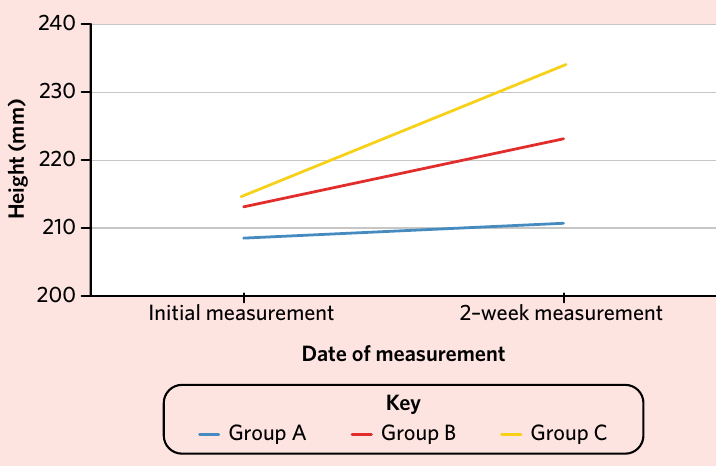
These results were presented in both a line graph showing height changes over time and a table showing detailed measurements and calculations.
Writing your discussion
The discussion is typically the longest section of your report and contains several important components. This is where you interpret your results, connect them to biological concepts, and evaluate your investigation's quality.
Analysis and evaluation of primary data:
Begin by restating your hypothesis and stating whether your data supports or refutes it. To analyse your data, compare your investigation's purpose with the type of data you obtained. Evaluate whether your data is suitable for answering your research question, considering the strength and limitations of your research.
Common types of errors:
When evaluating your investigation, consider potential errors:
Note
Types of Errors (SRP):
-
Personal errors: Mistakes made by the experimenter (counting incorrectly, rounding errors, labelling mistakes)
-
Systematic errors: Affect accuracy; occur when results differ from the true value by a consistent amount, usually due to faulty equipment or calibration
-
Random errors: Affect precision; caused by unpredictable variations in the measurement process
Common types of bias:
Also consider potential biases:
Important
Types of Bias (CSP):
-
Confirmation bias: The tendency to include only information supporting your hypothesis
-
Selection bias: When participant selection isn't randomised and the sample isn't representative
-
Publication bias: When study outcomes determine whether results are published
Identification of outliers:
If any results appear to be outliers, comment on this in your discussion. Clearly state whether you included or excluded these values in your analysis and justify your decision. Explain potential reasons for outliers and how they might affect the validity of your findings.
Linking results to relevant biological concepts:
Use the biological concepts introduced in your introduction to explain why you obtained your results. This is called cross-referencing results against relevant biological concepts. If you researched similar previous studies, comment on whether your findings support or differ from established research.
Example
Example discussion elements:
For the fiddle-leaf fig investigation, the discussion would:
- Note that results support the hypothesis, with plants in direct sunlight growing most
- Explain this using photosynthesis theory - plants with more light can generate more energy for growth
- Identify plant C1 as an outlier due to being knocked over
- Acknowledge that the tape measure might not have been the most precise tool
- Suggest that measuring weight rather than height might provide more comprehensive growth data
Identification of limitations and suggested improvements:
After evaluating whether results support your hypothesis, critically assess whether your results are reliable and trustworthy. Consider whether your method had flaws, whether extraneous or uncontrolled variables may have impacted results, and what errors may have occurred.
After identifying limitations, state how they could be addressed in future investigations. What could be changed to make results more accurate and precise? How could errors be avoided?
Finish your discussion by weighing limitations against strengths. Conclude by clearly stating whether your results and answer to your research question can be relied upon.
Writing your conclusion
Many students worry about conclusions, but they follow a straightforward structure. Your conclusion should:
- Restate your research question
- State whether your hypothesis was supported or refuted by your data
- Suggest avenues for further research based on your findings
- Explain how your findings are important in the real world
After reading your conclusion, your audience should feel that your findings have meaningful implications.
Example
Example conclusion:
The fiddle-leaf fig investigation conclusion would:
- Restate the research question
- Confirm that the hypothesis was supported (more sunlight increased growth)
- Suggest future research on other measurement methods and plant species
- Emphasise that office plant placement should consider sunlight availability to maximise plant growth and employee benefits
References and acknowledgements
Cite all sources used in your investigation at the end of your report. Check with your teacher which referencing style to use. For VCE Biology, APA and Harvard are commonly used.
Understanding citation types:
Referencing systems use two types of citations:
- In-text citations: Used in the body of your investigation directly after referencing a source. Include these when citing specific thoughts, claims, or findings from another source.
- Reference list: A list of all sources cited in your investigation. Only include sources you actually cited, not everything you read.
Example
Example referencing:
APA in-text citation: (Larsen et al., 1998)
APA reference list entry: Larsen, L., Adams, J., Deal, B., Kweon, B. S., Tyler, E. (1998). Plants in the workplace: the effects of plant density on productivity, attitudes, and perceptions. Environment and Behaviour, 30(3), 261-281.
Acknowledgements (optional):
You may include a brief acknowledgements section to thank people who helped with your investigation. Keep it brief and professional.
Assessment rubric
To ensure your poster includes all required elements, check your work against the VCAA requirements organised into three categories:
Summary
Investigation Design Checklist:
- Have you discussed biological concepts relevant to your investigation, including their significance and key term definitions?
- Have you discussed characteristics of your selected methodology and method, including why they are appropriate?
- Have you defined the independent, dependent, and controlled variables?
- Have you demonstrated techniques of primary quantitative data generation?
- Have you discussed accuracy, precision, reproducibility, repeatability, and validity?
- Have you discussed relevant health, safety, and ethical guidelines?
Summary
Scientific Evidence Checklist:
- Have you discussed the nature of your evidence and whether it supports or refutes your hypothesis?
- Have you organised your primary data appropriately?
- Have you analysed and evaluated your data to identify patterns, relationships, errors, and uncertainty?
- Have you authenticated your primary data through a complete, up-to-date logbook?
- Have you discussed possible assumptions and limitations of your investigation?
Summary
Scientific Communication Checklist:
- Have you demonstrated consistent scientific conventions (terminology, symbols, formulas, abbreviations, units)?
- Have you included relevant acknowledgements and references?
- Have you commented on overall findings and implications, including suggestions for future research?
Summary
Key Points to Remember:
-
Your scientific investigation must relate to Units 3 and 4 content on cellular processes and/or how life changes and responds to challenges.
-
The three stages (investigation design, scientific evidence, scientific communication) build upon each other - take time with planning before collecting data.
-
Clearly define all variables (independent, dependent, controlled) before starting your experiment.
-
Maintain a detailed logbook throughout your investigation to authenticate your primary data.
-
Your poster should not exceed 600 words and must include a one-sentence summary of your major finding in the centre (occupying 20-25% of poster space).
-
Use the assessment rubric to check that you have addressed all VCAA requirements across the three main categories.