Bioethanol (VCE SSCE Chemistry): Revision Notes
📚Revision Notes
Bioethanol
Introduction to bioethanol
Bioethanol is ethanol produced from biological sources, specifically plant material called biomass. While ethanol can be made from crude oil (via ethene), producing it from biomass offers significant environmental advantages. Australia's strong agricultural and forestry sectors provide excellent opportunities for bioethanol production from waste materials, making it an attractive renewable fuel option.
Note
Unlike petroleum-based ethanol production, bioethanol from biomass is renewable and can utilize agricultural and forestry waste products, making it both economically viable and environmentally sustainable for Australia's resource base.
Bioethanol serves as an energy source in:
- Combustion engines
- Fuel cells
- Electricity generators
Fermentation process
Important
Fermentation is a natural process in which an organism converts a carbohydrate such as starch or sugar into an alcohol.
Bioethanol is produced from glucose and other sugars through fermentation. Enzymes and microorganisms help speed up the chemical reactions involved. The process must be carried out at 35°C because higher temperatures would destroy the enzymes and microorganisms needed for the reaction.
The main chemical reaction is:
This equation shows that one glucose molecule produces two ethanol molecules and two carbon dioxide molecules.
Feedstock sources
Glucose exists in plants both as simple glucose molecules and as part of larger carbohydrate molecules. The bioethanol industry requires abundant carbohydrate sources that can be broken down to release glucose. The three main bioethanol feedstocks in Australia are:
- Sugar cane - high in sucrose (a disaccharide)
- Wheat - high in starch (a polysaccharide)
- Forest waste - high in cellulose (a polysaccharide)
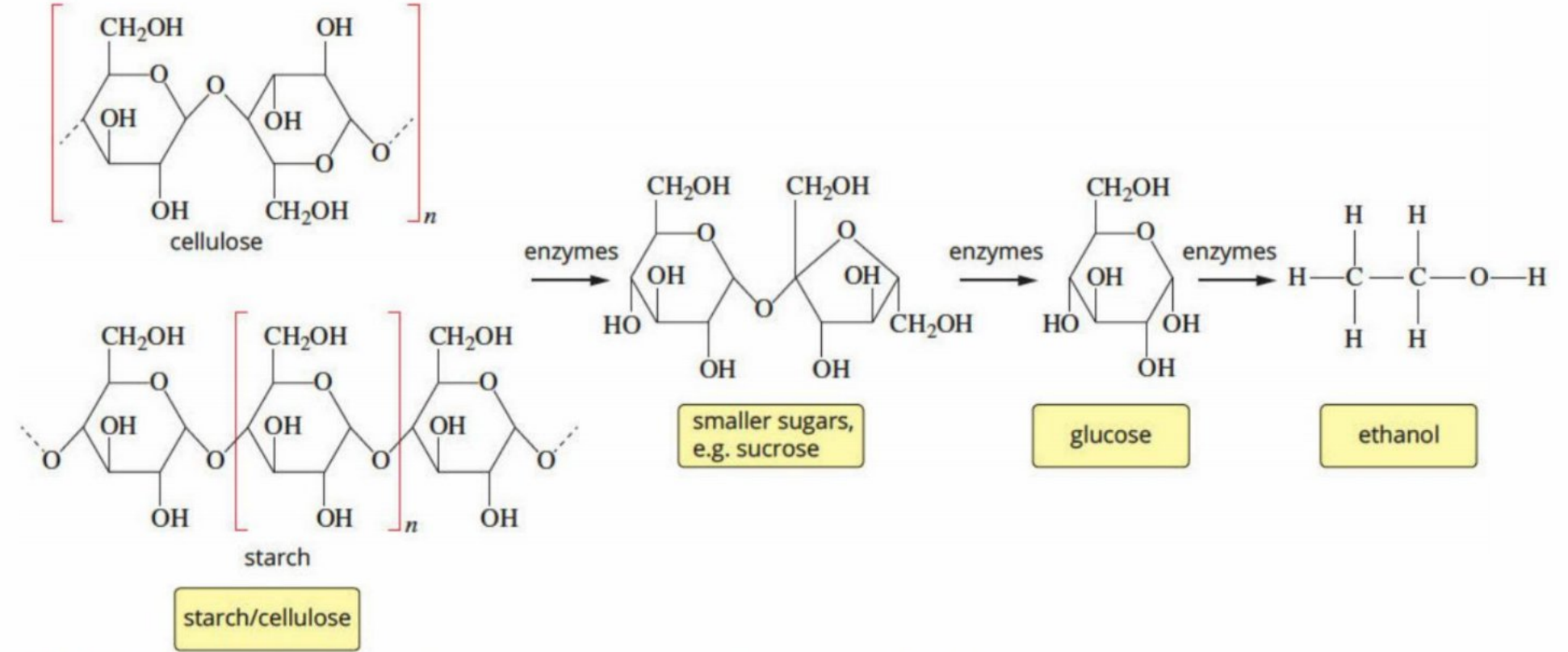
Breaking down carbohydrates to glucose
Different carbohydrate feedstocks require different levels of processing to release glucose. The complexity depends on how the carbohydrate molecules are bonded together:
Note
Pre-treatment Requirements by Feedstock:
- Sucrose (from sugar cane) - small, highly soluble molecules requiring no pre-treatment
- Starch (from wheat) - larger molecules requiring moderate pre-treatment
- Cellulose (from forest waste) - very large molecules with strong hydrogen bonds requiring intensive pre-treatment
The stronger the bonding in the carbohydrate feedstock, the greater the pre-treatment required.
Production process
The bioethanol production process involves several key stages:
Pre-treatment
The plant material is mixed and blended with water to break down the cellular and plant structures. This creates a pulp mixture. For cellulose-rich materials like forest waste, additional treatment with steam and specialised enzymes is required because the hydrogen bonds holding cellulose molecules together are particularly strong.
Saccharification
During saccharification, enzymes are added to the mixture to break large carbohydrate molecules down into glucose. The specific enzymes used depend on the feedstock:
- Cellulase - breaks down cellulose
- Amylase - breaks down starch
Fermentation
Once glucose is available, enzymes catalyse its conversion into ethanol. This produces a solution containing approximately 10% ethanol by volume ().
By-products
Note
The waste biomass remaining after fermentation can be converted into fertiliser, providing an additional useful product from the process and reducing waste.
Distillation
Important
Distillation is the process of separating the components or substances from a liquid mixture by using selective boiling and condensation.
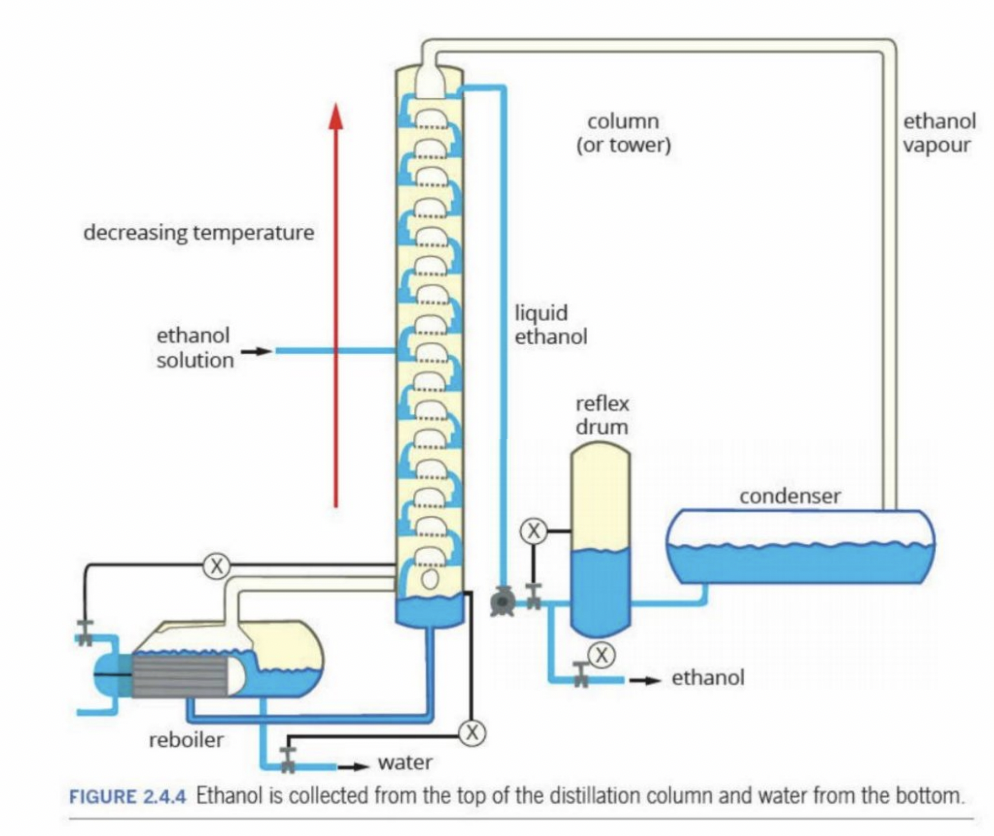
After fermentation produces a solution of approximately ethanol, the ethanol must be separated from water to be useful as a fuel. Distillation achieves this separation by exploiting the different boiling points of the two liquids:
- Ethanol: 79°C
- Water: 100°C

How distillation works
The ethanol solution is heated to boiling and fed into tall distillation columns. Temperature is carefully controlled throughout the column:
- Top of column: Cooler temperature allows ethanol vapour (lower boiling point) to rise and be collected
- Bottom of column: Water (higher boiling point) condenses and falls to the bottom
Note
The collected ethanol still contains traces of water, which are removed using micro-filtration and dehydrating agents to produce pure ethanol suitable for fuel use.
Energy requirements
Important
While distillation is a relatively straightforward process, it requires significant energy to boil the ethanol solution. This energy requirement means bioethanol production is not completely carbon-neutral, despite using renewable biomass as a feedstock.
Australian bioethanol industry
Australia has three commercial bioethanol manufacturing plants:
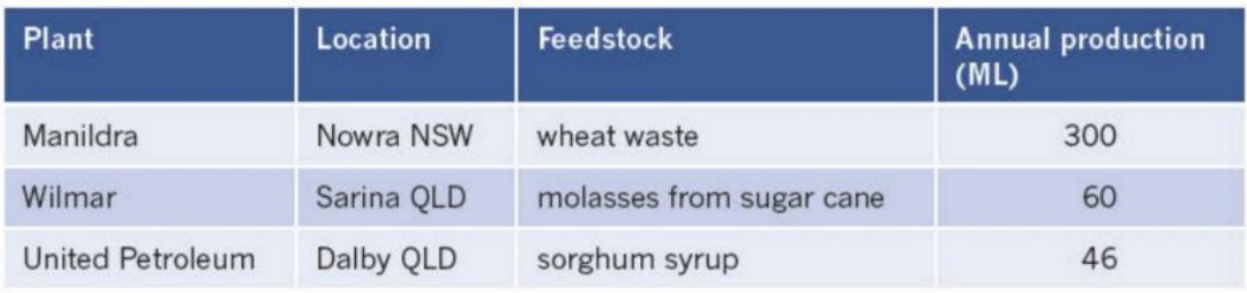
All three plants are strategically located in regions where their respective feedstock crops are grown, making it efficient to collect waste materials for fermentation.
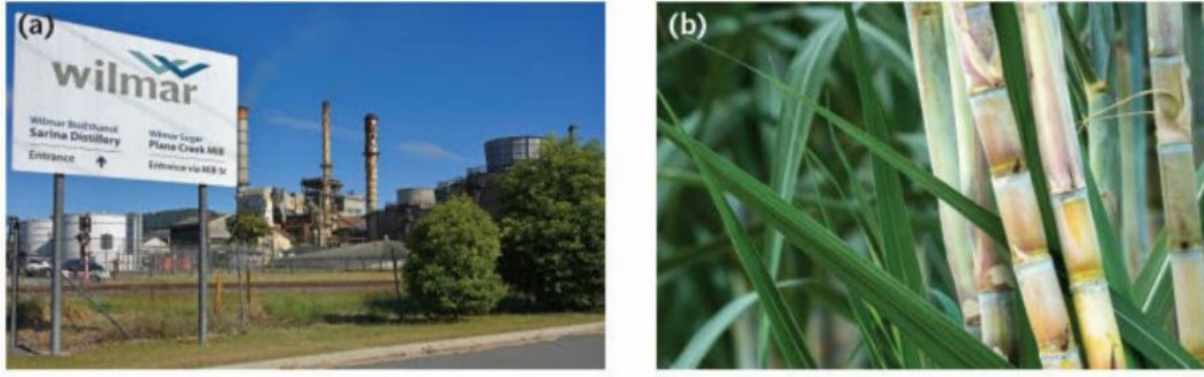
Sorghum, used by United Petroleum's Dalby plant, is primarily grown as animal feed for cattle, pigs and poultry. Its high starch content makes it ideal for bioethanol production.
Bioethanol potential and challenges
Food versus fuel debate
Important
The Food vs Fuel Dilemma
While sugar cane is an obvious source of fermentable sugars, it is also needed for table sugar production. This creates limits on bioethanol production from this source. The same dilemma extends to other food crops.
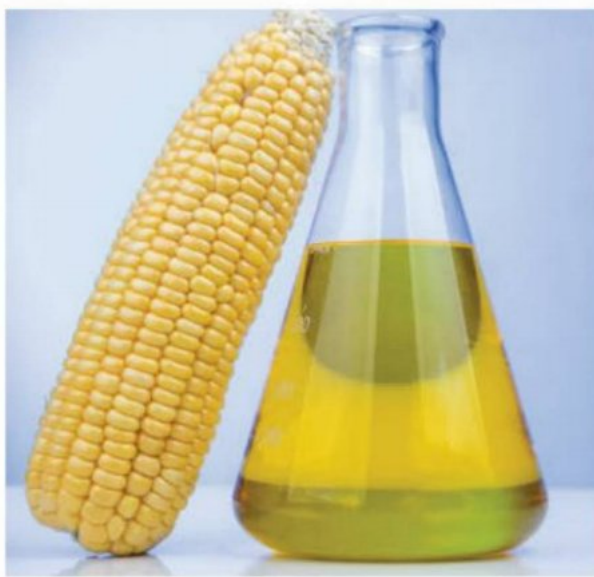
A balance must be maintained between ensuring basic nutrition needs are met and powering vehicles in an environmentally responsible manner. This is particularly important in countries like Brazil, where corn serves as both a major food staple and potential bioethanol feedstock.
Forest waste opportunities
Chemists are investigating less valuable sources of sugars and starches for bioethanol production. Forest waste represents an attractive target because:
- Australia has a large timber industry
- Bark and trimmings have little alternative use
- Abundant cellulose is available
Note
However, cellulose in forest waste is a polymer of glucose that requires harsh pre-treatment with steam and specialised enzymes to break it down into usable glucose. This makes forest waste more challenging to process than sugar cane or wheat waste.
E10 fuel blend
What is E10?
E10 is a fuel blend containing:
- 10% ethanol
- 90% petrol
Australian government regulations limit the proportion of ethanol in petrol to . This blend is sold at most Australian service stations, though not all vehicle models are suitable for E10 fuel.
Note
Queensland has different regulations from other states. To support local sugarcane growers, Queensland mandates that the volume of ethanol sold in fuel must be at least 4% of the total petrol volume sold.
Comparison with petrol
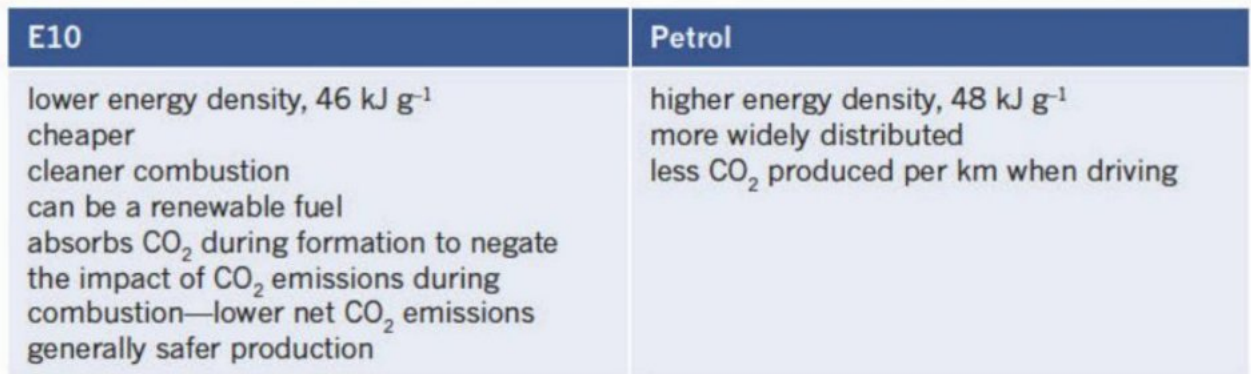
Energy content
The combustion equation for ethanol is:
where
The combustion of mole of ethanol releases 1360 kJ of energy, equivalent to 29.6 kJ g⁻¹.
Example
Energy Density Comparison:
- Ethanol energy density: 46 kJ g⁻¹
- Petrol energy density: 48 kJ g⁻¹
- Ethanol contains approximately 62% of the energy content of petrol
This means a larger mass (and volume) of ethanol is required to provide the same quantity of energy as petrol. The lower energy content occurs because carbon atoms in ethanol molecules are partially oxidised - some oxygen is already present in the ethanol molecules.
Environmental considerations
E10 offers several environmental advantages:
- Renewable fuel source: Can be produced from biomass
- Carbon dioxide absorption: Plants absorb CO₂ as they grow, offsetting the CO₂ released when bioethanol burns, resulting in lower net CO₂ emissions
- Cleaner combustion: Reduces emissions of particulates and nitrogen oxides
- Safer production: Generally safer to produce than petroleum-based fuels
However, petrol has some advantages:
- More widely distributed in Australia
- Produces less CO₂ per kilometre when driving (due to higher energy density)
Note
Increasing the volume of bioethanol blended into petrol should reduce overall emissions and decrease demand for scarce fossil fuel reserves.
Future developments: Ethtec case study
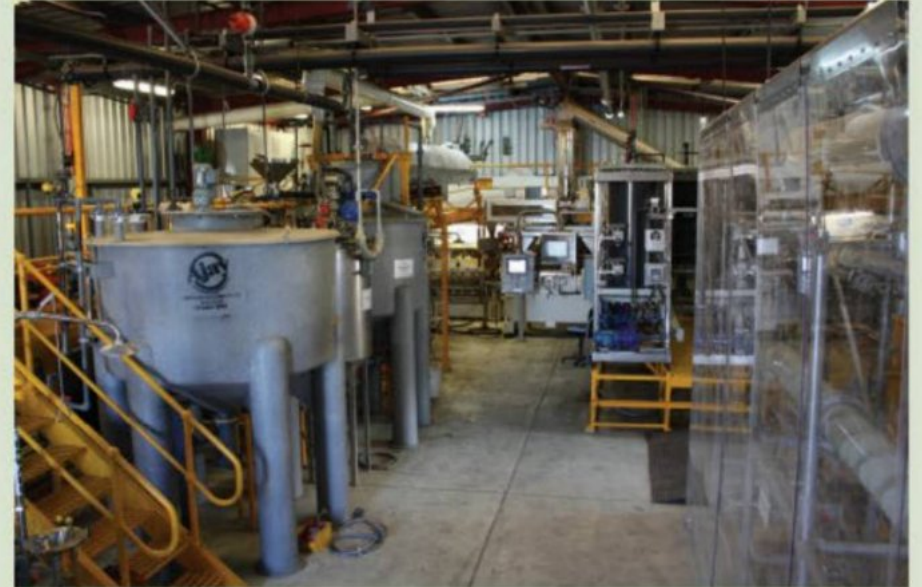
Ethtec (Ethanol Technologies) has established a next-generation bioethanol pilot plant near Muswellbrook in the Hunter Valley of New South Wales. Unlike traditional plants that focus on converting one waste source into one product, Ethtec's approach involves:
- Using any available biomass in the district
- Producing a range of useful products
Why Muswellbrook?
Muswellbrook was chosen because both sugar cane and timber are grown in the region, providing access to diverse waste materials from both industries.
Processing forest waste
The forest waste, referred to as lignocellulosic waste, contains high proportions of:
- Cellulose - a glucose polymer
- Lignin - a natural polymer present in plant cells
The process involves:
- Pulping the forest waste
- Heating with acid to break down (hydrolyse) cellulose into smaller sugars
- Removing lignin for alternative uses
Multiple products
Note
Multi-Product Approach
Rather than producing only bioethanol, the Ethtec plant converts:
- Small sugars → bioethanol (via fermentation and distillation)
- Lignin → electrical energy
This multi-product approach represents the future of bioethanol production, maximising the value obtained from biomass waste.
Remember!
Summary
Key Points to Remember:
-
Fermentation converts glucose to bioethanol at 35°C using enzymes and microorganisms:
-
The three main Australian feedstocks are sugar cane (sucrose), wheat (starch), and forest waste (cellulose), with cellulose requiring the most intensive pre-treatment
-
Distillation separates ethanol from water using their different boiling points (79°C vs 100°C), with ethanol vapour collected from the top of the column
-
E10 fuel contains bioethanol and has lower energy density than petrol ( vs ) but offers environmental benefits including renewable production and lower net CO₂ emissions
-
Next-generation plants like Ethtec use multiple biomass sources and produce multiple valuable products, representing the future of sustainable bioethanol production