Energy from the Combustion of Fuels (VCE SSCE Chemistry): Revision Notes
📚Revision Notes
Energy from the Combustion of Fuels
Introduction to combustion
Combustion is a chemical process that releases energy in the form of heat and light. Bushfires are a dramatic example of uncontrolled combustion, capable of destroying homes, habitats, and vast areas of land. Understanding the chemistry of combustion helps us control fire and use it safely as an energy source.
Combustion reactions are exothermic reactions in which a reactant combines with oxygen to produce oxides. This type of reaction is also called an oxidation reaction because oxygen is added to form oxides. When hydrocarbons undergo combustion with sufficient oxygen, the products are carbon dioxide and water.
Note
For any combustion reaction to occur, three essential components must be present:
- Fuel to burn
- Oxygen for the fuel to burn in
- Energy to initiate the process
By understanding these requirements, we can control combustion reactions and harness them effectively for energy production.
Complete combustion
Complete combustion occurs when there is a plentiful supply of oxygen. Under these conditions, the fuel burns efficiently to produce only two products: carbon dioxide () and water ().
For example, the complete combustion of methane can be represented by the equation:
This equation shows that one mole of methane gas reacts with two moles of oxygen gas to produce one mole of carbon dioxide gas and two moles of liquid water. The products are completely oxidised, meaning no carbon monoxide or carbon particles are formed.
Note
Complete combustion is characterised by a clean, blue flame and produces the maximum amount of energy from the fuel. This is the ideal type of combustion for fuel use because it:
- Releases the most energy per mole of fuel
- Produces fewer harmful pollutants
- Uses the fuel most efficiently
Incomplete combustion
When the oxygen supply is limited, incomplete combustion occurs. Under these conditions, not all the carbon in the fuel can be converted into carbon dioxide. Instead, the products include carbon monoxide () and/or solid carbon (), along with water.
Incomplete combustion is easily identified by a yellow, smoky, or sooty flame. The yellow colour and smoke result from glowing carbon particles that have not been fully oxidised.
The equation for the incomplete combustion of methane to form carbon monoxide is:
The danger of carbon monoxide
Important
Carbon Monoxide Poisoning Risk
Carbon monoxide is a highly poisonous gas produced during incomplete combustion. It poses a serious health risk because it binds strongly to haemoglobin, the oxygen-carrying molecule in blood. When haemoglobin is bound to carbon monoxide, it cannot transport oxygen around the body, leading to oxygen starvation of tissues.
The effects of carbon monoxide depend on its concentration:
- At concentrations as low as 10 parts per million (ppm), carbon monoxide can cause drowsiness, dizziness, and headaches
- At approximately 200 ppm, carbon monoxide can be lethal
- In large cities, the average concentration is around 7 ppm, mainly from incomplete combustion of fuels in vehicles
- At busy intersections during heavy traffic, concentrations can reach as high as 120 ppm
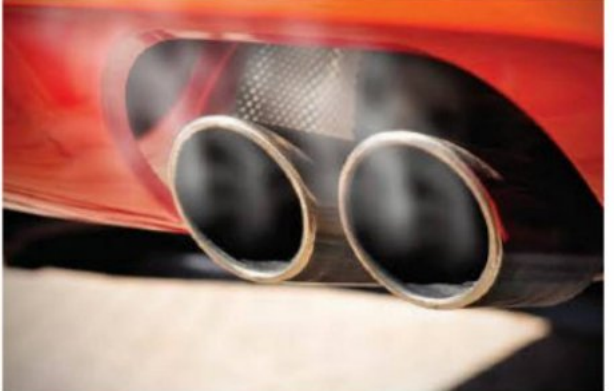
Car exhaust gases often contain high levels of carbon monoxide due to incomplete combustion of petrol and diesel fuels. This makes proper ventilation crucial when running engines in enclosed spaces.
Writing equations for complete combustion
Balancing combustion equations for hydrocarbons
Writing balanced equations for the complete combustion of hydrocarbons follows a systematic process. Since the products are always carbon dioxide and water, the main challenge is determining the correct coefficients.
Example
Worked Example: Balancing the Combustion of Butane
Let's examine the process using butane () as an example:
Step 1: Write the reactant (hydrocarbon) and oxygen on the left, and carbon dioxide and water on the right:
Step 2: Balance carbon atoms first. Since butane has 4 carbon atoms, we need 4 molecules of :
Step 3: Balance hydrogen atoms. Butane has 10 hydrogen atoms, so we need 5 molecules of :
Step 4: Count the total oxygen atoms on the product side:
- From : oxygen atoms
- From : 5 oxygen atoms
- Total: oxygen atoms
Step 5: If the total is an odd number, multiply all coefficients (except oxygen) by 2:
Step 6: Balance oxygen by adding the appropriate coefficient:
Step 7: Add state symbols to complete the equation:
This systematic approach ensures that the equation is properly balanced and follows chemical conventions. The state symbols indicate that the combustion occurs with gaseous reactants producing gaseous carbon dioxide and liquid water.
Balancing combustion equations for alcohols
Alcohols are carbon-based fuels that contain oxygen in their molecular structure. The process for balancing their combustion equations is similar to that for hydrocarbons, with one additional consideration: we must account for the oxygen already present in the alcohol molecule.
Example
Worked Example: Balancing the Combustion of Ethanol
Let's work through the combustion of ethanol ():
Step 1: Write the alcohol and oxygen as reactants, carbon dioxide and water as products:
Step 2: Balance carbon atoms (2 carbon atoms in ethanol):
Step 3: Balance hydrogen atoms (6 hydrogen atoms in ethanol):
Step 4: Count oxygen atoms on the product side:
- From : oxygen atoms
- From : 3 oxygen atoms
- Total: oxygen atoms
Step 5: Subtract the oxygen atom already present in the alcohol molecule: oxygen atoms needed from
Step 6: Since 6 is an even number, we can proceed directly to balance oxygen:
Step 7: Add state symbols:
Important
Key Difference for Alcohols
The key difference when balancing alcohol combustion equations is remembering to subtract the oxygen atom present in the alcohol molecule from the total oxygen count on the product side.
Writing equations for incomplete combustion
Incomplete combustion equations can also be written systematically. When oxygen supply is insufficient, the carbon products are carbon monoxide and/or solid carbon, along with water.
Example
Worked Example: Incomplete Combustion of Ethane
For ethane () undergoing incomplete combustion with carbon monoxide as the only carbon product:
Step 1: Write reactants and products:
Step 2: Balance carbon atoms (2 carbons):
Step 3: Balance hydrogen atoms (6 hydrogens):
Step 4: Balance oxygen atoms:
- Product side has: oxygen atoms
- Therefore: coefficient =
Step 5: Multiply all coefficients by 2 to eliminate the fraction:
Step 6: Add state symbols:
Note
Notice that less oxygen is required for incomplete combustion compared to complete combustion of the same fuel.
Heat of combustion
The heat of combustion is the heat energy released when a specified amount of a substance burns completely in oxygen. It is expressed as a positive value and measured under standard laboratory conditions of 298 K and 100 kPa. Under these conditions, water produced is in the liquid state.
Heat of combustion can be expressed in different units:
- kJ mol⁻¹ for pure substances
- kJ g⁻¹ or kJ L⁻¹ for fuel mixtures like wood, coal, or kerosene that don't have specific chemical formulas
Note
Heat of Combustion vs Enthalpy of Combustion
The term enthalpy of combustion () appears in thermochemical equations and has a negative value, indicating the exothermic nature of combustion. However, heat of combustion is conventionally stated as a positive value.
Molar enthalpy is the enthalpy per mole of substance and is essentially the same as enthalpy of combustion for fuels.
Heat of combustion values for common fuels
| Substance | Heat of combustion (kJ mol⁻¹) |
|---|---|
| methane | 890 |
| ethane | 1560 |
| propane | 2220 |
| butane | 2880 |
| octane | 5460 |
| methanol | 725 |
| ethanol | 1360 |
| hydrogen | 282 |
| carbon (graphite) | 394 |
These values show that larger hydrocarbon molecules generally release more energy per mole when burned. This is because they contain more carbon-hydrogen bonds that can be broken and reformed into carbon dioxide and water, releasing energy in the process.
Calculating energy from combustion
When we know the heat of combustion of a fuel, we can calculate the total energy released when a given mass of the fuel burns. The calculation involves two steps:
- Calculate the number of moles:
- Calculate energy released:
Example
Worked Example: Energy Released from Pentane Combustion
Calculate the energy released when 3.60 kg of pentane () burns completely. The heat of combustion of pentane is 3510 kJ mol⁻¹.
Solution:
First, calculate moles of pentane:
Then calculate energy:
This shows that burning 3.60 kg of pentane releases 176,000 kJ of energy.
Energy content per gram
For practical comparisons, especially for transport fuels, energy content is often expressed per gram. For pure substances, this can be calculated by dividing the heat of combustion per mole by the molar mass.
For example, for ethanol:
| Substance | State | Heat of combustion (kJ g⁻¹) (approx.) |
|---|---|---|
| kerosene | liquid | 18 |
| wood | solid | 21 |
| diesel | liquid | 25 |
| black coal | solid | 25 |
| natural gas | gas | 30 |
These values help us compare different fuels. Natural gas has the highest energy content per gram, making it highly efficient. However, other factors such as storage, transport, and availability also influence fuel choice.
Thermochemical equations
Thermochemical equations provide comprehensive information about chemical reactions by including both the balanced equation and the enthalpy change (). These equations are powerful tools for understanding energy changes in combustion reactions.
For example, the thermochemical equation for complete combustion of propane is:
Note
Information from Thermochemical Equations
This single equation tells us several important facts:
- The complete combustion of 1 mole of propane gas with 5 moles of oxygen gas produces 3 moles of carbon dioxide and 4 moles of water
- The reaction releases 2220 kJ of energy
- The molar enthalpy of combustion for propane is -2220 kJ mol⁻¹
- The reaction is exothermic (negative value)
- Propane is a useful fuel because it releases a large amount of energy
- Using propane contributes to greenhouse gas emissions because is produced
Relationship between mole ratios and enthalpy changes
The value in a thermochemical equation corresponds directly to the mole amounts specified by the coefficients. If you change the coefficients, the value changes proportionally.
For methanol combustion:
This equation shows that 726 kJ is released when 1 mole of methanol reacts. If we double all coefficients, the energy released also doubles:
Similarly, tripling the coefficients triples the value:
This proportional relationship allows us to calculate energy changes for any amount of fuel burned.
Reversing chemical equations
When a chemical equation is reversed, the sign of changes but the magnitude remains the same. This reflects the principle that the energy released by a reaction equals the energy required to reverse it.
Forward reaction (combustion of methane):
Reverse reaction:
The forward reaction is exothermic (releases energy), whilst the reverse reaction is endothermic (requires energy input).
Example
Worked Example: Reversing and Scaling Equations
Iron reacts with oxygen according to:
Calculate for:
Solution:
The second equation is the reverse of the first, so becomes positive. All coefficients have doubled, so the magnitude of also doubles:
The importance of state symbols
Important
State Symbols Matter!
State symbols are crucial in thermochemical equations because enthalpy changes occur during physical changes as well as chemical changes. The state of a substance significantly affects the energy calculations.
For example, boiling water is an endothermic process:
Energy must be supplied to convert liquid water into steam.
For propane combustion, the value depends on whether water is produced as a gas or liquid:
With water as gas:
With water as liquid:
Note
More energy is released when water forms as a liquid because the condensation of steam releases additional energy. By convention, heats of combustion are calculated at standard laboratory conditions (298 K and 100 kPa), where water exists as a liquid. Therefore, combustion equations should show products as and .
Case study: Explosives and chemical energy
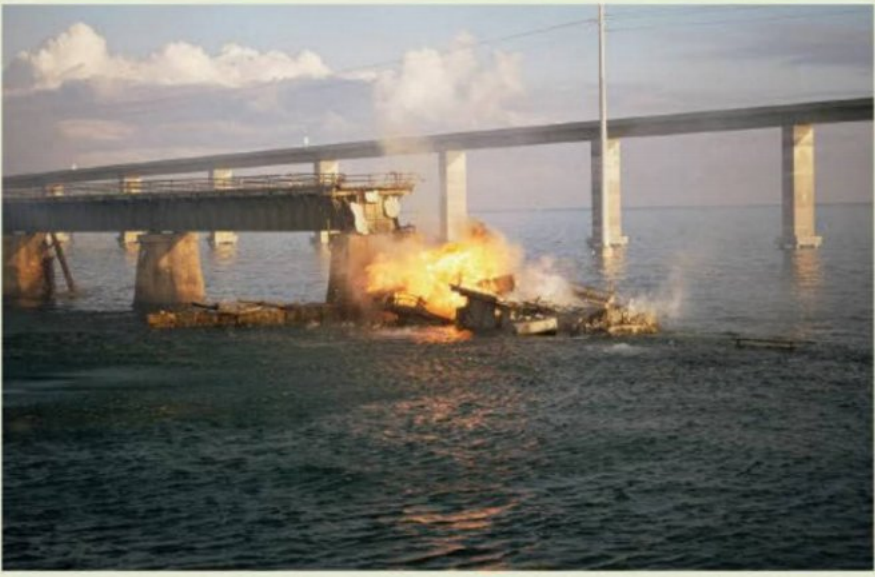
Explosives demonstrate the rapid release of chemical energy through combustion reactions. Humans have used explosives since 919 BCE, when the Chinese first mixed saltpetre (potassium nitrate), sulfur, and charcoal to create gunpowder. Today, explosives are essential tools for mining, road construction, tunnelling, and controlled demolition.
Whilst fuels like petrol and natural gas release thermal energy through combustion, their reaction rate is limited by oxygen availability. Explosives are fundamentally different because they contain sufficient oxygen within their molecular structure for complete (or nearly complete) reaction to occur almost instantaneously.
Chemical explosives such as ammonium nitrate, trinitrotoluene (TNT), and nitroglycerine decompose rapidly, releasing large quantities of energy and gaseous products. The thermochemical equation for nitroglycerine decomposition is:
Note
The Explosive Expansion
This equation highlights a key feature of explosives: solid or liquid reactants rapidly convert to gaseous products. At atmospheric pressure, these gaseous products would expand to occupy more than 10,000 times the volume of the original reactants. During a controlled explosion, the liquid explosive is placed in a confined space (such as a drilled hole in rock), where the rapidly expanding gases create enormous pressure that shatters the surrounding material.
The ratio of products to reactants is particularly significant. In the nitroglycerine equation, 4 moles of liquid reactant produce 29 moles of gaseous products. This dramatic increase in moles, combined with the phase change from liquid to gas, causes the explosive expansion.
Explosives require an activation trigger (such as a detonator or spark) to initiate the reaction. Once started, the reaction proceeds extremely rapidly because it is highly exothermic and generates its own heat to sustain the process.
Summary
Key Points to Remember:
-
Complete combustion occurs with plentiful oxygen, producing only carbon dioxide and water. Incomplete combustion occurs with limited oxygen, producing carbon monoxide and/or carbon, plus water.
-
Carbon monoxide is highly toxic because it binds to haemoglobin, preventing oxygen transport in the blood. Even low concentrations can cause serious health effects.
-
Balanced combustion equations follow a systematic process: balance carbon first, then hydrogen, count oxygen atoms on the product side, adjust coefficients if necessary, then balance oxygen atoms on the reactant side.
-
Heat of combustion (positive value) is the energy released when a fuel burns completely. Enthalpy of combustion (negative value) appears in thermochemical equations and indicates the exothermic nature of the reaction.
-
In thermochemical equations, changing coefficients proportionally changes values. Reversing an equation changes the sign of but not its magnitude. State symbols are essential because they affect energy calculations.