Exothermic and Endothermic Reactions (VCE SSCE Chemistry): Revision Notes
📚Revision Notes
Exothermic and Endothermic Reactions
Introduction to energy and chemical reactions
Energy is one of the most important topics in modern chemistry and society. We rely on energy for electricity, heating, and transport, and understanding how chemical reactions involve energy changes is essential for chemistry students.
All chemicals contain stored energy, and any chemical reaction will produce a change in energy. Some reactions release energy to their surroundings, while others absorb energy from their surroundings. Understanding these energy changes helps us evaluate different fuels and predict how reactions will behave.
A fuel is a substance that can release stored energy relatively easily. For a fuel to release its stored energy, it must undergo a chemical reaction. Most commonly, fuels react with oxygen in what we call combustion reactions.
Note
A combustion reaction is a reaction in which a substance reacts with oxygen gas, releasing energy. When fuels undergo combustion, energy is released in the form of heat. This makes combustion reactions particularly useful for generating energy for human needs.
Understanding enthalpy and enthalpy change
The chemical energy of a substance is sometimes called its heat content or enthalpy, represented by the symbol . Different substances have different amounts of stored chemical energy. When a chemical reaction occurs, the enthalpy of the reactants (represented as ) will differ from the enthalpy of the products (represented as ).
Enthalpy change is a measure of the quantity of energy absorbed or released during chemical reactions. It is given the symbol . The capital delta symbol () is commonly used in chemistry to represent 'change in'. For example, represents change in temperature.
Important
The enthalpy change for a reaction is calculated using the formula:
This formula tells us that enthalpy change equals the enthalpy of the products minus the enthalpy of the reactants. This calculation helps us determine whether a reaction releases or absorbs energy.
For reactions to occur, bonds in the reactants must break and new bonds must form in the products. Breaking bonds requires energy input, while forming bonds releases energy. The overall enthalpy change depends on whether more energy is released during bond formation or absorbed during bond breaking.
Exothermic reactions
When the enthalpy of the products is less than the enthalpy of the reactants (), energy is released from the system into the surroundings. These reactions are called exothermic reactions. The system has lost energy, so has a negative value.
For combustion reactions, which are exothermic reactions, .
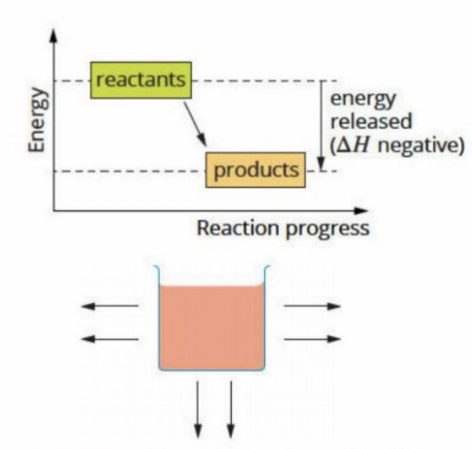
In an exothermic reaction:
- The total chemical energy of the products is less than the total chemical energy of the reactants
- The energy released when bonds form in the products is greater than the energy required to break bonds in the reactants
- Excess energy is released to the surroundings as heat
- is negative
Note
Exothermic reactions are important because they provide useful energy. When you burn fuel for heating or cooking, you are relying on exothermic combustion reactions to release energy that you can use.
Endothermic reactions
When the enthalpy of the products is greater than the enthalpy of the reactants (), energy must be absorbed from the surroundings. These reactions are called endothermic reactions. The system has gained energy, so has a positive value: .
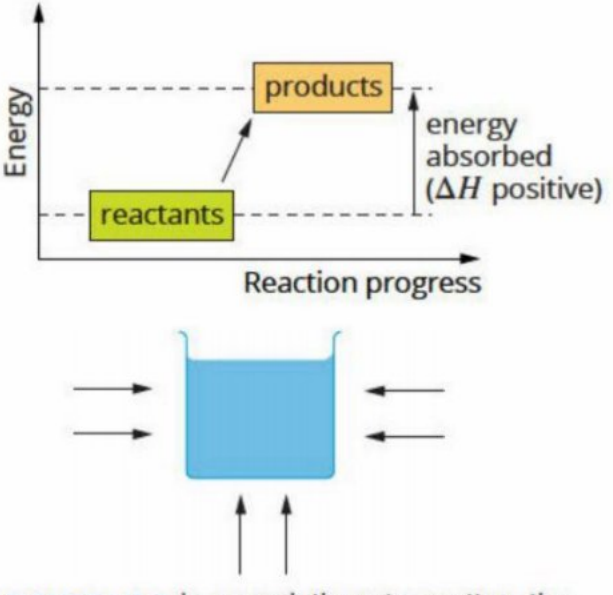
In an endothermic reaction:
- The total chemical energy of the products is greater than the total chemical energy of the reactants
- The energy released when bonds form in the products is less than the energy required to break bonds in the reactants
- The energy required is absorbed from the surroundings
- is positive
Note
Endothermic reactions are less common in everyday life than exothermic reactions, but they are still important in chemistry. They require a continuous supply of energy to proceed.
Activation energy
Even though some reactions release energy overall, they still need an initial input of energy to get started. The energy required to break the bonds of reactants so that a reaction can proceed is called the activation energy. Think of activation energy as an energy barrier that must be overcome before a reaction can commence.
Important
An activation energy barrier exists for both exothermic and endothermic reactions. This explains why some reactions need a spark or heat to get started, even if they release energy overall.
If the activation energy for a reaction is very low, the chemical reaction can be initiated as soon as the reactants come into contact. The reactants already have sufficient energy for the reaction to take place, so special conditions are not required.
Example
Worked Example: Low Activation Energy Reaction
When zinc is added to hydrochloric acid, the reaction begins immediately and hydrogen gas bubbles are vigorously produced:
The reactants in this reaction have sufficient energy to overcome the activation energy barrier without needing additional heating or sparks. This demonstrates a reaction with very low activation energy.
Units of energy
Understanding the magnitude of values allows us to compare different fuels and reactions. The International System of Units (SI units) specifies the joule (symbol ) as the unit for energy.
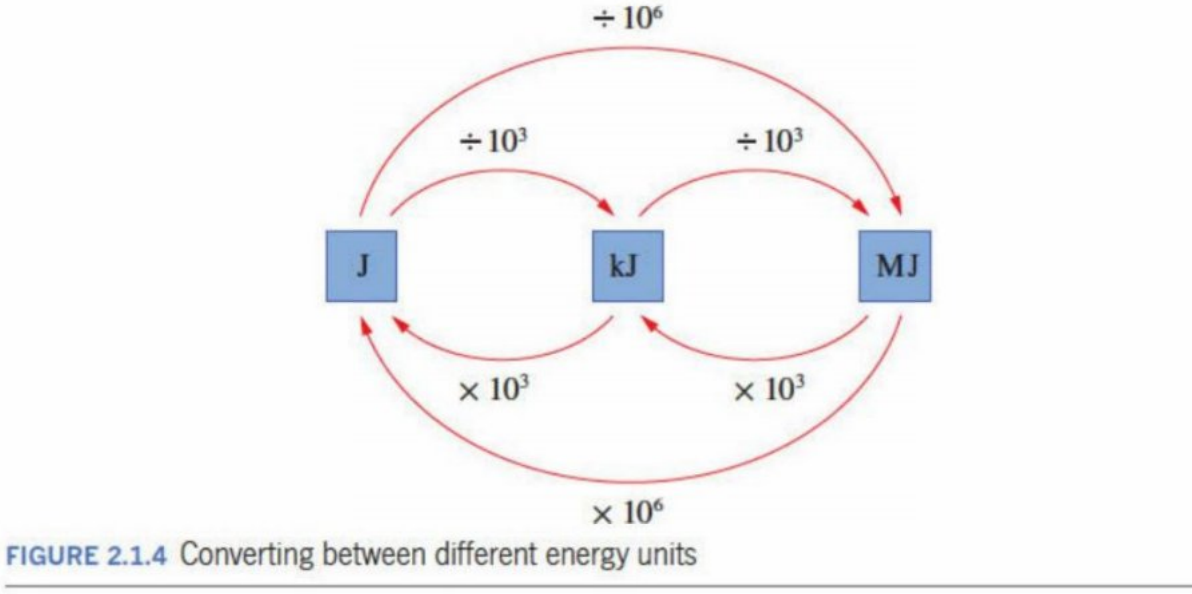
Since is a relatively small quantity of energy, chemists commonly use larger units:
- Kilojoules: (one thousand joules)
- Megajoules: (one million joules)
- Gigajoules: (one billion joules)
- Terajoules: (one trillion joules)
Note
Converting between these units involves multiplying or dividing by powers of ten. For example, to convert from joules to kilojoules, divide by (or ). To convert from kilojoules to joules, multiply by .
Thermochemical equations
A thermochemical equation is a balanced chemical equation that includes the enthalpy change, . These equations provide complete information about both the chemical change and the energy change that occurs during a reaction.
Example
Worked Example: Thermochemical Equation for Methane Combustion
The combustion of methane (a common fuel) can be written as:
When we add the enthalpy change to this equation, it becomes a thermochemical equation:
This equation tells us that when one mole of methane reacts with two moles of oxygen gas to produce one mole of carbon dioxide and two moles of liquid water, of energy is released. The negative sign indicates that this is an exothermic reaction.
Thermochemical equations are valuable because they allow us to calculate exactly how much energy will be released or absorbed when specific amounts of reactants are used. This is particularly important when comparing different fuels or designing chemical processes.
Energy profile diagrams
The energy changes that occur during a chemical reaction can be shown visually using an energy profile diagram (also called an energy profile). These diagrams plot energy on the vertical axis against reaction progress on the horizontal axis, showing how energy changes as reactants are converted to products.
Important
Energy profile diagrams are useful because they show not only the overall energy change () but also the activation energy that must be overcome for the reaction to proceed.
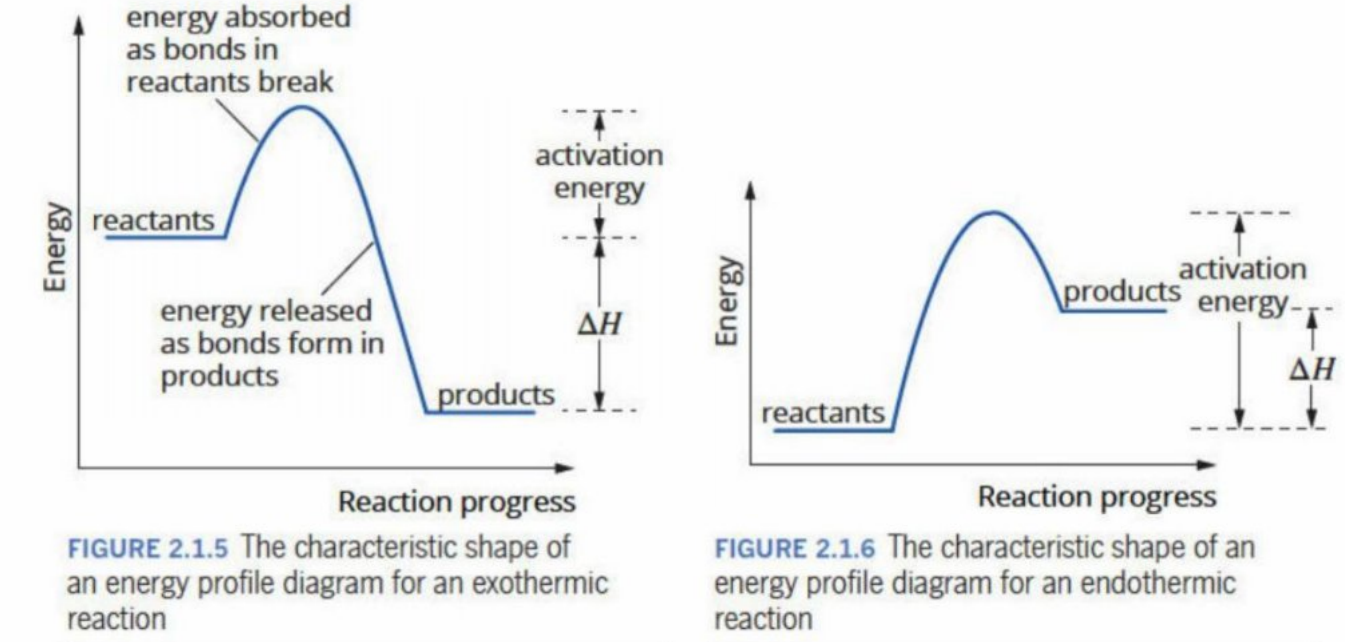
For an exothermic reaction, the energy profile diagram shows:
- Reactants starting at a higher energy level than products
- An initial increase in energy as activation energy is absorbed and bonds break
- A peak representing the highest energy point (the activation energy barrier)
- A decrease in energy as new bonds form in the products
- Products ending at a lower energy level than reactants
- Overall, is negative (shown as a downward arrow between reactants and products)
For an endothermic reaction, the energy profile diagram shows:
- Reactants starting at a lower energy level than products
- An initial increase in energy as activation energy is absorbed
- A peak representing the activation energy barrier
- Products ending at a higher energy level than reactants
- Overall, is positive (shown as an upward arrow between reactants and products)
Note
Both types of reactions require activation energy to initiate the reaction. The key difference is whether the products end up with more or less energy than the reactants started with.
Remember!
Summary
Key Points to Remember:
-
Exothermic reactions release energy to the surroundings, have negative values, and produce products with lower energy than the reactants. Combustion reactions are exothermic.
-
Endothermic reactions absorb energy from the surroundings, have positive values, and produce products with higher energy than the reactants.
-
Enthalpy change () is calculated using: , where is the enthalpy of products and is the enthalpy of reactants.
-
Activation energy is the energy barrier that must be overcome for any reaction to proceed, whether the reaction is exothermic or endothermic overall.
-
Energy profile diagrams visually represent energy changes during reactions, showing both activation energy and overall enthalpy change. They help you understand the energy pathway from reactants to products.