Fuel Sources for the Body (VCE SSCE Chemistry): Revision Notes
📚Revision Notes
Fuel Sources for the Body
Introduction to body energy requirements
The human body needs energy for multiple essential functions. Energy is required for maintaining body temperature, enabling physical movement, and synthesising vital biomolecules including hormones, enzymes, carbohydrates, and triglycerides. This energy comes from nutrients in our diet that are broken down and metabolised within our cells.
Photosynthesis: storing energy from the Sun
Glucose as a fundamental biomolecule
Glucose is one of the most important biomolecules for life. This simple sugar molecule is present in all living organisms, with particularly high concentrations in plant sap and in the blood and tissues of animals.
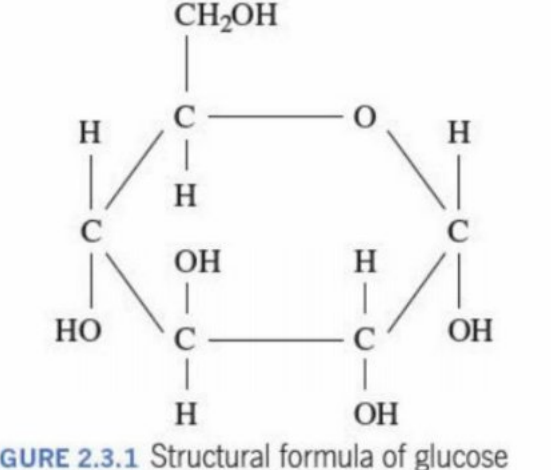
Plants utilise glucose as a building block (monomer) to construct larger molecules (polymers) such as starch and cellulose. Both glucose itself and starch polymers are digested more rapidly than other food types. They serve as the primary energy sources in most diets, and the human body preferentially uses them for energy before turning to fats and proteins.
The photosynthesis process
Green plants perform photosynthesis, one of the most crucial chemical reactions supporting life on Earth. Through photosynthesis, plants manufacture their own food in the form of glucose.

Note
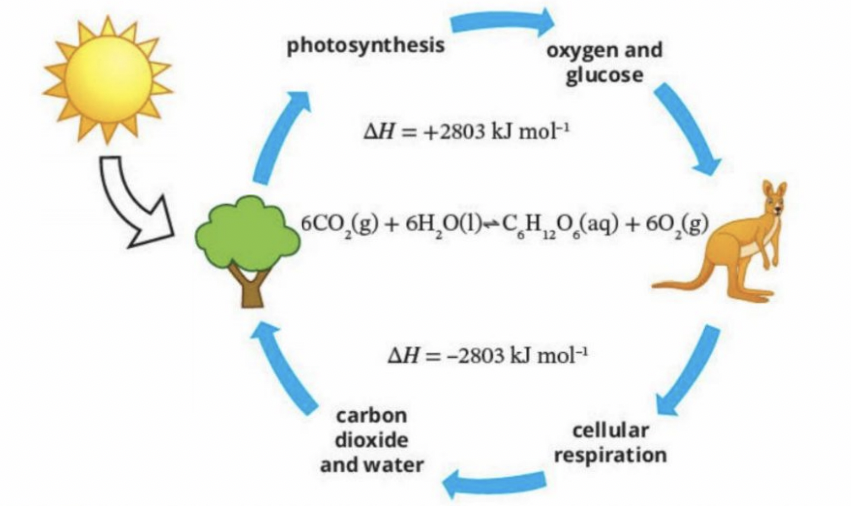
Photosynthesis is an endothermic chemical reaction that takes place in chloroplasts within the cells of green leaves. During this process, energy from sunlight drives the conversion of carbon dioxide and water into glucose. Oxygen gas is released as a by-product.
The thermochemical equation for photosynthesis is:
The positive enthalpy change indicates this is an endothermic reaction, meaning energy must be absorbed for the reaction to occur. The glucose produced contains stored chemical energy derived from sunlight. This energy sustains the plant and becomes available to animals that consume plant material.
Cellular respiration: releasing stored energy
Aerobic respiration in cells
Cellular respiration is the process by which cells extract energy from glucose. Glucose serves as the primary energy source for both plant and animal cells. The main form of respiration is aerobic respiration, which requires oxygen gas.
During aerobic respiration, glucose undergoes oxidation through a sequence of reactions, ultimately producing carbon dioxide and water. The overall equation is:
The negative enthalpy change indicates this is an exothermic reaction, releasing energy that cells can use for their functions.
The relationship between photosynthesis and respiration
Notice that the products of photosynthesis (glucose and oxygen) are the reactants for aerobic respiration, while the products of respiration (carbon dioxide and water) are the reactants for photosynthesis. These two processes form a complementary cycle.
Important
The energy from the Sun captured and stored in glucose molecules during photosynthesis is released back to plants or animals through respiration. The equal but opposite enthalpy changes ( kJ for photosynthesis and kJ for respiration) demonstrate this energy cycle.
It's important to note that respiration produces the same overall result as if glucose were completely burned in a flame. However, the actual biochemical pathways are quite different. Both photosynthesis and respiration occur through multiple stages involving many different biomolecules. Photosynthesis takes place only in plant cells, while respiration occurs in both animal and plant cells.
Case study: Lavoisier and combustion
Historical context
Antoine Lavoisier was a distinguished French chemist who made numerous groundbreaking contributions to chemistry. His achievements included developing a systematic method for naming chemicals based on their composition, discovering the composition of water, and clarifying how oxygen functions in combustion and oxidation reactions.
From the early 1780s, Lavoisier proposed a revolutionary idea: combustion and respiration were fundamentally the same process. He suggested that all respiration is a form of combustion. Given that oxygen had been discovered only recently, this insight was remarkably advanced for its time.
Experimental investigations
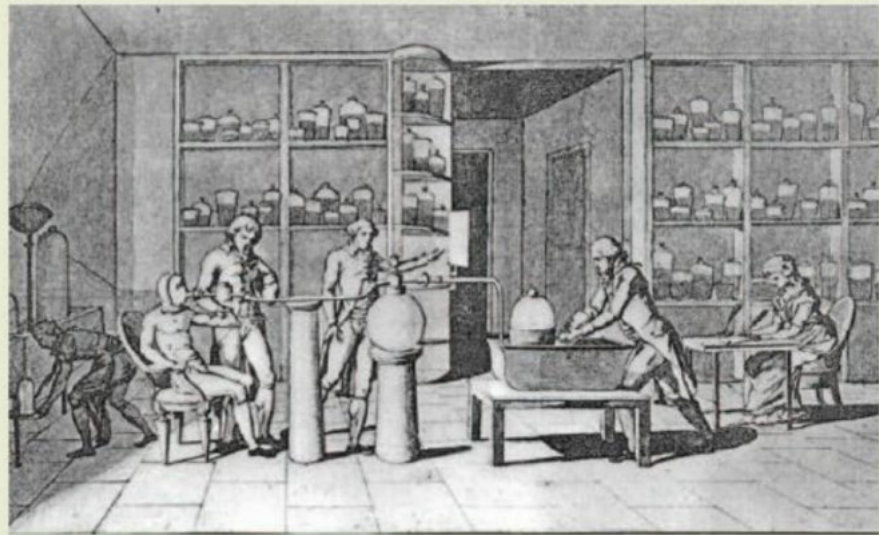
To test his hypothesis, Lavoisier designed apparatus that incorporated both a living guinea pig and ice. The activity level of the guinea pig provided an indication of the oxygen content in the air, while the rate at which the ice melted gave a measure of the energy being released. His experiments confirmed that respiration is indeed a reaction used by the body to release energy.
Lavoisier then conducted further experiments measuring the volume of oxygen inhaled by a human volunteer. He demonstrated that oxygen consumption increased with the rate of exercise, as did the volunteer's heart rate and pulse rate.
Lavoisier's conclusion
Note
Lavoisier's insightful conclusion stated:
"Respiration is nothing but a slow combustion of carbon and hydrogen, similar in all respects to that of a lamp or a lighted candle, and from this point of view, animals which breathe are really combustible substances burning and consuming themselves."
While most of Lavoisier's conclusions were correct, one aspect needed modification about 100 years later. Lavoisier incorrectly assumed that respiration occurred in the lungs themselves rather than in body cells throughout the organism.
Energy from different nutrients
Understanding nutrients
Nutrients are substances that an organism needs to survive, develop, and reproduce. A balanced diet contains various foods providing different types of nutrients, primarily carbohydrates (such as glucose), proteins, and fats. Food supplies the energy required for millions of chemical reactions occurring in your body.
One of the main reasons humans consume nutrients is to obtain energy. The quantity of energy obtained depends upon the chemical bonding within the nutrient molecule. Energy is needed for physical activity, maintaining body warmth, and essential functions like breathing. Energy is also required to build large molecules in our systems. This stored energy can be released when the molecules are digested, or metabolised, back into smaller units.
Carbohydrates: the body's preferred fuel
Carbohydrates are organic compounds composed of carbon, hydrogen, and oxygen elements. They typically have the general formula , where and are whole numbers.
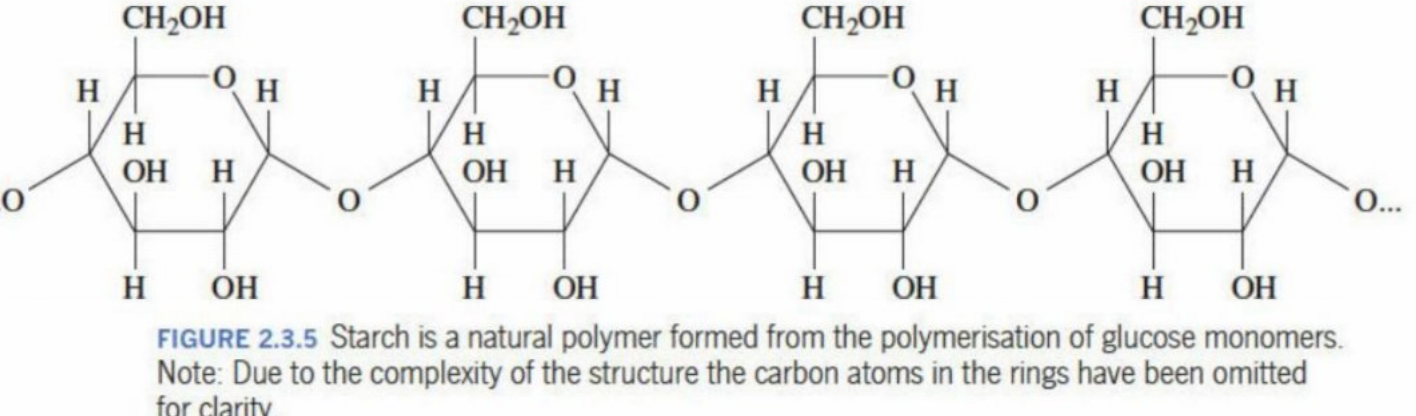
Many important carbohydrates are polymers of glucose. Starch is a key example, serving as an energy storage molecule in plants. The diagram below shows how glucose monomers link together repeatedly to form starch polymers.
Note
During digestion, enzymes (biological catalysts that alter the rate of biochemical reactions) in our saliva and small intestine break down starch molecules back into individual glucose units. The glucose is then transported via the bloodstream to body cells where respiration can occur.
Energy is required to form the numerous chemical bonds in these large carbohydrate molecules, and this energy is released during the digestion process.
Fats and oils: high-energy storage molecules
Fats and oils are examples of triglycerides, which are large non-polar molecules. Each triglyceride consists of three long hydrocarbon chains attached to a glycerol molecule through ester functional groups.
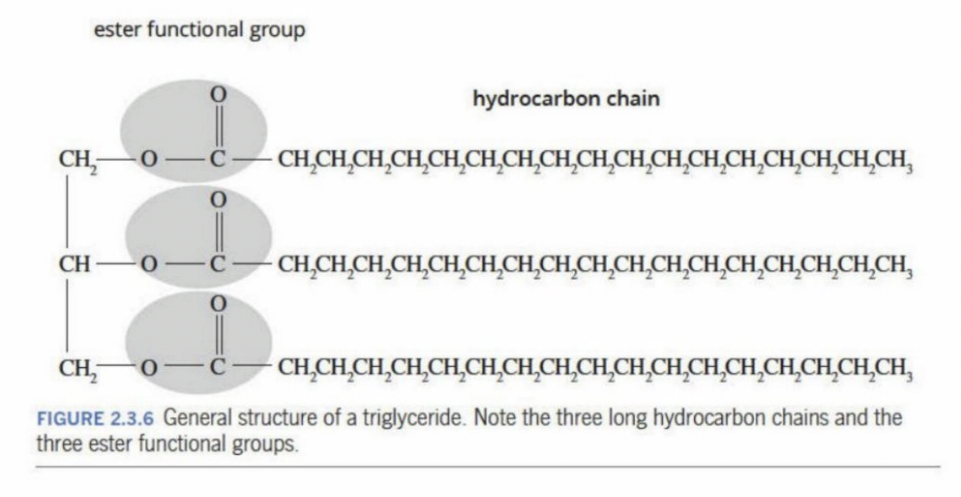
Fats play an important role in providing and storing energy in the body. During digestion, fats are broken down, and components from this breakdown can be oxidised in body cells to carbon dioxide and water, releasing large quantities of energy.
Proteins: alternative energy sources
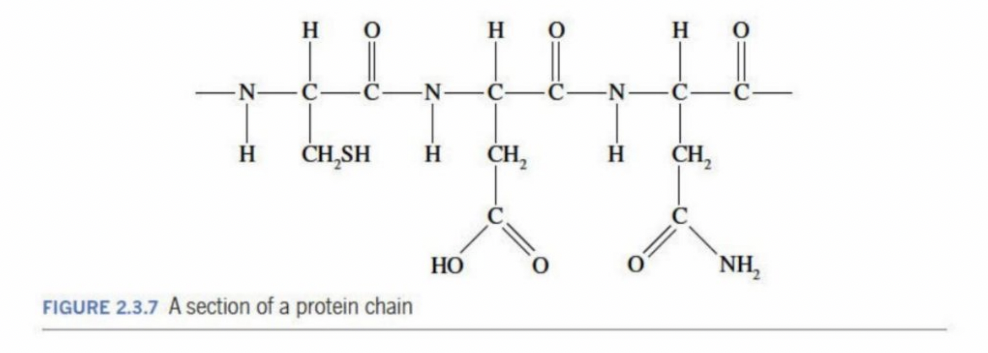
Proteins are complex molecules with varied and essential roles in the body. A segment of a typical protein molecule is shown below.
Important
The body rarely uses proteins as an energy source because they perform so many other critical functions. However, if intensive exercise depletes the body's stores of glycogen and fat, protein can serve as an alternative energy source. When this occurs, it becomes important to replace the protein quickly to ensure other body processes continue functioning properly.
Energy content of different nutrients
Measuring energy content
The energy content of foods refers to the amount of energy a food or fuel can supply. This is measured in kilojoules per gram (kJ g⁻¹), kilojoules per 100 grams (kJ/100 g), or kilojoules per mole (kJ mol⁻¹) for pure substances like glucose. For most foods, the energy released during combustion is similar to the energy released when the food is oxidised during respiration.
For convenience, each major food nutrient group (carbohydrates, fats, and proteins) is assigned a representative heat of combustion value, although individual members within these groups show some variation.
Example
Example: Variation in Carbohydrate Energy Content
While carbohydrates are generally considered to have a heat of combustion of 16 kJ g⁻¹, individual carbohydrates vary:
- Glucose: 15.7 kJ g⁻¹
- Polysaccharides: 17.6 kJ g⁻¹
Energy values for major nutrients
The energy value of a nutrient or food is the amount of energy available to the body after the food has been digested. The table below compares the heats of combustion (total energy content) and energy values (available energy) for the three main nutrient groups.
| Nutrient | Energy content (heat of combustion kJ g⁻¹) | Energy value (energy available for the body kJ g⁻¹) |
|---|---|---|
| Carbohydrates | 16 | 16 |
| Fats and oils | 39 | 37 |
| Proteins | 24 | 17 |
Why fats contain more energy
Fats and oils have a significantly higher energy value than carbohydrates and proteins. This difference is essentially due to the degree to which these molecules can be oxidised.
Important
Why Fats Have Higher Energy Content:
Carbohydrates tend to contain a higher proportion of oxygen atoms compared to fats and oils. At a simple level, the carbon atoms in carbohydrate molecules already have a higher "degree of oxidation". Consequently, fats and oils have greater potential for oxidation reactions and therefore release more energy during combustion.
Available energy versus total energy
The energy released when food is burned is often greater than the energy actually available for the human body to use after digestion.
Example
Example: Dietary Fibre and Energy Availability
Dietary fibre consists mainly of the carbohydrate cellulose. Humans cannot digest most fibre, so the energy it contains remains unavailable to us. This explains why the energy value can be lower than the heat of combustion, particularly noticeable for proteins (24 kJ g⁻¹ combustion energy but only 17 kJ g⁻¹ available energy).
Summary
Key Points to Remember:
-
Photosynthesis is an endothermic process where plants use sunlight energy to convert carbon dioxide and water into glucose and oxygen ( kJ).
-
Cellular respiration is an exothermic process where glucose is oxidised with oxygen to produce carbon dioxide and water, releasing energy ( kJ). These two processes are the reverse of each other and form a complementary energy cycle.
-
The three main nutrients providing energy are carbohydrates, fats and oils, and proteins. Fats and oils provide the most energy per gram (39 kJ g⁻¹), followed by proteins (24 kJ g⁻¹), then carbohydrates (16 kJ g⁻¹).
-
The body preferentially uses carbohydrates for energy, but can use proteins when carbohydrate and fat stores are depleted.
-
Fats contain more energy per gram than carbohydrates because they have fewer oxygen atoms and therefore greater potential for oxidation reactions.