Intermolecular Forces (VCE SSCE Chemistry): Revision Notes
📚Revision Notes
Intermolecular Forces
Understanding intermolecular forces
Intermolecular forces are the attractive forces that exist between molecules. These forces are much weaker than the covalent bonds that hold atoms together within molecules (intramolecular bonds). Understanding the difference between these two types of forces is essential for explaining the physical properties of molecular substances.
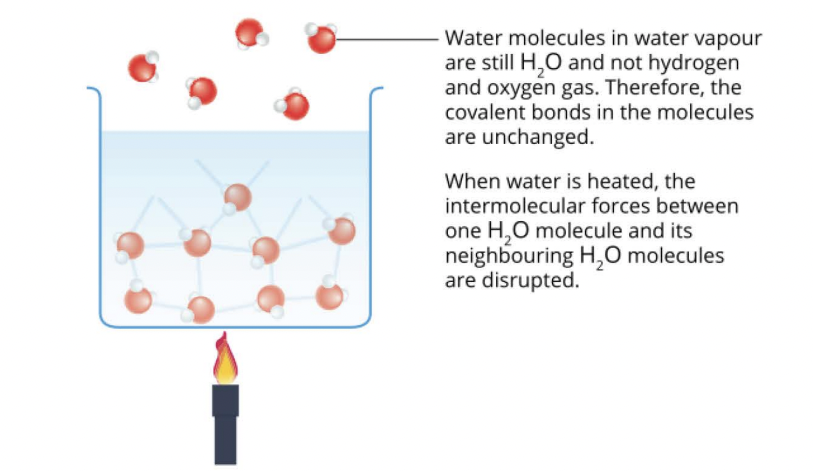
When you heat water, the molecules gain kinetic energy. Some molecules gain sufficient energy to overcome the forces holding them to neighbouring molecules and escape from the liquid surface. The resulting water vapour still consists of molecules - the covalent bonds within each molecule remain intact. What has been disrupted are the forces between the water molecules. This demonstrates that covalent bonds within molecules are considerably stronger than intermolecular forces between molecules.
Note
When water boils, the molecules remain intact - only the intermolecular forces between molecules are broken. The strong covalent O-H bonds within each water molecule stay firmly in place. This is why water vapour is still and not separate hydrogen and oxygen atoms.
The strength of intermolecular forces depends on several factors, including molecular size, molecular shape, and molecular polarity. These factors determine not only how strong the forces are, but also which type of intermolecular force exists.
Types of intermolecular forces
There are three main types of intermolecular forces:
- Dispersion forces (also called London forces)
- Dipole-dipole attraction
- Hydrogen bonding
Each type has different characteristics and strengths, which affect the physical properties of substances such as melting points and boiling points.
Note
These three types are listed in order of increasing strength: dispersion forces are the weakest, while hydrogen bonding is the strongest intermolecular force.
Dispersion forces
Dispersion forces are present between all molecules, regardless of whether they are polar or non-polar. These forces arise from temporary fluctuations in electron distribution around molecules.
Important
Dispersion forces exist in ALL molecules - both polar and non-polar. This makes them universal, even though they are the weakest type of intermolecular force.
How dispersion forces work
Electrons are constantly moving within atoms and molecules. Even in non-polar molecules like fluorine (), the electrons occasionally cluster more densely at one end of the molecule. This creates a temporary imbalance in charge distribution - one end becomes slightly negative () while the other becomes slightly positive (). These temporary charge separations are called temporary dipoles or instantaneous dipoles.
When a temporary dipole forms in one molecule, it can induce similar dipoles in neighbouring molecules. These induced dipoles then attract each other, creating dispersion forces throughout the substance.
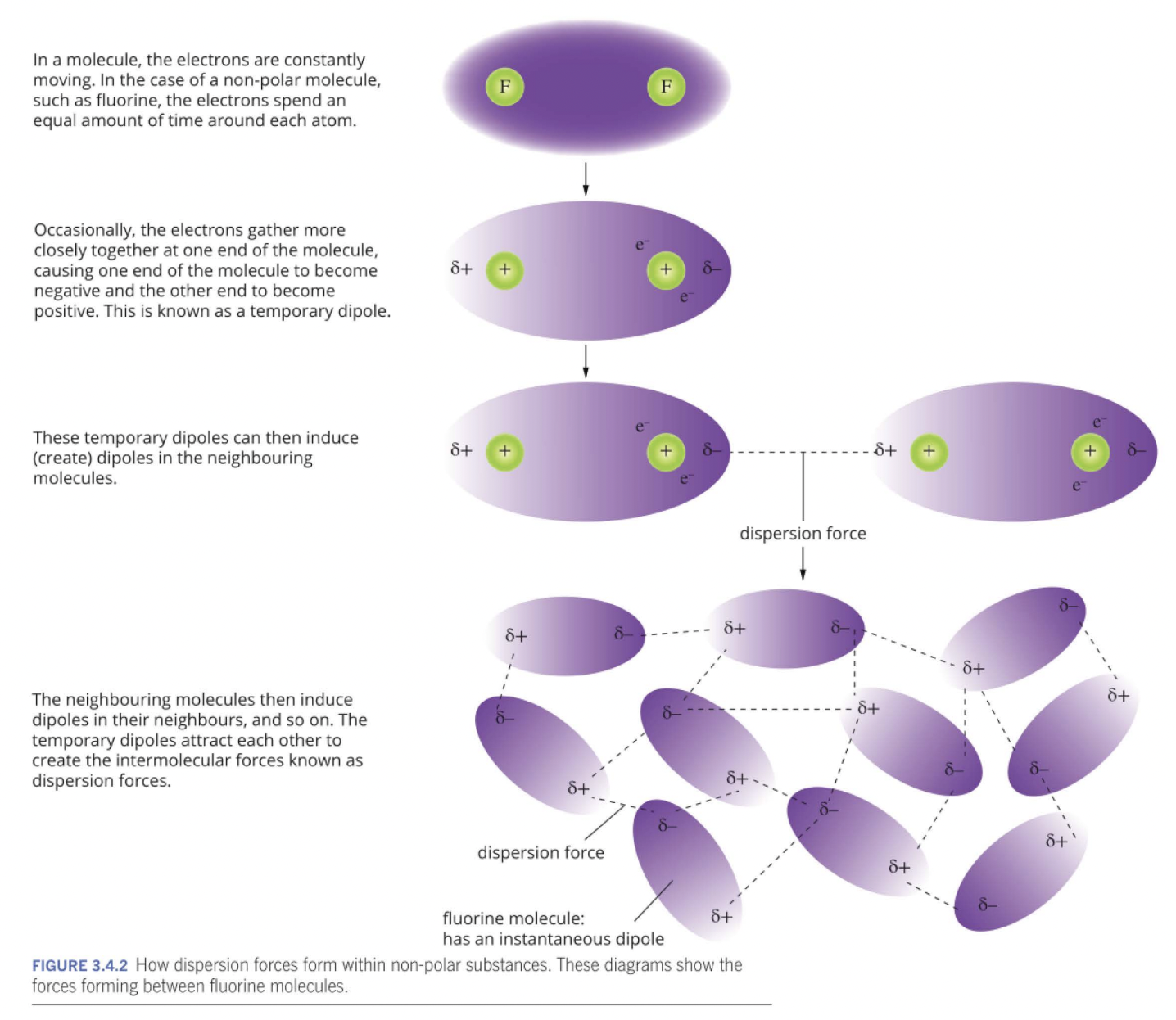
Because these dipoles are only temporary and constantly changing, dispersion forces are the weakest of the three types of intermolecular forces.
Factors affecting dispersion force strength
Molecular mass and electron count
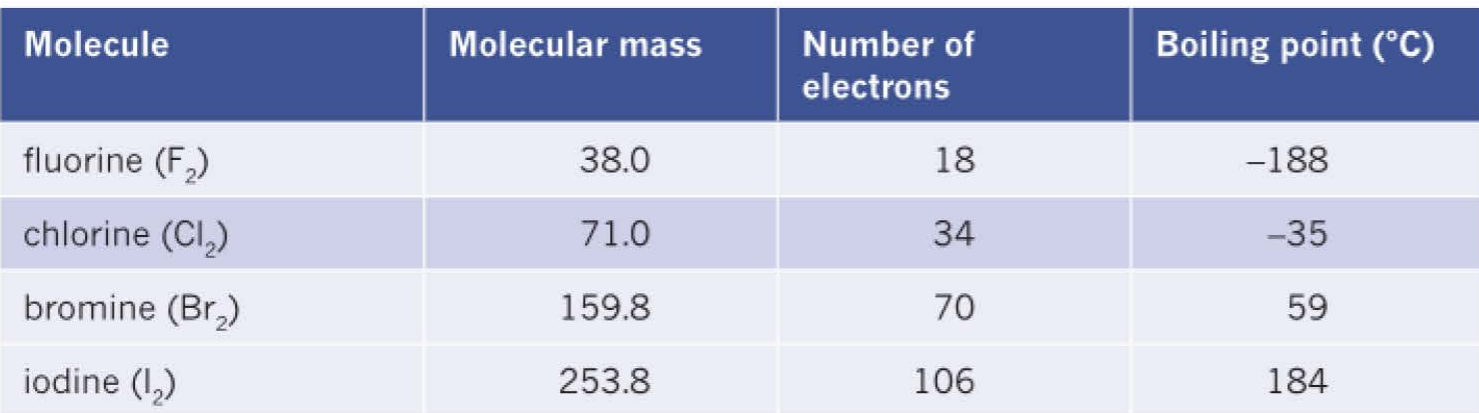
The strength of dispersion forces increases as the molecular mass increases. Larger molecules contain more electrons, making it easier for temporary dipoles to form. Substances with stronger dispersion forces have higher melting and boiling points because more energy is needed to overcome these forces.
The table below shows this trend for the halogen group. All halogens form non-polar diatomic molecules with only dispersion forces between them. As molecular mass and electron count increase down the group, boiling points rise significantly.
Example
Worked Example: Halogen Boiling Points
Looking at the halogen data in the table above:
- Fluorine (): smallest molecule, fewest electrons → weakest dispersion forces → lowest boiling point
- Chlorine (): more electrons than → stronger dispersion forces → higher boiling point
- Bromine (): even more electrons → even stronger dispersion forces → higher boiling point still
- Iodine (): largest molecule, most electrons → strongest dispersion forces → highest boiling point
This demonstrates how increasing electron count directly leads to stronger dispersion forces and higher boiling points.
Molecular shape
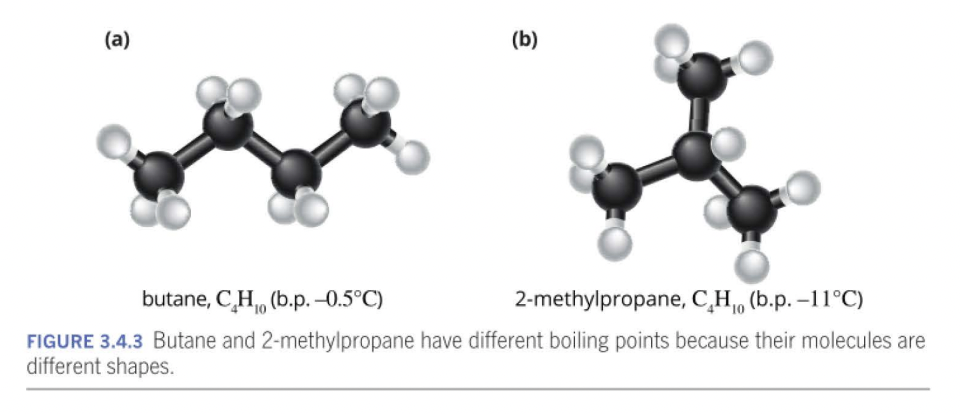
The shape of a molecule also affects dispersion force strength. Molecules with elongated, chain-like structures can form stronger dispersion forces than more compact, spherical molecules of similar molecular mass.
Consider butane () and -methylpropane (). Both have identical molecular formulas but different shapes. Butane has a linear structure while -methylpropane is branched. The linear butane molecule has a larger surface area for contact with neighbouring molecules, allowing stronger dispersion forces to form. This explains why butane has a boiling point of compared to for -methylpropane.
Note
Shape matters for dispersion forces
Linear molecules can "lie alongside" each other with greater surface contact than branched molecules. This increased contact area allows more temporary dipoles to interact simultaneously, creating stronger overall dispersion forces even when the molecular mass is identical.
Dipole-dipole attraction
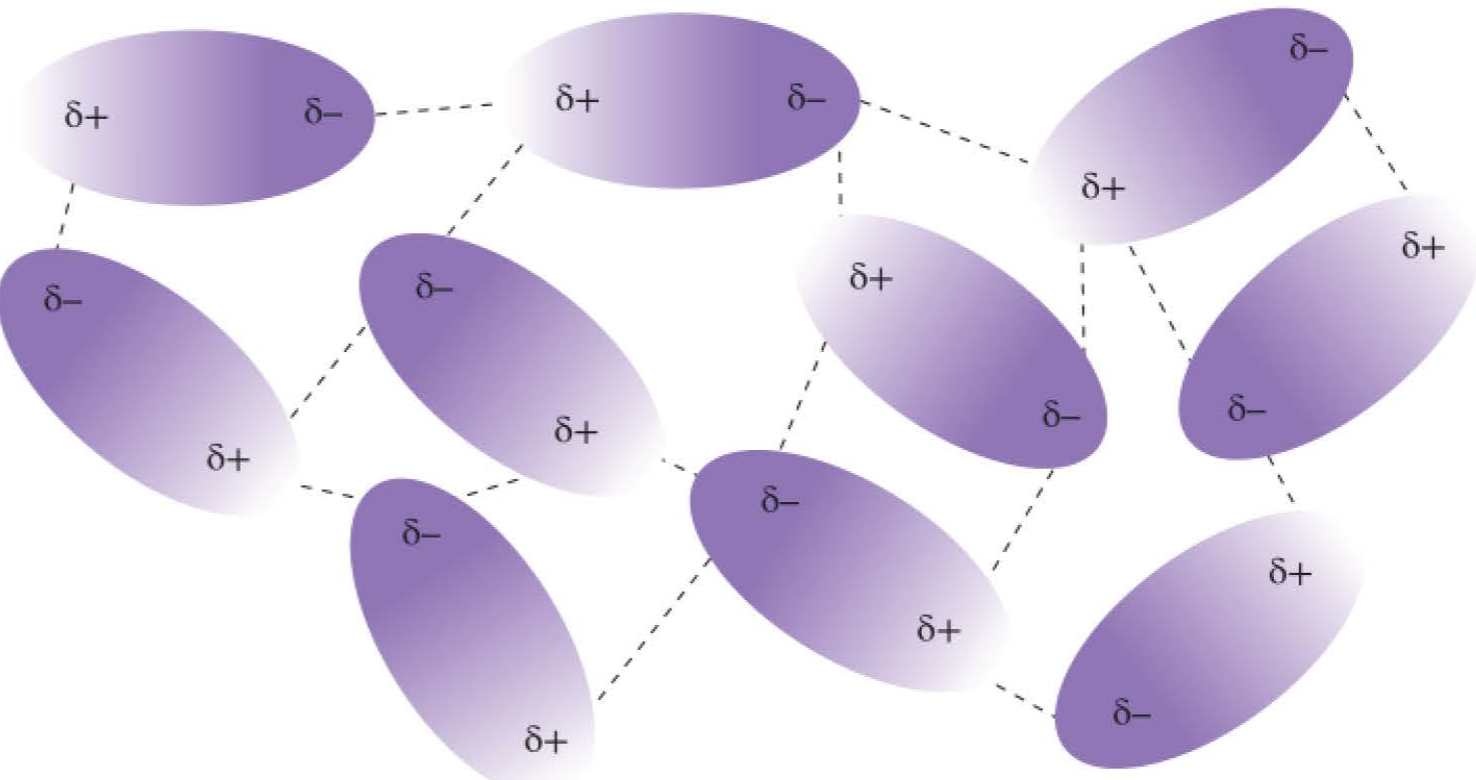
In addition to dispersion forces, polar molecules experience dipole-dipole attraction. This occurs because polar molecules have permanent charge separations - one end of the molecule is permanently slightly positive while the other end is permanently slightly negative.
These permanent dipoles cause polar molecules to align so that the positive end of one molecule attracts the negative end of a neighbouring molecule. Because these dipoles are permanent (rather than temporary), dipole-dipole attractions are stronger than dispersion forces.
Important
Dipole-dipole attraction is stronger than dispersion forces because it involves permanent (not temporary) charge separations. The dipoles don't disappear and reform randomly - they're always present in polar molecules.
Polarity and strength
The more polar a molecule is, the stronger the dipole-dipole attraction between molecules. Polarity increases when:
- There is a large difference in electronegativity between bonded atoms
- The molecule has an asymmetric shape
Substances with stronger dipole-dipole attractions have higher melting and boiling points. More energy (higher temperature) is required to overcome these stronger attractive forces when the substance changes state.
Example
Worked Example: Methanal vs Ethane
Compare methanal () with ethane ():
Methanal:
- Asymmetric molecular structure (C=O bond creates polarity)
- Polar molecule → permanent dipoles present
- Experiences dipole-dipole attraction PLUS dispersion forces
- Boiling point:
Ethane:
- Symmetric molecular structure
- Non-polar molecule → no permanent dipoles
- Only dispersion forces present
- Boiling point:
The 69.5°C difference in boiling points demonstrates how dipole-dipole attraction significantly strengthens intermolecular forces compared to dispersion forces alone.
Hydrogen bonding
Hydrogen bonding is a particularly strong type of dipole-dipole attraction. It occurs in specific circumstances and is approximately ten times stronger than regular dipole-dipole attraction (though still only about one-tenth the strength of covalent or ionic bonds).
Requirements for hydrogen bonding
For hydrogen bonding to occur, molecules must meet two specific requirements:
Important
Requirements for Hydrogen Bonding:
- A hydrogen atom must be covalently bonded to a nitrogen, oxygen, or fluorine atom
- The nitrogen, oxygen, or fluorine atoms on neighbouring molecules must have non-bonding (lone) pairs of electrons
Remember the NOF rule: only N, O, and F are small and electronegative enough to create hydrogen bonds.
These three elements (nitrogen, oxygen, and fluorine) are small and highly electronegative. When bonded to hydrogen, they strongly attract the bonding electrons, creating a large dipole. The hydrogen atom's single electron is pulled away, leaving the hydrogen nucleus (a proton) exposed. This exposed proton is strongly attracted to lone pairs of electrons on neighbouring molecules, forming the hydrogen bond.
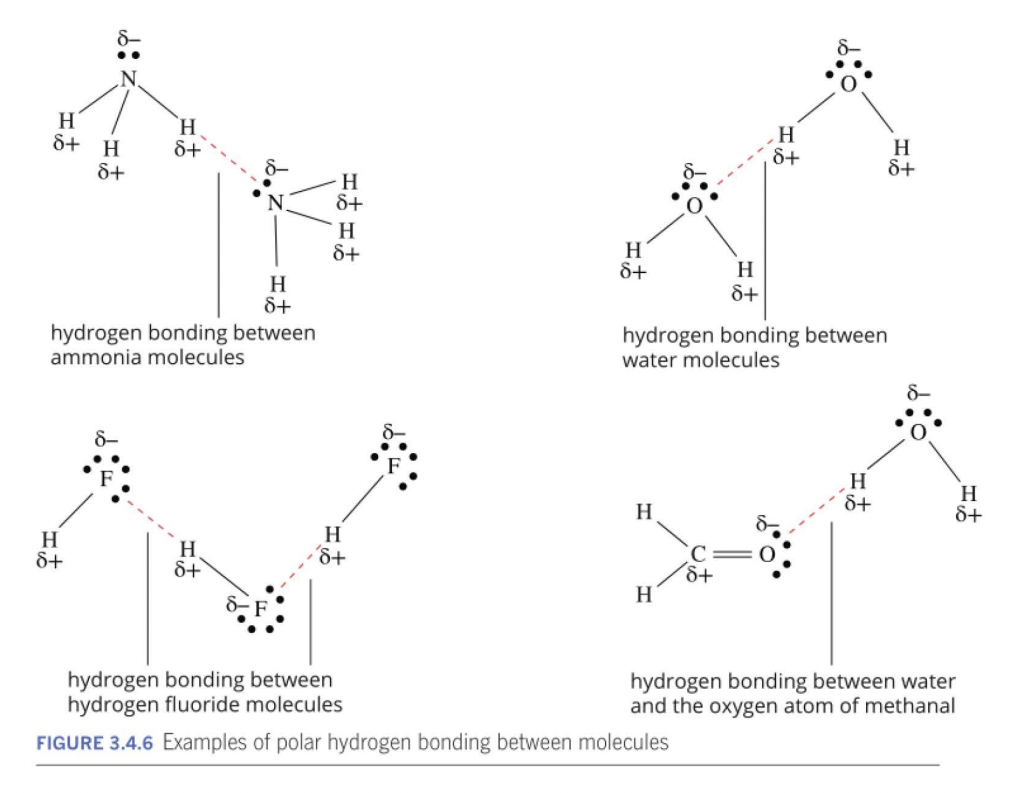
The small size of the hydrogen atom allows neighbouring molecules to approach very closely, making the attractive force relatively strong.
Why other atoms don't form hydrogen bonds
You might wonder why other electronegative atoms like chlorine don't form hydrogen bonds. Although chlorine has high electronegativity, chlorine atoms are larger than nitrogen, oxygen, and fluorine. The electron density is more spread out and less concentrated, resulting in weaker attraction to hydrogen atoms on neighbouring molecules - not strong enough to be classified as hydrogen bonding.
Note
Why chlorine doesn't form hydrogen bonds
Despite being highly electronegative, chlorine atoms are too large. The lone pair electrons are farther from the nucleus and more spread out, making the attraction to hydrogen atoms on neighbouring molecules too weak to qualify as true hydrogen bonding.
Effect on physical properties
Hydrogen bonding significantly increases melting and boiling points.
Example
Worked Example: Methanol, Methanal, and Ethane Comparison
Compare methanol (), methanal (), and ethane ():
Ethane ():
- Non-polar molecule
- Only dispersion forces present
- Boiling point:
Methanal ():
- Polar molecule
- Dipole-dipole attraction + dispersion forces
- No hydrogen bonding (no O-H bond)
- Boiling point:
Methanol ():
- Polar molecule with O-H bond
- Hydrogen bonding + dipole-dipole attraction + dispersion forces
- Boiling point:
The dramatic jump from to (a difference of 83.7°C) when hydrogen bonding is present demonstrates the exceptional strength of hydrogen bonds compared to other intermolecular forces.
Molecular size and intermolecular forces
An important principle to remember is that dispersion forces exist between all molecules - both polar and non-polar. In substances with large molecular masses, dispersion forces can become very strong and may even exceed the strength of dipole-dipole attraction or hydrogen bonding.
Important
Dispersion forces in large molecules can dominate
When molecules are very large, the dispersion forces can become so strong that they outweigh the effects of molecular polarity. This means a larger, less polar molecule can sometimes have a higher boiling point than a smaller, more polar molecule.
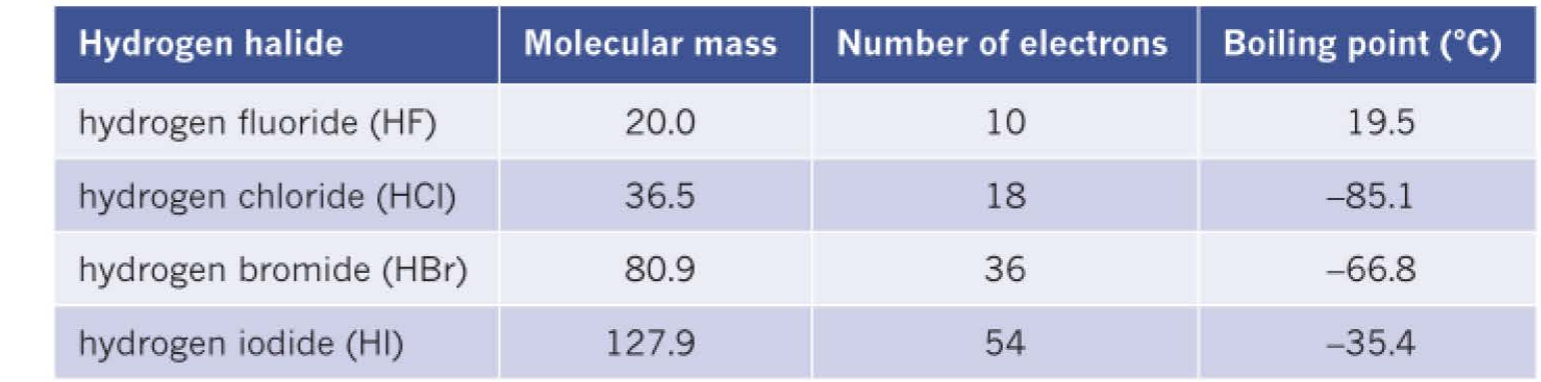
The table below compares four hydrogen halides. All except hydrogen fluoride follow an expected trend: as molecular mass increases, boiling point increases due to stronger dispersion forces. Hydrogen chloride is more polar than hydrogen iodide, but hydrogen iodide has the higher boiling point because its larger molecular mass creates stronger dispersion forces that outweigh the polarity effect.
Example
Worked Example: Hydrogen Halide Comparison
Comparing the hydrogen halides:
HCl, HBr, and HI (excluding HF):
- All are polar molecules
- HCl is the most polar (largest electronegativity difference)
- Yet HI has the highest boiling point among these three
- Why? HI has the largest molecular mass and most electrons
- The stronger dispersion forces in HI overcome its lower polarity
HF (hydrogen fluoride):
- Much smaller molecular mass than HI
- Much weaker dispersion forces than HI
- But has the highest boiling point overall at
- Reason: Hydrogen bonding between HF molecules is much stronger than either the dispersion forces or dipole-dipole attraction in the other hydrogen halides
This example perfectly demonstrates that while dispersion forces can dominate in large molecules, hydrogen bonding trumps them all.
Summary
Key Points to Remember:
-
Intermolecular forces are much weaker than covalent bonds - they are the forces between molecules, not within them
-
All molecules have dispersion forces - these are the weakest intermolecular forces, caused by temporary dipoles from electron movement
-
Dispersion force strength increases with molecular size and elongated shape - more electrons and greater surface contact area lead to stronger forces
-
Polar molecules also experience dipole-dipole attraction - permanent charge separation creates stronger forces than dispersion alone
-
Hydrogen bonding is the strongest intermolecular force - it requires H bonded to N, O, or F, plus lone pairs on neighbouring molecules
-
In large molecules, dispersion forces can dominate - even if a substance is more polar, a larger molecular mass can result in stronger overall intermolecular forces
-
Strength order: Dispersion forces < Dipole-dipole attraction < Hydrogen bonding < Covalent/Ionic bonds