Shapes of Molecules (VCE SSCE Chemistry): Revision Notes
📚Revision Notes
Shapes of Molecules
Introduction to molecular shapes
The shape of a molecule plays a crucial role in determining its physical properties. Properties such as melting point, boiling point, hardness, and solubility are all influenced by molecular shape. This is because the shape determines how molecules interact with each other.
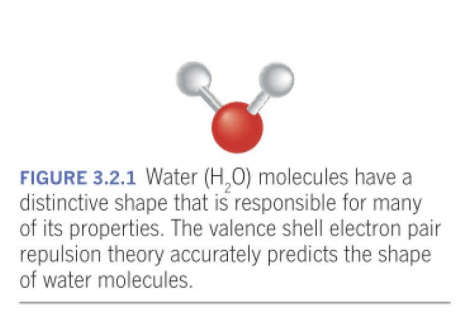
For small molecules, we can predict their shapes using a relatively simple model called valence shell electron pair repulsion (VSEPR) theory. This theory allows us to predict the three-dimensional arrangement of atoms in molecules.
Valence shell electron pair repulsion (VSEPR) theory
Lewis structures show us how valence electrons are arranged in a molecule. VSEPR theory uses this information to predict molecular shape. The theory is based on a simple principle: negatively charged electron groups around an atom repel each other and arrange themselves as far apart as possible.
Important
The fundamental principle of VSEPR theory is that electron groups repel each other because they are all negatively charged. To minimize this repulsion, they spread out as much as possible in three-dimensional space.
What are electron groups?
Valence electrons around an atom can be organized into electron groups. An electron group can be:
- A covalent bond (single, double, or triple)
- A non-bonding pair of electrons (also called a lone pair)
Note
In VSEPR theory, all electron groups are treated equally when determining their spatial arrangement, regardless of whether they form bonds or remain as lone pairs. However, double and triple bonds count as one electron group, just like single bonds.
The key idea is that these electron groups repel each other because they are all negatively charged. To minimize repulsion, they spread out as much as possible.
Molecules with four electron groups
The octet rule and electron arrangement
Most atoms in covalent molecules follow the octet rule—they are most stable with eight electrons in their valence shell. These eight electrons are arranged into four pairs of electrons.
Methane: tetrahedral shape
Let's look at methane () as our first example.
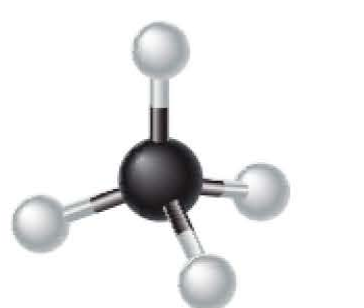
In methane, the central carbon atom shares one pair of electrons with each of the four hydrogen atoms, forming four single covalent bonds. Each bond is an electron group. According to VSEPR theory, these four electron groups repel each other and arrange themselves as far apart as possible. This results in a tetrahedral shape, where the bond angles are approximately .
Non-bonding pairs of electrons
Non-bonding pairs of electrons (also called lone pairs) are also considered electron groups in VSEPR theory. They influence the shape of a molecule but are not considered part of the molecular shape itself—the shape is defined only by the positions of the atoms.
Important
When determining molecular shape, remember that only the positions of atoms define the shape, not the positions of lone pairs. However, lone pairs still affect the overall arrangement of electron groups and therefore influence bond angles.
Ammonia: pyramidal shape
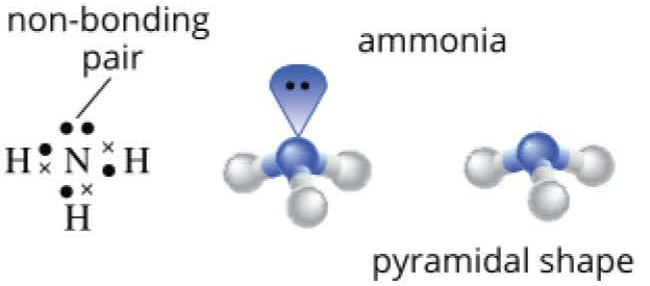
In an ammonia molecule (), the nitrogen atom has:
- Three single bonds to hydrogen atoms
- One non-bonding pair of electrons
These four electron groups repel each other to form a tetrahedral arrangement. However, since only three of these groups are bonds (and therefore connect to atoms), the molecular shape is pyramidal. The three hydrogen atoms form a triangular base, with the nitrogen atom at the apex of the pyramid.
Water: bent shape
In a water molecule (), the oxygen atom has:
- Two single bonds to hydrogen atoms
- Two non-bonding pairs of electrons
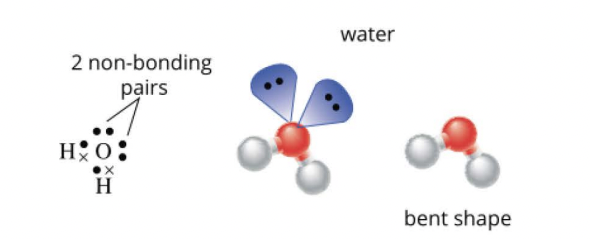
Again, the four electron groups repel each other to form a tetrahedral arrangement. But with only two bonds to atoms, the molecular shape is bent (or V-shaped). The two hydrogen atoms and the oxygen atom do not form a straight line.
Hydrogen fluoride: linear shape
In a hydrogen fluoride molecule (), the fluorine atom has:
- One single bond to a hydrogen atom
- Three non-bonding pairs of electrons
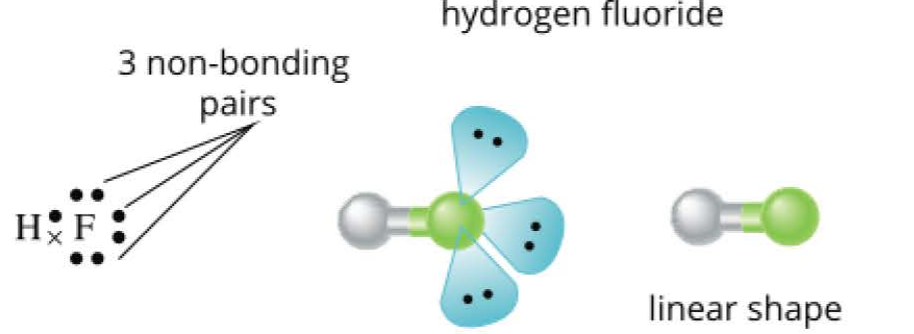
The four electron groups still arrange themselves in a tetrahedral pattern. However, since there is only one bond, the molecule consists of just two atoms and is therefore linear.
Note
Notice the pattern: as the number of bonding pairs decreases and lone pairs increase, the molecular shape changes even though all these molecules have four electron groups arranged tetrahedrally:
- 4 bonding pairs, 0 lone pairs = tetrahedral
- 3 bonding pairs, 1 lone pair = pyramidal
- 2 bonding pairs, 2 lone pairs = bent
- 1 bonding pair, 3 lone pairs = linear
Worked example: predicting molecular shape
Let's work through an example to see how to predict molecular shape using VSEPR theory.
Example
Worked Example: Predicting the Shape of Phosphine
Question: Predict the shape of a phosphine molecule ().
Solution:
Step 1: Draw the Lewis structure The phosphorus atom has three single bonds to hydrogen atoms and one non-bonding pair of electrons.
Step 2: Count the electron groups There are four electron groups (three single bonds and one non-bonding pair).
Step 3: Determine the electron arrangement Because there are four electron groups, they will be arranged in a tetrahedral arrangement to minimize repulsion.
Step 4: Deduce the molecular shape Only the positions of the atoms matter for the molecular shape. The phosphorus and three hydrogen atoms are arranged in a pyramidal shape (similar to ammonia).
Molecules with fewer than four electron groups
When a central atom forms double or triple covalent bonds, it tends to have fewer than four electron groups. In VSEPR theory, double and triple bonds are each treated as one electron group, just like single bonds and lone pairs.
Trigonal planar shape
If a central atom has three electron groups, they will repel each other to achieve maximum separation. This results in a trigonal planar shape, where the atoms form a triangle in one flat plane, with bond angles of approximately .
Example
Worked Example: Methanal ()
In methanal (also called formaldehyde), the central carbon atom forms:
- One double bond with an oxygen atom (counts as one electron group)
- Two single bonds with hydrogen atoms (each counts as one electron group)
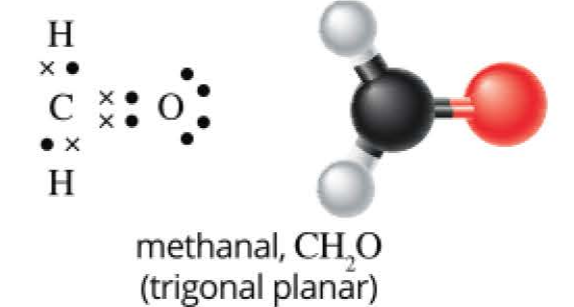
The three electron groups repel each other, forming a trigonal planar arrangement. All four atoms lie in the same plane.
Linear shape with two electron groups
If a central atom has only two electron groups, they will repel each other to be as far apart as possible. This results in a linear shape, with a bond angle of .
Example 1: Carbon dioxide ()
In carbon dioxide, the central carbon atom forms:
- Two double bonds with oxygen atoms (each counts as one electron group)

The two electron groups repel each other, resulting in a linear molecule. All three atoms lie in a straight line.
Example 2: Hydrogen cyanide ()
In hydrogen cyanide, the central carbon atom forms:
- One triple bond with a nitrogen atom (counts as one electron group)
- One single bond with a hydrogen atom (counts as one electron group)
The molecule also has two electron groups and is therefore linear.
Octahedral shape: sulfur hexafluoride
Some molecules can have more than four electron groups. Sulfur hexafluoride () is an example where the central sulfur atom has six valence electrons and forms single bonds to six fluorine atoms.
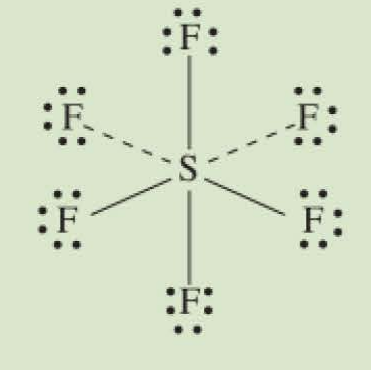
The six electron groups repel each other to form an octahedral shape. Sulfur hexafluoride is a dense gas used as an insulator in high-voltage equipment. As a greenhouse gas, it is 23,900 times more potent than carbon dioxide, so its use is highly regulated.
Important
Sulfur hexafluoride demonstrates that VSEPR theory can be extended beyond four electron groups. With six electron groups, the octahedral arrangement provides maximum separation between all electron groups.
Structural formulas
Lewis structures are useful for showing how electrons are arranged, but they don't always clearly show the three-dimensional shape of a molecule. After using VSEPR theory to determine a molecule's shape, we can represent it using a structural formula.
Note
In a structural formula:
- Each bonding pair of electrons is shown as a line (—, =, or ≡ for single, double, or triple bonds)
- Non-bonding electrons are not shown
- The arrangement of atoms reflects the molecular shape
Example: Nitrogen trifluoride ()
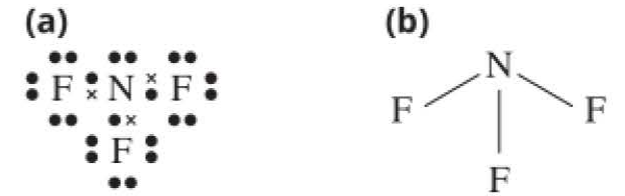
Figure (a) shows the Lewis structure with all electron pairs. Figure (b) shows the structural formula, which clearly represents the pyramidal shape without showing the lone pair on nitrogen.
Summary
Key Points to Remember:
-
VSEPR theory predicts molecular shape based on the principle that electron groups repel each other and arrange themselves as far apart as possible.
-
An electron group can be a covalent bond (single, double, or triple) or a non-bonding pair of electrons.
-
Four electron groups arrange in a tetrahedral pattern. The molecular shape depends on how many are bonds:
- 4 bonds = tetrahedral
- 3 bonds + 1 lone pair = pyramidal
- 2 bonds + 2 lone pairs = bent
- 1 bond + 3 lone pairs = linear
-
Double and triple bonds count as one electron group when using VSEPR theory.
-
Three electron groups give a trigonal planar shape ( bond angles), and two electron groups give a linear shape ( bond angle).
-
Non-bonding pairs influence the molecular shape but are not considered part of the shape itself—only the positions of atoms define the shape.