Galvanic Cells (VCE SSCE Chemistry): Revision Notes
📚Revision Notes
Galvanic Cells
Introduction to galvanic cells
Modern portable devices including smartphones, laptops, cameras, and hearing aids require small, portable sources of electricity. These power sources come in the form of cells and batteries, which provide the convenience of operating electrical equipment without needing to be connected to mains power.

The demand for electronic devices has driven the development of many different types of cells. These range from tiny button cells in watches and calculators to large batteries that power lighthouses. While the energy from cells and batteries may cost more than energy from other sources like fossil fuels, the convenience they provide makes them invaluable.
Note
Cells and batteries have become indispensable in modern life, powering everything from medical devices like hearing aids and pacemakers to communication devices and portable computing equipment. The development of increasingly efficient and compact cell designs continues to be a major area of research in electrochemistry.
Galvanic cells (also called voltaic cells) are electrochemical devices that convert chemical energy directly into electrical energy. An electrochemical cell is any device where chemical energy and electrical energy can be interconverted.
Historical development of galvanic cells
Galvani's discovery
Electrochemistry originated in 1791 when Italian biologist Luigi Galvani and his assistant made an unexpected observation. While experimenting with dissected frogs, they noticed a frog's leg hanging on a copper hook would twitch when it touched an iron rail. The frog's muscles were responding to an electric shock. Galvani had discovered how to generate electrical current, though he incorrectly believed it was a type of biological "life force."
Volta's voltaic pile
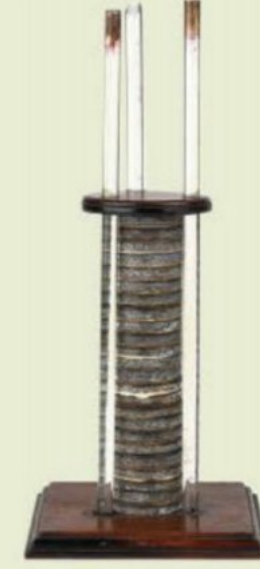
Other scientists investigated whether metals were truly involved in generating electricity. After years of research, Alessandro Volta developed a device in 1800 that used chemical reactions to produce electric current.
Note
The First Battery
Volta's device, now called the voltaic pile, consisted of alternating copper and zinc discs separated by cardboard soaked in salt water. This was the first true battery, marking the beginning of practical electrochemistry. Its invention quickly led to important discoveries, including the use of electricity to decompose compounds into their elements through a process called electrolysis.
Scientists used this technique to isolate elements including hydrogen, oxygen, sodium, potassium, calcium, boron, barium, strontium, and magnesium.
In the voltaic pile, electricity is produced through a redox reaction involving zinc metal, water, and dissolved oxygen gas. The reaction produces and ions.
The Daniell cell: A classic example
Structure and operation
The Daniell cell, invented by English chemist John Daniell in 1836, provides an excellent example of how galvanic cells work. This cell produces an electric current that flows through an external circuit (the wire and connected device).
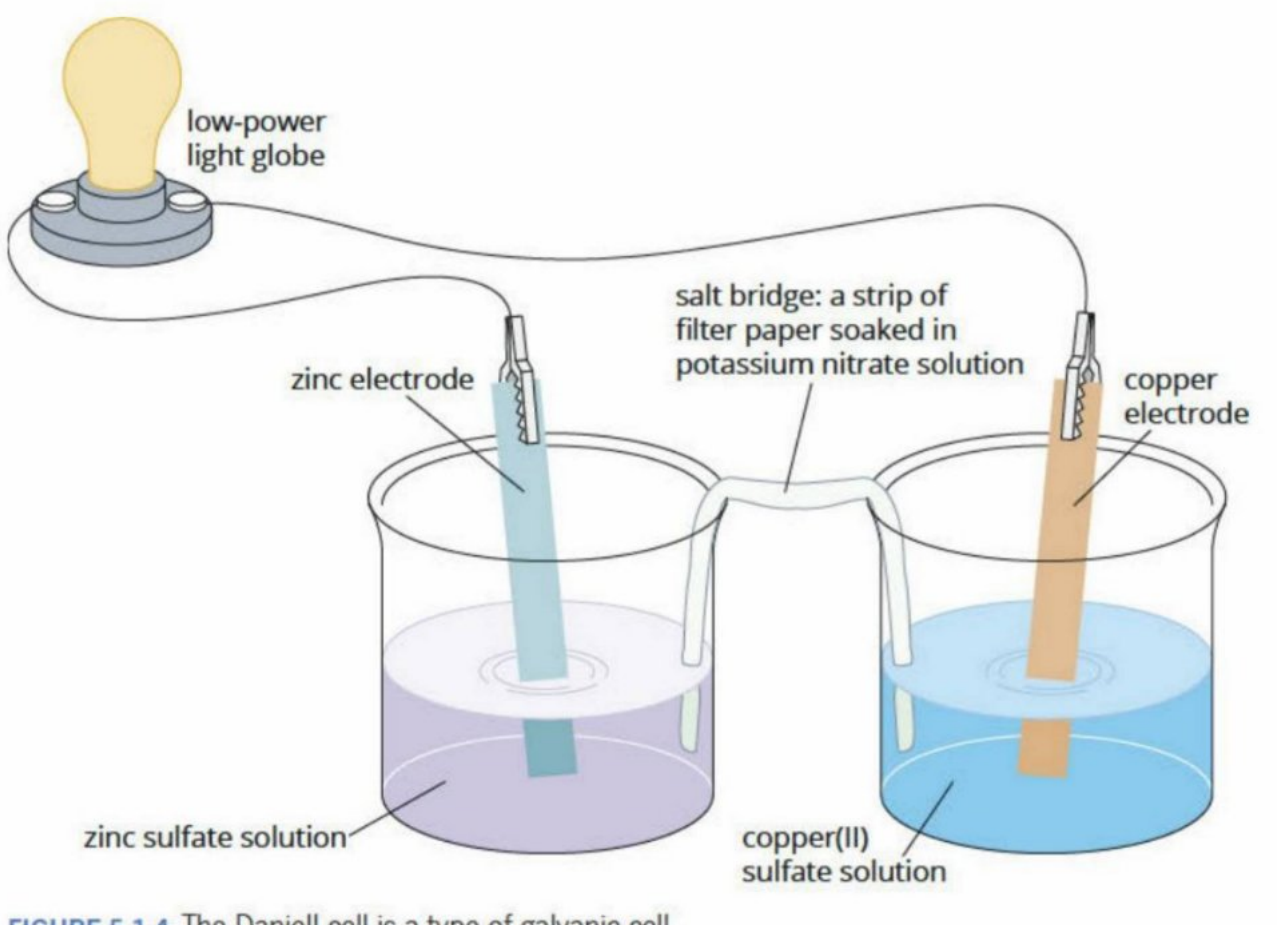
When the cell operates for several hours with a light bulb connected, visible changes occur:
- The zinc metal corrodes
- The copper metal develops a dark-brown coating
- The blue copper(II) sulfate solution fades in colour
Replacing the light bulb with a galvanometer (a device that detects electric current) reveals that electrons flow from the zinc electrode through the wire to the copper electrode. Importantly, current only flows when the two halves of the cell are connected by a salt bridge, typically made from filter paper soaked in an unreactive electrolyte solution such as potassium nitrate.
Reactions in the Daniell cell
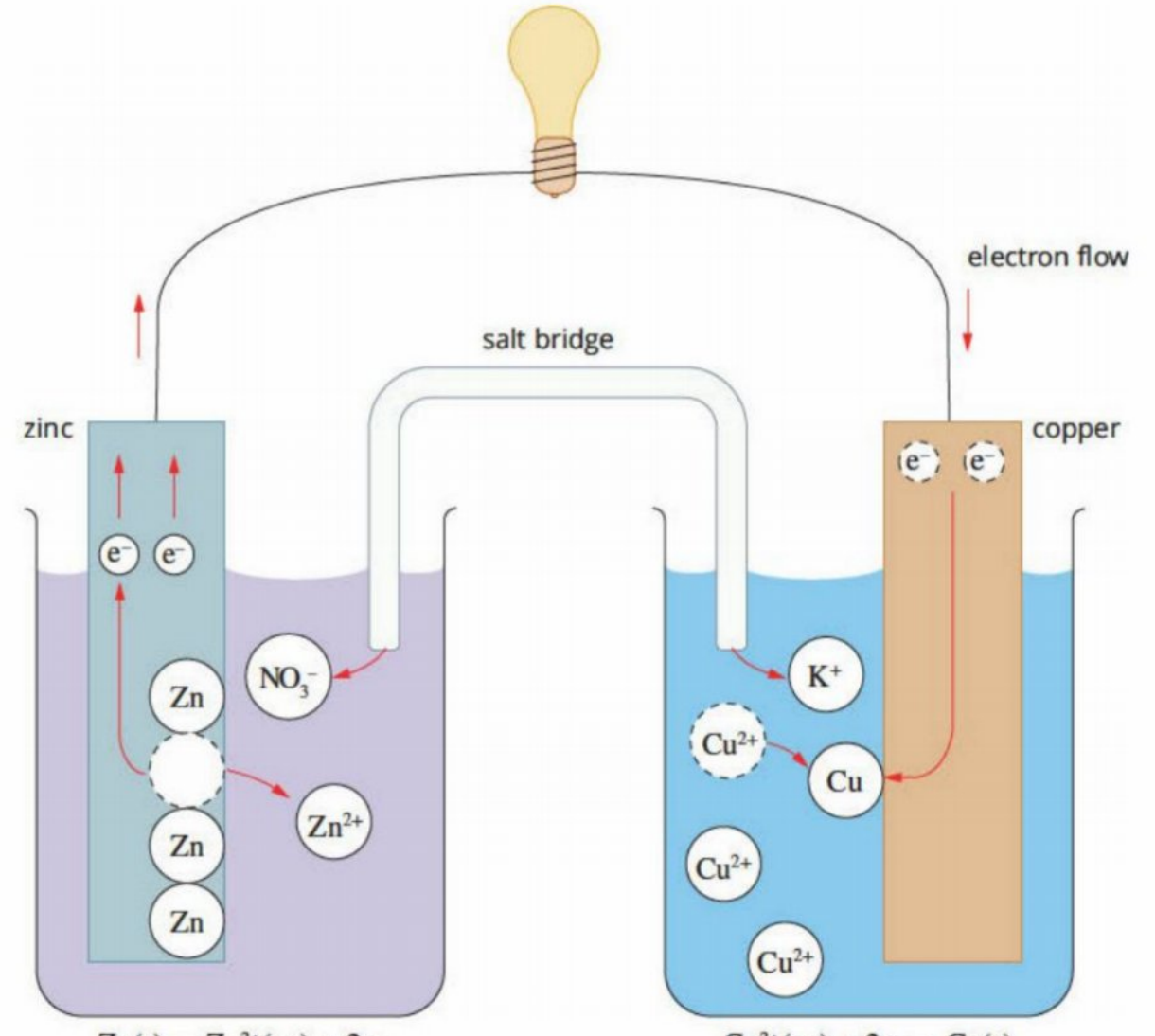
The observations from the Daniell cell reveal several key processes:
Example
Understanding the Daniell Cell Reactions
-
Oxidation at the zinc electrode: Zinc metal loses electrons and forms zinc ions in solution:
-
Electron flow: The electrons released from zinc travel through the external wire to the copper electrode.
-
Reduction at the copper electrode: Copper(II) ions in solution gain electrons when they collide with the copper electrode:
-
Copper deposition: The formed copper metal deposits on the electrode as a dark-brown coating.
The overall reaction combines both half-equations:
This is a spontaneous reaction because it occurs naturally without needing external energy to drive it. In this reaction, copper(II) ions act as the oxidising agent (or oxidant), while zinc metal acts as the reducing agent (or reductant).
Important
Key Terminology:
- An oxidising agent causes another substance to be oxidised (it accepts electrons and is itself reduced)
- A reducing agent causes another substance to be reduced (it donates electrons and is itself oxidised)
Remember: The oxidising agent is reduced, and the reducing agent is oxidised!
The Daniell cell's historical significance
The Daniell cell was a major advance in battery technology as it provided the first reliable source of electric current. It was used almost exclusively to power early telegraph systems in England and the United States. The original design used a copper cylinder with an ox gullet (oesophagus) hanging inside containing a zinc rod. The cylinder was filled with sulfuric acid solution saturated with copper sulfate, while the ox gullet contained sulfuric acid solution. The organic membrane acted as a separator, allowing ion passage.
Energy transformations in galvanic cells
Galvanic cells versus direct reactions
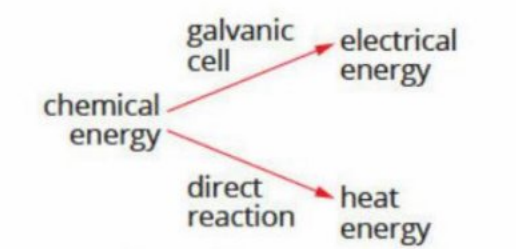
When copper(II) ions react directly with zinc metal (such as when zinc is immersed in copper sulfate solution), the same overall reaction occurs:
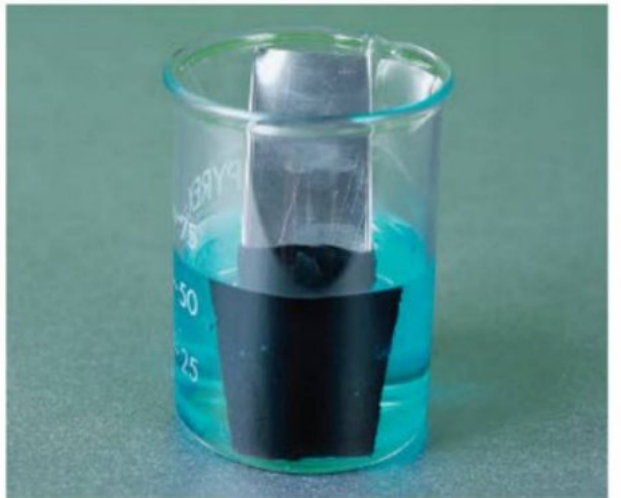
However, in this direct reaction, the chemical energy transforms directly into thermal energy, which escapes as heat into the surroundings. This is an example of a spontaneous exothermic reaction.
In contrast, a galvanic cell separates the oxidation and reduction reactions into different compartments. The electrons must travel through an external circuit, so the chemical energy converts into electrical energy instead of heat.
Important
The Key Advantage of Galvanic Cells
Galvanic cells harness chemical energy in a useful form (electricity) rather than losing it as heat. By physically separating the oxidation and reduction reactions, the cell forces electrons to travel through an external circuit, where they can perform useful work before completing the circuit.
Components of galvanic cells
Half-cells and conjugate redox pairs
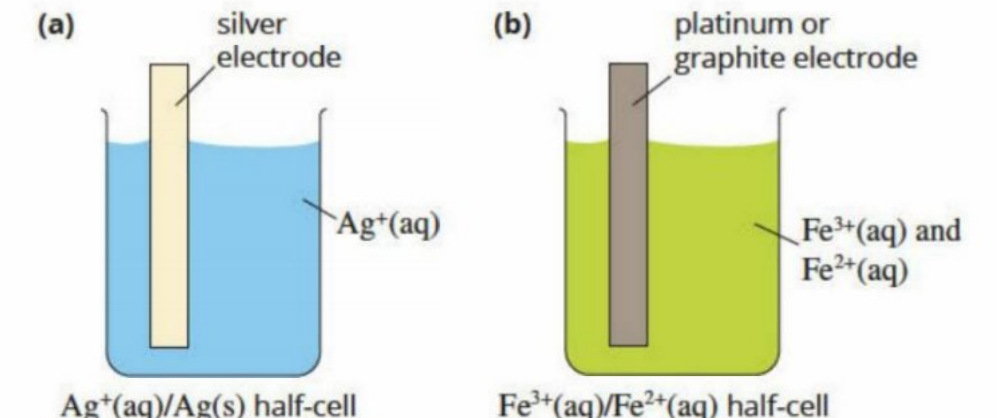
A galvanic cell consists of two half-cells, each containing an electrode in contact with a solution. In the Daniell cell, one half-cell contains and , while the other contains and .
The species present in each half-cell form a conjugate redox pair - an oxidising agent paired with its corresponding reduced form.
Types of electrodes
Metal electrodes: When one member of the conjugate pair is a metal, that metal typically serves as the electrode itself. For example, in the zinc half-cell, the zinc metal acts as both a reactant and the electrode.
Inert electrodes: Some redox pairs, such as and , don't involve solid metals. In these cases, an unreactive electrode made of platinum or graphite is used. While platinum is more chemically inert, graphite is commonly used in educational settings due to lower cost.
Gas electrodes: When one member of the conjugate pair is a gas, a special electrode setup is required.
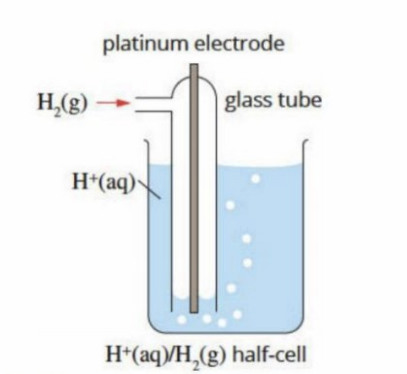
For example, in an half-cell, hydrogen gas bubbles through the solution and contacts a platinum electrode.
Anode and cathode
Understanding electrode terminology is essential:
Important
Critical Definitions:
-
The anode is where oxidation occurs. In a galvanic cell, the anode is the negative terminal because electrons are released here.
-
The cathode is where reduction occurs. In a galvanic cell, the cathode is the positive terminal because electrons are consumed here.
Note
Helpful Mnemonic: "An Ox, Red Cat"
- Anode Oxidation
- Reduction Cathode
Another useful memory aid: "LEO says GER"
- Loss of Electrons is Oxidation
- Gain of Electrons is Reduction
The salt bridge
The salt bridge serves a critical function in galvanic cells. It contains mobile ions that balance charges developing in the two compartments as reactions proceed.
- Cations (positive ions) in the salt bridge move toward the cathode
- Anions (negative ions) in the salt bridge move toward the anode
Without a salt bridge, one compartment would accumulate excessive negative charge while the other accumulated positive charge. This charge buildup would quickly stop the reaction. The salt bridge forms part of the internal circuit of the galvanic cell.
Note
Ion Movement Pattern
Remember: Cations move to the Cathode, and Anions move to the Anode. The salt bridge completes the circuit by allowing this ion flow, which maintains electrical neutrality in both half-cells.
Writing equations for galvanic cells
Half-cell equations
When a conjugate redox pair consists of an element and its corresponding ion, writing the half-equation is straightforward. For instance, for the reduction of zinc ions:
Half-cell equations involving polyatomic ions can be more complex. For example, the reduction of dichromate ions:
Overall equations
The half-equations for oxidation and reduction can be combined to give an overall equation. In balanced overall equations:
Important
Balancing Requirements:
- The number of atoms of each element is equal on both sides
- The total charge is equal on both sides
- No electrons appear (they cancel out)
The number of electrons lost in oxidation must equal the number gained in reduction. You may need to multiply one or both half-equations by appropriate factors before adding them together.
Drawing and labeling galvanic cell diagrams
Identifying components from the cell reaction
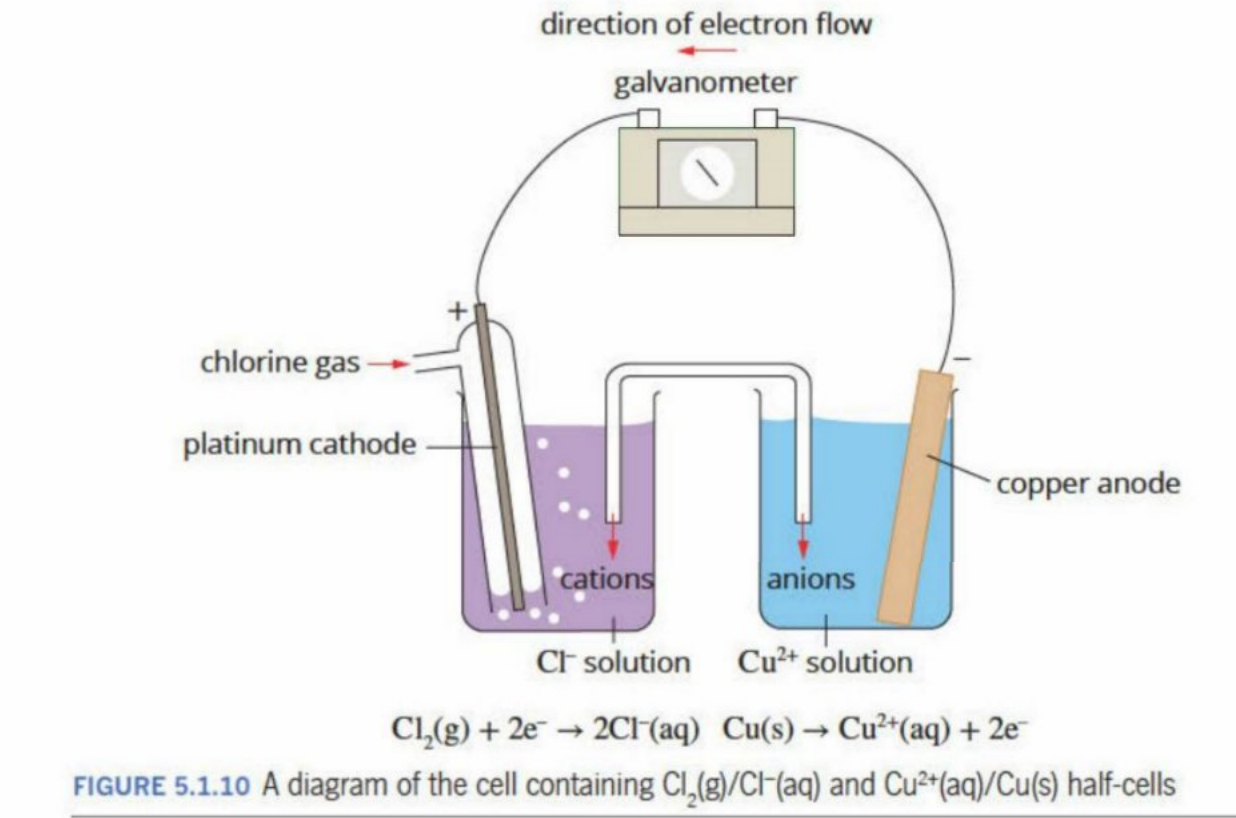
When given an overall cell reaction, you can identify and draw all cell components systematically. Consider this example:
From this equation:
- Copper metal is at the anode (copper is oxidised)
- Chlorine gas is present at the cathode (chlorine is reduced)
General rules for all galvanic cells
When drawing any galvanic cell diagram:
- Electrons flow through the external circuit from anode (negative) to cathode (positive)
- Anions flow in the internal circuit toward the anode
- Cations flow toward the cathode
- The oxidation half-equation is written at the anode
- The reduction half-equation is written at the cathode
Worked example approach
Example
Worked Example: Drawing a Galvanic Cell
Consider a cell with this reaction:
Step 1: Identify the half-equations
- Reduction:
- Oxidation:
Step 2: Identify anode and cathode
- The zinc electrode is the anode (oxidation occurs here)
- The lead electrode is the cathode (reduction occurs here)
Step 3: Determine polarities and electron flow
- The anode is negative (−)
- The cathode is positive (+)
- Electrons flow from zinc (anode) to lead (cathode) through the external circuit
Step 4: Show ion movement
- Anions in the salt bridge move toward the anode
- Cations in the salt bridge move toward the cathode
Primary cells
Types of galvanic cells
Galvanic cells fall into two categories:
Primary cells are designed to be disposable and cannot be recharged. These are often called non-rechargeable cells. They "go flat" when the cell reaction reaches equilibrium (when there's no tendency for reactants and products to change). In primary cells, the products migrate away from the electrodes or are consumed by side reactions, preventing recharging.
Secondary cells are rechargeable and designed for multiple uses. These will be covered in later study.
Applications of primary cells
Note
Common Applications of Primary Cells
Primary cells are widely used in both fixed and portable applications:
Fixed systems:
- Solar energy storage
- Burglar alarms
- Smoke detectors
Portable devices:
- Mobile phones
- Watches
- Digital cameras
- Laptop computers
- Torches
- Remote controls
- Motorised toys
The alkaline cell
The alkaline cell was developed in the late 1960s to meet growing demand for small, high-capacity power sources for portable devices.
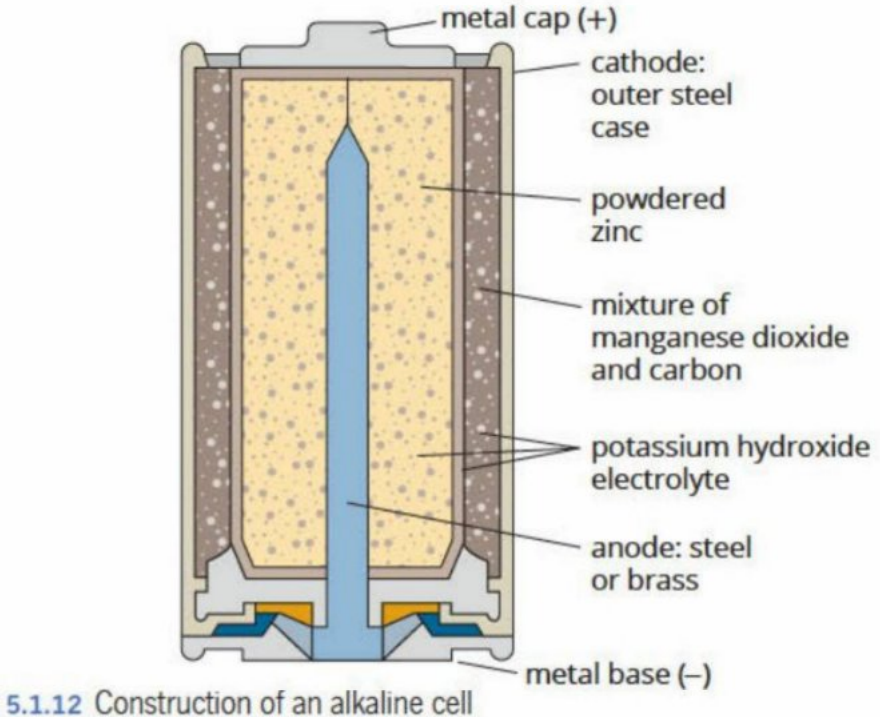
Structure: The alkaline cell is similar to simple laboratory galvanic cells but designed so both half-reactions occur in separate locations within one container. A potassium hydroxide electrolyte performs the same function as a salt bridge in simple cells.
Performance: Alkaline cells typically produce about 1.5 V. They are especially cost-effective for applications requiring high currents intermittently, such as torches and motorised toys.
Limitations: Once the reactants are consumed, the cell is "flat" and cannot be reused. This is characteristic of all primary cells.
Historical application: The Overland Telegraph
Note
The Overland Telegraph
Early primary cells called Leclanché cells had similar reactions to modern alkaline cells. These cells powered the Australian Overland Telegraph Line, completed in 1872. This 3200 km line connected Port Augusta in South Australia with Darwin in the Northern Territory, and then via undersea cable to the rest of the world. This was one of 19th-century Australia's great engineering achievements.
Summary
Summary
Key Points to Remember:
-
Galvanic cells convert chemical energy into electrical energy through spontaneous redox reactions
-
Oxidation occurs at the anode (negative terminal), releasing electrons that flow through the external circuit
-
Reduction occurs at the cathode (positive terminal), where electrons are consumed
-
The salt bridge allows ion movement to complete the internal circuit and maintain electrical neutrality
-
Half-cells contain conjugate redox pairs (an oxidising agent and its reduced form)
-
Primary cells are disposable and cannot be recharged, while secondary cells are rechargeable
-
Remember the mnemonic: "An Ox, Red Cat" (Anode Oxidation, Reduction Cathode)
-
Electrons flow from the anode to the cathode through the external circuit, while ions move through the salt bridge in the internal circuit