The Electrochemical Series (VCE SSCE Chemistry): Revision Notes
📚Revision Notes
The Electrochemical Series
Understanding metal reactivity
Metals have different levels of reactivity. Some metals like platinum and gold barely react at all, which is why they're perfect for jewellery. Other metals are extremely reactive. For instance, sodium reacts so vigorously with oxygen and water that it must be stored in paraffin oil to prevent reactions.
Galvanic cells help us compare the reactivity of different metals. By constructing galvanic cells from various combinations of half-cells and measuring their behaviour, chemists can determine how strongly different substances oxidise or reduce other substances. This information is incredibly useful because it allows us to predict what will happen in chemical reactions, calculate the voltage that cells will produce, and design more powerful, longer-lasting batteries.
Relative oxidising and reducing strengths
Understanding half-cells and redox pairs
Each half-cell contains a conjugate redox pair - two forms of the same element or compound that differ by electrons. The reactions in a half-cell can be written as reversible equations showing the relationship between the oxidised and reduced forms.
For example:
- The redox pair:
- The redox pair:
Example: Comparing zinc and hydrogen
Let's examine a galvanic cell made from hydrogen and zinc half-cells:
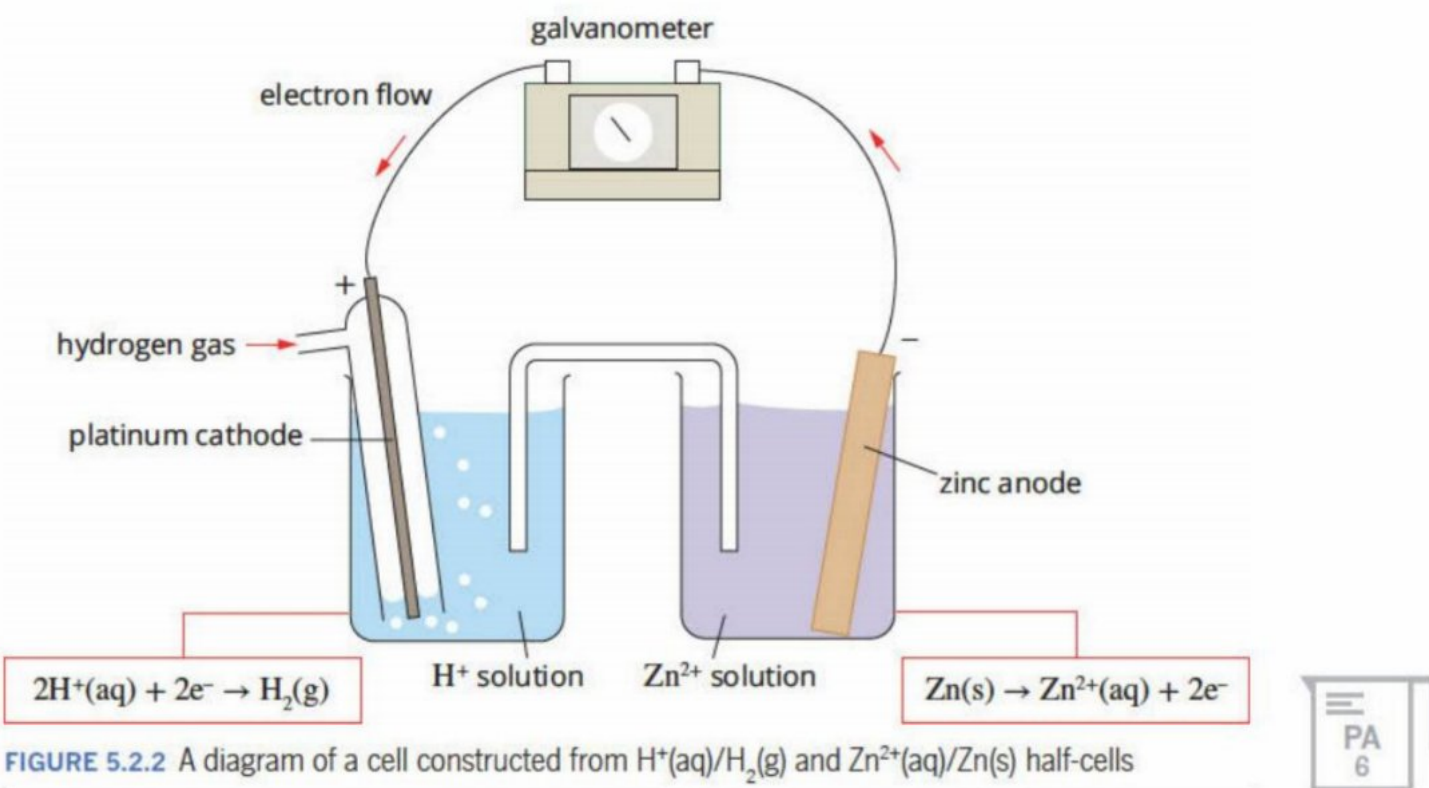
In this cell, the zinc electrode (the anode) is negative. The reactions occurring are:
- At the cathode:
- At the anode:
Note
In this process, zinc is oxidised to ions and ions are reduced to hydrogen gas. We can describe these substances as:
- Zinc is a reducing agent because it donates electrons and causes the reduction of
- is an oxidising agent because it accepts electrons and causes zinc to be oxidised
Determining relative strengths
Since electrons flow from the zinc half-cell to the hydrogen half-cell, we can conclude that:
- Zinc is a stronger reducing agent than hydrogen gas
- ions are a stronger oxidising agent than ions
Important
Key principle: In a galvanic cell, the stronger reducing agent is always in the half-cell with the negative electrode (anode). The stronger oxidising agent is always in the half-cell with the positive electrode (cathode).
Potential difference in galvanic cells
What is potential difference?
Current flows in a galvanic cell because one half-cell has a greater tendency to push electrons into the external circuit than the other. This difference is called the potential difference. You might also hear it called the electromotive force (emf) or simply the voltage.
The potential difference is:
- Represented by the symbol
- Measured in volts ()
- Measured using a voltmeter
Standard conditions
Note
To make fair comparisons between different cells, potential differences are usually measured under standard conditions:
- Pressure:
- Concentration: for all solutions
- Temperature: (though this isn't strictly part of the standard conditions definition)
The potential difference under standard conditions is given the symbol .
Standard electrode potentials
You can't measure the potential difference of a single half-cell on its own - you need both oxidation and reduction to occur for a potential difference to exist. However, we can assign a standard electrode potential () to each half-cell by comparing it to a reference.
Important
The reference is the standard hydrogen half-cell (also called the standard hydrogen electrode or SHE). This half-cell contains the redox pair under standard conditions, and it's arbitrarily assigned an value of zero.
To measure the standard electrode potential of any other half-cell, we connect it to the standard hydrogen electrode and measure the voltage produced.
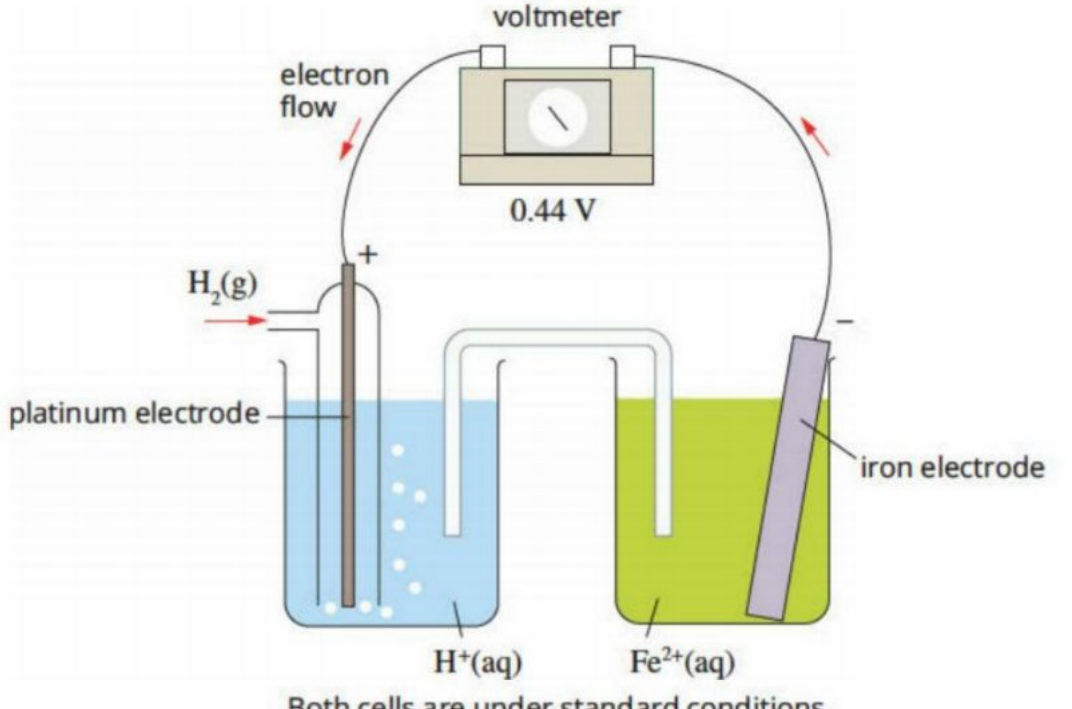
For example, when an half-cell is connected to the standard hydrogen electrode, the voltmeter reads and the iron electrode is negative.
We can summarise this as:
Note
The negative sign tells us that the iron electrode was negative when connected to the hydrogen electrode. This means oxidation is occurring at the iron electrode - iron atoms are losing electrons to form ions, and these electrons flow towards the hydrogen half-cell.
The value is both the standard electrode potential and the standard reduction potential. It gives us a numerical measure of how readily this half-cell reaction occurs as a reduction reaction.
Using the electrochemical series
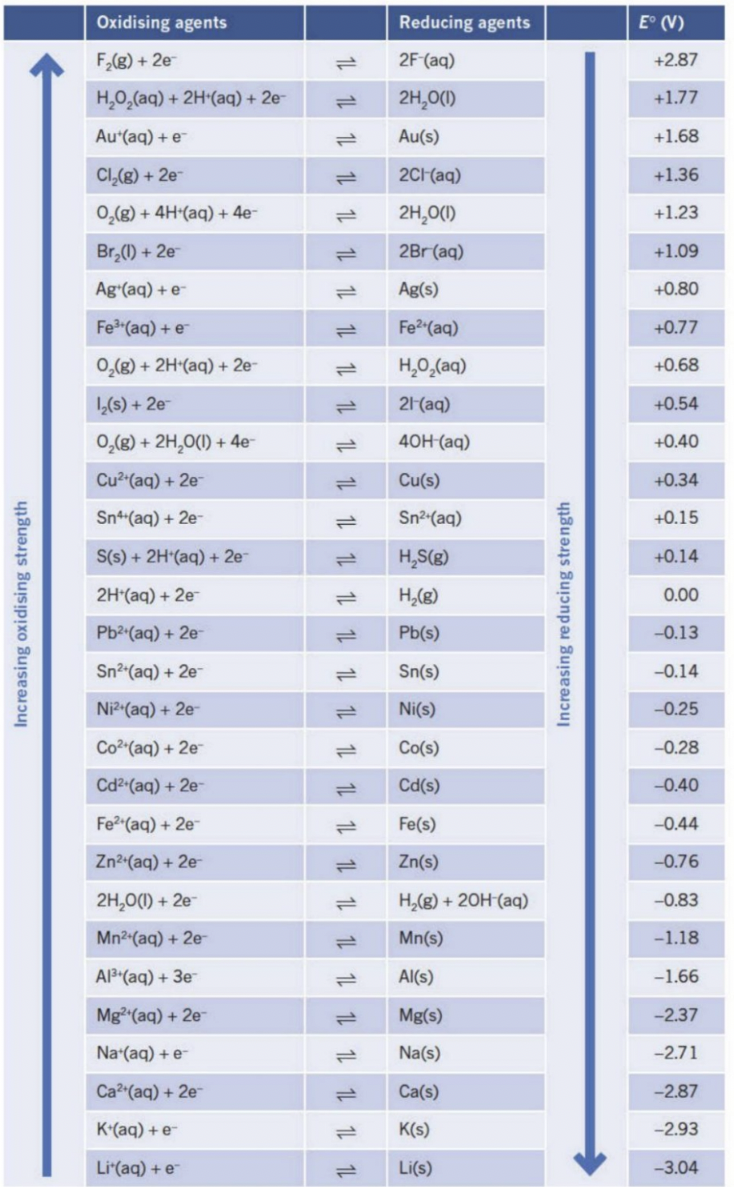
By measuring the standard electrode potentials of many different half-cells, chemists have compiled a table called the electrochemical series.
Understanding the table
The electrochemical series is arranged with:
- Oxidising agents (substances that accept electrons) on the left
- Reducing agents (substances that donate electrons) on the right
- Standard electrode potentials () in the right column
- Arrows showing that oxidising strength increases going up the table
- Arrows showing that reducing strength increases going down the table
Note
Key features:
- The strongest oxidising agent () is at the top left
- The strongest reducing agent () is at the bottom right
- The standard hydrogen electrode () is at in the middle
- All values are measured relative to this arbitrary zero point
Important relationships
Strong reducing agents:
- Donate electrons readily
- Have weak conjugate oxidising agents
- Are found at the bottom right of the table
- Have very negative values
Strong oxidising agents:
- Accept electrons readily
- Have weak conjugate reducing agents
- Are found at the top left of the table
- Have very positive values
Important
Fundamental rule: Oxidising agents react with reducing agents that are lower in the electrochemical series.
Predicting cell reactions
The electrochemical series allows you to predict what will happen when any two half-cells are connected. The strongest oxidising agent in the cell will react with the strongest reducing agent.
Another way to think about it:
- The half-reaction higher in the series goes forward (reduction occurs)
- The half-reaction lower in the series goes backward (oxidation occurs)
This means:
- Reduction occurs in the half-cell with the higher value
- Oxidation occurs in the half-cell with the lower value
- The positive electrode (cathode) is in the half-cell with the higher value
- The negative electrode (anode) is in the half-cell with the lower value
The overall cell equation is found by adding the two half-equations together.
Worked example: Predicting cell operation
Example
Worked Example: Predicting Cell Operation
Let's work through an example with a cell made from and half-cells.
Step 1: Identify the relevant half-equations:
- with
- with
Step 2: Identify the strongest oxidising and reducing agents:
- is higher on the left side, so it's the stronger oxidising agent
- is lower on the right side, so it's the stronger reducing agent
Step 3: Write the half-equations that will occur:
- Reduction (higher ):
- Oxidation (lower ):
Step 4: Write the overall equation:
Multiply the silver equation by 2 to balance electrons:
Overall:
Step 5: Identify electrodes:
- The silver electrode is the cathode (positive)
- The iron electrode is the anode (negative)
- Electrons flow from the iron electrode (anode) to the silver electrode (cathode)
Calculating cell voltage
The maximum potential difference of a cell under standard conditions is simply the difference between the values of the two half-cells.
Important
Formula:
For the silver-iron cell:
Note
Important notes:
- Different voltage values are obtained under non-standard conditions
- As a galvanic cell discharges, the voltage gradually drops
- When the voltage reaches zero, the cell is "flat" and equilibrium has been reached
Limitations of predictions
While the electrochemical series is very useful, it has some limitations you need to be aware of:
Important
Non-standard conditions
The values in the electrochemical series are measured under standard conditions (, concentrations, ). Electrode potentials can vary significantly under other conditions. When conditions are very different from standard, the order of half-reactions in the series may change, making predictions less reliable.
Reaction rates
The electrochemical series tells you nothing about how fast reactions occur. Just because a reaction is predicted to occur doesn't mean it will happen rapidly or even noticeably. Some thermodynamically favourable reactions are kinetically very slow.
Direct redox reactions
Understanding spontaneous reactions
If you mixed the contents of both half-cells from a galvanic cell, the same chemical reaction would occur, but the energy would be released as heat rather than electrical energy. Reactions that occur in galvanic cells, or when chemicals are directly mixed, are called naturally occurring reactions or spontaneous reactions.
The same principles apply to direct reactions as to galvanic cells:
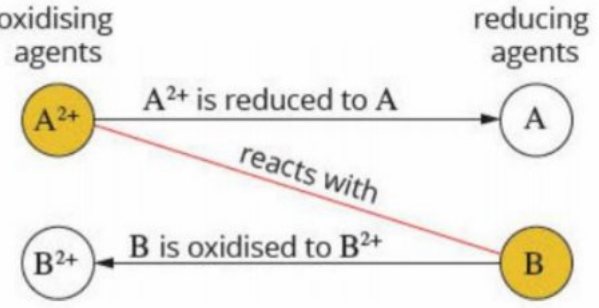
- The stronger oxidising agent reacts with the stronger reducing agent
- The higher half-reaction in the electrochemical series goes forward (reduction)
- The lower half-reaction goes backward (oxidation)
The key rule
Important
For a spontaneous reaction to occur when substances are mixed directly, an oxidising agent (on the left of the electrochemical series) must react with a reducing agent (on the right) that is lower in the series.
Visual tip: Look for substances arranged in a top-left/bottom-right pattern in the electrochemical series. If you can draw a diagonal line from top-left to bottom-right connecting an oxidising agent to a reducing agent, a reaction will occur.
Predicting direct reactions
Example
Worked Example: Predicting Direct Reactions
Let's look at some examples using these half-equations:
- with
- with
- with
Example a: Mixing and
Both species are on the left side of the electrochemical series, so they're both oxidising agents. No reaction occurs because there's no reducing agent present.
Example b: Mixing and
is an oxidising agent and is a reducing agent. However, is below in the series. No reaction occurs because the oxidising agent must be above the reducing agent.
Example c: Mixing and
is an oxidising agent (left side) and is a reducing agent (right side). Since is above in the series, a reaction will occur.
The higher half-equation goes forward:
The lower half-equation goes backward:
Overall reaction:
Case study: Biodegradable batteries
Note
Biodegradable Batteries for Medical Implants
Most battery research focuses on developing rechargeable (secondary) cells because they're more efficient and create less waste. However, some researchers are developing biodegradable primary cells for a fascinating application: medical implants.
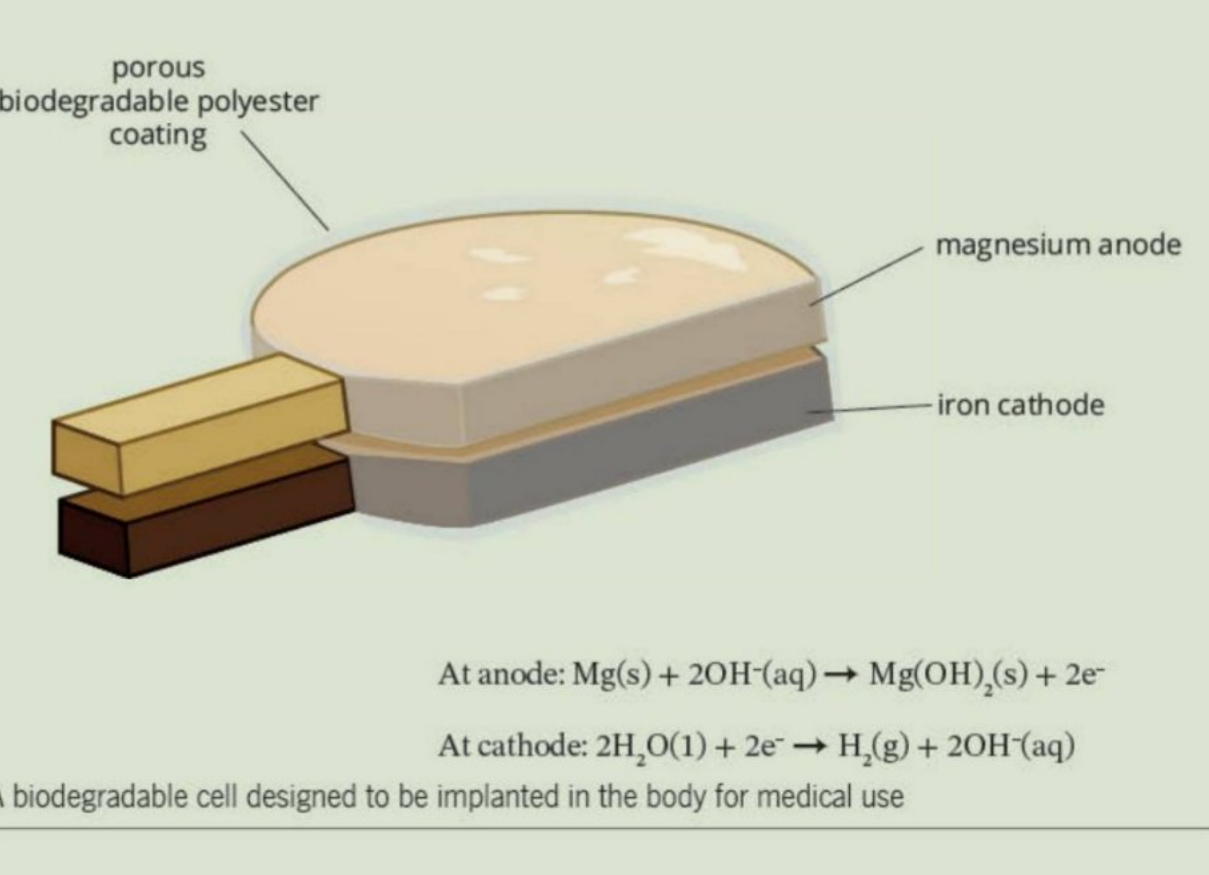
These biodegradable batteries can be implanted directly into the body to power low-power medical devices used for wound healing, bone regeneration, and diagnostic monitoring. The devices only need to operate for a short time, and using a biodegradable battery means there's no need for surgery to remove it afterward. The battery simply dissolves after completing its task, without harming the body.
The batteries use ions present in body fluids as the electrolyte. These ions can pass through the porous polymer casing that separates the anode and cathode.
Example reactions in a magnesium-iron cell:
- At the anode:
- At the cathode:
Research is still in early stages, but scientists have reported success with several cell designs including magnesium-iron, magnesium-molybdenum oxide, magnesium-gold, and magnesium-molybdenum combinations.
Remember!
Summary
Key Points to Remember:
-
The electrochemical series ranks substances by their oxidising and reducing strengths, with the strongest oxidisers at the top and strongest reducers at the bottom
-
The standard hydrogen electrode is the reference point () for all measurements
-
In a galvanic cell, the stronger reducing agent is at the anode (negative electrode) and the stronger oxidising agent is at the cathode (positive electrode)
-
Cell voltage is calculated as: higher half-cell minus lower half-cell
-
For a spontaneous reaction to occur, an oxidising agent must be higher in the electrochemical series than the reducing agent it reacts with
-
The electrochemical series is most reliable under standard conditions and doesn't predict reaction rates