Alcohols and Carboxylic Acids (VCE SSCE Chemistry): Revision Notes
📚Revision Notes
Alcohols and Carboxylic Acids
Introduction to functional groups
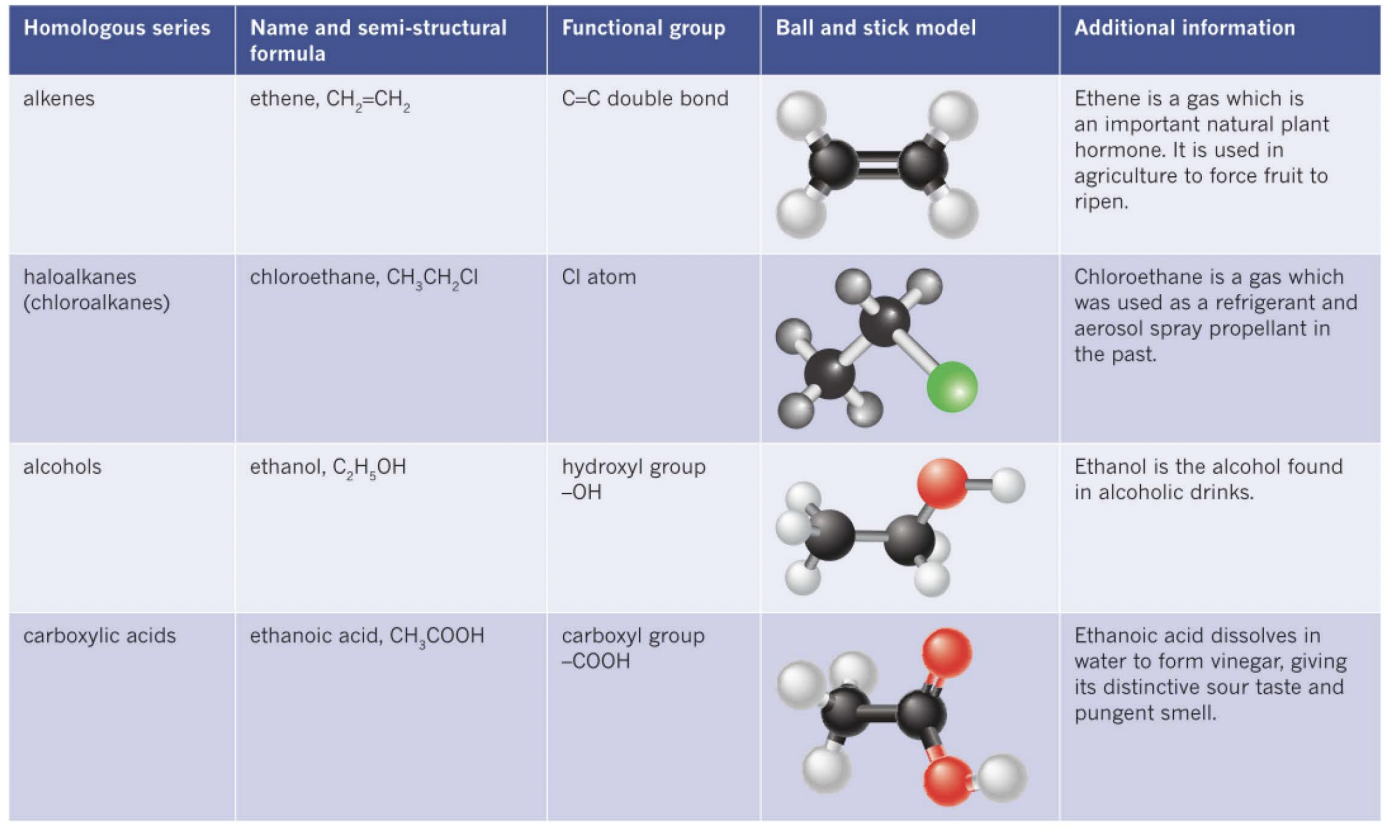
Organic molecules can contain different atoms besides just carbon and hydrogen. These additional atoms are called functional groups, and they significantly increase the chemical reactivity of organic compounds. Different functional groups give molecules different properties and allow them to perform various functions.
Two important homologous series containing functional groups are:
- Alcohols: contain a hydroxyl group ()
- Carboxylic acids: contain a carboxyl group ()
Note
Members of the same homologous series share the same functional group. This means they have similar (though not identical) physical and chemical properties. Successive members of each series differ by a unit, which allows us to predict properties and reactions.
Alcohols
What are alcohols?
Alcohols are organic compounds where a hydroxyl group () replaces one hydrogen atom in an alkane structure. The hydroxyl group consists of an oxygen atom bonded to a hydrogen atom, and this is the functional group that defines alcohols.
General formula of alcohols:
Naming and representing alcohols
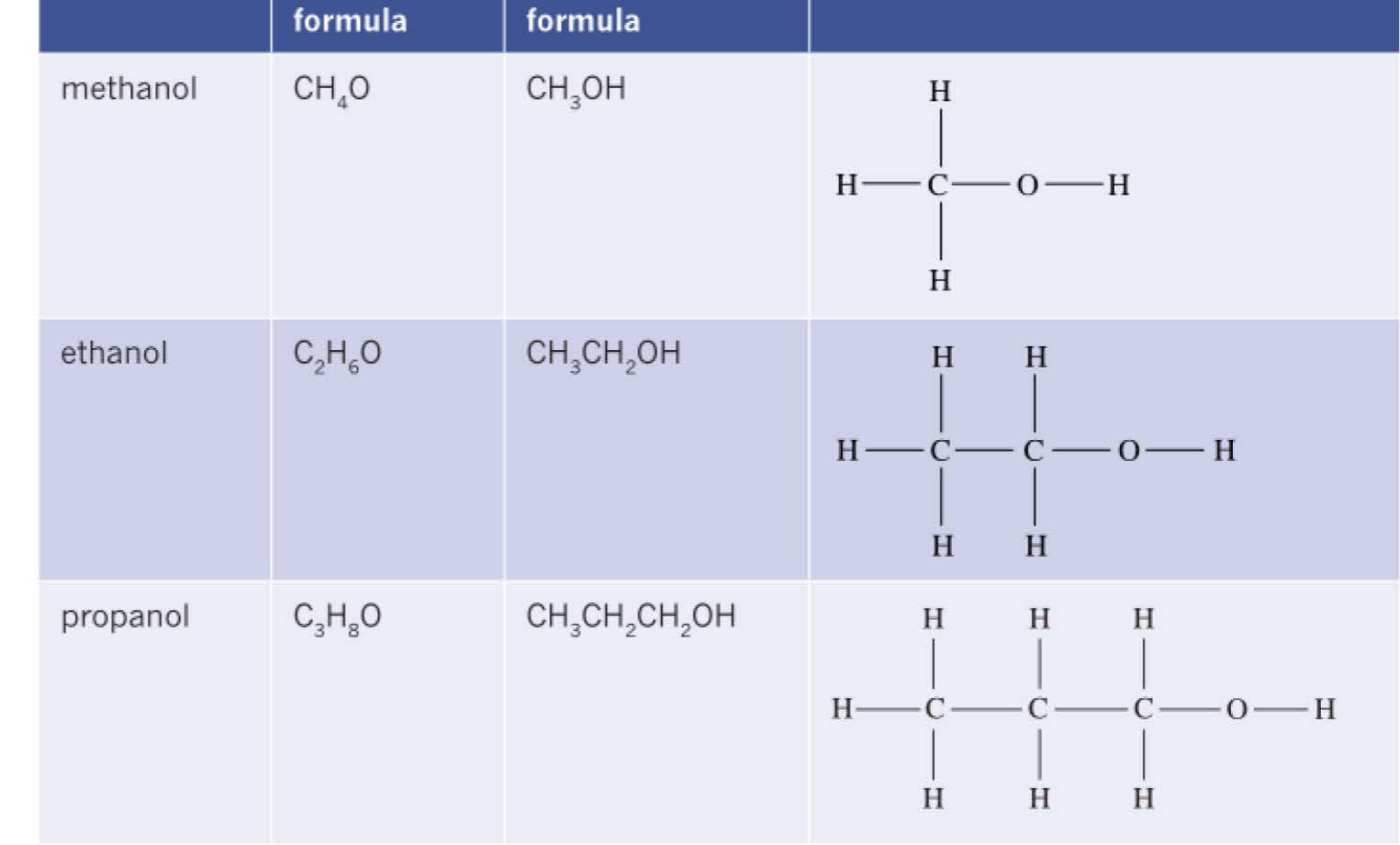
When naming alcohols, we use the same stem names as for alkanes (meth-, eth-, prop-, but-) to indicate the number of carbon atoms. However, the suffix (ending) is always -ol.
The table below shows three common alcohols represented in different ways:
Important
Key naming rules for alcohols:
- The suffix is always -ol (e.g., methanol, ethanol, propanol)
- Number the carbon chain from the end closest to the hydroxyl group
- Include the position number of the hydroxyl group before the -ol suffix
- For branched alcohols, identify side chains and include their positions
Physical properties of alcohols
Boiling points
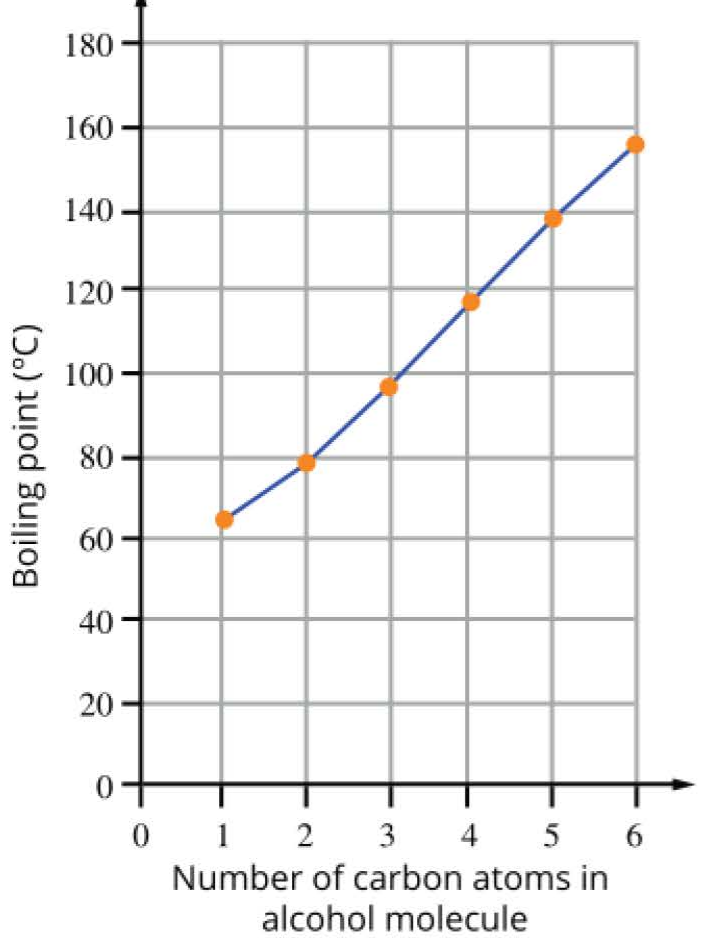
Alcohols have significantly higher boiling points than the corresponding alkanes. This is because the group allows hydrogen bonding to occur between alcohol molecules, which strengthens the intermolecular forces.
As the number of carbon atoms in an alcohol increases, the boiling point also increases:
Note
All alcohols with 1-6 carbons are liquids at room temperature, unlike many alkanes and alkenes which are gases. This is a direct consequence of the stronger intermolecular forces created by hydrogen bonding.
Hydrogen bonding in alcohols
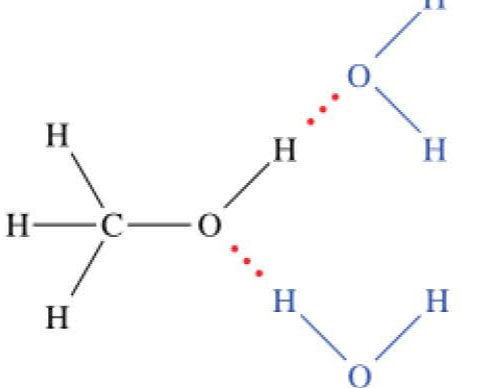
The oxygen atom in the hydroxyl group is highly electronegative. This creates a polar bond where oxygen has a partial negative charge () and hydrogen has a partial positive charge (). This polarity allows hydrogen bonds to form between alcohol molecules and also between alcohol and water molecules.
Solubility in water
Smaller alcohols like methanol and ethanol dissolve readily in water because hydrogen bonds can form between the group and water molecules. However, as the carbon chain length increases, solubility decreases.
Note
A longer carbon chain means more of the molecule is non-polar, making the overall molecule less polar and less able to interact with water. This creates a clear trend: the longer the carbon chain, the less soluble the alcohol becomes in water.
Uses of alcohols
Many small alcohols are useful as fuels. Ethanol can be used as a fuel on its own or mixed with petrol. The combustion reaction produces carbon dioxide and water:
Champagne production: Ethanol is produced by fermenting glucose from grapes using yeast:
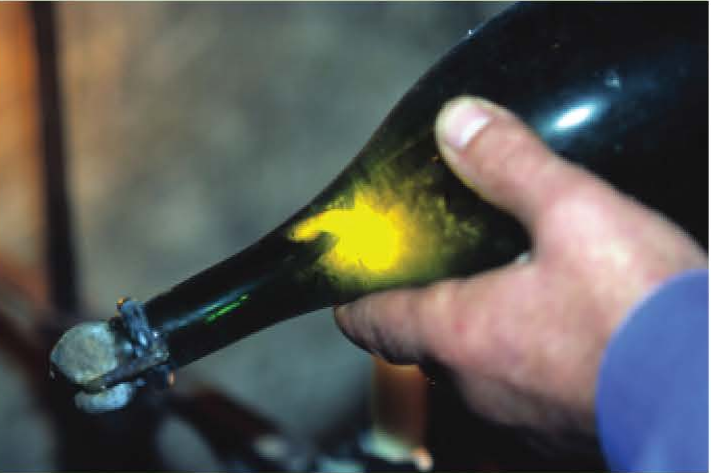
The solubility of ethanol in water is essential for producing alcoholic drinks. In champagne production, carbon dioxide also dissolves in the aqueous solution, creating the characteristic bubbles.
Structural isomers of alcohols
For alcohols with more than two carbon atoms, the hydroxyl group can be positioned at different locations on the carbon chain. This creates different structural isomers with different properties.
Note
For example, propanol () can exist as:
- (hydroxyl on first carbon)
- (hydroxyl on second carbon)
The systematic name must indicate which carbon atom the hydroxyl group is bonded to.
How to name alcohols systematically
Example
Worked Example: Naming Alcohols
Step-by-step process:
- Identify the longest carbon chain containing the hydroxyl group
- Name this chain using the alkane stem (meth-, eth-, prop-, but-, etc.)
- Remove the 'e' from the alkane name and add -ol
- Number the carbon atoms starting from the end closest to the hydroxyl group
- Place the position number of the hydroxyl group before the -ol suffix
- Identify any side chains (branches) and their positions
- Combine all parts with hyphens between numbers and names
Exam tip: Always number from the end that gives the hydroxyl group the lowest possible number. This takes priority over numbering for side chains.
Carboxylic acids
What are carboxylic acids?
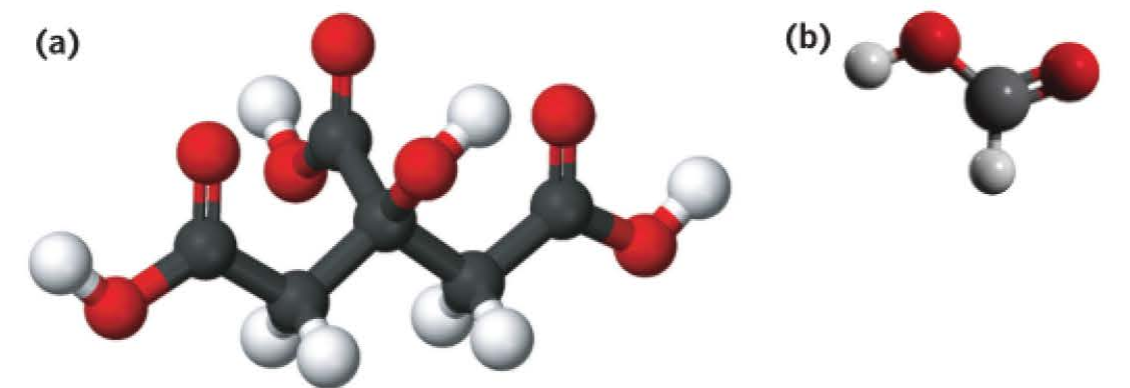
Carboxylic acids are organic compounds containing a carboxyl group (). This functional group consists of:
- A carbon atom with a double bond to one oxygen atom (carbonyl group, )
- A single bond to a second oxygen atom
- This second oxygen is bonded to a hydrogen atom (hydroxyl group)
Note
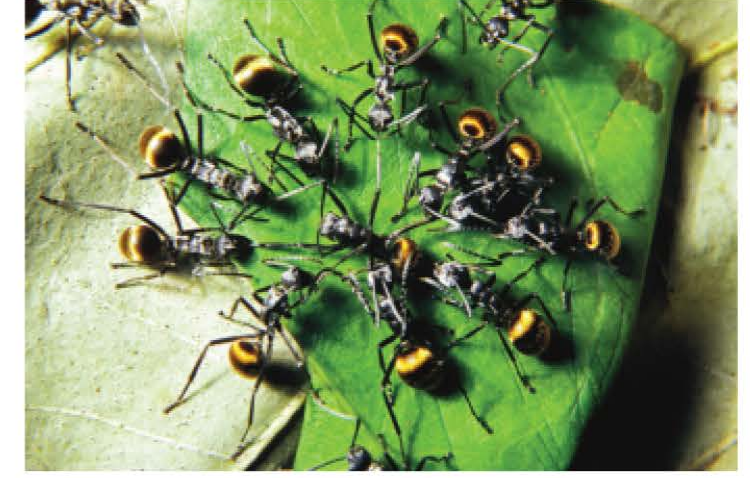
Carboxylic acids are weak acids commonly found in food, where they provide a sour taste. They are also found in some insect venoms, such as formic acid in ant stings.
Naming and representing carboxylic acids
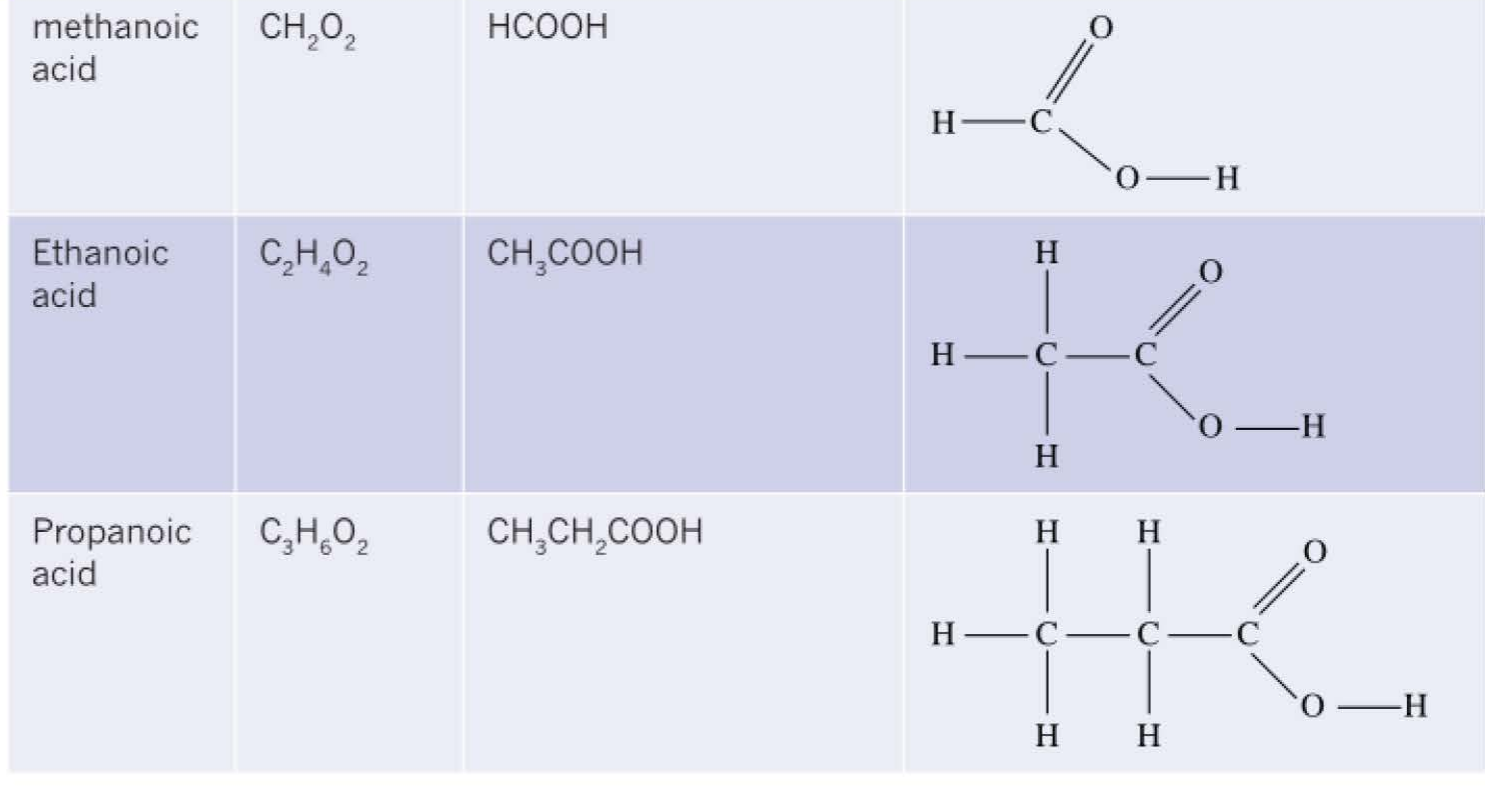
The prefixes used for alkanes are also used for carboxylic acids, but the suffix changes to -oic acid.
Important
Important naming rules for carboxylic acids:
- Names end with -oic acid (e.g., methanoic acid, ethanoic acid)
- The carbon in the carboxyl group is counted in the total carbon chain
- The carboxyl carbon is always numbered as carbon 1
- No position number is needed for the carboxyl group itself
For example, has three carbons total and is called propanoic acid.
The general formula is often written as RCOOH, where R represents an alkyl group like or .
How to name carboxylic acids systematically
Example
Worked Example: Naming Carboxylic Acids
Step-by-step process:
- Identify the functional group (carboxyl group, )
- Identify the longest carbon chain that includes the carboxyl carbon
- Name the chain using the alkane stem
- Change the ending to -oic acid
- Number from the carboxyl carbon (this is always C1)
- Identify any side chains and their positions
- Combine all components with position numbers for side chains only
Note that because the carboxyl group is always at the end and always C1, you never need to write "butan-1-oic acid" - it's simply "butanoic acid".
Properties and uses of carboxylic acids
Acidic behavior
The carboxyl functional group is made up of both a carbonyl group () and a hydroxyl group (). Both groups are polar because oxygen is much more electronegative than carbon and hydrogen.
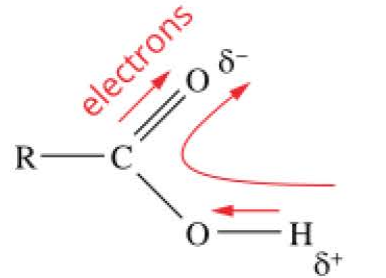
The electrons are drawn away from the hydrogen atom in the hydroxyl group. This enables the hydrogen to be donated as an ion when the carboxylic acid reacts with water, which is why the group acts as an acid:
The product is a carboxylate ion with the functional group . Carboxylate ions are named with the suffix -oate (e.g., ethanoate ion from ethanoic acid).
Important
Carboxylic acids are weak acids, meaning they only partially ionise in water. This is shown by the equilibrium arrow () in the equation above, indicating that both the acid and the carboxylate ion exist in solution simultaneously.
Common examples
Carboxylic acids are often found in foods:
- Ethanoic acid gives vinegar its sour taste and smell
- Citric acid is found in lemon and orange juice
- Methanoic acid (formic acid) is found in ant venom and stinging nettles
Note
When foods deteriorate, carboxylic acids can form. For example, wine exposed to air can convert to ethanoic acid (vinegar). This is why wine that has been left open for too long develops a sour, vinegar-like taste.
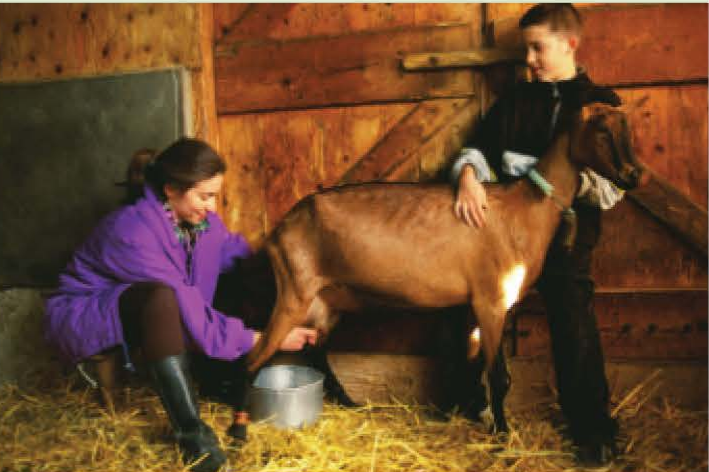
Goat milk acids: Three carboxylic acids called caproic acid, caprylic acid, and capric acid are found in high concentrations in goat's milk. These give the milk its characteristic flavour. Interestingly, all three names derive from "Capra", the genus name for goats.
Boiling points
Carboxylic acids have higher boiling points than you might expect from their molecular masses. They have even higher boiling points than alcohols of similar molecular mass:
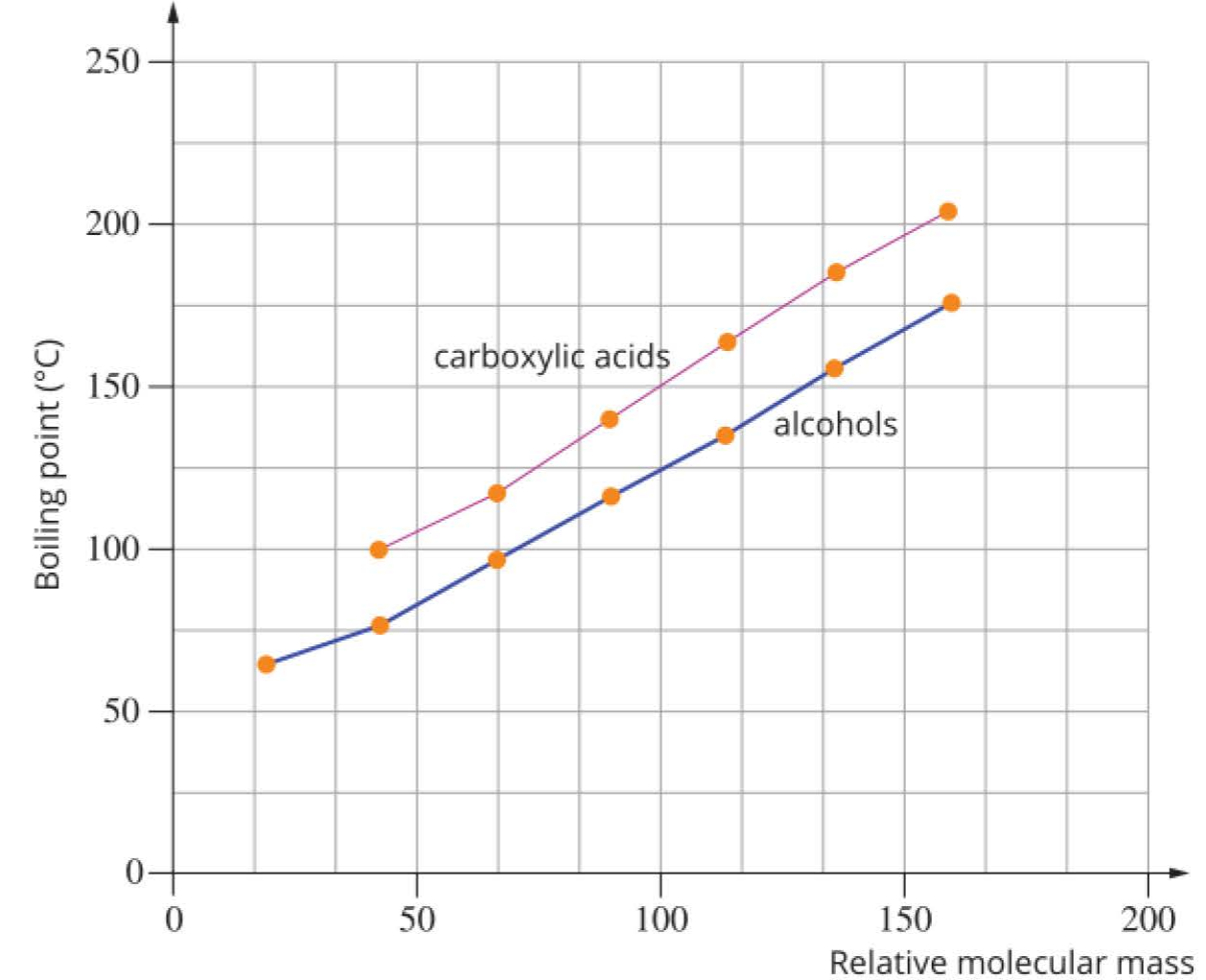
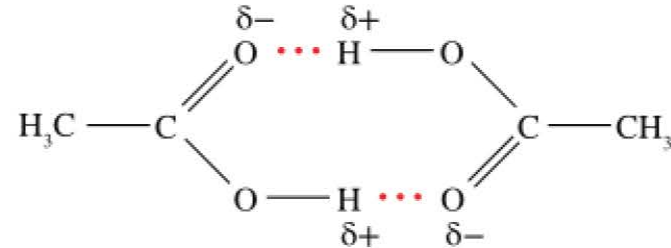
This is because hydrogen bonding between two carboxylic acid molecules results in the formation of a dimer - two identical molecules bonded together through hydrogen bonds:
Note
Dimer formation increases the effective molecular size and strengthens the dispersion forces between molecules, significantly raising the boiling point. Each carboxylic acid molecule can form two hydrogen bonds with another molecule, creating a very stable paired structure.
Solubility in water
When dissolved in water, hydrogen bonding occurs between the carboxyl group and water molecules. This makes carboxylic acids more soluble than alcohols in water:
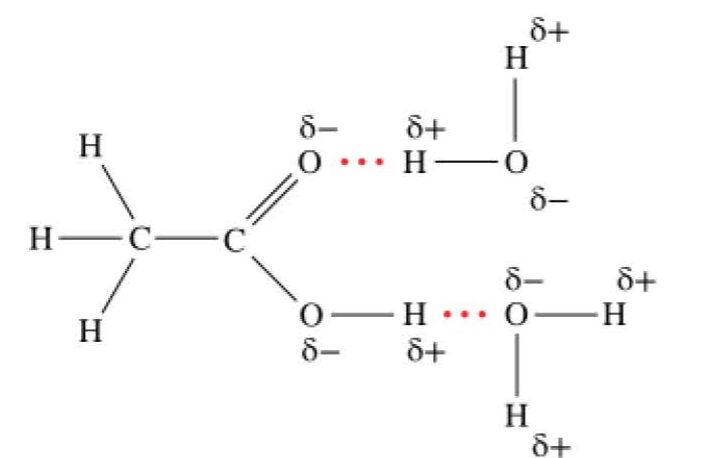
The high solubility of carboxylic acids explains why they are frequently found in aqueous solutions like citric acid in fruit juices.
However, like alcohols, solubility decreases as the carbon chain length increases. A longer carbon chain means more of the molecule is non-polar, reducing its ability to dissolve in water:
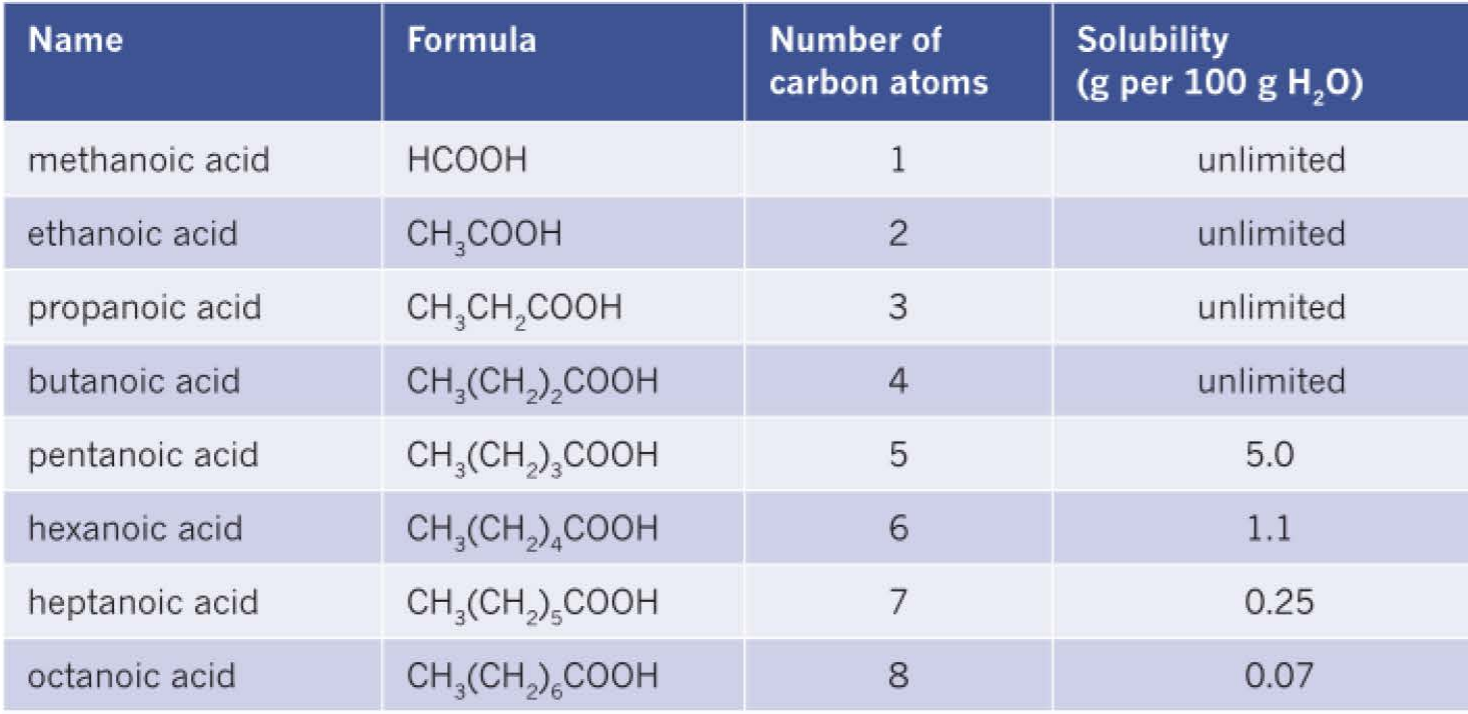
Notice that acids with 1-4 carbons have unlimited solubility, while solubility drops significantly for longer chains.
Summary
Key Points to Remember:
-
Functional groups are atoms or groups of atoms that determine the chemical properties of organic molecules
-
Alcohols contain a hydroxyl group () and are named with the suffix -ol
-
Carboxylic acids contain a carboxyl group () and are named with the suffix -oic acid
-
Hydrogen bonding in both alcohols and carboxylic acids leads to higher boiling points and increased water solubility compared to simple hydrocarbons
-
Carboxylic acids form dimers through hydrogen bonding between pairs of molecules, giving them even higher boiling points than alcohols
-
For both alcohols and carboxylic acids, solubility in water decreases as the carbon chain length increases (longer carbon chains = more non-polar character)
-
When naming organic compounds, always number from the end closest to the functional group, and include position numbers for the hydroxyl group in alcohols (but not for the carboxyl group in acids, which is always C1)