Haloalkanes (VCE SSCE Chemistry): Revision Notes
📚Revision Notes
Haloalkanes
Introduction to haloalkanes
Haloalkanes are an important class of organic compounds derived from alkanes. To understand haloalkanes, we first need to understand what a functional group is.
A functional group is an atom or a group of atoms that gives a characteristic set of chemical properties to a molecule containing those atoms. When a hydrogen atom in an alkane is replaced by a functional group, a new homologous series is created with distinct physical and chemical properties.
Haloalkanes are compounds formed when one or more hydrogen atoms in an alkane are replaced by halogen atoms (fluorine, chlorine, bromine, or iodine). They belong to a homologous series with the general formula:
where X represents a halogen atom (F, Cl, Br, or I).
Note
The halogen elements are found in Group 17 of the periodic table. All halogen atoms have seven valence electrons, which allows them to form one single covalent bond with a carbon atom. The most commonly used halogens in organic compounds are chlorine, bromine, and iodine, with fluorine being less frequently used.
Representing haloalkanes
Haloalkanes can be represented in three different ways, each showing different levels of structural detail. The table below illustrates these representations using bromoethane and 1-chloropropane as examples.
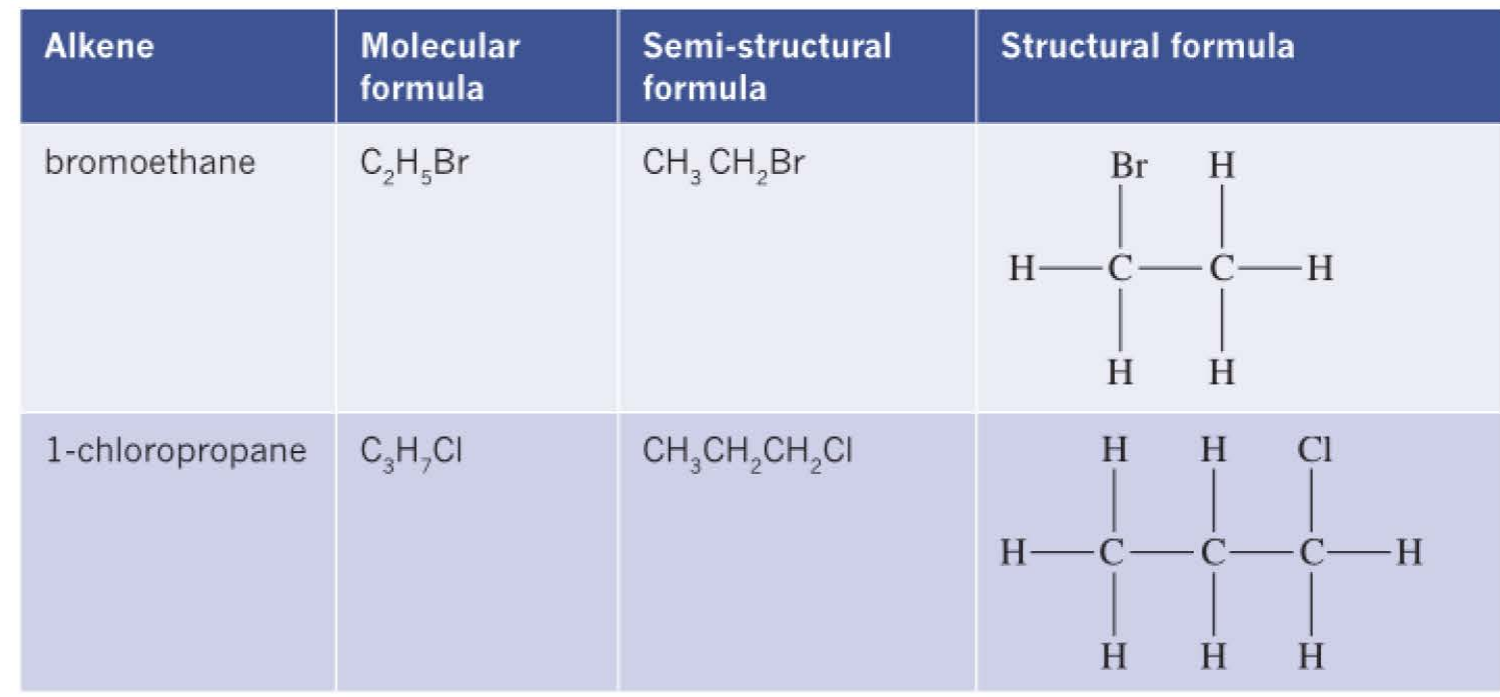
- Molecular formula: Shows only the types and numbers of atoms present (e.g., )
- Semi-structural formula: Shows how atoms are grouped together (e.g., )
- Structural formula: Shows all atoms and bonds in the molecule, providing complete structural information
Note
Each representation provides different information. The molecular formula is most compact, while the structural formula shows the complete arrangement of atoms and bonds. The semi-structural formula offers a practical middle ground for writing chemical equations and reactions.
Structural isomers of haloalkanes
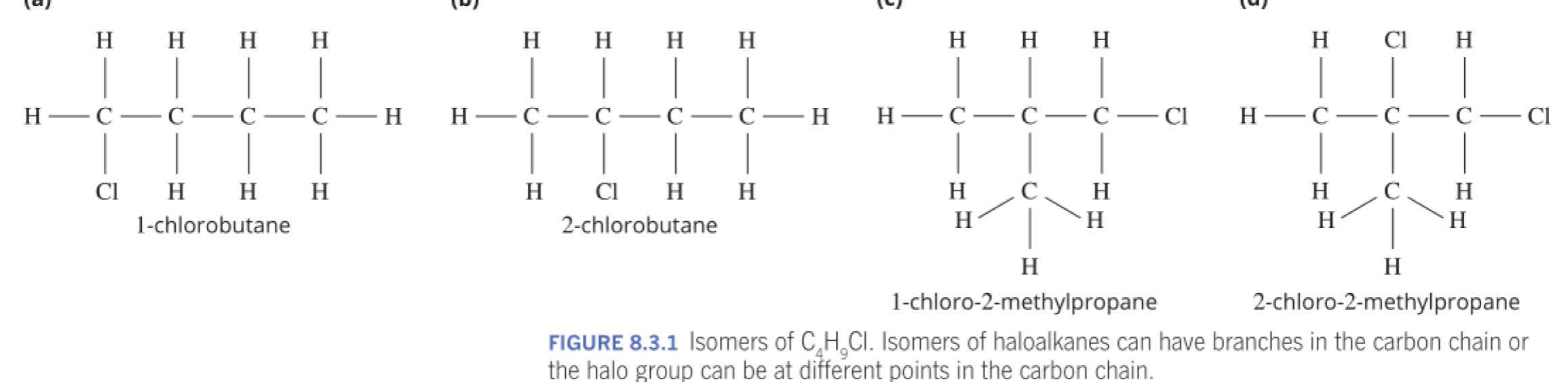
Haloalkanes containing more than three carbon atoms, or those with two or more carbon atoms and multiple halogen atoms, can exist as structural isomers. These isomers have the same molecular formula but different structural arrangements.
Structural isomers in haloalkanes arise from two main factors:
- Branching in the carbon chain: The carbon skeleton can have different branching patterns
- Different halogen positions: The halogen atom can be attached to different carbon atoms in the chain
For example, the molecular formula can represent four different structural isomers, as shown below.
Naming haloalkanes
Halogen naming conventions
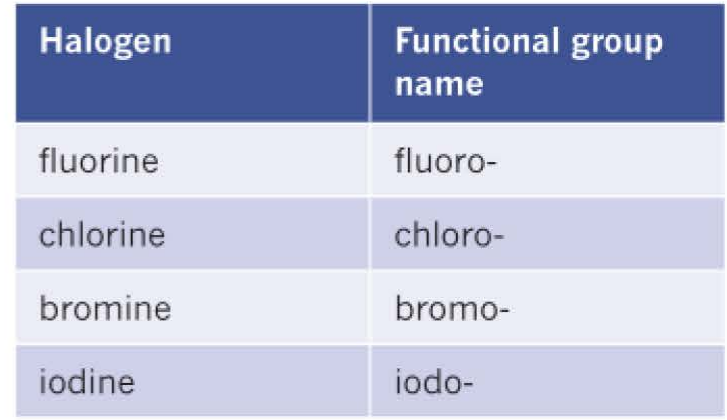
The names of haloalkane functional groups are derived from the halogen element name, with specific prefixes used in systematic naming.
Systematic naming rules
The rules for naming haloalkanes build upon the rules for naming alkanes, with additional conventions:
- Place the halogen name first: The modified halogen name (with the '-o' suffix) appears at the start of the parent alkane's name
- Number from the nearest halogen: Number the carbon atoms in the parent chain starting from the end closest to the first halogen group
- Use prefixes for multiple halogens: When more than one of the same halogen is present, use prefixes like 'di-' or 'tri-'
- Alphabetical order: If multiple types of halogens or alkyl groups are present, list them alphabetically in the name
Step-by-step naming process
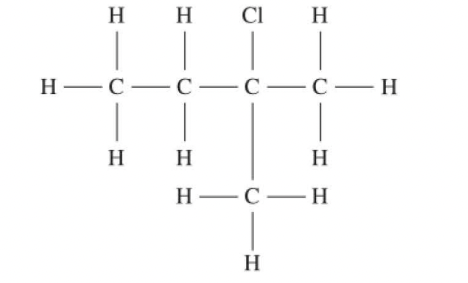
Let's work through naming a haloalkane systematically using the example below.
Example
Worked Example: Naming a Complex Haloalkane
Step 1 - Identify the longest carbon chain: Find the longest continuous carbon chain that contains the halogen atoms. The molecule's name is based on this chain. In the example shown, there is a 4-carbon chain, so the parent alkane is butane.
Step 2 - Number the carbons: Start numbering from the end of the chain closest to the first halogen atom. Note the position(s) of the halogen atom(s). In the example, both the chlorine and bromine atoms are attached to carbon number 2.
Step 3 - Identify side chains: Name any alkyl side chains and note which carbon they are attached to. The example shows a methyl group on carbon number 3.
Step 4 - Combine components: Put all the parts together in the correct order. List halogens and alkyl groups alphabetically, with position numbers preceding each substituent.
For the example shown, the complete name is 2-bromo-2-chloro-3-methylbutane.
Important
When alphabetizing substituents, the prefixes 'di-', 'tri-', etc. are ignored, but 'bromo', 'chloro', 'methyl' etc. are compared alphabetically. Always number from the end nearest to the first substituent to give the lowest possible numbers.
Physical properties of haloalkanes
Polarity in haloalkanes
The presence of a halogen atom significantly affects the physical properties of haloalkanes compared to alkanes. Halogen atoms are more electronegative than carbon, which creates a polar covalent bond between the carbon and halogen atoms.
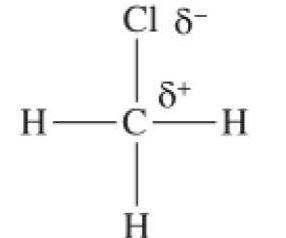
In this chloromethane molecule, the chlorine atom is more electronegative than carbon. This draws electron density toward the chlorine, creating a partial negative charge () on the chlorine and a partial positive charge () on the carbon. This polarity makes the molecule polar overall because it is asymmetrical.
Important
Not all haloalkanes are polar! If a haloalkane molecule has more than one halogen of the same type and is symmetrical, the individual bond dipoles can cancel out, making the molecule non-polar overall.
The polarity of haloalkanes has several important consequences:
- Stronger intermolecular forces: Polar haloalkanes experience dipole-dipole attractions in addition to dispersion forces, leading to stronger overall intermolecular forces than in non-polar alkanes
- Partial water solubility: The polar nature allows smaller haloalkanes to dissolve partially in water
- Higher boiling points: The stronger intermolecular forces result in higher boiling and melting points compared to alkanes of similar size
Effect of halogen type
The type of halogen atom present significantly affects the physical properties of haloalkanes. The table below shows three haloalkanes with different halogen atoms but the same carbon chain length.
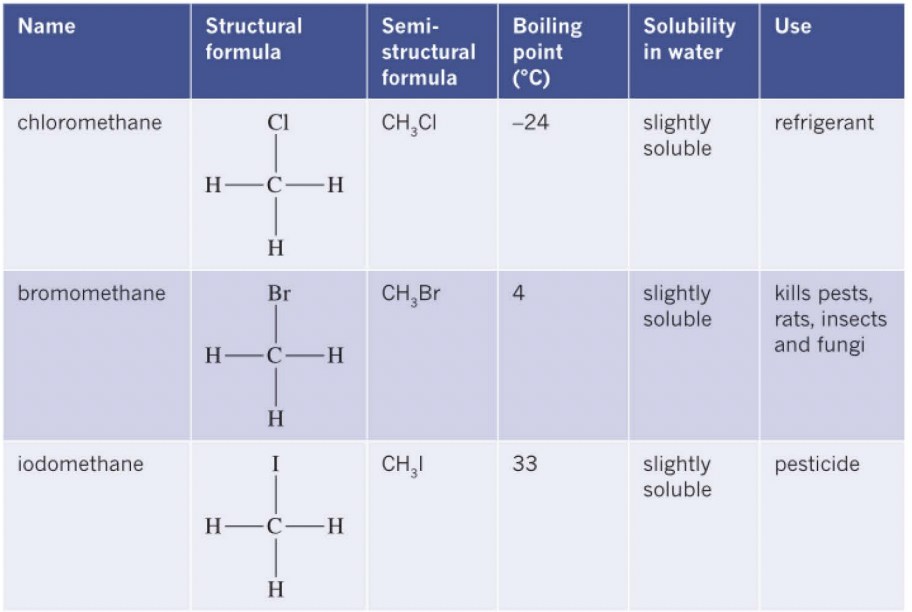
As you can see from the table, the boiling point increases significantly as the size of the halogen increases from chlorine to bromine to iodine. This trend occurs because:
- Larger halogen atoms have more electrons
- More electrons create stronger dispersion forces between molecules
- Stronger intermolecular forces require more energy to overcome, resulting in higher boiling points
Effect of carbon chain length
The length of the carbon chain also significantly affects the physical properties of haloalkanes. The table below compares three chloroalkanes with increasing carbon chain lengths.
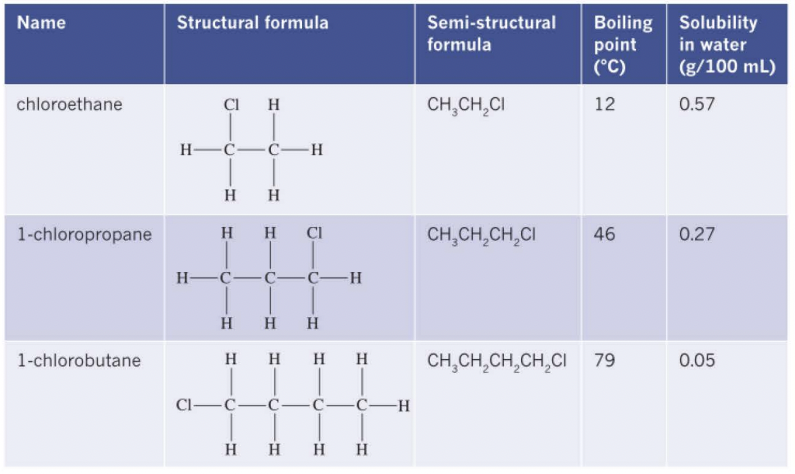
Several important trends are evident:
Boiling point increases with chain length: As the carbon chain becomes longer, the boiling point increases. This occurs because:
- Longer molecules have greater surface area for intermolecular contact
- This increases the strength of dispersion forces between molecules
- The combination of dispersion forces and dipole-dipole attractions from the polar C-Cl bond results in progressively higher boiling points
Solubility in water decreases with chain length: While all three compounds show some solubility in water, the amount that dissolves decreases as the chain lengthens:
- Chloroethane: 0.57 g/100 mL
- 1-Chloropropane: 0.27 g/100 mL
- 1-Chlorobutane: 0.05 g/100 mL
Note
This trend occurs because the non-polar hydrocarbon portion of the molecule becomes increasingly dominant as the chain lengthens, reducing the molecule's overall ability to interact with polar water molecules.
Uses of haloalkanes
Haloalkanes have widespread industrial applications, including:
- Flame retardants: Added to materials to reduce flammability
- Refrigerants: Used in cooling systems (though many have been phased out due to environmental concerns)
- Propellants: Previously used in aerosol cans
- Pesticides: Used to control pests, insects, and fungi
- Solvents: Used to dissolve other substances in industrial processes
- Pharmaceuticals: Used in the manufacture of medicines
Important
Some haloalkanes, particularly chlorofluorocarbons (CFCs), are ozone-depleting chemicals. Their use has been phased out in many applications where they were previously released into the environment.
Chemical properties of haloalkanes
The polarity of the carbon-halogen bond not only affects physical properties but also makes haloalkanes significantly more reactive than alkanes.
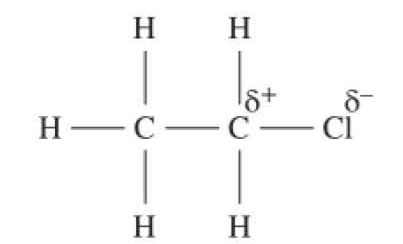
In chloroethane, the highly electronegative chlorine atom draws electron density away from the bonded carbon atom. This creates a partial positive charge () on the carbon, making it susceptible to attack by negatively charged or electron-rich species.
In contrast, carbon and hydrogen have similar electronegativities, so C-H bonds in alkanes are essentially non-polar. This makes alkanes much less reactive than haloalkanes.
Substitution reactions
One important reaction type for haloalkanes is the substitution reaction, where the halogen atom is replaced by another atom or group. For example, haloalkanes can react with hydroxide ions () to form alcohols, which contain an -OH group instead of the halogen.

In this reaction:
- The hydroxide ion acts as a nucleophile (an electron-rich species attracted to the positive carbon)
- The halogen atom leaves as a halide ion (e.g., )
- An alcohol is formed as the product
Note
This reaction demonstrates the increased reactivity of haloalkanes compared to alkanes. The partial positive charge on the carbon bonded to the halogen makes it vulnerable to attack by nucleophiles, facilitating this type of chemical transformation.
Haloalkanes and the ozone layer
Ozone () is an unstable form of oxygen that forms a protective layer in the stratosphere (upper atmosphere). While ozone is harmful to humans at ground level, the stratospheric ozone layer protects us from much of the Sun's harmful ultraviolet (UV) radiation.
Natural ozone chemistry
In the ozone layer, reactions constantly occur that both break down and reform ozone molecules:
Dissociation of ozone:
Formation of ozone:
Note
The symbol represents a free radical—a species with an unpaired electron that is highly reactive due to the electron wanting to pair up with another electron.
CFCs and ozone depletion
Chlorofluorocarbons (CFCs) are haloalkanes that were widely used during the twentieth century as:
- Coolants in refrigeration and air conditioners
- Foaming agents in fire extinguishers
- Propellants in aerosols
Their use as propellants and foaming agents resulted in routine release into the atmosphere. Even when used in refrigeration, CFCs were often released during servicing. A CFC molecule can persist in the atmosphere for more than 100 years.
CFC breakdown in the stratosphere:
In the stratosphere, high-energy UV radiation breaks the carbon-chlorine bond in CFCs, releasing chlorine radicals:
Catalytic destruction of ozone:
These chlorine radicals catalyse the decomposition of ozone, converting it to oxygen:
Important
Notice that the chlorine radical is regenerated in the second step, allowing a single chlorine radical to destroy many ozone molecules in a catalytic cycle. This is why even small amounts of CFCs can cause extensive damage to the ozone layer.
Impact and current status
Over time, the breakdown of ozone led to gradual thinning of the ozone layer. Eventually, an "ozone hole" developed, covering an area of approximately 22 million square kilometres, with much of this impacting Australia.
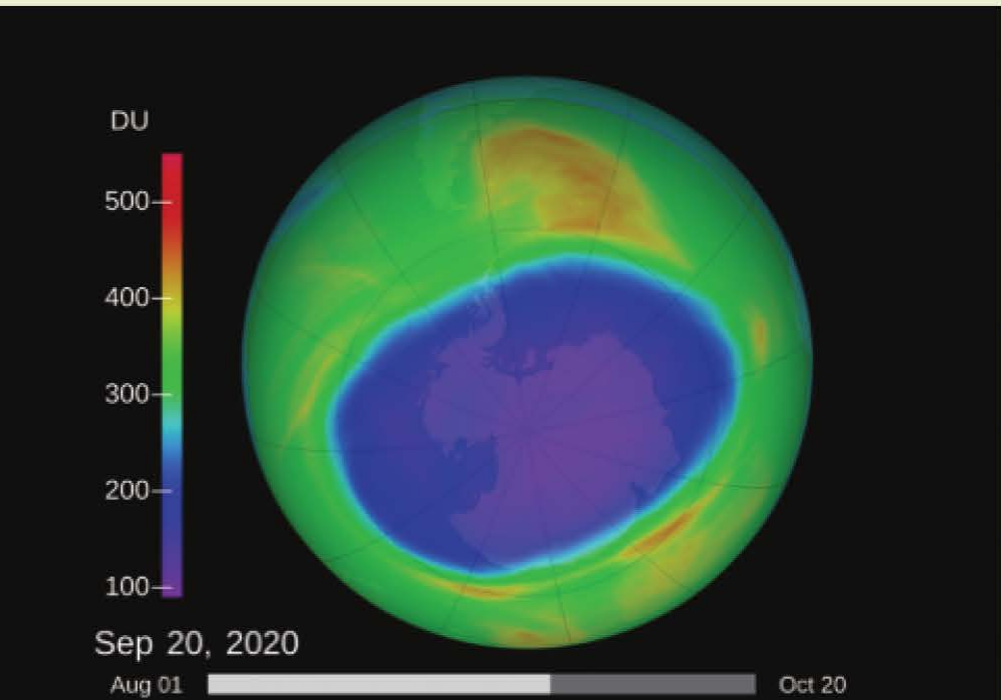
The reduction in ozone protection has resulted in:
- Increased incidence of skin cancer
- Higher rates of cataracts
- Other detrimental effects on human health and the environment
Note
Since the 1980s, the use of CFCs has been significantly limited through international agreements. The amount of ozone-depleting substances in Earth's atmosphere has decreased from peak levels in 2000, and the ozone layer is slowly recovering. However, because CFCs persist for so long, they remain present in large concentrations in the stratosphere.
Summary
Key Points to Remember:
-
Haloalkanes are organic compounds with the general formula where X is a halogen (F, Cl, Br, or I)
-
When naming haloalkanes, always number the carbon chain from the end nearest to the first halogen atom, and list substituents in alphabetical order
-
Most haloalkanes are polar molecules due to the electronegative halogen atom creating a dipole, resulting in dipole-dipole attractions and higher boiling points than comparable alkanes
-
Larger halogens (I > Br > Cl > F) and longer carbon chains both increase boiling points due to stronger dispersion forces, while solubility in water decreases with increasing chain length
-
Haloalkanes are more reactive than alkanes because the polar C-X bond makes the carbon atom susceptible to attack by nucleophiles in substitution reactions
-
CFCs (chlorofluorocarbons) are stable haloalkanes that release chlorine radicals in the stratosphere, which catalytically destroy ozone molecules, leading to ozone layer depletion and increased UV radiation reaching Earth's surface