Hydrocarbons (VCE SSCE Chemistry): Revision Notes
📚Revision Notes
Hydrocarbons
Why carbon forms so many compounds
Carbon is unique among elements in its ability to form an enormous variety of compounds. This remarkable property exists for several key reasons:
- Carbon has four valence electrons, allowing it to form covalent bonds with up to four different atoms
- Carbon atoms can bond strongly with other carbon atoms, creating stable carbon chains
- These carbon-carbon bonds can be single, double, or triple bonds, adding to the diversity of possible structures
Because of these properties, carbon atoms can link together to form molecules of varying lengths and shapes. Each different structure has unique properties and practical applications.
Note
Hydrocarbons are compounds made up exclusively of carbon and hydrogen atoms. They are fundamental to organic chemistry and form the basis of many important materials.
Naming hydrocarbons: the IUPAC system
The International Union of Pure and Applied Chemists (IUPAC) has established a systematic naming convention for hydrocarbons. This system ensures that each compound's name provides information about its structure.
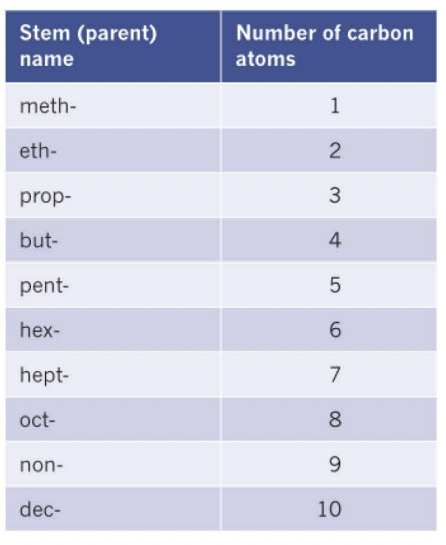
The stem name (or parent name) indicates the number of carbon atoms in the longest continuous chain. For example, "prop-" tells you there are three carbon atoms in the main chain.
Important
Understanding these stem names is essential for naming any hydrocarbon correctly. Memorize the stem names from meth- (1 carbon) to dec- (10 carbons) as they form the foundation of all hydrocarbon nomenclature.
Alkanes: saturated hydrocarbons
What are alkanes?
Alkanes are hydrocarbons in which all carbon-carbon bonds are single covalent bonds. Because they contain only single bonds, alkanes are described as saturated molecules.
Methane () is the simplest alkane. From methane onwards, each member of the alkane series differs from the previous one by a unit. This type of series is called a homologous series.
Characteristics of a homologous series
Members of the same homologous series share several features:
- Similar molecular structures
- A predictable pattern in their physical properties
- Similar chemical properties
- The same general formula
For alkanes, the general formula is , where represents the number of carbon atoms.
Example
Worked Example: Calculating Molecular Formula
If an alkane has 12 carbon atoms, you can calculate the number of hydrogen atoms:
So the molecular formula is .
Alkanes are named by adding the suffix -ane after the stem name. A five-carbon alkane is called pentane ().
Different ways to represent alkanes
Chemists use various methods to show the structure of alkane molecules, each providing different levels of detail:
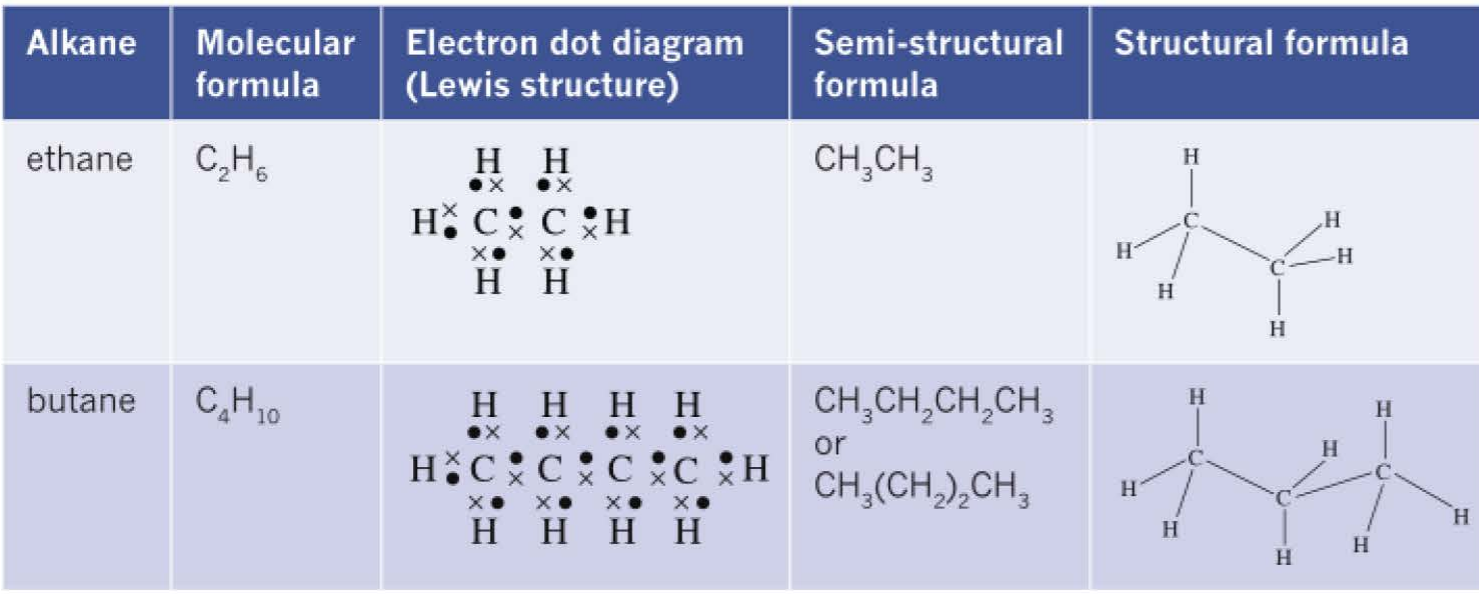
Molecular formula: Shows only the total number of each type of atom (e.g., )
Electron dot diagram (Lewis structure): Shows all valence electrons and how they are shared in bonds
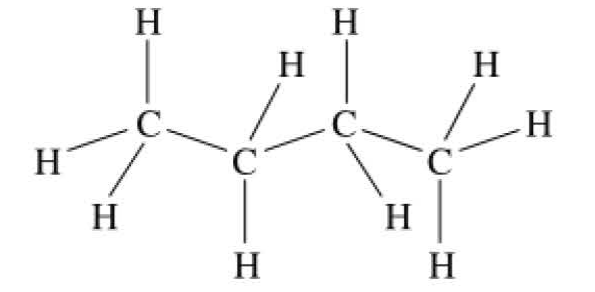
Semi-structural formula: Shows the arrangement of carbon atoms and which atoms are bonded to each carbon, but doesn't show all the bonds. Also called condensed structural formula. For example, butane can be written as or
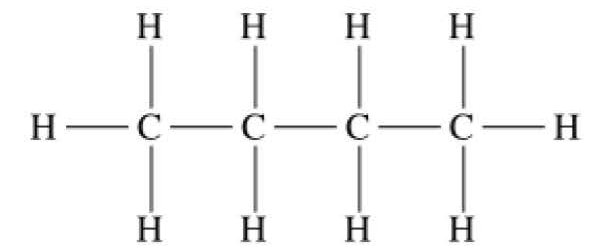
Structural formula: Shows all atoms and all bonds in the molecule
Note
When drawing structural formulas, molecules are often shown in a simplified two-dimensional format, even though the actual three-dimensional shape around each carbon is tetrahedral.
Structural isomers of alkanes
For alkanes with one, two, or three carbon atoms (methane, ethane, propane), only one possible structure exists for each molecular formula. However, when you have four or more carbon atoms, multiple structural arrangements become possible.
Structural isomers are molecules that have the same molecular formula but different arrangements of atoms. The more carbon atoms present, the more possible isomers exist.
Butane () has two structural isomers:
- Straight-chain isomer: The four carbon atoms form a continuous, unbranched chain
- Branched isomer: One carbon chain branches off from the main chain
Note
The branched isomer contains a side group attached to the main carbon chain. This side group is called a methyl group because its structure resembles methane with one hydrogen removed.
Alkyl groups and side chains
Alkyl groups (or alkyl side chains) are fragments derived from alkanes by removing one hydrogen atom. They are named after their parent alkane with a -yl ending instead of -ane.

Since alkyl groups have one less hydrogen than their parent alkane, their general formula is .
Common examples:
- : methyl group (from methane)
- : ethyl group (from ethane)
- : propyl group (from propane)
Physical properties of structural isomers
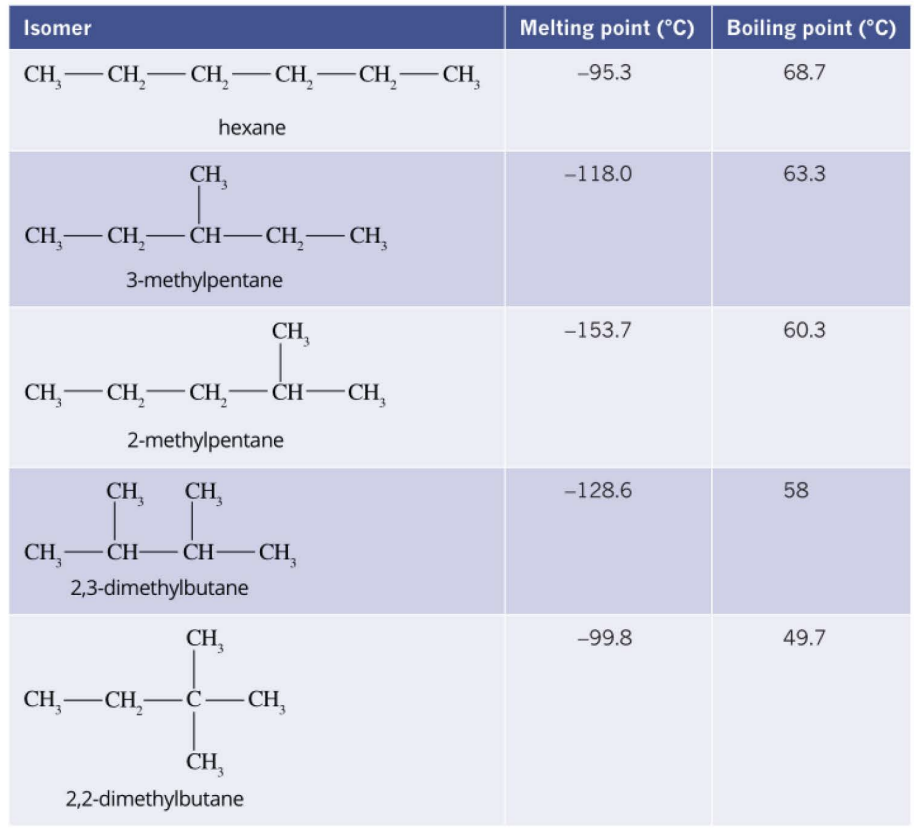
Structural isomers are distinct compounds with different physical and chemical properties. The table below shows the isomers of hexane () and their melting and boiling points:
Important
Notice how branching affects the physical properties - more branched isomers generally have lower boiling points than straight-chain isomers. This is because branched molecules have a smaller surface area, resulting in weaker dispersion forces between molecules.
Rules for naming alkanes systematically
The IUPAC system uses specific rules for naming alkanes. Follow these steps carefully:
Important
IUPAC Naming Rules for Alkanes:
-
Identify the longest unbranched carbon chain - This determines the stem name
-
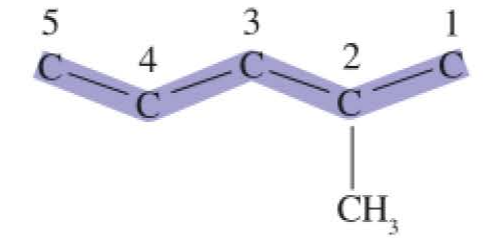
Number the carbon atoms starting from the end that gives the smallest numbers to any branching side chains
-
Name the alkyl side chains according to the alkane from which they derive
-
Indicate the position of each side chain by placing its carbon number at the beginning of the name
-
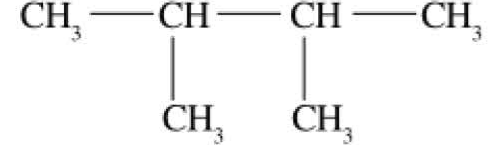
Use prefixes for multiple identical groups:
- Two identical groups: use di-
- Three identical groups: use tri-
-
List different side chains in alphabetical order at the start of the name, each with its position number
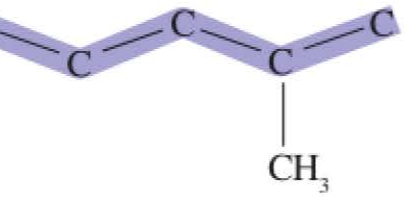
Important tip: The longest carbon chain is not always drawn in a straight line. Carefully trace through the molecule to find the longest continuous chain.
Worked example: naming an alkane
Example
Worked Example: Naming a Branched Alkane
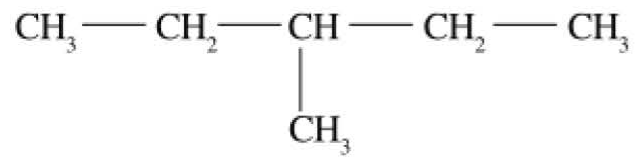
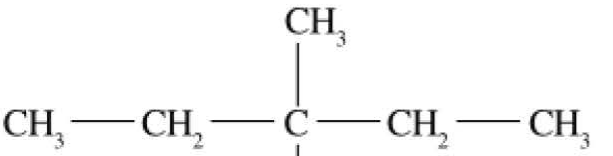
Let's name this molecule step by step:
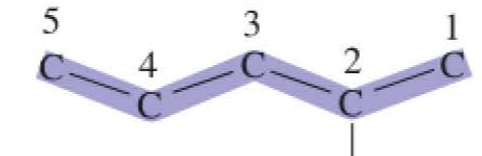
Step 1: Find the longest unbranched chain
- Count the carbons: 6 atoms in the longest chain
- Stem name: hexane
Step 2: Number the chain from the end nearest to the branch
- Numbering from right to left gives the branch at position 3
- Numbering from left to right would give position 4
- Choose the numbering that gives the lowest number: right to left
Step 3: Identify the side chain
- There is a (methyl) group at position 3
Step 4: Combine the components
- Position: 3
- Side chain: methyl
- Main chain: hexane
- Name: 3-methylhexane
Note
There are no spaces in the systematic names of these compounds. Numbers are separated from words by hyphens.
Physical properties of alkanes
The physical properties of organic compounds follow predictable patterns within each homologous series. Physical properties (such as melting point, boiling point, and solubility) are determined by intermolecular forces rather than by breaking chemical bonds.
Alkanes are non-polar molecules. This has important consequences:
- They are insoluble in water
- The only attractive forces between alkane molecules are weak dispersion forces
Note
Trends in Physical Properties
As the number of carbon atoms increases within the alkane series, the molecules become larger. Larger molecules have stronger dispersion forces between them, requiring more energy to separate. Therefore:
- Melting points increase as the carbon chain lengthens
- Boiling points increase as the carbon chain lengthens
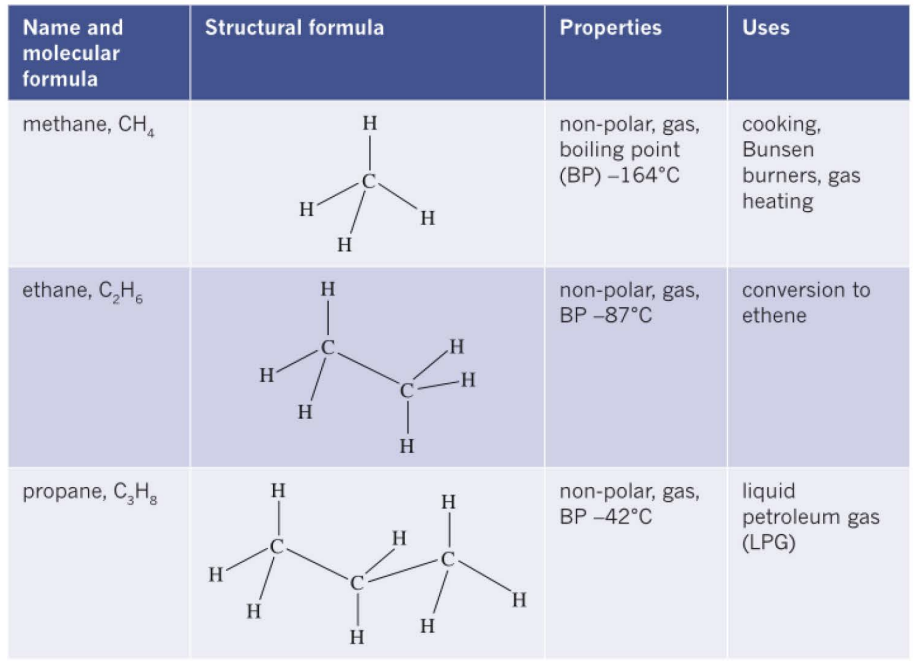
The table above shows the first three alkanes with their structural formulas, physical properties, and common uses. Notice how the boiling point increases from methane () to ethane () to propane ().
Chemical properties of alkanes
Chemical properties describe how a substance reacts with other substances. Alkanes are relatively unreactive compared to other hydrocarbons, but they do undergo combustion reactions readily.
Combustion is the reaction between a fuel and oxygen. When alkanes burn in a plentiful supply of oxygen, complete combustion occurs, producing carbon dioxide and water:
This reaction releases significant amounts of energy, which is why alkanes are excellent fuels. Natural gas (mainly methane) for cooking and petrol (a mixture of alkanes) for vehicles both rely on combustion reactions.
Important
Incomplete combustion can occur when oxygen supply is limited. The products may be carbon monoxide and water, or carbon and water, depending on how much oxygen is available. Incomplete combustion releases less energy than complete combustion.
For example, a Bunsen burner with closed air holes produces a yellow flame due to incomplete combustion:
The yellow colour comes from glowing carbon particles. When the air holes are open, enough oxygen reaches the methane for complete combustion, producing the hotter blue flame.
Alkenes: unsaturated hydrocarbons
What are alkenes?
Alkenes are hydrocarbons that contain one carbon-carbon double bond (). A double bond forms when two pairs of electrons are shared between two carbon atoms.
Because alkenes contain at least one double bond, they are classified as unsaturated hydrocarbons. Alkenes form a homologous series with the general formula (for alkenes with one double bond).
The simplest alkene is ethene (). The next member is propene (), which has an additional unit compared to ethene.
Note
Alkenes are more reactive than alkanes due to the presence of the carbon-carbon double bond.
Representing alkenes
Like alkanes, alkenes can be represented using different formula types:
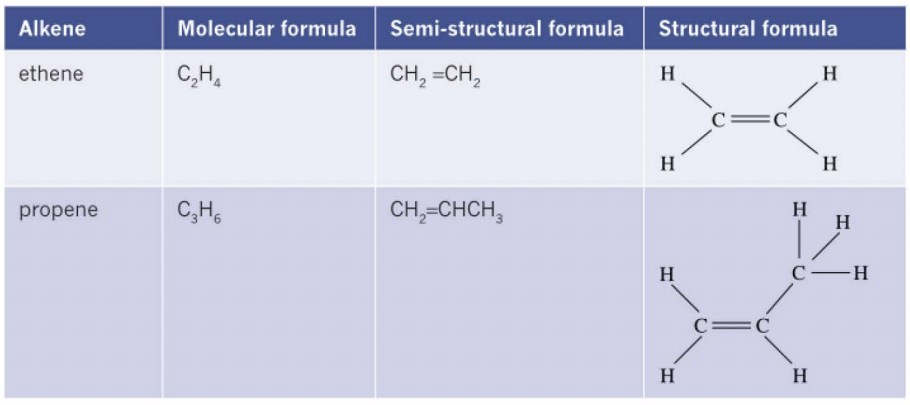
In semi-structural formulas, the double bond can be shown (e.g., ) or sometimes omitted (e.g., ), though showing it is clearer. In structural formulas, the double bond must always be explicitly shown.
Structural isomers of alkenes
Alkenes with more than three carbon atoms can have structural isomers. Isomerism in alkenes can arise from:
- Different positions of the double bond along the carbon chain
- Branching of the carbon chain
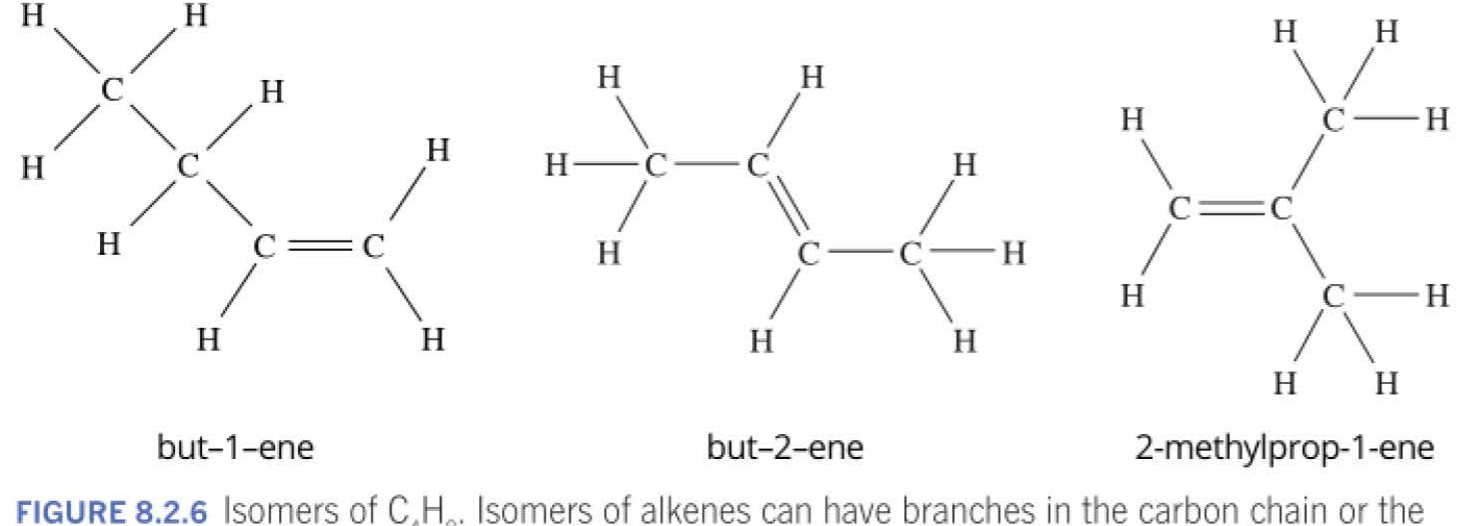
The figure above shows three isomers of :
- But-1-ene: double bond between carbons 1 and 2
- But-2-ene: double bond between carbons 2 and 3
- 2-methylprop-1-ene: a branched structure with the double bond between carbons 1 and 2
Rules for naming alkenes systematically
Naming alkenes follows similar principles to alkanes, with additional rules for the double bond:
Important
IUPAC Naming Rules for Alkenes:
-
Identify the longest unbranched carbon chain that contains the double bond - The double bond must be included in this chain
-
Number the carbon atoms from the end that gives the smallest number to the first carbon in the double bond
-
Name any alkyl side chains according to their parent alkanes
-
Indicate the position of the double bond using the number of the first carbon involved in the bond, followed by the suffix -ene
-
List side chains at the beginning of the name in alphabetical order, with their position numbers
-
Use di- or tri- prefixes for multiple identical side chains
Note
Important note about locants (position numbers): According to IUPAC rules, if one locant is needed in a molecule, all locants should be specified. For example:
- Correct: 2-methylprop-1-ene
- Incorrect: methylpropene or 2-methylpropene
The locant can only be omitted if it's a '1' AND the structure is completely unambiguous (like propene).
Worked example: naming an alkene
Let's work through naming an alkene systematically:
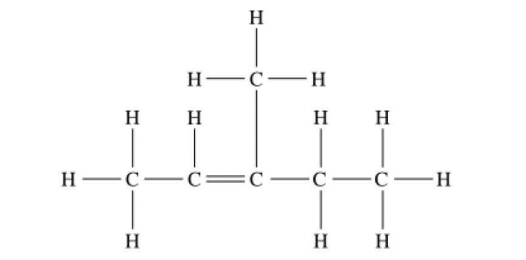
Example
Worked Example: Naming a Branched Alkene
Step 1: Find the longest chain containing the double bond
- Count: 5 carbon atoms with the double bond included
- Base name: pentene
Step 2: Number from the end closest to the double bond
- Number from left to right: double bond starts at C2
- The chain is pent-2-ene
Step 3: Identify side chains and their positions
- One methyl () group at position 3
Step 4: Combine all components
- Name: 3-methylpent-2-ene
More examples of correctly named alkenes demonstrate these principles in action.
Physical properties of alkenes
Alkenes have very similar physical properties to alkanes with the same chain length. This is because they differ by only two hydrogen atoms.
Like alkanes, alkenes are non-polar molecules. This means:
- Alkenes are insoluble in water
- Only weak dispersion forces exist between alkene molecules
- Alkenes have relatively low boiling points
As the carbon chain lengthens, melting points and boiling points increase due to stronger dispersion forces between larger molecules.
The table below shows physical properties and uses of the first three alkenes:
| Name and molecular formula | Structural formula | Physical properties | Uses |
|---|---|---|---|
| Ethene, | Non-polar, gas, BP | Manufacture of polyethene and other chemicals | |
| Propene, | Non-polar, gas, BP | Manufacture of propene oxide and polymers | |
| But-1-ene, | Non-polar, gas, BP | Manufacture of butanol and polymers |
Note
Interestingly, ethene is naturally produced by ripening fruit and can trigger further ripening in nearby fruit. This is why damaged bananas (which produce extra ethene) can make other bananas ripen more quickly.
Chemical properties of alkenes
Alkenes undergo similar combustion reactions to alkanes. For example, complete combustion of ethene produces carbon dioxide and water:
However, the most important chemical property of alkenes is their ability to undergo addition reactions. The carbon-carbon double bond is more reactive than a single bond, making these reactions possible.
Important
Addition reactions occur when:
- The double bond breaks
- A single bond forms
- Parts of another molecule bond to each of the carbon atoms that were joined by the double bond
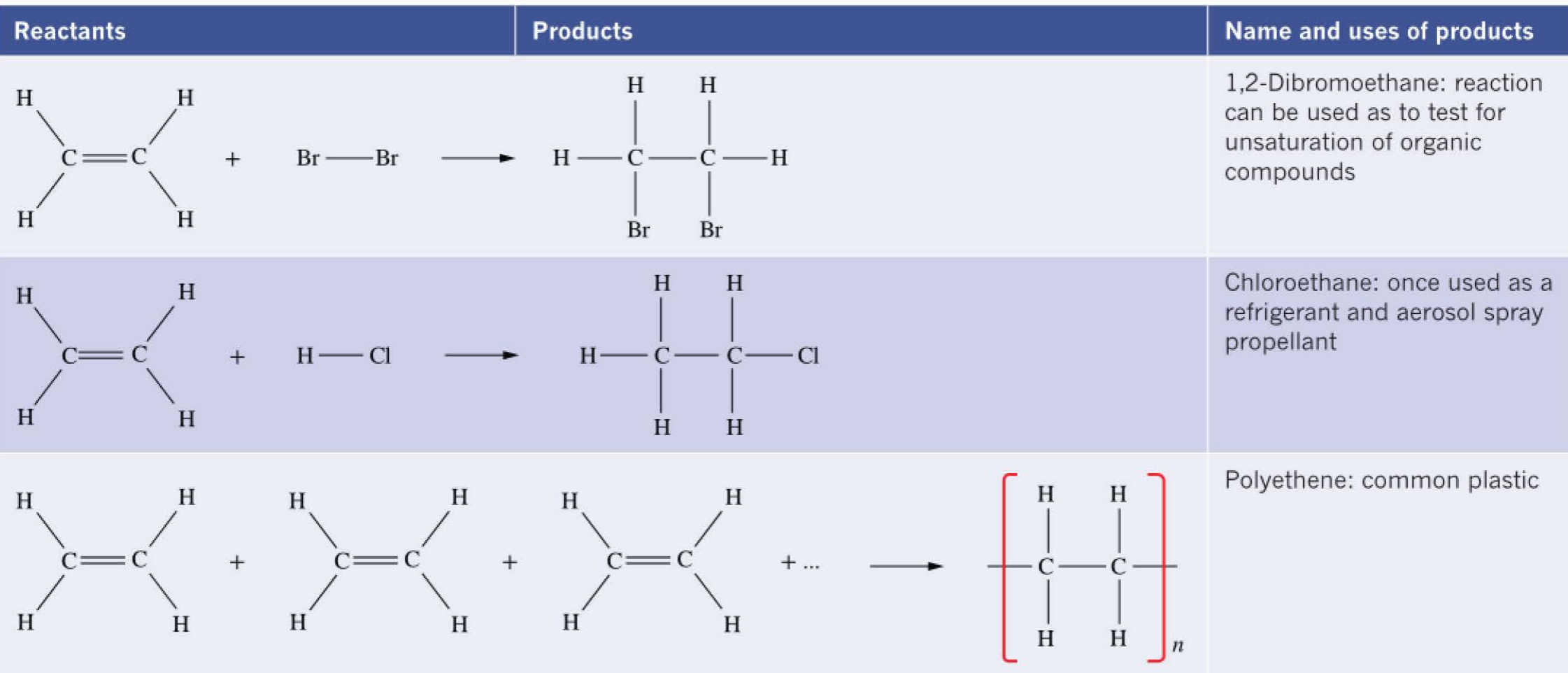
The table above shows important addition reactions of ethene:
1. Addition with bromine ():
Product: 1,2-dibromoethane
Note
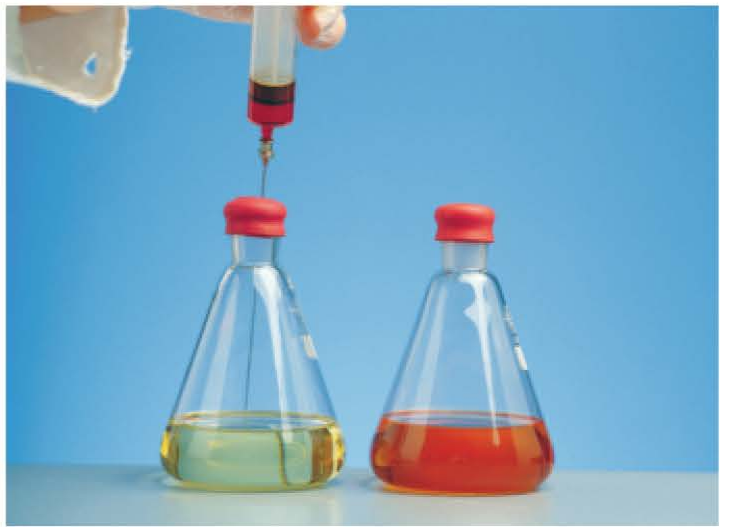
Test for Unsaturation
This reaction is used as a test for unsaturation. Bromine water (an orange solution) loses its colour when it reacts with an alkene because the bromine is incorporated into the product molecule. This colour change from orange to colourless quickly distinguishes unsaturated compounds (like alkenes) from saturated ones (like alkanes).
2. Addition with hydrogen chloride ():
Product: Chloroethane (once used as a refrigerant)
3. Polymerisation:
Many ethene molecules can join together in an addition reaction to form long-chain polymers:
Product: Polyethene (a common plastic)
This ability to form polymers makes alkenes extremely valuable in the manufacture of plastics and other materials.
Summary
Key Points to Remember:
Carbon forms many compounds because it has four valence electrons, can bond strongly with other carbon atoms, and can form single, double, or triple bonds
Alkanes () are saturated hydrocarbons with only single bonds, named with the suffix -ane
Alkenes () are unsaturated hydrocarbons with one double bond, named with the suffix -ene
Structural isomers have the same molecular formula but different structural arrangements, giving them different properties
Both alkanes and alkenes are non-polar with low boiling points that increase as chain length increases
Alkanes undergo combustion but are relatively unreactive otherwise
Alkenes undergo addition reactions due to their reactive double bonds, and can be tested using bromine water, which changes from orange to colourless