Electrolytic Cells (VCE SSCE Chemistry): Revision Notes
📚Revision Notes
Electrolytic Cells
Introduction to electrolysis
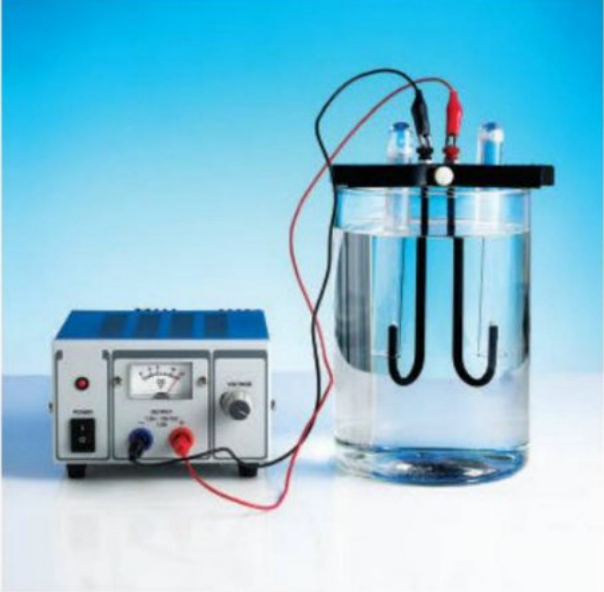
Electrolysis is a process that uses electrical energy from a direct current (DC) power supply to drive chemical reactions that would not normally occur on their own. When an electric current passes through a conducting liquid, it can break down compounds into their elements or produce new substances.
Note
For example, when electricity passes through a dilute sodium nitrate solution, water molecules break apart to form hydrogen gas at one electrode and oxygen gas at the other. This demonstrates how electrical energy can be converted into chemical energy through electrolysis.
What is an electrolytic cell?
An electrolytic cell is a device that uses electrical energy to drive non-spontaneous chemical reactions. The key components are:
- Power supply: Provides the electrical energy needed to force the reaction to occur
- Electrodes: Conduct electricity into and out of the cell (usually made from inert materials like platinum or graphite)
- Electrolyte: A conducting liquid containing ions that can move and react at the electrodes
Note
The power supply acts like an 'electron pump', pushing electrons into one electrode and removing them from the other. This creates a flow of electrons that drives the chemical reactions.
Understanding electrodes
In an electrolytic cell, reactions occur at two different electrodes:
Important
Cathode (negative electrode):
- Connected to the negative terminal of the power supply
- Electrons are pushed towards this electrode
- Cations (positive ions) are attracted to the cathode
- Reduction reactions occur here (gain of electrons)
Anode (positive electrode):
- Connected to the positive terminal of the power supply
- Electrons are withdrawn from this electrode
- Anions (negative ions) are attracted to the anode
- Oxidation reactions occur here (loss of electrons)
A helpful way to remember this is: Anions to Anode (both start with A) and Cations to Cathode (both start with C).
Electrolysis of molten ionic compounds
When an ionic compound is heated above its melting point, it becomes molten (liquid). Molten ionic compounds can act as electrolytes because the ions can move freely.
Example: electrolysis of molten sodium chloride
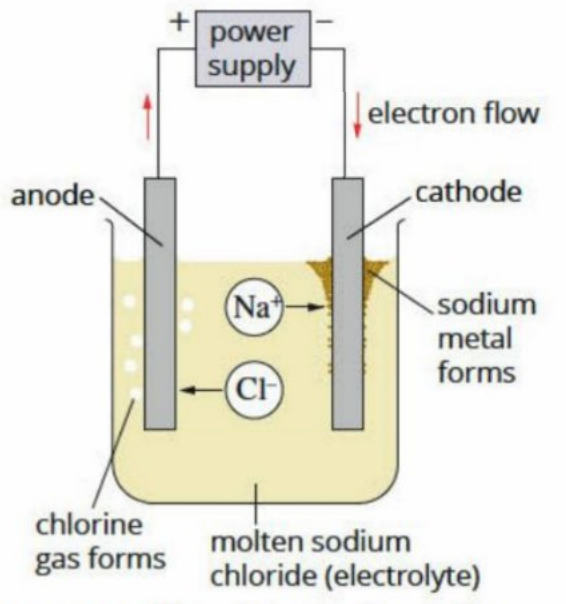
Sodium chloride melts at , so this process must occur at very high temperatures. The molten sodium chloride contains only and ions – there is no water present.
Example
Worked Example: Electrolysis of Molten NaCl
At the cathode (negative electrode):
Sodium ions are attracted to the cathode, where they gain electrons and become sodium atoms:
This is a reduction reaction (gain of electrons). Sodium is liquid at these high temperatures and floats to the top because it is less dense than molten sodium chloride.
At the anode (positive electrode):
Chloride ions move towards the anode, where they lose electrons to form chlorine gas:
This is an oxidation reaction (loss of electrons). Bubbles of chlorine gas appear at the electrode.
Overall reaction:
This is a non-spontaneous reaction, meaning it would not occur without the input of electrical energy. The electrical energy from the power supply is converted into chemical energy stored in the products.
Important
When writing equations for the electrolysis of molten ionic compounds, remember that the reactants are in the liquid state .
Competition at electrodes
When electrolyzing aqueous solutions or using reactive electrodes, several different species may be present that could potentially react at each electrode. To predict which reaction will occur, we use the electrochemical series.
Using the electrochemical series to predict reactions
Note
The electrochemical series lists half-equations with their standard electrode potentials. The key principles are:
- The strongest oxidising agent present (appears higher on the left side of the series) will be reduced at the cathode
- The strongest reducing agent present (appears lower on the right side of the series) will be oxidised at the anode
This is the same principle used in galvanic cells, but with electrical energy supplied to drive the reactions.
Electrolysis of aqueous solutions
When electrolyzing aqueous solutions, water is present along with the dissolved ions. This means water can potentially participate in the reactions at either electrode.
Example: electrolysis of aqueous sodium chloride
Consider a solution of sodium chloride with inert electrodes. The species present are:
- Water molecules ()
- Sodium ions ()
- Chloride ions ()
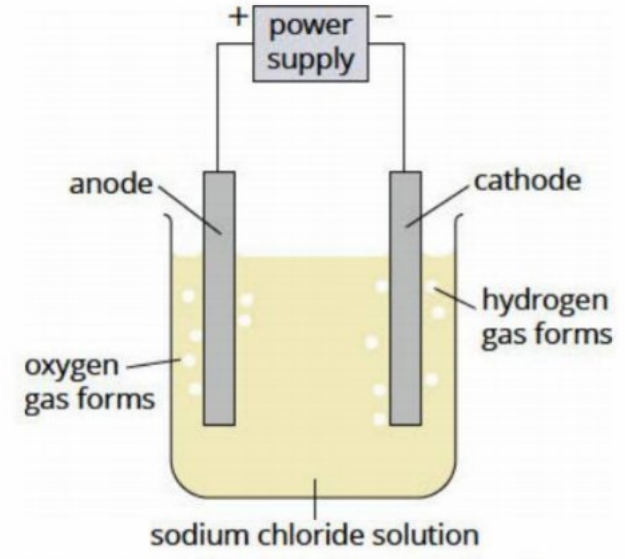
At the cathode:
Two species could potentially be reduced:
- with
- with
Water is the stronger oxidising agent (less negative value), so it will be reduced:
Hydrogen gas forms at the cathode, and sodium ions remain in solution as spectator ions.
Important
Water is a stronger oxidising agent than , , , , , and . This means aqueous solutions containing these metal ions cannot be electrolyzed to produce the metals – water will be reduced instead.
At the anode (for dilute solution):
Two species could potentially be oxidised:
- with
- with
Water is the stronger reducing agent (lower value), so it will be oxidised:
Overall reaction (dilute solution):
Water breaks down into hydrogen and oxygen gases.
Note
In practice, with concentrated sodium chloride solutions, chloride ions can be oxidised at the anode to produce chlorine gas. The electrochemical series is based on standard conditions, and actual reactions can be affected by concentration, temperature, pressure, and electrode materials.
Why don't nitrate and sulfate ions react?
Many ionic compounds contain nitrate () or sulfate () ions. During electrolysis, these ions are attracted to the anode but are not oxidised. This is because:
- Nitrogen in has an oxidation number of , which is the maximum for nitrogen (it has five valence electrons)
- Sulfur in has an oxidation number of , which is the maximum for sulfur
Important
These elements cannot lose any more electrons, so they cannot be oxidised further.
Comparison: molten vs aqueous sodium chloride
The products of electrolysis depend on whether the electrolyte is molten or aqueous, and on the concentration:
| Condition | Temperature | Anode reaction | Cathode reaction |
|---|---|---|---|
| Molten NaCl | High () | ||
| Aqueous dilute NaCl | Room temperature | ||
| Aqueous concentrated NaCl | Room temperature |
Reactive electrodes
So far we have considered inert electrodes (platinum or graphite) that do not participate in the reaction. However, some electrodes are made from reactive materials that can be consumed during electrolysis. These are called reactive electrodes.
Worked example: nickel(II) sulfate with copper electrodes
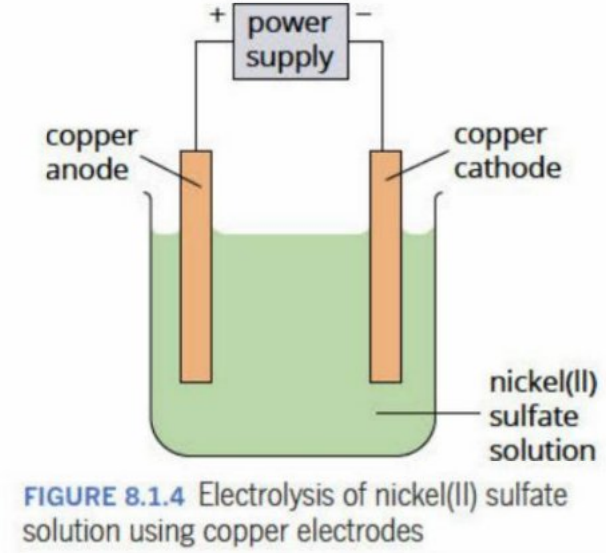
Consider the electrolysis of nickel(II) sulfate solution using copper electrodes at .
Example
Worked Example: Reactive Electrodes with Nickel(II) Sulfate
Step 1: Identify species present
- Copper electrodes (Cu)
Step 2: List possible reactions using the electrochemical series
Oxidising agents (could be reduced):
- with
- with
- with
- with
- with
Reducing agents (could be oxidised):
Step 3: Determine reactions at anode (+)
The strongest reducing agent is copper metal from the electrode:
The copper electrode dissolves, releasing copper ions into solution.
Step 4: Determine reactions at cathode (-)
The strongest oxidising agent is :
Nickel metal is deposited on the cathode.
Result: Nickel is produced at the cathode while the copper anode dissolves.
Hydrogen production and artificial photosynthesis
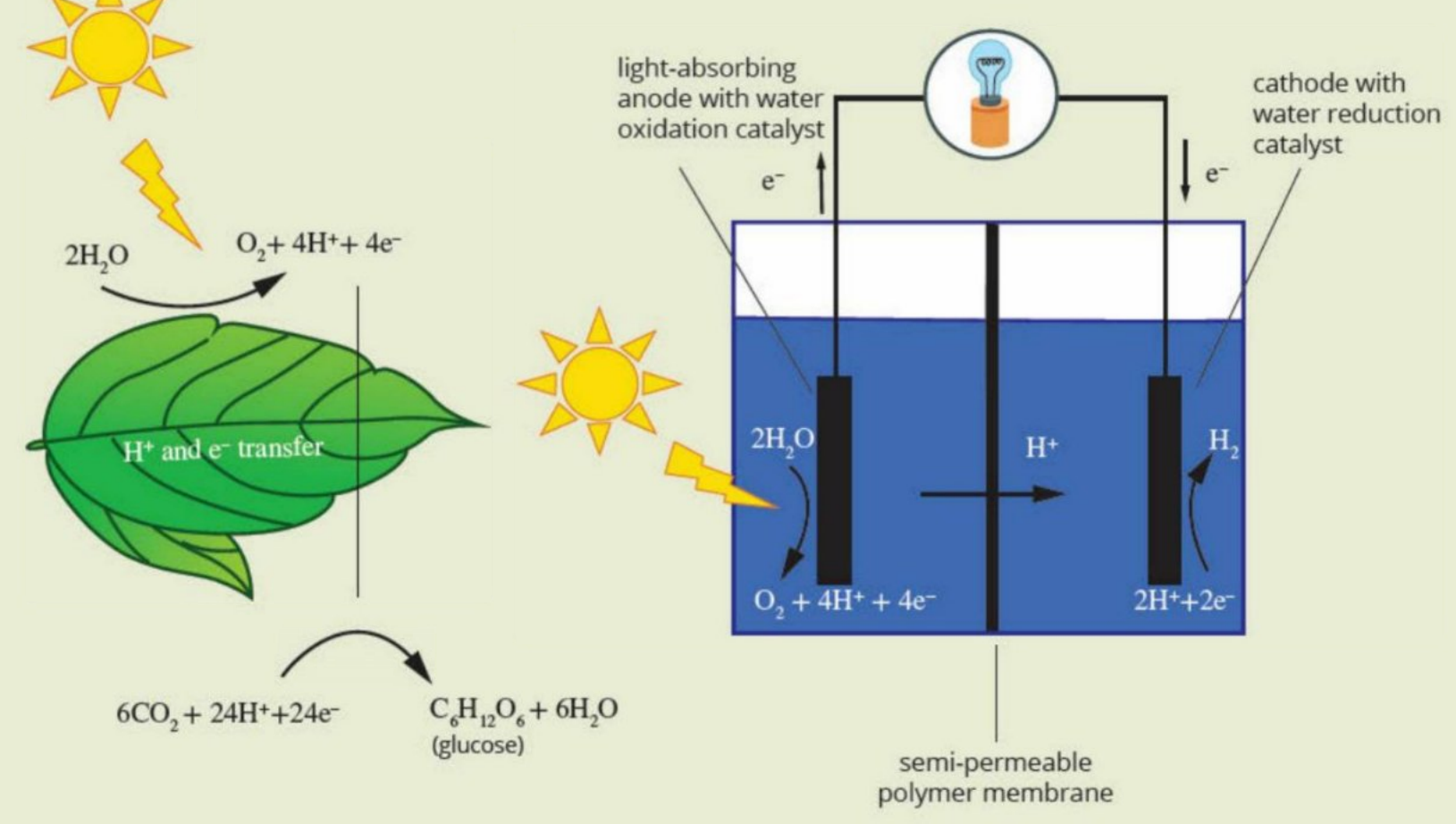
Electrolysis of water can produce hydrogen gas, which is a potential clean fuel. However, the process requires significant electrical energy. Scientists are working on developing artificial photosynthesis systems that use light energy to split water molecules, similar to how plants use photosynthesis.
Note
These systems use special catalysts and light-absorbing materials to increase efficiency and reduce costs. This research could help develop sustainable methods for hydrogen production.
Comparison of electrolytic and galvanic cells
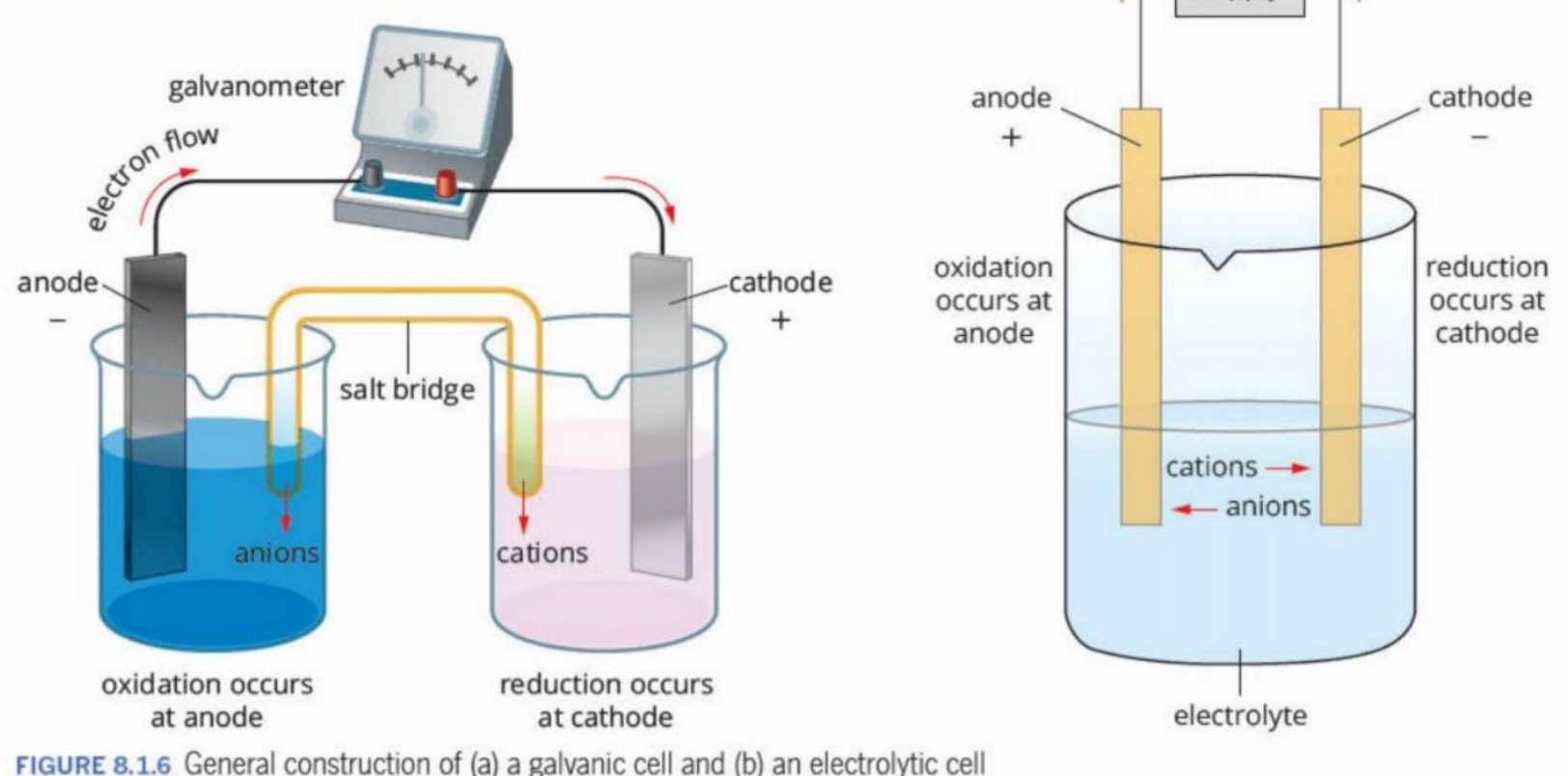
Both electrolytic and galvanic cells are types of electrochemical cells, but they work in opposite ways:
| Feature | Galvanic cells | Electrolytic cells |
|---|---|---|
| Energy conversion | Chemical → Electrical | Electrical → Chemical |
| Reaction type | Spontaneous | Non-spontaneous |
| Electricity | Produce electricity | Consume electricity |
| Anode charge | Negative (-) | Positive (+) |
| Cathode charge | Positive (+) | Negative (-) |
| Oxidation | Occurs at anode | Occurs at anode |
| Reduction | Occurs at cathode | Occurs at cathode |
Important
Key similarity: In both types of cells, oxidation always occurs at the anode and reduction always occurs at the cathode.
Key difference: The main difference is in the electrode polarity and whether energy is produced or consumed.
Exam tips
- Always identify whether a cell is galvanic or electrolytic before attempting questions
- When predicting products, systematically list all species present and their possible reactions
- Use the electrochemical series to determine which species will react
- Remember that in electrolytic cells, the anode is positive and the cathode is negative
- Don't forget that water can participate in reactions in aqueous solutions
- Consider whether electrodes are inert or reactive
- Conditions like concentration and temperature can affect which reactions occur
Remember!
Summary
Key Points to Remember:
- Electrolysis uses electrical energy to drive non-spontaneous reactions
- Cathode is the negative electrode where reduction occurs (electrons gained)
- Anode is the positive electrode where oxidation occurs (electrons lost)
- In molten compounds, only the metal and non-metal ions are present
- In aqueous solutions, water can participate in electrode reactions
- The strongest oxidising agent reacts at the cathode
- The strongest reducing agent reacts at the anode
- Electrolytic cells convert electrical energy to chemical energy, while galvanic cells do the opposite