Introducing Redox Reactions (VCE SSCE Chemistry): Revision Notes
📚Revision Notes
Introducing Redox Reactions
What are redox reactions?
Your everyday life depends on many chemical reactions, and a large number of these are redox reactions. The term 'redox' combines two types of reaction: reduction and oxidation. These reactions are happening within you and around you constantly.
Note
Examples of Redox Reactions in Daily Life:
- Respiration reactions that enable your cells to produce energy
- Combustion reactions that warm your home
- Reactions in batteries that power your mobile phone
- The spectacular reaction between potassium and chlorine gas
In redox reactions, electrons are transferred between atoms or ions. Understanding this electron transfer is key to mastering redox chemistry.
Early understandings of redox reactions
Origins of oxidation
When chemistry evolved from alchemy, many reactions known to early chemists involved air. French chemist Antoine Lavoisier identified the reactive component of air and named it oxygen. As a result, reactions in which oxygen was a reactant became known as oxidation reactions.
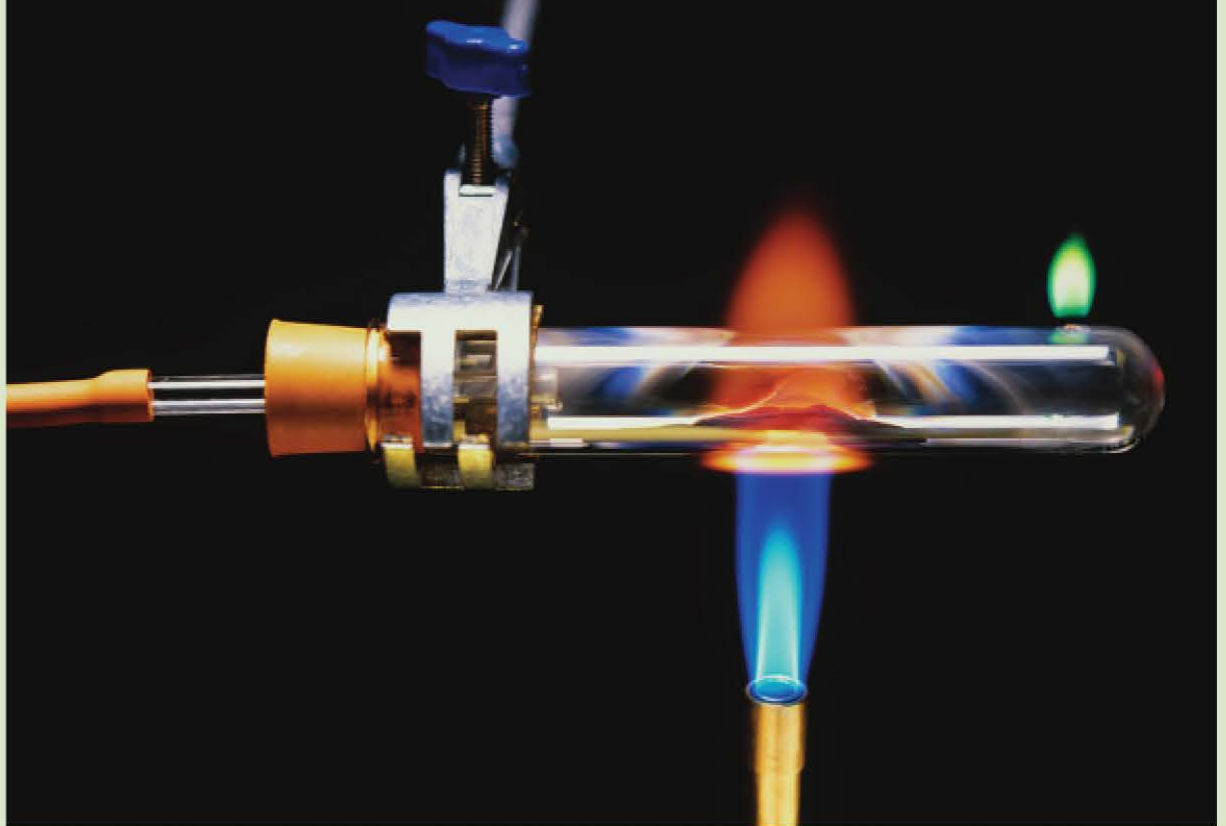
When elements burn in air, they produce oxides. For example:
Origins of reduction
The term reduction was used to describe the process of extracting metals from their ores. The word comes from the Latin 'reduco', meaning to restore. Metal extraction was seen as restoring the metal from its compounds.
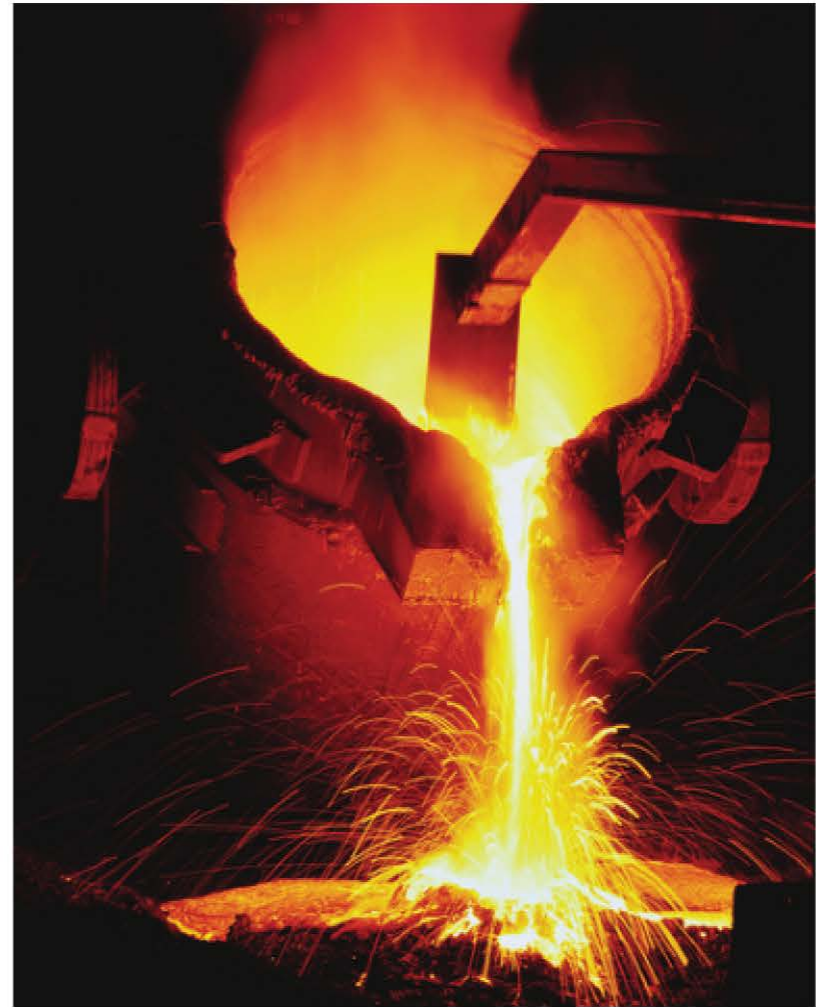
For example, iron is extracted from iron ore in a blast furnace:
In this reaction:
- Iron(III) oxide has lost oxygen and is described as having been reduced
- Carbon monoxide has gained oxygen and is described as having been oxidised
Important
Critical Principle:
Oxidation and reduction always occur simultaneously, hence the term 'redox reaction'. You cannot have one without the other!
Modern definition: transfer of electrons
Today, redox reactions are defined in terms of electron transfer rather than oxygen transfer. This provides a more general and useful definition.
The magnesium and oxygen example
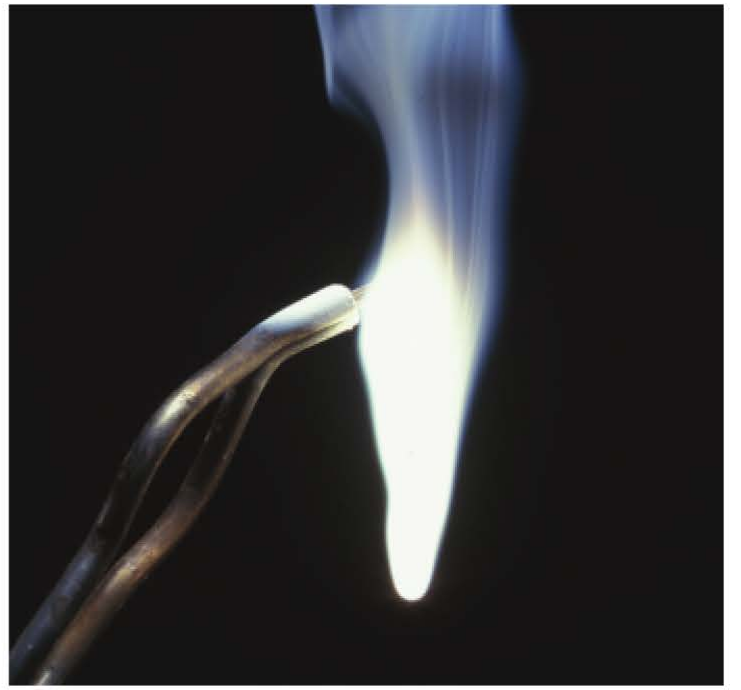
When magnesium ribbon burns with a brilliant white flame, magnesium oxide powder forms:
Example
Worked Example: Electron Transfer in Magnesium Combustion
This reaction involves the loss and gain of electrons, which can be represented by two half-equations:
Oxidation half-equation:
Each magnesium atom loses two electrons to form a magnesium ion.
Reduction half-equation:
Each oxygen molecule gains four electrons (two per oxygen atom).
The electrons gained by oxygen have come from the magnesium atoms. This transfer of electrons is the basis of the modern definitions.
Key definitions
Oxidation is defined as the loss of electrons.
Reduction is defined as the gain of electrons.
The OIL RIG mnemonic
Important
Remember: OIL RIG
A useful memory aid for these definitions is OIL RIG:
- Oxidation Is Loss (of electrons)
- Reduction Is Gain (of electrons)
Note
Key Points About Electron Transfer:
- When electrons are lost in a half-equation, they appear as products
- When electrons are gained in a half-equation, they appear as reactants
- There is no overall loss of electrons, just a transfer from one atom to another
- If an atom loses electrons, another atom must gain electrons
- Therefore, oxidation and reduction always occur simultaneously
Other examples of redox reactions
Many redox reactions do not involve oxygen at all. For example:
Example
Example 1: Potassium and Chlorine
Overall equation:
Oxidation half-equation:
Reduction half-equation:
Example
Example 2: Zinc and Hydrochloric Acid
Overall equation:
Oxidation half-equation:
Reduction half-equation:
Oxidising agents and reducing agents
Just as an employment agent enables a client to become employed, chemical agents enable certain processes to occur.
Definitions
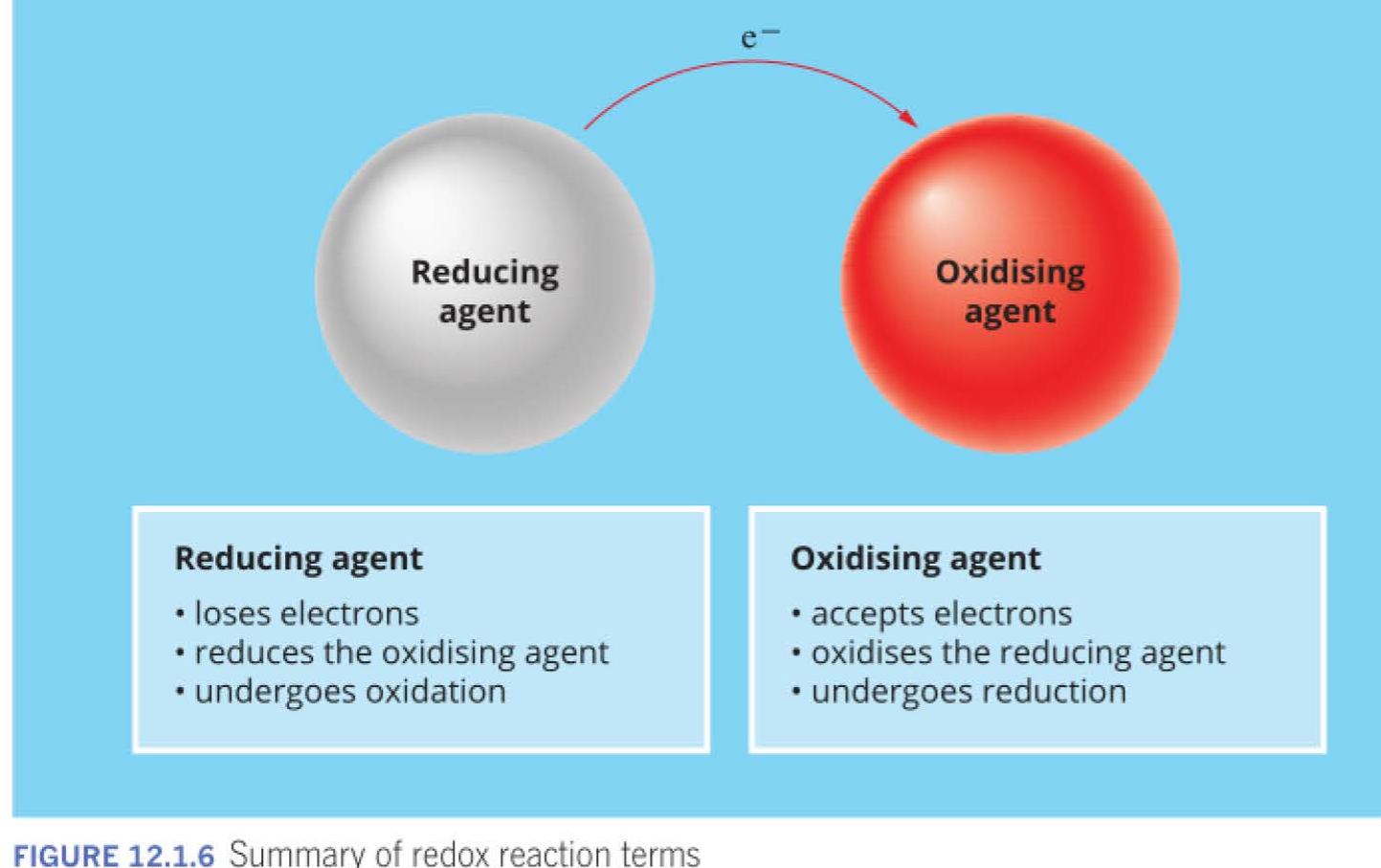
An oxidising agent (or oxidant) enables or causes another chemical to be oxidised.
A reducing agent (or reductant) enables or causes another chemical to be reduced.
Key relationships
Important
Understanding Agent Behavior - A Critical Concept!
Understanding these relationships is crucial:
- Reducing agents cause another reactant to be reduced. In the reaction, they are oxidised.
- Oxidising agents cause another reactant to be oxidised. In the reaction, they are reduced.
In other words: agents undergo the opposite process to what they cause!
Example: magnesium and oxygen
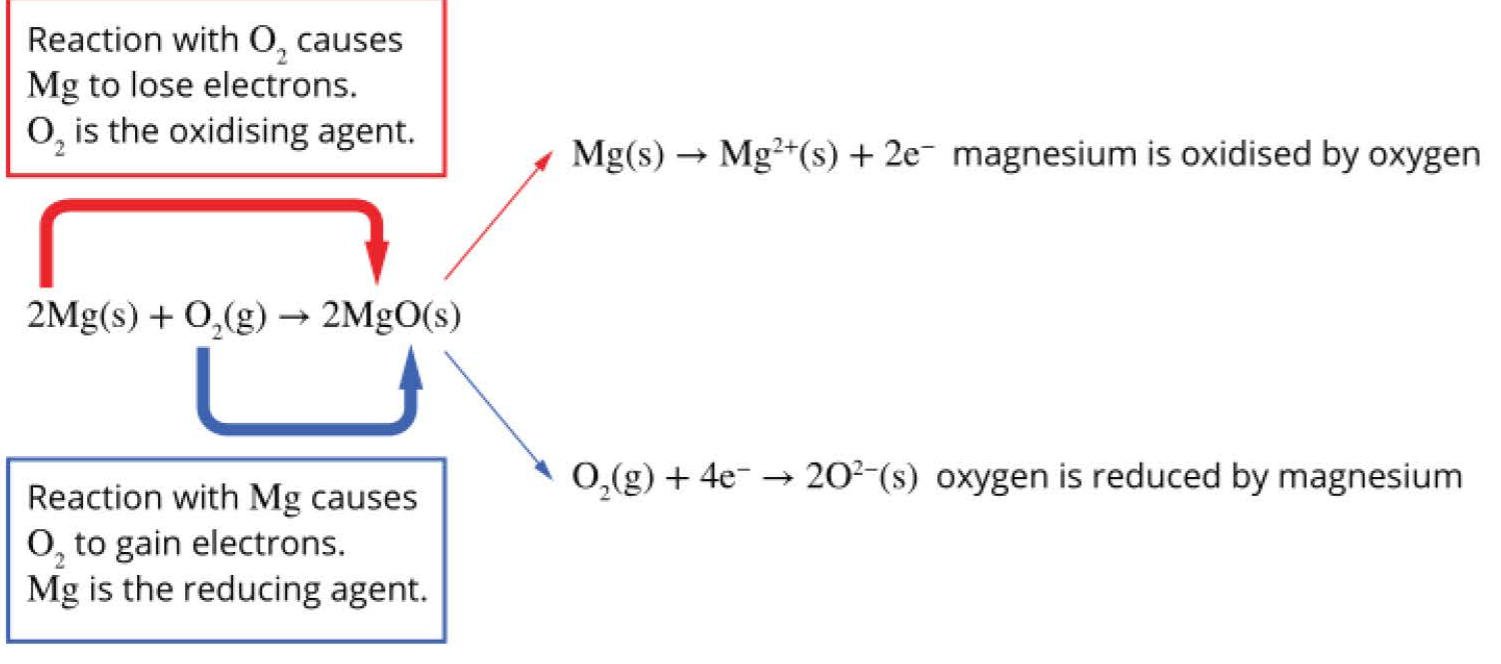
In the reaction between magnesium and oxygen:
- Magnesium is being oxidised by oxygen, so oxygen is the oxidising agent
- Oxygen is being reduced by magnesium, so magnesium is the reducing agent
Note
Since metals tend to lose electrons, they often act as reducing agents.
Writing redox equations
Writing simple half-equations
Half-equations show the detail of what happens in a redox reaction. Like all chemical equations, half-equations must be balanced for:
- The number of atoms of each element
- The charge on each side
- State symbols should be included
Example
Step-by-Step Guide: Writing Simple Half-Equations
Follow these steps:
- Identify one reactant and the product it forms
- Balance the equation for the element
- Add electrons to balance the charge
- Determine whether the reaction is oxidation or reduction (OIL RIG)
- Repeat for the other reactant
Writing overall redox equations
When writing equations for redox reactions, the two half-equations are written first, then added together to obtain the overall equation.
Important
Critical Rule for Overall Equations:
An overall equation does not show any electrons transferred. All the electrons lost in oxidation are gained in reduction.
Steps for combining half-equations:
- Write both half-equations
- Multiply one or both equations by suitable factors to ensure the number of electrons is the same in each
- Add the two half-equations together
- Cancel out the electrons (as there is no overall change)
- Simplify if necessary
Example
Worked Example: Sodium and Water
Step 1: Write the half-equations
Oxidation:
Reduction:
Step 2: Balance electrons
Since each water molecule requires two electrons, the oxidation equation must be multiplied by 2:
Step 3: Add and cancel electrons
Adding these and cancelling electrons gives:
Conjugate redox pairs
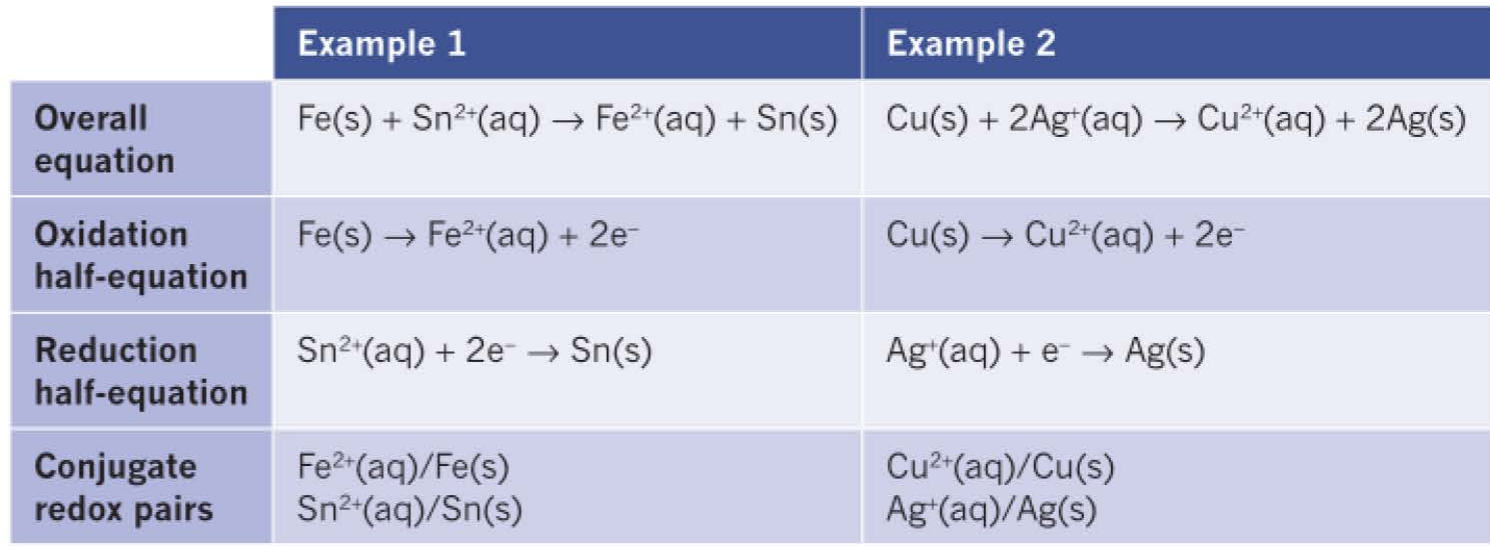
When a half-equation is written for an oxidation reaction, the reactant (a reducing agent) loses electrons. The product formed is the oxidised form of the reactant and is called the conjugate oxidising agent. The reactant and the product that it forms are known as a conjugate redox pair.
Example
Example 1: Zinc Oxidation
- Zinc metal is the reducing agent
- is the conjugate oxidising agent
- and form a conjugate redox pair
Example
Example 2: Copper(II) Reduction
- Copper(II) ion is the oxidising agent
- is the conjugate reducing agent
- and form a conjugate redox pair
Note
There are two conjugate redox pairs in every redox reaction, usually written in the format: oxidising agent/reducing agent.
Half-equations for complex redox reactions
Some redox reactions involve more complex species that contain oxygen, such as permanganate ions (), dichromate ions (), and chromate ions (). These are strong oxidising agents.
Balancing complex half-equations in acidic solution
For complex redox half-equations in acidic solutions, use this method:
- Balance all atoms except oxygen and hydrogen
- Balance oxygen atoms by adding
- Balance hydrogen atoms by adding
- Balance the charge by adding electrons to the more positive side
- Add state symbols
Example
Worked Example: Permanganate Reduction
The permanganate ion reacts with iron(II) sulfate in acidified solution:
Reduction half-equation for permanganate:
Step 1: Balance Mn atoms
Step 2: Balance oxygen with
Step 3: Balance hydrogen with
Step 4: Balance charge with electrons
Oxidation half-equation for iron(II):
Multiply by 5 to balance electrons:
Add the half-equations and cancel electrons to get the overall equation.
Remember!
Summary
Key Points to Remember:
- Redox reactions involve the transfer of electrons between reactants
- Oxidation is the loss of electrons (OIL)
- Reduction is the gain of electrons (RIG)
- Oxidation and reduction always occur simultaneously in redox reactions
- Oxidising agents cause oxidation and are themselves reduced
- Reducing agents cause reduction and are themselves oxidised
- Half-equations show the electron transfer in each part of a redox reaction
- Overall redox equations are obtained by combining balanced half-equations with no electrons remaining
- For complex redox equations in acidic solution, balance oxygen with , hydrogen with , and charge with electrons