Redox Reactions in Society (VCE SSCE Chemistry): Revision Notes
📚Revision Notes
Redox Reactions in Society
Introduction
Redox reactions play a vital role in modern daily life. Many people rely heavily on mobile phones, laptop computers, calculators, and other portable electronic devices. These devices depend on redox reactions in rechargeable batteries to generate electricity. Without these reactions, we would need to keep our devices permanently plugged into mains electricity. This section explores how redox reactions are used to produce electrical energy in simple galvanic cells.
Simple galvanic cells
When a spontaneous reaction occurs between a metal and a non-metal, heat energy is released. The surrounding solution becomes warm, and sometimes even hot. This type of reaction is called an exothermic reaction, and it is typical of spontaneous redox reactions. Previously, we described redox reactions as electron transfer reactions, but we lacked concrete evidence of electrons moving from the reducing agent to the oxidising agent. Now we can see how the flow of electrons between reactants in a redox reaction can be used to operate electrical devices, providing clear evidence of electron movement.
Evidence for electron transfer
Consider what happens when zinc metal is placed in a copper(II) sulfate solution. The zinc is oxidised, and a brown deposit of copper metal forms on the surface:
Oxidation half-reaction:
Reduction half-reaction:
Overall equation:
Electrons flow from zinc atoms to copper(II) ions as these particles collide. In the direct reaction, heat is released. However, if we separate the reactants using specialized equipment, we can gain clear evidence for the flow of electrons.
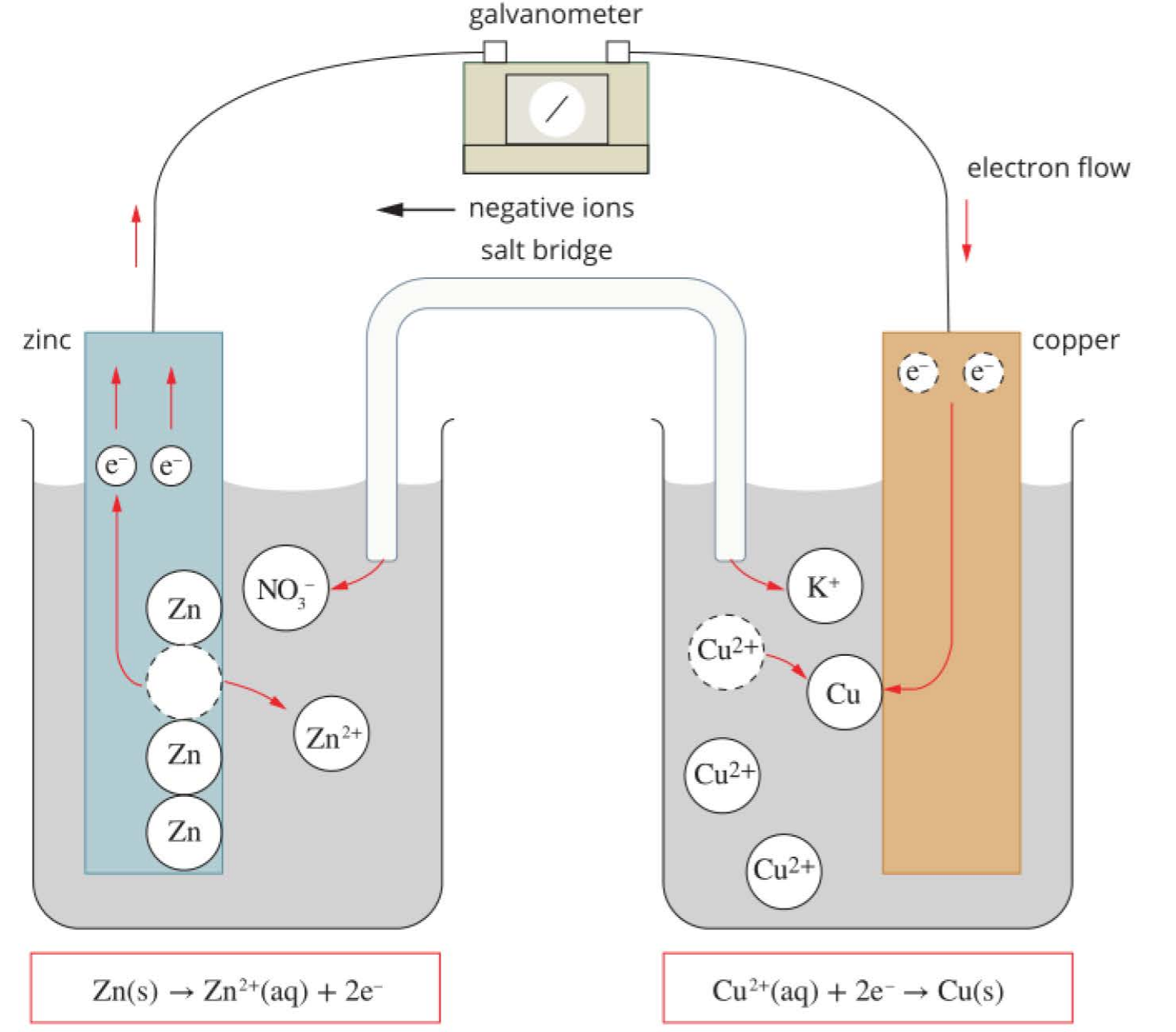
In this setup, the zinc metal and the copper(II) ion solution are in separate beakers. This prevents a spontaneous, heat-releasing reaction from occurring. Instead, electrons are forced to travel through the external circuit (the wire) to reach the oxidising agent. A copper strip, dipping into the copper(II) ion solution, is connected to the zinc strip. A galvanometer—a device for detecting electron flow—is also included in the circuit.
The solutions in the two beakers are connected by a salt bridge. The salt bridge contains a solution of an ionic compound, such as potassium nitrate (), which will not react with either solution. The salt bridge may be as simple as a piece of filter paper soaked in the potassium nitrate solution.
Note
The flow of charge in a galvanic cell:
The flow of charge occurs in two forms:
- Electrons move through the wire from the zinc electrode to the copper electrode
- Ions move through the solutions, with negative ions travelling in the same direction as the electrons (clockwise in this case), and positive ions travelling in the opposite direction
The salt bridge completes the circuit by allowing ions to move between the half-cells, maintaining electrical neutrality in both solutions.
This apparatus is known as a galvanic cell, also called a voltaic cell, which is a type of electrochemical cell. A galvanic cell converts chemical energy into electrical energy and is one of the most important devices in modern life. It is a simple form of what we call a battery.
When the galvanic cell operates, the positive reading on the galvanometer indicates that electrons are flowing from the zinc strip to the copper strip. This observation provides evidence that the same oxidation and reduction reactions occur when the two reactants are separated as when they are mixed together in a beaker. It also supports the idea that redox reactions involve electron transfer.
Understanding half-cells
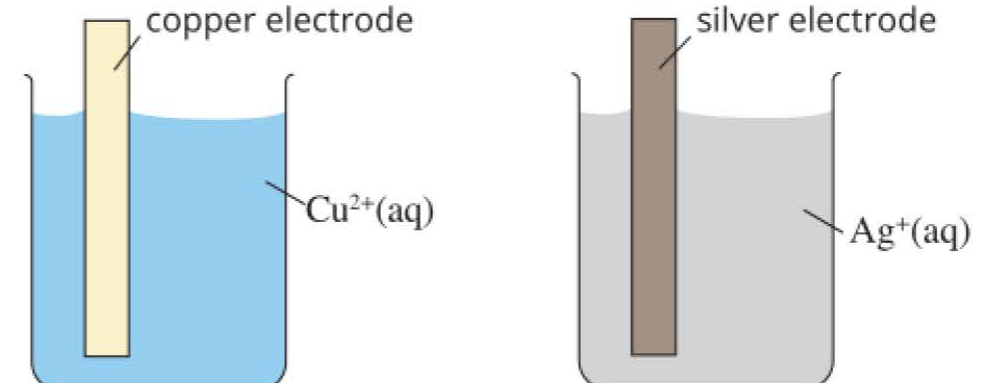
All galvanic cells consist of two half-cells. Each half-cell contains a reducing agent and its conjugate oxidising agent. Oxidation occurs in one half-cell, and reduction occurs in the other.
Note
Essential components of a half-cell:
A half-cell must contain two essential components:
-
An electrode - a solid electrical conductor, such as a metal or graphite rod. It provides a link between the external circuit and the solution where the reaction occurs.
-
An electrolyte - a solution that can conduct electricity through the movement of charged particles (ions). A solution of an ionic compound serves as the electrolyte.
The two half-cells shown consist of metal electrodes in aqueous solutions of metal ions. For example:
- A silver electrode in a solution of silver ions, represented as
- A copper electrode in a solution of copper(II) ions, represented as
Important
Dual purpose of metals in half-cells:
When a metal and a metal ion are used in a half-cell, the solid metal serves two purposes:
- It acts as the reducing agent
- It functions as the electrode that carries electrons into and out of the half-cell
Any combination of half-cells can be used to make a galvanic cell. When we join half-cells with a salt bridge and connect them with wire (the external circuit), we create a complete galvanic cell.
Oxidation and reduction in galvanic cells
Identifying the anode and cathode
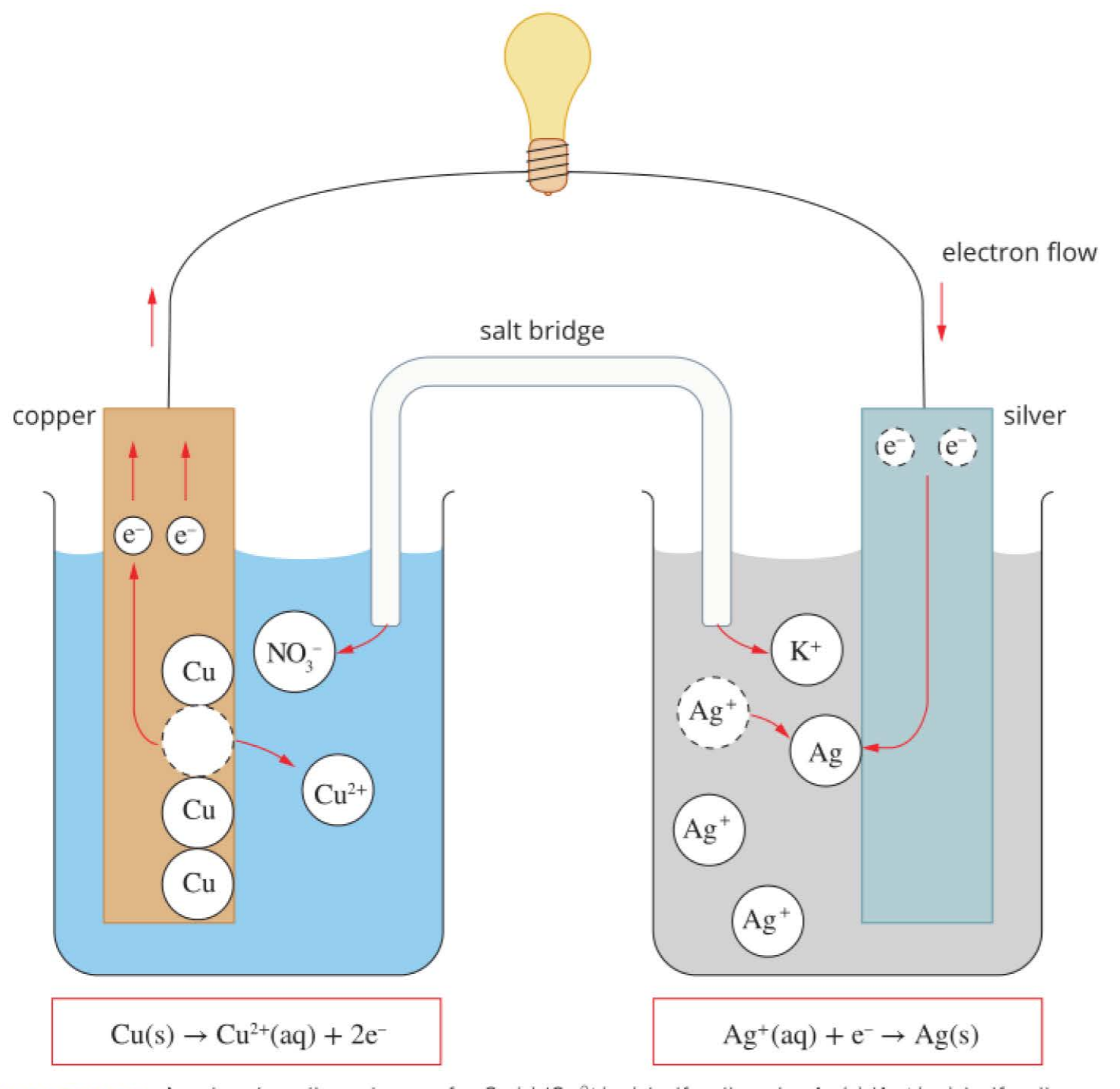
Using the reactivity series, we can predict which reactions will occur in a galvanic cell. The stronger reducing agent will be oxidised. For the copper-silver cell shown above, copper is a stronger reducing agent than silver, so copper will be oxidised in the left-hand half-cell. The silver ions are a stronger oxidising agent than the copper(II) ions, so is reduced in the right-hand half-cell.
The half-cell reactions are:
Because electrons leave the copper electrode to move into the external circuit, the copper electrode is known as the negative electrode—the source of electrons. Electrons then flow through the wire from the negative electrode to the positive electrode (the silver electrode). The silver metal does not gain electrons directly, but it conducts the electrons to the solution, where reduction of occurs.
Important terminology
The electrode at which oxidation occurs is called the anode, while the electrode at which reduction occurs is called the cathode. It is important to remember that the names anode and cathode relate to the type of reaction occurring at each electrode, rather than the charge on the electrode. However, in a galvanic cell, the anode is negative and the cathode is positive.

Important
Memory aid for electrode identification:
This useful memory aid helps you remember:
- OX-AN: Oxidation occurs at the Anode
- RED-CAT: Reduction occurs at the Cathode
Note
Key points about galvanic cells:
- In a galvanic cell, the strongest reducing agent will be oxidised and, if it is a metal, it will be the negative electrode
- Oxidation occurs at the anode and reduction occurs at the cathode
- Electrons flow from the negative electrode (anode) to the positive electrode (cathode) through the external circuit
Constructing and analysing galvanic cells
When working with galvanic cells, you need to be able to identify several key features. Let's examine how to approach this using a zinc-lead galvanic cell as an example.
Example
Worked Example: Analysing a Galvanic Cell
To analyse a galvanic cell systematically:
Step 1: Identify the reducing and oxidising agents Use the reactivity series to determine which metal is the stronger reducing agent (it will be oxidised). The metal ion in the other half-cell will be the oxidising agent (it will be reduced).
Step 2: Write the half-reactions The oxidation half-reaction shows the metal losing electrons. The reduction half-reaction shows the metal ions gaining electrons.
Step 3: Determine electron flow direction Electrons flow from the electrode being oxidised (the reducing agent) through the external circuit to the other electrode.
Step 4: Label the electrodes The negative electrode is where electrons originate (oxidation occurs). The positive electrode is where electrons arrive (reduction occurs).
Step 5: Identify anode and cathode The anode is where oxidation happens. The cathode is where reduction happens.
Historical development of batteries
The development of the battery is a fascinating story of scientific discovery and innovation that began with an unexpected observation about frogs.
Galvani's discoveries
Luigi Galvani (1737-1798), Professor of Anatomy at the University of Bologna in Italy, had a deep interest in frog anatomy and the effects of electricity on muscles. This led to the discovery of electrical flow between two different metals.
Note
Galvani's famous experiments:
Galvani conducted extensive experiments with frogs under various conditions. He is credited with making frog muscles contract by touching a nerve with scissors during an electrical storm. Most famously, he observed a frog's legs twitching when he pressed a copper hook into the frog's spinal cord while it hung on an iron railing.
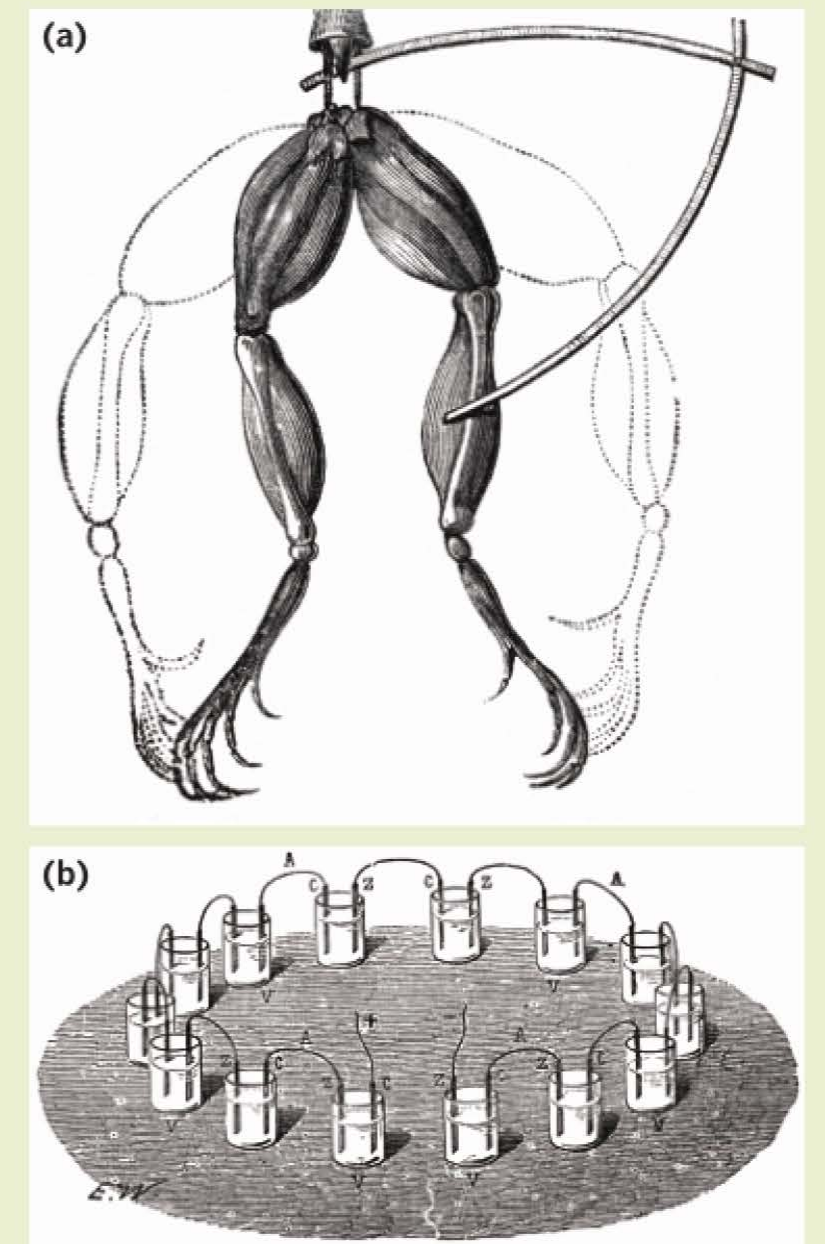
In 1791, when Galvani published his findings about electricity movement through the frog, he concluded that animal tissue contained a new form of electricity called "animal electricity", which activated nerves and muscles when metal probes were introduced.
Volta's contributions
Alessandro Volta (1745-1827), Professor of Physics at the University of Pavia in Italy, disagreed with Galvani's "animal electricity" idea. Instead, he proposed that the frog in Galvani's experiments simply conducted electricity between the two metals.
In 1792, Volta began experimenting with disks of different metals—without frogs! He detected the very weak flow of electricity between the disks by placing them on his tongue.
Note
Volta's innovations:
Volta experimented with various combinations of electrodes connected in different ways. One example was the "crown of cups", shown in the historical image. This arrangement is still used by modern chemistry students to increase the voltage of simple galvanic cells made in the laboratory.
Volta preferred zinc and copper, or silver, as his electrodes, with saltwater as the electrolyte. By 1800, he had built the first battery by alternating disks of zinc and silver, separated by paper or cloth soaked in saltwater. This was known as a voltaic pile.
Volta received great recognition for his work from Napoleon I and the Austrian emperor Francis I. Most notably, the unit of electromotive force, the volt, was named in his honour in 1881.
Modern applications of galvanic cells
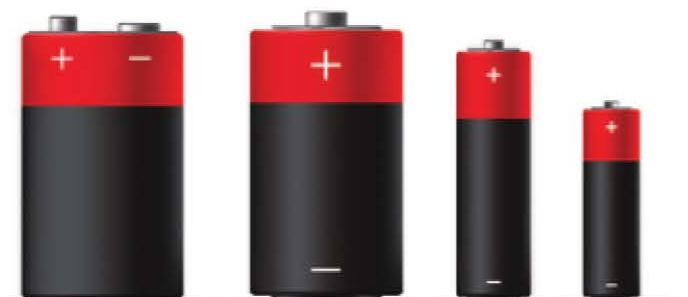
The portable power source essential for modern lifestyle—the battery—is based on a simple galvanic cell. While a battery is strictly defined as a series of cells connected together (like Volta's "crown of cups"), many portable power sources we refer to as batteries are actually individual cells. They consist of two electrodes and an electrolyte.
Primary cells
A cell that is disposable and designed not to be recharged is called a primary cell. The simplest primary cell that became widely available during the 20th century was known as a dry cell, based on a cell developed in 1866 by French scientist George Leclanche.
If you use a primary cell in a device such as a wireless computer mouse or a child's toy, you are more likely to be using an improvement on the dry cell called an alkaline cell. The difference between a dry cell and an alkaline cell relates to the electrolyte in the cell. While the electrolyte in a dry cell is acidic, the electrolyte in an alkaline cell is alkaline.
Secondary cells and renewable energy
An improvement on the dry cell is the ability to recharge these cells. A rechargeable cell designed to be reused many times is called a secondary cell. Many of the latest technological developments, such as electric vehicles and state-of-the-art power storage, are based on improvements in battery technology that have occurred in recent years. Most of this progress has focused on secondary cells.

Note
Batteries and renewable energy:
Batteries, in one form or another, are widely seen as the key to transitioning away from fossil fuel dependence towards making better use of renewable energy sources. New battery technologies play a major role in storing energy from solar panels and wind turbines, allowing renewable energy to be available when it's needed, not just when the sun shines or wind blows.
Environmental importance of battery recycling
In July 2019, the Victorian government banned all e-waste from landfill, meaning that used batteries should not be thrown into general waste or household recycling bins.

Important
Why battery recycling matters:
There are several important reasons for recycling batteries:
-
Resource conservation: Batteries contain many different metals, all of which are non-renewable resources. Recycling allows these valuable materials to be reused.
-
Preventing environmental contamination: If batteries break apart in landfill, toxic metals such as lead and mercury can leach into soil or waterways, causing serious environmental damage.
-
Ethical considerations: Some metals used in rechargeable batteries, such as cobalt, are mined in parts of the world where poverty and corruption create human suffering. Recycling these metals helps minimise the negative social impact of mining.
Separate bins for recycling batteries and other electronic devices can be found at local recycling centres and tips.
Summary
Summary
Key Points to Remember:
-
Galvanic cells convert chemical energy into electrical energy through spontaneous redox reactions
-
A galvanic cell consists of two half-cells, each containing an electrode and an electrolyte, connected by a salt bridge
-
Oxidation occurs at the anode (negative electrode), where electrons are released
-
Reduction occurs at the cathode (positive electrode), where electrons are accepted
-
The reactivity series helps predict which metal will be oxidised and which metal ion will be reduced
-
Primary cells are disposable batteries, while secondary cells are rechargeable
-
Battery recycling is essential for conserving resources, protecting the environment, and reducing social harm from mining